On virtual singular braid groups
Pith reviewed 2026-05-24 11:45 UTC · model grok-4.3
The pith
Virtual singular braid groups VSG_n admit semi-direct product decompositions from their homomorphisms to the symmetric group S_n.
A machine-rendered reading of the paper's core claim, the machinery that carries it, and where it could break.
Core claim
All group homomorphisms from the virtual singular braid group VSG_n to the symmetric group S_n are determined up to conjugation, yielding corresponding semi-direct product decompositions of VSG_n. Numerical invariants arise from exponent sums, their kernels to abelian groups are described explicitly, and for n=2 the kernels receive concrete presentations. Certain relations are shown to be forbidden in VSG_n, and welded and unrestricted quotients are introduced with parallel decomposition results.
What carries the argument
The homomorphisms from VSG_n to S_n, which produce the semi-direct product decompositions of the virtual singular braid group.
If this is right
- VSG_n splits as a semi-direct product for each such homomorphism to S_n.
- The kernels of the exponent-sum maps to abelian groups are explicitly described.
- For n=2 the kernels of the maps to S_2 receive explicit group presentations.
- Welded and unrestricted quotients of VSG_n inherit the same homomorphism classification and decomposition property.
Where Pith is reading between the lines
- The classification may allow systematic computation of representations of VSG_n that factor through S_n.
- The forbidden relations could be used to distinguish VSG_n from other braid-like groups in presentations.
- The numerical invariants might descend to invariants of virtual singular links via the quotient maps.
Load-bearing premise
The relations that define VSG_n as a common generalization of singular and virtual braid groups are consistent and complete enough for the listed homomorphisms and decompositions to hold.
What would settle it
Discovery of a homomorphism from VSG_n to S_n that is not conjugate to any of the classified ones.
Figures


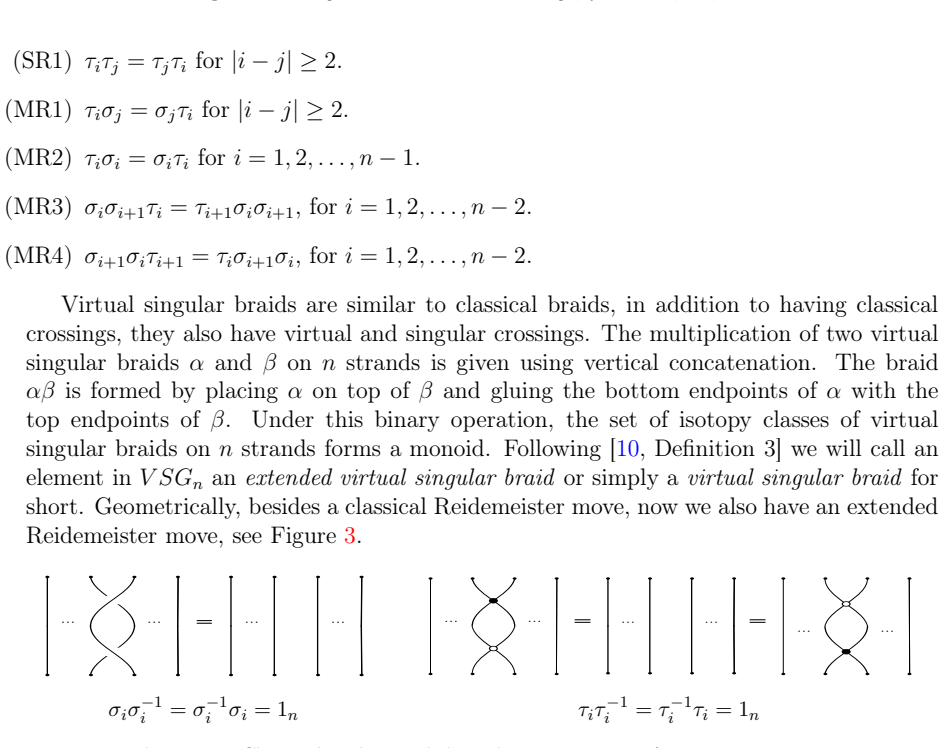

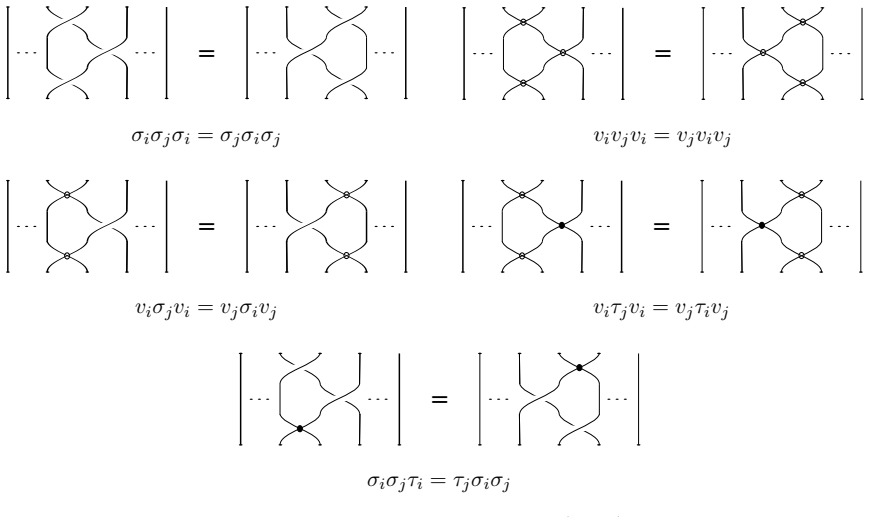

read the original abstract
The virtual singular braid group arises as a natural common generalization of classical singular braid groups and virtual braid groups. In this paper, we study several algebraic properties of the virtual singular braid group $VSG_n$. We introduce numerical invariants for virtual singular braids arising from exponent sums of words in $VSG_n$, and describe explicitly the kernels of the associated homomorphisms onto abelian groups. We then determine all group homomorphisms, up to conjugation, from $VSG_n$ to the symmetric group $S_n$, and obtain corresponding semi-direct product decompositions. In the particular case $n=2$, we provide explicit presentations and algebraic descriptions of the kernels. Moreover, we show that certain relations are forbidden in $VSG_n$, and we introduce and study natural quotients of the virtual singular braid group, including welded and unrestricted versions, for which analogous structural results are obtained.
Editorial analysis
A structured set of objections, weighed in public.
Referee Report
Summary. The paper studies the virtual singular braid group VSG_n, a common generalization of singular braid groups and virtual braid groups. It introduces numerical invariants from exponent sums of words and describes the kernels of the associated homomorphisms to abelian groups. The central results are a complete classification (up to conjugation) of all group homomorphisms VSG_n → S_n together with the resulting semidirect-product decompositions of VSG_n; explicit presentations and kernel descriptions are given for the case n=2. The paper also identifies certain forbidden relations in VSG_n and introduces and analyzes natural quotients (welded and unrestricted versions) for which analogous structural results hold.
Significance. If the classification of homomorphisms holds, the work supplies a concrete structural description of how VSG_n maps onto S_n and the resulting splittings, which is useful for understanding representations of these generalized braid groups. The explicit n=2 case supplies an independent verification point, and the treatment of quotients extends the results in a natural direction.
minor comments (2)
- [Abstract] The abstract states that 'certain relations are forbidden' but does not name them; a brief parenthetical list of the forbidden relations would improve readability.
- Notation for the generators of VSG_n (e.g., the virtual, singular, and classical crossings) is introduced inline; a short table or dedicated paragraph collecting the full presentation would aid readers.
Simulated Author's Rebuttal
We thank the referee for their careful reading and positive evaluation of the manuscript. The referee's summary accurately captures the main results on homomorphisms from VSG_n to S_n, the semidirect product decompositions, the n=2 case, and the treatment of quotients. We are pleased that the work is recommended for acceptance.
Circularity Check
No significant circularity detected
full rationale
The paper defines VSG_n by a presentation extending singular and virtual braid groups, then classifies homomorphisms VSG_n → S_n (up to conjugation) by checking which assignments of generators to S_n elements satisfy every defining relation, followed by kernel descriptions and semidirect-product splittings. This is a direct enumeration from the relations with no fitted parameters, no self-citation chains invoked as uniqueness theorems, and no renaming of known results as new derivations. The n=2 case supplies an explicit independent verification. The derivation chain remains self-contained against the presentation without any step reducing to its own inputs by construction.
Axiom & Free-Parameter Ledger
axioms (1)
- domain assumption VSG_n is generated by the standard generators of singular and virtual braid groups with the usual relations plus additional ones for the combination.
Forward citations
Cited by 2 Pith papers
-
Universal virtual braid groups
UV_n(c) contains a finite-index right-angled Artin subgroup and has S_n as its smallest non-abelian finite quotient for n≥5, with LERF and Howson properties holding only for n≤3.
-
On Universal Virtual and Welded Braid Groups and Their Linear Representations
Universal virtual and welded braid groups are constructed to unify prior variants, with classifications of their complex homogeneous local representations and proofs of abelianization, perfect commutator, trivial cent...
Reference graph
Works this paper leans on
-
[1]
E. Artin, Theory of braids, Ann. Math. 48 (1947), 101–126
work page 1947
-
[2]
Baez, Link invariants of finite type and perturbation th eory, Lett
J. Baez, Link invariants of finite type and perturbation th eory, Lett. Math. Phys. 26 (1992), 43–51
work page 1992
-
[3]
Bar-Natan, Vassiliev homotopy string link invariants , J
D. Bar-Natan, Vassiliev homotopy string link invariants , J. Knot Theory Ramifications 4 (1995) 13–32
work page 1995
-
[4]
V. G. Bardakov, The virtual and universal braids, Fundamenta Mathematicae 184 (2004), 1–18
work page 2004
-
[5]
V. G. Bardakov and P. Bellingeri, Combinatorial propertie s of virtual braids, Topology and its Applications 156, 6 (2009), 1071–1082
work page 2009
-
[6]
V. G. Bardakov, P. Bellingeri and C. Damiani, Unrestricted virtual braids, fused links and other quotients of virtual braid groups, Journal of Knot Theory and Its Ramifications 24, 12 (2015), 1550063
work page 2015
-
[7]
P. Bellingeri and L. Paris, Virtual braids and permutatio ns, Annales de l’Institut Fourier 70, 3 (2020), 1341–1362
work page 2020
-
[8]
Birman, New points of view in knot theory, Bull
J. Birman, New points of view in knot theory, Bull. Amer. Math. Soc. 28 (1993), 253–287
work page 1993
- [9]
-
[10]
C. Caprau and A. Yeung, Algebraic structures among virt ual singular braids, (2022) arXiv:2201.09187v1
-
[11]
C. Caprau and S. Zepeda, On the virtual singular braid mo noid, J. Knot Theory Ramifica- tions 30, 14 (2021), 2141002
work page 2021
-
[12]
B. A. Cisneros de la Cruz and G. Gandolfi, Algebraic, combi natorial and topological proper- ties of singular virtual braid monoids, J. Knot Theory Ramifications 28, 10 (2019), 1950069
work page 2019
-
[13]
Damiani, A journey through loop braid groups, Expositiones Mathematicae 35, 3 (2017), 252–285
C. Damiani, A journey through loop braid groups, Expositiones Mathematicae 35, 3 (2017), 252–285
work page 2017
- [14]
-
[15]
R. Fenn, E. Keyman and C. Rourke, The singular braid mono id embeds in a group, J. Knot Theory Ramifications 7(7) (1998) 881–892
work page 1998
-
[16]
Kamada, Braid presentation of virtual knots and welde d knots, Osaka J
S. Kamada, Braid presentation of virtual knots and welde d knots, Osaka J. Math. 44, 2 (2007), 441–458
work page 2007
-
[17]
L. H. Kauffman, Virtual knot theory, Eur. J. Comb. 20, 7 (1999), 663–690
work page 1999
-
[18]
L. H. Kauffman and S. Lambropoulou, Virtual braids, Fund. Math. 184 (2004), 159–186
work page 2004
- [19]
-
[20]
V. V. Vershinin, On homology of virtual braids and Burau r epresentation, J. Knot Theory Ramifications 10, 5 (2001), 795–812
work page 2001
-
[21]
J. Zhu, On singular braids, J. Knot Theory Ramifications 6 (1997) 427–440. 19
work page 1997
discussion (0)
Sign in with ORCID, Apple, or X to comment. Anyone can read and Pith papers without signing in.