Canonical scattering problem in topological metamaterials: Valley-Hall modes through a bend
Pith reviewed 2026-05-24 04:44 UTC · model grok-4.3
The pith
Valley Hall modes transmit near-maximally through sharp bends even without valley index conservation.
A machine-rendered reading of the paper's core claim, the machinery that carries it, and where it could break.
Core claim
In a tight-binding model of graphene ribbons with an interface, Valley Hall modes exhibit transmission coefficients close to maximal when encountering sharp bends, including those that do not conserve the valley index; consequently no correlation exists between valley conservation and transmission quality.
What carries the argument
Transfer-matrix computation of reflection and transmission coefficients on a tight-binding model of graphene ribbons with an interface, applied to Valley Hall modes at bends.
If this is right
- Transmission remains close to maximal for Valley Hall modes in every bend configuration examined.
- Valley index conservation shows no correlation with transmission quality.
- The results hold for both valley-conserving and valley-nonconserving bends in the model.
- The computed coefficients provide a reference standard for Valley Hall metamaterial design.
Where Pith is reading between the lines
- High transmission may arise from interface properties rather than valley symmetry alone.
- Design rules for bends in these metamaterials could relax the requirement to preserve valley index.
- The same scattering analysis might apply to other index-protected modes in reciprocal systems.
Load-bearing premise
The chosen tight-binding model together with its transfer-matrix implementation faithfully reproduces the scattering of Valley Hall modes at sharp bends without large discretization artifacts.
What would settle it
A measurement or exact computation that finds reflection coefficients substantially above zero for Valley Hall modes at a valley-nonconserving bend would contradict the near-maximal transmission result.
Figures








read the original abstract
We study the amount of backscattering of Valley Hall modes in a classical topological insulator. In reciprocal systems, the conservation of the valley index has been argued to be at the root of the high-transmission of Valley Hall modes, observed in many experimental realisations. Here, we reconsider this hypothesis by quantitatively analysing the canonical scattering problem of interface Valley Hall modes impinging on sharp bends which may or may not conserve the valley index. We consider a tight binding model of graphene ribbons with an interface and compute the reflection and transmission coefficients using a transfer matrix formalism. We find that, in all configurations considered, the transmission of Valley Hall modes is close to being maximal, even in cases where the valley index is not conserved. Hence there appears to be no correlation between valley conservation and good transmission. Our results serve as a reference case for the design of Valley Hall type metamaterial.
Editorial analysis
A structured set of objections, weighed in public.
Referee Report
Summary. The manuscript studies backscattering of Valley Hall modes at sharp bends in a tight-binding model of graphene ribbons with an interface. Using a transfer-matrix formalism, it computes reflection and transmission for bend geometries that do and do not conserve the valley index. The central claim is that transmission remains close to maximal in all cases examined, implying no correlation between valley conservation and high transmission; the results are positioned as a reference case for metamaterial design.
Significance. If the numerical results are free of discretization or truncation artifacts, the work supplies a clean, parameter-free benchmark that directly tests and challenges the hypothesis that valley-index conservation is the dominant mechanism for suppressed backscattering in Valley-Hall systems. This could usefully inform both theoretical modeling and experimental design in topological metamaterials.
major comments (2)
- [Methods (transfer-matrix formalism)] Transfer-matrix implementation (methods section): the paper must demonstrate convergence of the reported transmission coefficients with respect to both ribbon width and the number of modes retained in the basis. Without such checks, the near-unity transmission found for non-valley-conserving bends could arise from truncation that artificially limits coupling to additional scattering channels at the lattice-scale corner.
- [Results (bend scattering calculations)] Results for non-conserving configurations: the claim that transmission is insensitive to valley conservation rests on the specific tight-binding ribbon model; the manuscript should quantify how transmission changes when the interface termination or ribbon width is varied, to confirm that the observed high transmission is not an artifact of the finite-width discretization.
minor comments (2)
- Figure captions should explicitly state the numerical values of transmission and reflection for each geometry rather than relying solely on visual inspection.
- [Introduction] The introduction would benefit from a brief statement of the precise valley-conservation hypothesis being tested, with a citation to the key prior works that advanced it.
Simulated Author's Rebuttal
We thank the referee for their careful reading of the manuscript and for the constructive comments. We appreciate the positive assessment of the work's potential significance as a benchmark. We address each major comment below and will revise the manuscript to incorporate the requested checks and additional data.
read point-by-point responses
-
Referee: [Methods (transfer-matrix formalism)] Transfer-matrix implementation (methods section): the paper must demonstrate convergence of the reported transmission coefficients with respect to both ribbon width and the number of modes retained in the basis. Without such checks, the near-unity transmission found for non-valley-conserving bends could arise from truncation that artificially limits coupling to additional scattering channels at the lattice-scale corner.
Authors: We agree that explicit convergence checks are necessary to rule out possible truncation artifacts in the transfer-matrix calculations. In the revised manuscript we will add an appendix (or dedicated subsection in Methods) containing convergence data. This will include transmission versus ribbon width (extending to at least twice the widths used in the main figures) at fixed mode count, and transmission versus number of retained modes at the largest ribbon width. These plots will confirm that the reported near-unity values have saturated and are insensitive to further increases in basis size or width. revision: yes
-
Referee: [Results (bend scattering calculations)] Results for non-conserving configurations: the claim that transmission is insensitive to valley conservation rests on the specific tight-binding ribbon model; the manuscript should quantify how transmission changes when the interface termination or ribbon width is varied, to confirm that the observed high transmission is not an artifact of the finite-width discretization.
Authors: We accept that robustness with respect to interface termination and ribbon width should be demonstrated explicitly. The revised manuscript will include additional calculations for alternative interface terminations (different edge configurations at the bend) and for a broader range of ribbon widths. These new results will be presented in the Results section (or a supplementary figure) to show that the high transmission persists across these variations, thereby supporting that the finding is not an artifact of the particular finite-width discretization originally employed. revision: yes
Circularity Check
Numerical scattering computation on fixed lattice model yields transmission results independent of valley conservation.
full rationale
The paper's central result is obtained by direct numerical solution of a linear scattering problem: a tight-binding Hamiltonian on graphene ribbons is discretized, a transfer-matrix method is applied to compute reflection/transmission coefficients for Valley-Hall interface modes at bends, and the output coefficients are reported. No parameter is fitted to the target transmission data, no self-referential definition equates the output to an input, and no self-citation chain is invoked to justify the model or the conclusion. The computation is therefore self-contained; its outputs are not equivalent to its inputs by construction.
Axiom & Free-Parameter Ledger
axioms (1)
- domain assumption The tight-binding Hamiltonian on a graphene lattice with an interface supports Valley Hall modes whose scattering can be computed via transfer matrix.
Lean theorems connected to this paper
-
IndisputableMonolith/Foundation/RealityFromDistinction.leanreality_from_one_distinction unclear?
unclearRelation between the paper passage and the cited Recognition theorem.
We consider a tight binding model of graphene ribbons with an interface and compute the reflection and transmission coefficients using a transfer matrix formalism. We find that, in all configurations considered, the transmission of Valley Hall modes is close to being maximal, even in cases where the valley index is not conserved.
-
IndisputableMonolith/Cost/FunctionalEquation.leanwashburn_uniqueness_aczel unclear?
unclearRelation between the paper passage and the cited Recognition theorem.
The energy eigenvalues are given by E± = ±√(u² + |f|²), which leads to a band structure presenting a gap of magnitude 2u
What do these tags mean?
- matches
- The paper's claim is directly supported by a theorem in the formal canon.
- supports
- The theorem supports part of the paper's argument, but the paper may add assumptions or extra steps.
- extends
- The paper goes beyond the formal theorem; the theorem is a base layer rather than the whole result.
- uses
- The paper appears to rely on the theorem as machinery.
- contradicts
- The paper's claim conflicts with a theorem or certificate in the canon.
- unclear
- Pith found a possible connection, but the passage is too broad, indirect, or ambiguous to say the theorem truly supports the claim.
Reference graph
Works this paper leans on
-
[1]
Graphene ribbons with onsite potential The graphene ribbon described above does not exhibit any band gap. As for the infinite lattice, we now introduce an onsite potential to open a gap around the energy E = 0. We consider a graphene ribbon with zigzag edges, with the addition of an onsite potential + u on the A sites and −u on the B sites of the lattice....
-
[2]
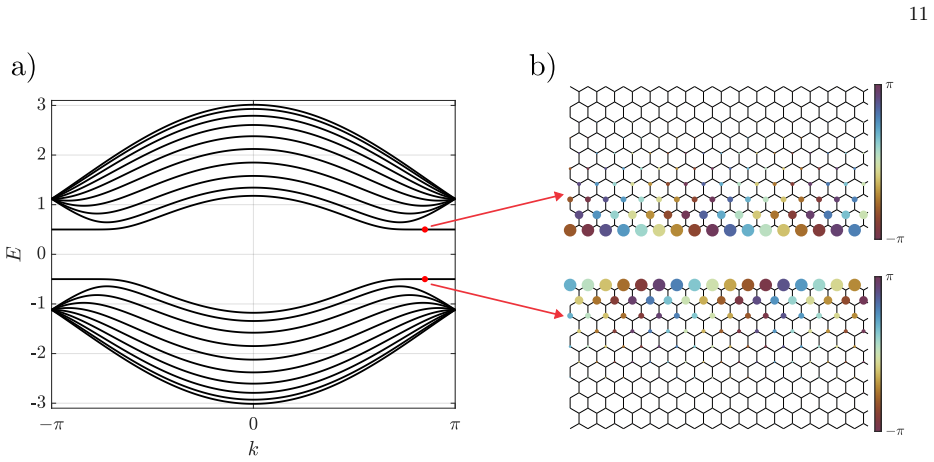
Graphene ribbons with an interface We now consider graphene ribbons with the addition of an onsite potential and in the presence of an interface. The interface will always be considered in the middle of the ribbon hence there are two possible configurations for the interface : i) a bridge interface or ii) a zigzag interface. The ribbons are made of superc...
-
[3]
This can most easily be seen from Eqs
Conserved current Due to the fact that the Hamiltonian of an isolated supercell of the ribbon is self-adjoint, there exists a conserved current in the ribbon. This can most easily be seen from Eqs. (3.5) and (3.6). By multiplying Eq. (3.5) by B† n and Eq. (3.6) by A† n, we get B† nAn+1 + B† n(UB − E1N)Bn = −B† n 1N + J T An (3.10) A† n (1N + J) Bn = A† n ...
-
[4]
Eigenmodes The modes of the ribbon are given by the eigenvectors of the transfer matrix, M ψj = λjψj, (3.17) with j = 1 , ..., N. Writing the eigenvalues as λj = eikj, we see that if |λj| = 1 the mode is propagative and if |λj| ̸ = 1, the mode is evanescent. For propagating modes, kj is real and it corresponds to the Bloch wavenumber. The wavevector assoc...
-
[5]
We now need to connect those modes on each side of the bend
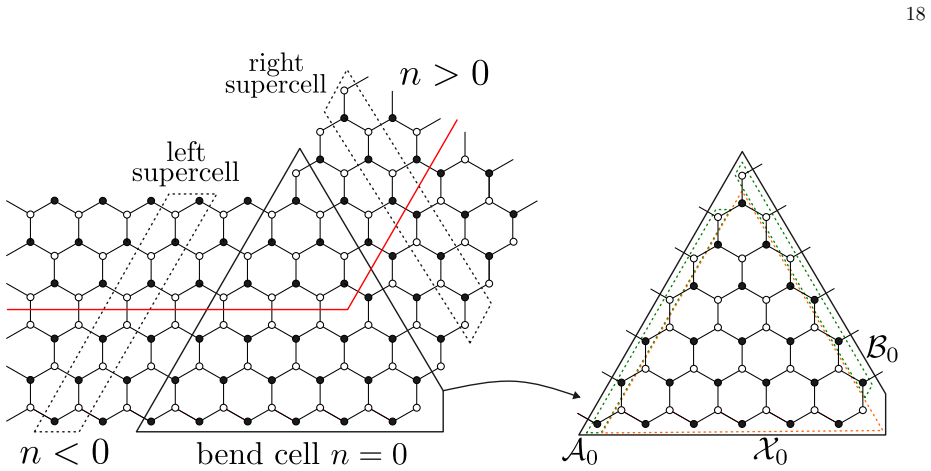
Connection across a bend In the previous section, we have constructed the propagating and evanescent eigenmodes and their associated eigenvalues in a ribbon configuration. We now need to connect those modes on each side of the bend. To do so, we will construct the transfer matrix of the bend cell. 18 FIG. 8: Illustration of the various supercells in a rib...
-
[6]
We can then define a scattering problem by imposing specific boundary conditions
Reflection and transmission across a bend Using the modal decomposition constructed from the transfer matrix of the ribbons, Ψ n outside the bend cell can be decomposed as a linear superposition of the ribbons eigenmodes. We can then define a scattering problem by imposing specific boundary conditions. A general scattering solution can be written as Ψn = ...
-
[7]
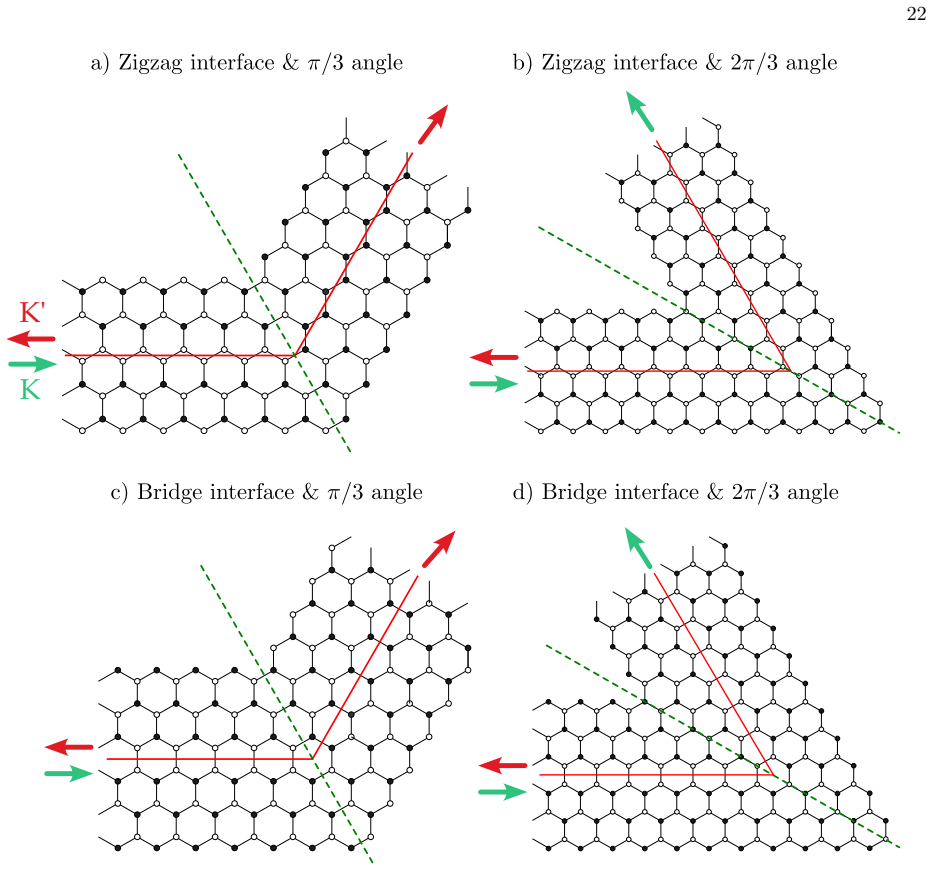
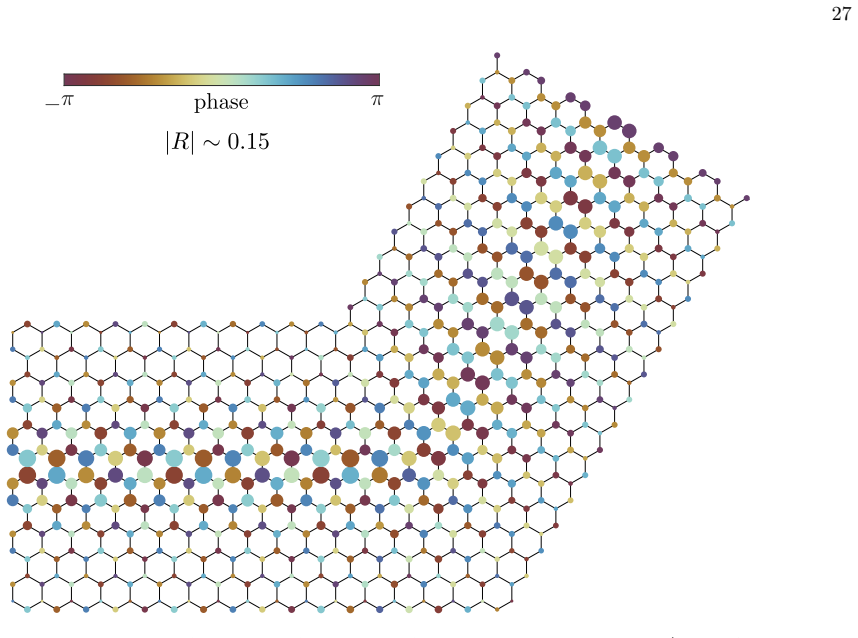
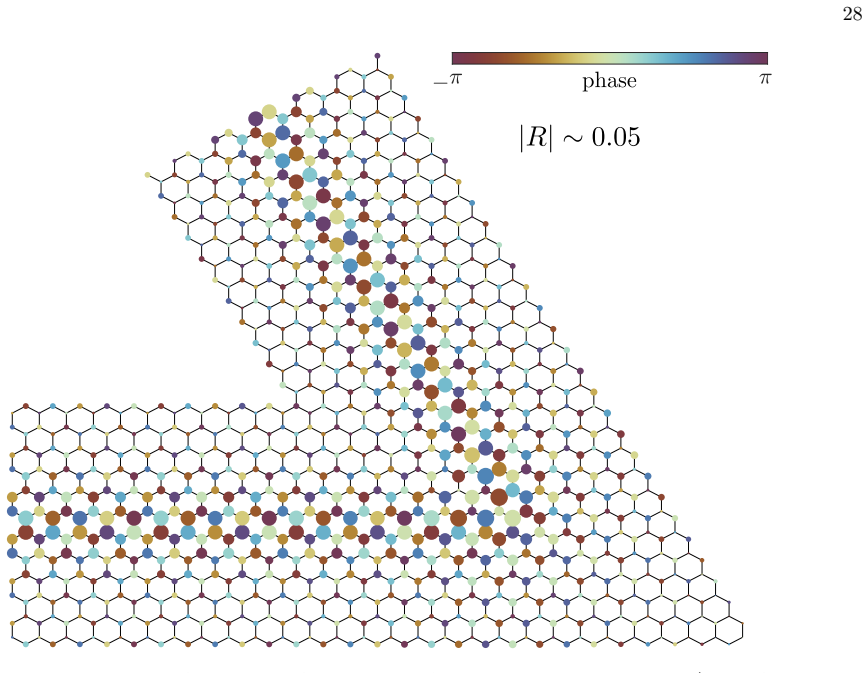
Spectrum The reflection and transmission coefficients are computed over the energy range where there exists a single pair of propagating modes on each side of the bend and are presented in Fig. 10. The main observation from this example is the fact that in all configurations, the reflection coefficient is relatively small and therefore the transmission is...
-
[8]
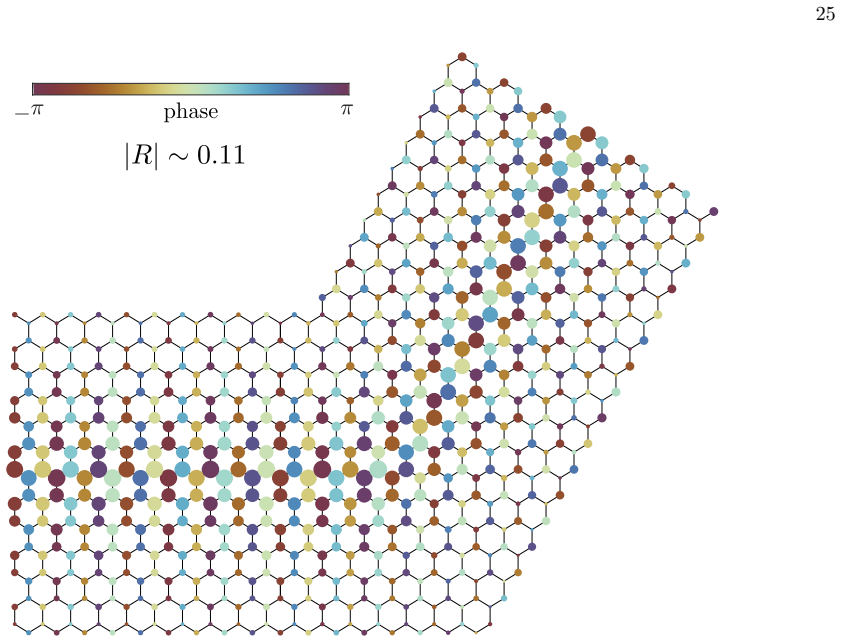
Visualisation of scattering solutions Using Eqs. (3.36) & (3.37) as well as the reflection an transmission matrices, we can reconstruct the field in the ribbons of both sides of the bend as well as within the bend. This allows to visualise the scattering solutions which we present below for a fixed value of the energy for all possible configurations. The ...
work page 2030
-
[9]
2013 Photonic topological insulators
Khanikaev AB, Hossein Mousavi S, Tse WK, Kargarian M, MacDonald AH, Shvets G. 2013 Photonic topological insulators. Nature materials 12, 233–239
work page 2013
-
[10]
2014 Topological photonics.Nature photonics 8, 821–829
Lu L, Joannopoulos JD, Soljaˇ ci´ c M. 2014 Topological photonics.Nature photonics 8, 821–829
work page 2014
-
[11]
Ozawa T, Price HM, Amo A, Goldman N, Hafezi M, Lu L, Rechtsman MC, Schuster D, Simon J, Zilberberg O et al.. 2019 Topological photonics. Reviews of Modern Physics 91, 015006
work page 2019
-
[12]
2019 Topological phases in acoustic and mechanical systems
Ma G, Xiao M, Chan CT. 2019 Topological phases in acoustic and mechanical systems. Nature Reviews Physics 1, 281–294
work page 2019
-
[13]
2020 Topological wave insulators: a review
Zangeneh-Nejad F, Al` u A, Fleury R. 2020 Topological wave insulators: a review. Comptes Rendus. Physique 21, 467–499
work page 2020
-
[14]
2021 Design of topological elastic waveguides
Miniaci M, Pal R. 2021 Design of topological elastic waveguides. Journal of Applied Physics 130
work page 2021
-
[15]
2022 Topological sound in two dimensions
Yves S, Ni X, Al` u A. 2022 Topological sound in two dimensions. Annals of the New York Academy of Sciences 1517, 63–77
work page 2022
- [16]
-
[17]
2011 The quantum spin Hall effect
Maciejko J, Hughes TL, Zhang SC. 2011 The quantum spin Hall effect. Annu. Rev. Condens. Matter Phys. 2, 31–53
work page 2011
-
[18]
2005 Quantum spin Hall effect in graphene
Kane CL, Mele EJ. 2005 Quantum spin Hall effect in graphene. Physical review letters 95, 226801
work page 2005
-
[19]
2015 Scheme for achieving a topological photonic crystal by using dielectric material
Wu LH, Hu X. 2015 Scheme for achieving a topological photonic crystal by using dielectric material. Physical review letters 114, 223901
work page 2015
-
[20]
2016 Acoustic topological insulator and robust one-way sound transport
He C, Ni X, Ge H, Sun XC, Chen YB, Lu MH, Liu XP, Chen YF. 2016 Acoustic topological insulator and robust one-way sound transport. Nature physics 12, 1124–1129
work page 2016
-
[21]
2017 Pseudospins and topological effects of phonons in a kekul´ e lattice
Liu Y, Lian CS, Li Y, Xu Y, Duan W. 2017 Pseudospins and topological effects of phonons in a kekul´ e lattice. Physical review letters 119, 255901
work page 2017
-
[22]
Miniaci M, Pal RK, Morvan B, Ruzzene M. 2018 Experimental Observation of Topologically Protected Helical Edge Modes in Patterned Elastic Plates. Phys. Rev. X 8, 031074. (10.1103/PhysRevX.8.031074)
-
[23]
2016 Pseudo-time-reversal symmetry and topological edge states in two-dimensional acoustic crystals
Mei J, Chen Z, Wu Y. 2016 Pseudo-time-reversal symmetry and topological edge states in two-dimensional acoustic crystals. Scientific reports 6, 32752
work page 2016
-
[24]
2017 Crystalline metamaterials for topological properties at subwavelength scales
Yves S, Fleury R, Berthelot T, Fink M, Lemoult F, Lerosey G. 2017 Crystalline metamaterials for topological properties at subwavelength scales. Nature communications 8, 16023
work page 2017
-
[25]
Yang Y, Xu YF, Xu T, Wang HX, Jiang JH, Hu X, Hang ZH. 2018 Visualization of a unidirectional electromagnetic waveguide using topological photonic crystals made of dielectric materials. Physical review letters 120, 217401
work page 2018
-
[26]
2017 Observation of topological valley transport of sound in sonic crystals
Lu J, Qiu C, Ye L, Fan X, Ke M, Zhang F, Liu Z. 2017 Observation of topological valley transport of sound in sonic crystals. Nature Physics 13, 369–374
work page 2017
-
[27]
2017 Edge waves in plates with resonators: an elastic analogue of the quantum valley Hall effect
Pal RK, Ruzzene M. 2017 Edge waves in plates with resonators: an elastic analogue of the quantum valley Hall effect. New Journal of Physics 19, 025001
work page 2017
-
[28]
2018 Valley topological phases in bilayer sonic crystals
Lu J, Qiu C, Deng W, Huang X, Li F, Zhang F, Chen S, Liu Z. 2018 Valley topological phases in bilayer sonic crystals. Physical review letters 120, 116802
work page 2018
-
[29]
Zheng LY, Achilleos V, Chen ZG, Richoux O, Theocharis G, Wu Y, Mei J, Felix S, Tournat V, Pagneux V. 2020 Acoustic graphene network loaded with Helmholtz resonators: a first-principle modeling, Dirac cones, edge and interface waves. New Journal of Physics 22, 013029
work page 2020
-
[30]
2017 Observation of topological valley modes in an elastic hexagonal lattice
Vila J, Pal RK, Ruzzene M. 2017 Observation of topological valley modes in an elastic hexagonal lattice. Physical Review B 96, 134307
work page 2017
-
[31]
2018 Tunable acoustic valley–hall edge states in reconfigurable phononic elastic waveg- uides
Liu TW, Semperlotti F. 2018 Tunable acoustic valley–hall edge states in reconfigurable phononic elastic waveg- uides. Physical Review Applied 9, 014001. 33
work page 2018
-
[32]
Zhang Z, Cheng Y, Liu X. 2018 Achieving acoustic topological valley-Hall states by modulating the subwavelength honeycomb lattice. Scientific Reports 8, 16784
work page 2018
-
[33]
Tian Z, Shen C, Li J, Reit E, Bachman H, Socolar JE, Cummer SA, Jun Huang T. 2020 Dispersion tuning and route reconfiguration of acoustic waves in valley topological phononic crystals. Nature communications 11, 762
work page 2020
-
[34]
2019 Programmable elastic valley Hall insulator with tunable interface propagation routes
Zhang Q, Chen Y, Zhang K, Hu G. 2019 Programmable elastic valley Hall insulator with tunable interface propagation routes. Extreme Mechanics Letters 28, 76–80
work page 2019
-
[35]
2022 Gigahertz topological valley Hall effect in nanoelectromechanical phononic crystals
Zhang Q, Lee D, Zheng L, Ma X, Meyer SI, He L, Ye H, Gong Z, Zhen B, Lai K et al.. 2022 Gigahertz topological valley Hall effect in nanoelectromechanical phononic crystals. Nature Electronics 5, 157–163
work page 2022
-
[36]
2022 Localized waves in elastic plates with perturbed honeycomb arrays of constraints
Haslinger S, Frecentese S, Carta G. 2022 Localized waves in elastic plates with perturbed honeycomb arrays of constraints. Philosophical Transactions of the Royal Society A 380, 20210404
work page 2022
-
[37]
Orazbayev B, Fleury R. 2019 Quantitative robustness analysis of topological edge modes in C6 and valley-Hall metamaterial waveguides. Nanophotonics 8, 1433–1441
work page 2019
-
[38]
Deng Y, Lu M, Jing Y. 2019 A comparison study between acoustic topological states based on valley Hall and quantum spin Hall effects. The Journal of the Acoustical Society of America 146, 721–728
work page 2019
-
[39]
Arora S, Bauer T, Barczyk R, Verhagen E, Kuipers L. 2021 Direct quantification of topological protection in symmetry-protected photonic edge states at telecom wavelengths. Light: Science & Applications 10, 9
work page 2021
-
[40]
2023 Quantifying topological protection in valley photonic crystals using triangular resonators
L´ evˆ eque G, Pennec Y, Szriftgiser P, Amo A, Mart´ ınez A. 2023 Quantifying topological protection in valley photonic crystals using triangular resonators. arXiv preprint arXiv:2301.10565
-
[41]
2023 Observation of strong backscattering in valley-Hall photonic topological interface modes
Rosiek CA, Arregui G, Vladimirova A, Albrechtsen M, Vosoughi Lahijani B, Christiansen RE, Stobbe S. 2023 Observation of strong backscattering in valley-Hall photonic topological interface modes. Nature Photonics pp. 1–7
work page 2023
-
[42]
2023 Reciprocal topological photonic crystals allow backscattering.Nature Photonics 17, 383–384
Rechtsman MC. 2023 Reciprocal topological photonic crystals allow backscattering.Nature Photonics 17, 383–384
work page 2023
-
[43]
2020 Analytical methods for perfect wedge diffraction: A review
Nethercote MA, Assier RC, Abrahams ID. 2020 Analytical methods for perfect wedge diffraction: A review. Wave Motion 93, 102479
work page 2020
-
[44]
2020 Observations of symmetry-induced topological mode steering in a reconfigurable elastic plate
Tang K, Makwana M, Craster RV, Sebbah P. 2020 Observations of symmetry-induced topological mode steering in a reconfigurable elastic plate. Physical Review B 102, 214103
work page 2020
-
[45]
2018 Designing multidirectional energy splitters and topological valley supernetworks
Makwana MP, Craster RV. 2018 Designing multidirectional energy splitters and topological valley supernetworks. Physical Review B 98, 235125
work page 2018
-
[46]
2020 Manipulating topological valley modes in plasmonic metasurfaces
Proctor M, Huidobro PA, Maier SA, Craster RV, Makwana MP. 2020 Manipulating topological valley modes in plasmonic metasurfaces. Nanophotonics 9, 657–665
work page 2020
-
[47]
Vanel AL, Schnitzer O, Craster RV. 2017 Asymptotic network models of subwavelength metamaterials formed by closely packed photonic and phononic crystals. Europhysics Letters 119, 64002
work page 2017
-
[48]
2018 A study of topological effects in 1D and 2D mechanical lattices
Chen H, Nassar H, Huang G. 2018 A study of topological effects in 1D and 2D mechanical lattices. Journal of the Mechanics and Physics of Solids 117, 22–36
work page 2018
-
[49]
Coutant A, Sivadon A, Zheng L, Achilleos V, Richoux O, Theocharis G, Pagneux V. 2021a Acoustic Su-Schrieffer- Heeger lattice: Direct mapping of acoustic waveguides to the Su-Schrieffer-Heeger model. Physical Review B 103, 224309
-
[50]
Coutant A, Achilleos V, Richoux O, Theocharis G, Pagneux V. 2021b Topological two-dimensional Su–Schrieffer– Heeger analog acoustic networks: Total reflection at corners and corner induced modes. Journal of Applied Physics 129
-
[51]
2023 Topologically invisible defects in chiral mirror lattices
Coutant A, Zheng LY, Achilleos V, Richoux O, Theocharis G, Pagneux V. 2023 Topologically invisible defects in chiral mirror lattices. arXiv preprint arXiv:2303.02029
-
[52]
2020 Emulating tightly bound electrons in crystalline solids using mechanical waves
Ram´ ırez-Ram´ ırez F, Flores-Olmedo E, B´ aez G, Sadurn´ ı E, M´ endez-S´ anchez R. 2020 Emulating tightly bound electrons in crystalline solids using mechanical waves. Scientific Reports 10, 10229
work page 2020
-
[53]
Fan H, Gao H, An S, Gu Z, Liang S, Zheng Y, Liu T. 2022 Hermitian and non-Hermitian topological edge states in one-dimensional perturbative elastic metamaterials. Mechanical Systems and Signal Processing 169, 108774. 34
work page 2022
-
[54]
2008 Wave propagation: from electrons to photonic crystals and left-handed materials
Markos P, Soukoulis CM. 2008 Wave propagation: from electrons to photonic crystals and left-handed materials . Princeton University Press
work page 2008
-
[55]
2022 Theory of edge states in graphene-like systems
Lado J, Fern´ andez-Rossier J. 2022 Theory of edge states in graphene-like systems. arXiv preprint arXiv:2210.07568
-
[56]
2010 Electronic states of graphene nanoribbons and analytical solutions
Wakabayashi K, Sasaki Ki, Nakanishi T, Enoki T. 2010 Electronic states of graphene nanoribbons and analytical solutions. Science and technology of advanced materials 11, 054504
work page 2010
-
[57]
1979 Solitons in polyacetylene
Su WP, Schrieffer JR, Heeger AJ. 1979 Solitons in polyacetylene. Physical review letters 42, 1698
work page 1979
-
[58]
2016 A short course on topological insulators.Lecture notes in physics 919, 166
Asb´ oth JK, Oroszl´ any L, P´ alyi A. 2016 A short course on topological insulators.Lecture notes in physics 919, 166
work page 2016
-
[59]
2016 Of bulk and boundaries: Generalized transfer matrices for tight-binding models
Dwivedi V, Chua V. 2016 Of bulk and boundaries: Generalized transfer matrices for tight-binding models. Physical Review B 93, 134304
work page 2016
-
[60]
However, the associated Rice-Mele chain obeys the mirror symmetry
Note1. However, the associated Rice-Mele chain obeys the mirror symmetry. Hence it is the eigenmodes of the Rice-Mele and not directly of the graphene ribbon which display symmetric and anti-symmetric behaviours
-
[61]
2011 Zak phase and the existence of edge states in graphene
Delplace P, Ullmo D, Montambaux G. 2011 Zak phase and the existence of edge states in graphene. Physical Review B 84, 195452. 35 Appendix A: Berry curvature of a two level system Here we present the details to compute the Berry curvature of the graphene lattice with onsite potential [50]. The Bloch Hamiltonian (2.5) is a 2 × 2 matrix which can be decompos...
work page 2011
-
[62]
Spectrum in the fully dimerized limit One can gain valuable insight by considering the fully dimerized limit, that is the case where the intracell hopping vanishes. We consider the general Rice-Mele chain with intracell hopping h1, intercell hopping h2 and onsite potential u. A schematic of the chain is shown in Fig. 17. To connect the Rice-Mele chain to ...
-
[63]
Interface states of the periodic chain Another instructive limit is the one of an infinite Rice-Mele chain, which corresponds to a ribbon with infinite width. We derive here analytically the expression for the energy as well as for the eigenvectors of interface states in a ribbon with infinite transverse width. The Rice-Mele chain with an interface is sho...
-
[64]
Transfer matrix for arbitrary ribbons The construction of the transfer matrix in Sec. III A was done directly from the specific ribbon configuration and its decomposition in tilted supercells. In particular, we used the fact the supercell only contained sites which were connected to adjacent supercells. Here, we present a more abstract discussion allowing...
-
[65]
As an illustration we now apply this formalism to the case of graphene ribbons with armchair edges
Application to ribbons with armchair edges We have now constructed the transfer matrix for general ribbons with arbitrary supercell. As an illustration we now apply this formalism to the case of graphene ribbons with armchair edges. a. Graphene ribbons As for the case of the zigzag ribbon, we begin by briefly reviewing the band properties of the armchair ...
discussion (0)
Sign in with ORCID, Apple, or X to comment. Anyone can read and Pith papers without signing in.