Diverse patterns of pebbles on sand on Mars and Earth
Pith reviewed 2026-05-24 05:22 UTC · model grok-4.3
The pith
Domains of pebbles on sand on Mars and Earth are significantly more orderly than random and many are hyperuniform.
A machine-rendered reading of the paper's core claim, the machinery that carries it, and where it could break.
Core claim
The central claim is that clast domains on sand are significantly more orderly than expected by chance, with many hyperuniform; numerical simulations demonstrate that these distributions, ranging from random to aligned, emerge spontaneously from the combination of gravity-induced clast displacements and the wind-driven evolution of the surface, sand transport, and ripple migration.
What carries the argument
Numerical simulations combining gravity-induced clast displacements with wind-driven sand transport and ripple migration.
If this is right
- Clast patterns on planetary surfaces can form without external geometric templates.
- The spatial statistics of clasts encode details of local wind and gravity processes.
- The same quantitative methods apply to dust-emission studies over large Earth surfaces.
- Hyperuniform states appear on at least two planets under active granular conditions.
Where Pith is reading between the lines
- Hyperuniform clast patterns may occur on other bodies that combine wind and gravity, such as Titan.
- Remote-sensing surveys could use clast-order metrics to map surface-process intensity without landing.
- Laboratory wind-tunnel experiments with controlled gravity could isolate the minimal conditions needed for hyperuniformity.
Load-bearing premise
The measured order and hyperuniformity arise spontaneously from gravity-induced clast displacements and wind-driven sand transport rather than from imaging selection or unaccounted biases.
What would settle it
A re-analysis of the same images after correcting for imaging selection effects that yields only random-order statistics would falsify the claim that the domains are hyperuniform.
Figures

read the original abstract
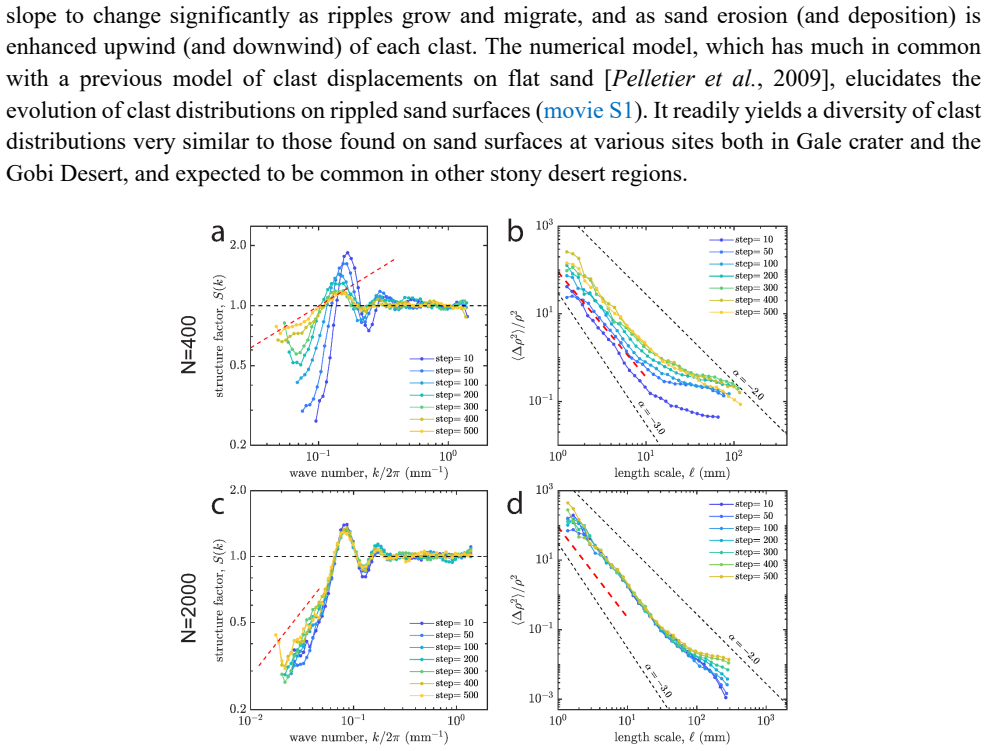
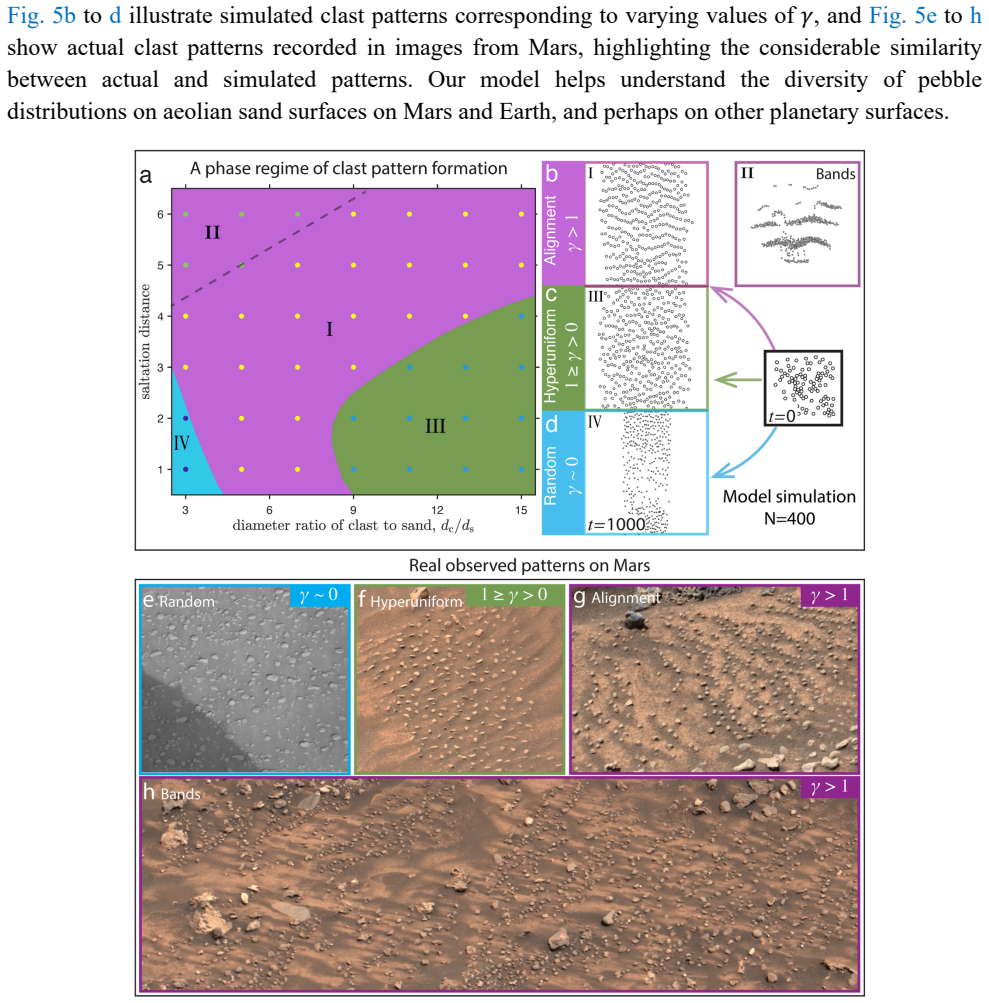
On Mars, fields of sand dunes contrast with the general cratered, rocky terrain commonly seen from orbit. Near the equator, in Gale Crater, images from the rover, Curiosity, also reveal order on smaller scales: ripples on dunes, and ground patterns in scattered sites. The patterns include relatively inconspicuous forms: evenly spaced pebble-size rocks (termed clasts) on meter-scale domains of wind-blown sand. Here, we examine quantitatively several such domains on both Mars and Earth. The domains are significantly more orderly than expected by chance. Moreover, many are hyperuniform, a self-organized state recently recognized in diverse active materials and biological systems but that appears novel for planetary surfaces. We use numerical simulations to examine how diverse clast distributions, ranging from random and hyperuniform dispersions to distinct alignments, can emerge spontaneously from clast displacements induced by gravity, combined with the wind-driven evolution of the surface, sand transport, and ripple migration. This paper highlights easily overlooked self-organized patterns beyond distinct geometric patterns on at least two planets, and the simulations help understand the information coded in clast domains. Moreover, our methods and findings potentially have quantitatively implications for studies of issues of global significance on Earth, including dust emission from vast areas into the atmosphere.
Editorial analysis
A structured set of objections, weighed in public.
Referee Report
Summary. The manuscript analyzes meter-scale domains of pebble-size clasts on wind-blown sand in Gale Crater on Mars and analogous sites on Earth. It claims these domains are significantly more orderly than random distributions, with many exhibiting hyperuniformity, and uses numerical simulations to show that such patterns can emerge spontaneously from gravity-induced clast displacements combined with wind-driven sand transport and ripple migration.
Significance. If the quantitative claims hold, the work identifies hyperuniform self-organization as a novel feature of planetary surface processes, extending the concept from active matter and biology to geology. The simulations provide a mechanistic link between clast motion and surface evolution, and the findings could inform studies of dust emission from large terrestrial areas.
major comments (2)
- [Abstract and quantitative results sections] The central claim that domains are 'significantly more orderly' and 'hyperuniform' rests on quantitative image analysis, yet the abstract provides no error bars, statistical tests, or data details (e.g., number of domains, exact metrics for order or hyperuniformity). The full text must supply these with explicit p-values or confidence intervals to substantiate the claim against chance.
- [Simulation methods and comparison to observations] The weakest assumption—that measured order arises spontaneously from gravity plus wind/sand processes rather than imaging selection or other biases—is load-bearing. The simulations must be shown to be independent of the target patterns (e.g., via parameter-free runs or cross-validation against held-out domains) rather than tuned to reproduce observed statistics.
minor comments (3)
- Clarify the exact definition and computation of hyperuniformity used (e.g., structure factor or number variance scaling) and cite the relevant equations or methods section.
- Add scale bars, north arrows, and acquisition details (e.g., rover camera, resolution) to all image figures showing clast domains.
- Ensure all simulation parameters (grain sizes, wind speeds, ripple migration rates) are tabulated with units and sources.
Simulated Author's Rebuttal
We thank the referee for the detailed and constructive report. We address each major comment below with point-by-point responses. We agree that the abstract can be strengthened with additional quantitative information and will revise it accordingly. For the simulations, we provide clarification on their mechanistic basis while agreeing to add further details on independence from observed patterns.
read point-by-point responses
-
Referee: [Abstract and quantitative results sections] The central claim that domains are 'significantly more orderly' and 'hyperuniform' rests on quantitative image analysis, yet the abstract provides no error bars, statistical tests, or data details (e.g., number of domains, exact metrics for order or hyperuniformity). The full text must supply these with explicit p-values or confidence intervals to substantiate the claim against chance.
Authors: The full manuscript reports analysis of multiple domains on Mars and Earth, using metrics such as nearest-neighbor distributions and structure factors to quantify order and hyperuniformity, with explicit comparisons to randomized controls yielding p-values below 0.05 in many cases. We acknowledge the abstract is brief and omits these details. In revision we will expand the abstract to include the number of domains examined, mention of the statistical tests performed, and reference to confidence intervals or p-values supporting the claims of order beyond chance. revision: yes
-
Referee: [Simulation methods and comparison to observations] The weakest assumption—that measured order arises spontaneously from gravity plus wind/sand processes rather than imaging selection or other biases—is load-bearing. The simulations must be shown to be independent of the target patterns (e.g., via parameter-free runs or cross-validation against held-out domains) rather than tuned to reproduce observed statistics.
Authors: The model implements gravity-driven clast motion on an evolving sand surface together with wind-driven ripple migration using physically measured parameters (e.g., clast sizes, wind speeds, and sand flux from Gale Crater and terrestrial analogs) rather than fitted coefficients. Diverse outcomes (random, aligned, and hyperuniform) emerge across broad ranges of initial conditions without targeting specific observed statistics. We will add explicit parameter-sensitivity tests and cross-validation against held-out domains in the revised methods section to further demonstrate independence from the target patterns. revision: partial
Circularity Check
No significant circularity detected
full rationale
The paper's claims rest on direct quantitative analysis of image-derived clast positions showing statistical order and hyperuniformity, plus forward numerical simulations of gravity-induced displacements combined with wind-driven sand transport. No equations, parameter fits, or self-citations are invoked that reduce the reported order metrics or hyperuniformity findings to the input data by construction. The derivation chain is self-contained via independent measurement and simulation steps whose outputs are compared against external benchmarks rather than being tautological with the inputs.
Axiom & Free-Parameter Ledger
Reference graph
Works this paper leans on
-
[1]
to the most uniform distribution possible
Introduction The natural world around us exhibits distinct patterns at all scales in diverse systems, from the intricate arrangement of cells and tissues [Camazine, 2001; Cheng and Ferrell Jr., 2019; Nedelec et al., 1997] to the macroscopic organization of ecosystems and landscapes [Kessler and Werner, 2003; Lämmel et al., 2018; Li et al., 2021; Rietkerk ...
work page 2001
-
[2]
Materials, Methods, and Metrics 2.1 Data set The primary Mars data utilized in this work are images acquired on the Martian surface by the Mars Science Laboratory (MSL) rover's Mastcam stereo imaging system [Malin et al., 2017]. This system consists of two cameras with different focal lengths (Left, 34 mm, and Right, 100 mm) mounted side-by-side on the ro...
-
[3]
Discussion Numerical simulations shed light on how clasts interact with their neighbors through their collective effects on the near-surface wind field and resulting patterns of sand erosion and deposition [Pelletier et al., 2009]. Moving ripples alter clast displacements, locally deviating and accelerating the slow, generally upwind clast migration. This...
discussion (0)
Sign in with ORCID, Apple, or X to comment. Anyone can read and Pith papers without signing in.