AI, Meet Human: Learning Paradigms for Hybrid Decision Making Systems
Pith reviewed 2026-05-24 04:09 UTC · model grok-4.3
The pith
A taxonomy organizes the ways humans and machine learning systems interact in decisions.
A machine-rendered reading of the paper's core claim, the machinery that carries it, and where it could break.
Core claim
The authors propose a taxonomy of Hybrid Decision Making Systems that supplies both a conceptual and technical framework for understanding how current computer science literature models interaction between humans and machines.
What carries the argument
The taxonomy of Hybrid Decision Making Systems, which classifies literature on human-ML interaction into coherent categories.
If this is right
- Researchers gain a shared language for comparing different human-ML collaboration techniques.
- System designers can select interaction paradigms with explicit awareness of their technical and conceptual differences.
- Future surveys can build on the same categories rather than starting from scattered classifications.
Where Pith is reading between the lines
- The taxonomy could serve as a checklist when new hybrid systems are proposed, to check which interaction modes are already covered.
- If the taxonomy holds, it might reveal under-explored combinations of human and machine roles that current papers overlook.
Load-bearing premise
The varied techniques in the computer science literature on human-ML interaction can be organized into one coherent taxonomy without substantial loss of important distinctions or coverage gaps.
What would settle it
A systematic review that identifies multiple high-impact human-ML interaction methods or goals that fall outside every category in the proposed taxonomy.
Figures
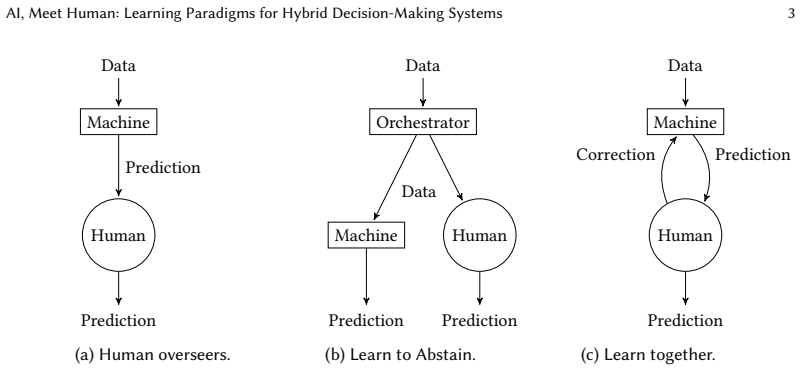


read the original abstract
Everyday we increasingly rely on machine learning models to automate and support high-stake tasks and decisions. This growing presence means that humans are now constantly interacting with machine learning-based systems, training and using models everyday. Several different techniques in computer science literature account for the human interaction with machine learning systems, but their classification is sparse and the goals varied. This survey proposes a taxonomy of Hybrid Decision Making Systems, providing both a conceptual and technical framework for understanding how current computer science literature models interaction between humans and machines.
Editorial analysis
A structured set of objections, weighed in public.
Referee Report
Summary. The manuscript is a survey of techniques in the computer science literature for human interaction with machine learning systems. It proposes a taxonomy of Hybrid Decision Making Systems intended to supply both a conceptual and a technical framework for organizing how these interactions are modeled.
Significance. If the taxonomy organizes the literature coherently and with adequate coverage, it could serve as a useful reference point for researchers working on human-AI collaboration and hybrid systems. The paper contains no original empirical results, derivations, or machine-checked proofs; its contribution is therefore entirely synthetic.
minor comments (2)
- [Abstract] Abstract: the statement that existing classifications are 'sparse' is not accompanied by any enumeration of prior taxonomies or explicit comparison, leaving the novelty of the proposed framework difficult to gauge from the opening paragraph.
- The manuscript would benefit from an explicit statement of the literature search strategy, inclusion criteria, and total number of works reviewed so that readers can assess coverage.
Simulated Author's Rebuttal
We thank the referee for their review and recommendation of minor revision. No specific major comments were provided in the report, so we have no individual points to address here. We remain ready to incorporate any minor changes identified during the revision process.
Circularity Check
No significant circularity: survey taxonomy with no derivations
full rationale
This paper is a literature survey that proposes a conceptual and technical taxonomy for organizing existing work on hybrid human-ML decision systems. It contains no mathematical derivations, fitted parameters, predictions, or load-bearing self-citations. The central claim is the usefulness of the proposed framework for classifying prior techniques; no step reduces by construction to its own inputs or to a self-referential chain. The paper is self-contained as an organizational review against external literature.
Axiom & Free-Parameter Ledger
Reference graph
Works this paper leans on
- [1]
-
[2]
S. Alon-Barkat and M. Busuioc. 2023. Human–AI interactions in public sector decision making:“automation bias” and “selective adherence” to algorithmic advice.Journal of Public Administration Research and Theory , 33, 1
work page 2023
-
[3]
J. V. Alves, D. Leitão, S. M. Jesus, M. O. P. Sampaio, J. Liébana, P. Saleiro, M. A. T. Figueiredo, and P. Bizarro. 2024. Cost-sensitive learning to defer to multiple experts with workload constraints. Trans. Mach. Learn. Res
work page 2024
-
[4]
S. Amershi, M. Cakmak, W. B. Knox, and T. Kulesza. 2014. Power to the people: the role of humans in interactive machine learning. AI Mag., 35, 4
work page 2014
-
[5]
S. Ando and A. Yamamoto. 2023. Anomaly detection via few-shot learning on normality. In Machine Learning and Knowledge Discovery in Databases . M.-R. Amini, S. Canu, A. Fischer, T. Guns, P. Kralj Novak, and G. Tsoumakas, (Eds.) Springer International Publishing, Cham, 275–290
work page 2023
-
[6]
A. N. Angelopoulos, S. Bates, A. Fisch, L. Lei, and T. Schuster. 2022. Conformal risk control
work page 2022
-
[7]
A. Asif and F. u. Amir Afsar Minhas. 2020. Generalized neural framework for learning with rejection. In 2020 International Joint Conference on Neural Networks (IJCNN)
work page 2020
-
[8]
P. Awasthi, A. Mao, M. Mohri, and Y. Zhong. 2022. H-consistency bounds for surrogate loss minimizers. In International Conference on Machine Learning . PMLR, 1117–1174
work page 2022
-
[9]
A. Babuta and M. Oswald. 2021. Machine learning predictive algorithms and the policing of future crimes: governance and oversight. In Predictive Policing and Artificial Intelligence
work page 2021
- [10]
- [11]
- [12]
-
[13]
G. Bansal and D. S. Weld. 2018. A coverage-based utility model for identifying unknown unknowns. In AAAI
work page 2018
-
[14]
P. L. Bartlett, M. I. Jordan, and J. D. McAuliffe. 2006. Convexity, classification, and risk bounds. Journal of the American Statistical Association
work page 2006
-
[15]
P. L. Bartlett and M. H. Wegkamp. 2008. Classification with a reject option using a hinge loss. JMLR
work page 2008
-
[16]
R. Battiti and A. Colla. 1994. Democracy in neural nets: voting schemes for classification. Neural Networks
work page 1994
-
[17]
A. Bontempelli, F. Giunchiglia, A. Passerini, and S. Teso. 2022. Human-in-the-loop handling of knowledge drift. Data Min. Knowl. Discov., 36, 5
work page 2022
-
[18]
K. Bostrom, X. Zhao, S. Chaudhuri, and G. Durrett. 2021. Flexible generation of natural language deductions. In EMNLP
work page 2021
-
[19]
J. Brinkrolf and B. Hammer. 2018. Interpretable machine learning with reject option. at - Automatisierungstechnik
work page 2018
-
[20]
J. Brinkrolf and B. Hammer. 2017. Probabilistic extension and reject options for pairwise lvq. In International Workshop on Self-Organizing Maps and Learning Vector Quantization, Clustering and Data Visualization
work page 2017
- [21]
-
[22]
Z. Buçinca, M. B. Malaya, and K. Z. Gajos. 2021. To trust or to think: cognitive forcing functions can reduce overreliance on AI in ai-assisted decision-making. Proc. ACM Hum. Comput. Interact. , 5, CSCW1
work page 2021
-
[23]
Y. Cao, H. Mozannar, L. Feng, H. Wei, and B. An. 2024. In defense of softmax parametrization for calibrated and consistent learning to defer. Advances in Neural Information Processing Systems , 36
work page 2024
-
[24]
H. Cecotti and S. Vajda. 2013. Rejection schemes in multi-class classification - application to handwritten character recognition. In ICDAR. IEEE Computer Society, 445–449
work page 2013
-
[25]
M.-A. Charusaie, H. Mozannar, D. Sontag, and S. Samadi. 2022. Sample efficient learning of predictors that comple- ment humans. In Proc. of the 39th International Conference on Machine Learning
work page 2022
-
[26]
J. Chen, W. Shi, Z. Fu, S. Cheng, L. Li, and Y. Xiao. 2023. Say what you mean! Large language models speak too positively about negative commonsense knowledge. In ACL (1)
work page 2023
-
[27]
C. Chow. 1970. On optimum recognition error and reject tradeoff. IEEE Transactions on Information Theory , 16, 1
work page 1970
-
[28]
M. R. Ciosici, J. Cecil, D. Lee, A. Hedges, M. Freedman, and R. M. Weischedel. 2021. Perhaps ptlms should go to school - A task to assess open book and closed book QA. In EMNLP (1)
work page 2021
- [29]
- [30]
-
[31]
D. Cohn, L. Atlas, and R. Ladner. 2016. Improving generalization with active learning. Machine Learning
work page 2016
-
[32]
D. A. Cohn, L. E. Atlas, and R. E. Ladner. 1994. Improving generalization with active learning. Mach. Learn., 15, 2
work page 1994
-
[33]
S. Coles. 2001. An introduction to statistical modeling of extreme values . Springer Series in Statistics . London. J. ACM, Vol. 1, No. 1, Article . Publication date: March 2024. 32 Punzi, Pellungrini, Setzu, et al
work page 2001
- [34]
-
[35]
C. Dalitz. 2009. Reject options and confidence measures for knn classifiers. Schriftenreihe des Fachbereichs Elek- trotechnik und Informatik Hochschule Niederrhein , 8, 2009, 16–38
work page 2009
-
[36]
A. P. Dawid. [n. d.] The well-calibrated bayesian. Journal of the American Statistical Association
-
[37]
A. De, P. Koley, N. Ganguly, and M. Gomez-Rodriguez. 2020. Regression under human assistance. InAAAI Conference on Artificial Intelligence
work page 2020
-
[38]
A. De, N. Okati, A. Zarezade, and M. Gomez-Rodriguez. 2020. Classification under human assistance. In AAAI Conference on Artificial Intelligence
work page 2020
-
[39]
C. De Stefano, C. Sansone, and M. Vento. 2000. To reject or not to reject: that is the question-an answer in case of neural classifiers. IEEE Transactions on Systems, Man, and Cybernetics, Part C (Applications and Reviews) , 30, 1
work page 2000
-
[40]
B. J. Dietvorst, J. P. Simmons, and C. Massey. 2015. Algorithm aversion: people erroneously avoid algorithms after seeing them err. Journal of Experimental Psychology: General , 144, 1
work page 2015
-
[41]
B. J. Dietvorst, J. P. Simmons, and C. Massey. 2018. Overcoming algorithm aversion: people will use imperfect algorithms if they can (even slightly) modify them. Management science, 64, 3
work page 2018
- [42]
-
[43]
Dreamcoder: bootstrapping inductive program synthesis with wake-sleep library learning. In PLDI
-
[44]
B. Englich, T. Mussweiler, and F. Strack. 2006. Playing dice with criminal sentences: the influence of irrelevant anchors on experts’ judicial decision making.Personality and Social Psychology Bulletin , 32, 2
work page 2006
-
[45]
A. G. Ferguson. 2020. High-tech surveillance amplifies police bias and overreach. The Conversation, 12
work page 2020
-
[46]
L. Fischer, B. Hammer, and H. Wersing. 2015. Efficient rejection strategies for prototype-based classification. Neurocomputing, 169, (Apr. 2015)
work page 2015
-
[47]
L. Fischer, B. Hammer, and H. Wersing. 2014. Local rejection strategies for learning vector quantization. In ICANN ’14. Springer
work page 2014
-
[48]
V. Franc and D. Prusa. 2019. On discriminative learning of prediction uncertainty. In ICML
work page 2019
-
[49]
R. Gao, M. Saar-Tsechansky, M. De-Arteaga, L. Han, M. K. Lee, and M. Lease. 2021. Human-ai collaboration with bandit feedback. In International Joint Conference on Artificial Intelligence
work page 2021
-
[50]
Y. Geifman and R. El-Yaniv. 2017. Selective classification for deep neural networks. InAdvances in Neural Information Processing Systems. Vol. 30
work page 2017
-
[51]
Y. Geifman and R. El-Yaniv. 2019. Selectivenet: a deep neural network with an integrated reject option. InInternational Conference on Machine Learning
work page 2019
- [52]
-
[53]
J. W. Goodell, S. Kumar, W. M. Lim, and D. Pattnaik. 2021. Artificial intelligence and machine learning in finance: identifying foundations, themes, and research clusters from bibliometric analysis. JBEF, 32
work page 2021
-
[54]
I. Goodfellow, Y. Bengio, and A. Courville. 2016. Deep Learning. http://www.deeplearningbook.org
work page 2016
-
[55]
Y. Grandvalet, A. Rakotomamonjy, J. Keshet, and S. Canu. 2008. Support vector machines with a reject option. In Advances in Neural Information Processing Systems . Vol. 21
work page 2008
-
[56]
N. Grgic-Hlaca, E. M. Redmiles, K. P. Gummadi, and A. Weller. 2018. Human perceptions of fairness in algorithmic decision making: A case study of criminal risk prediction. In Proc. of the 2018 WWW
work page 2018
-
[57]
N. Grgić-Hlača, G. Lima, A. Weller, and E. M. Redmiles. 2022. Dimensions of diversity in human perceptions of algorithmic fairness. In Equity and Access in Algorithms, Mechanisms, and Optimization
work page 2022
-
[58]
R. Guidotti, A. Monreale, F. Giannotti, D. Pedreschi, S. Ruggieri, and F. Turini. 2019. Factual and counterfactual explanations for black box decision making. IEEE Intell. Syst., 34, 6
work page 2019
-
[59]
R. Guidotti, A. Monreale, S. Ruggieri, F. Turini, F. Giannotti, and D. Pedreschi. 2019. A survey of methods for explaining black box models. ACM Comput. Surv., 51, 5
work page 2019
-
[60]
L. Guo, E. M. Daly, O. Alkan, M. Mattetti, O. Cornec, and B. P. Knijnenburg. 2022. Building trust in interactive machine learning via user contributed interpretable rules. In IUI 2022
work page 2022
- [61]
-
[62]
L. K. Hansen, C. Liisberg, and P. Salamon. 1997. The Error-Reject Tradeoff. Open Systems & Information Dynamics , 4, 2, (Apr. 1997)
work page 1997
-
[63]
P. Hemmer, S. Schellhammer, M. Vössing, J. Jakubik, and G. Satzger. 2022. Forming effective human-AI teams: building machine learning models that complement the capabilities of multiple experts. In Proceedings of the Thirty-First International Joint Conference on Artificial Intelligence . (July 2022)
work page 2022
-
[64]
P. Hemmer, L. Thede, M. Vössing, J. Jakubik, and N. Kühl. 2023. Learning to defer with limited expert predictions. Proceedings of the AAAI Conference on Artificial Intelligence , 37, 5, (June 2023). J. ACM, Vol. 1, No. 1, Article . Publication date: March 2024. AI, Meet Human: Learning Paradigms for Hybrid Decision-Making Systems 33
work page 2023
- [65]
-
[66]
K. Hendrickx, L. Perini, D. Van der Plas, W. Meert, and J. Davis. 2024. Machine learning with a reject option: a survey. Machine Learning, 113, 5
work page 2024
-
[67]
V. J. Hodge and J. Austin. 2014. A Survey of Outlier Detection Methodologies. Artificial Intelligence Review
work page 2014
-
[68]
J. D. Hwang, C. Bhagavatula, R. L. Bras, J. Da, K. Sakaguchi, A. Bosselut, and Y. Choi. 2021. (comet-) atomic 2020: on symbolic and neural commonsense knowledge graphs. In AAAI
work page 2021
-
[69]
J. Johnson, B. Hariharan, L. van der Maaten, L. Fei-Fei, C. L. Zitnick, and R. B. Girshick. 2017. CLEVR: A diagnostic dataset for compositional language and elementary visual reasoning. In CVPR
work page 2017
- [70]
- [71]
-
[72]
P. R. M. Júnior, R. M. de Souza, R. de Oliveira Werneck, B. V. Stein, D. V. Pazinato, W. R. de Almeida, O. A. B. Penatti, R. da Silva Torres, and A. Rocha. 2017. Nearest neighbors distance ratio open-set classifier. Machine Learning, 106
work page 2017
-
[73]
N. Kassner, O. Tafjord, H. Schütze, and P. Clark. 2021. Beliefbank: adding memory to a pre-trained language model for a systematic notion of belief. In EMNLP 21
work page 2021
-
[74]
S. Kaufman, S. Rosset, C. Perlich, and O. Stitelman. 2012. Leakage in data mining: formulation, detection, and avoidance. ACM Trans. Knowl. Discov. Data, 6, 4
work page 2012
-
[75]
I’m afraid I can’t let you do that, Doctor
H. Kempt, J.-C. Heilinger, and S. K. Nagel. 2022. “I’m afraid I can’t let you do that, Doctor”: meaningful disagreements with AI in medical contexts. AI & society
work page 2022
-
[76]
G. Kerrigan, P. Smyth, and M. Steyvers. 2021. Combining human predictions with model probabilities via confusion matrices and calibration. In Advances in Neural Information Processing Systems . Vol. 34
work page 2021
-
[77]
V. Keswani, M. Lease, and K. Kenthapadi. 2021. Towards unbiased and accurate deferral to multiple experts. In Proceedings of the 2021 AAAI/ACM Conference on AI, Ethics, and Society
work page 2021
-
[78]
P. W. Koh and P. Liang. 2017. Understanding black-box predictions via influence functions. InInternational conference on machine learning. PMLR, 1885–1894
work page 2017
-
[79]
R. Koulu. 2020. Proceduralizing control and discretion: human oversight in artificial intelligence policy. Maastricht Journal of European and Comparative Law , 27, 6
work page 2020
-
[80]
I. Lage and F. Doshi-Velez. 2020. Learning interpretable concept-based models with human feedback. presented at the International Conference on Machine Learning: Workshop on Human Interpretability in Machine Learnin , 1, 1–11
work page 2020
discussion (0)
Sign in with ORCID, Apple, or X to comment. Anyone can read and Pith papers without signing in.