Equitable Routing--Rethinking the Multiple Traveling Salesman Problem
Pith reviewed 2026-05-24 01:44 UTC · model grok-4.3
The pith
Two new parametric fairness models for the multiple traveling salesman problem achieve equitable tour lengths while controlling total cost.
A machine-rendered reading of the paper's core claim, the machinery that carries it, and where it could break.
Core claim
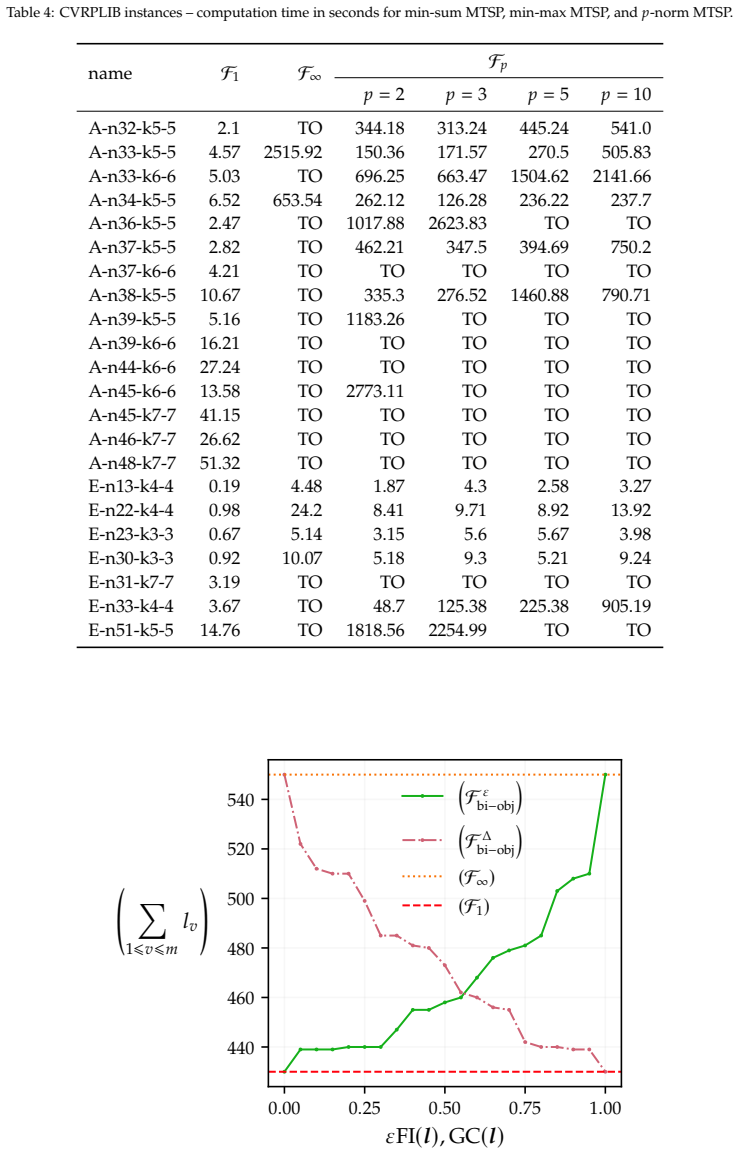
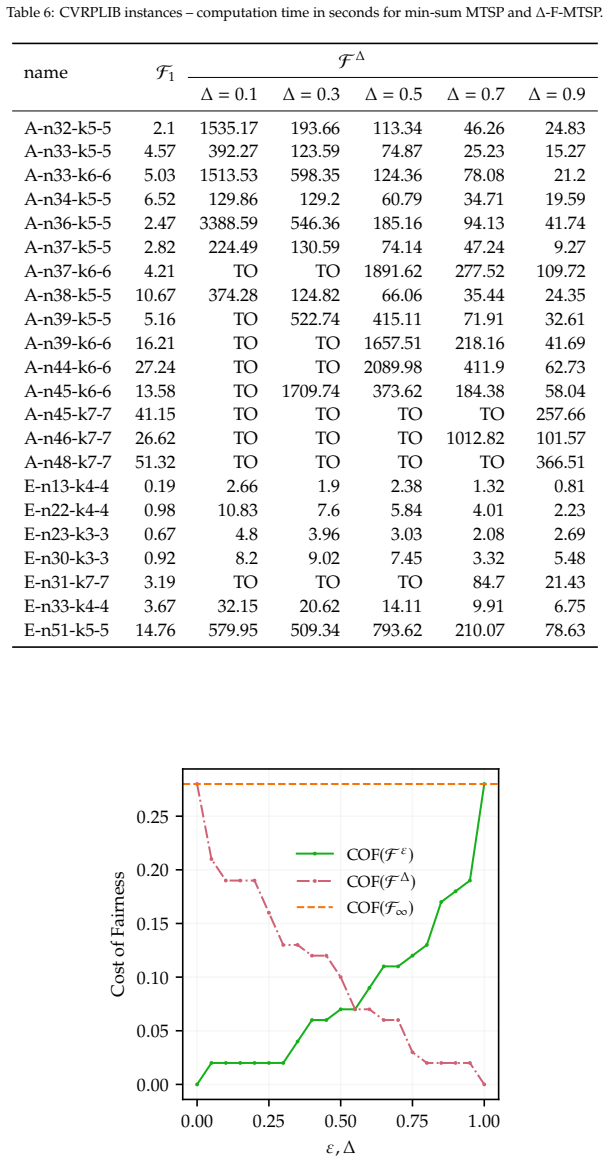
The paper establishes that the ε-Fair-MTSP and Δ-Fair-MTSP, defined through fairness parameters ε and Δ that bound differences in individual tour lengths, admit globally optimal solutions via mixed-integer second-order cone and linear programming formulations respectively, and that the same algorithms also recover the Pareto front of the bi-objective problem that jointly minimizes total tour length and the spread of tour lengths.
What carries the argument
The ε-Fair-MTSP and Δ-Fair-MTSP formulations that impose parametric limits on the maximum difference between any pair of salesman tour lengths.
If this is right
- The same algorithms recover the Pareto front between total tour length and tour-length balance.
- The models are effective on both standard MTSP benchmarks and real electric-vehicle routing instances.
- They remain solvable to global optimality by the developed branch-and-cut procedures.
- They supply tunable control over equity that is absent from the strict min-max formulation.
Where Pith is reading between the lines
- The parametric structure could be reused to enforce fairness in other vehicle-routing variants such as capacitated or time-window problems.
- Operators could learn preferred ε or Δ values from historical route-acceptance data.
- Embedding the models inside a rolling-horizon planner might keep daily workloads balanced under demand changes.
Load-bearing premise
The chosen values of the fairness parameters ε and Δ will produce routes that operators in practice regard as equitable.
What would settle it
Solve the models on the same benchmark instances used in the paper and check whether, for the reported ε and Δ values, the obtained solutions exhibit the claimed fairness bounds and remain solvable to proven optimality within the same time limits.
Figures


read the original abstract
The Multiple Traveling Salesman Problem (MTSP) extends the traveling salesman problem by assigning multiple salesmen to visit a set of targets from a common depot, with each target visited exactly once while minimizing total tour length. A common variant, the min-max MTSP, focuses on workload balance by minimizing the longest tour, but it is difficult to solve optimally due to weak linear relaxation bounds. This paper introduces two new parametric fairness-driven variants of the MTSP: the $\varepsilon$-Fair-MTSP and the $\Delta$-Fair-MTSP, which promote equitable distribution of tour lengths while controlling overall cost. The $\varepsilon$-Fair-MTSP is formulated as a mixed-integer second-order cone program, while the $\Delta$-Fair-MTSP is modeled as a mixed-integer linear program. We develop algorithms that guarantee global optimality for both formulations. Computational experiments on benchmark instances and real-world applications, including electric vehicle fleet routing, demonstrate their effectiveness. Furthermore, we show that the algorithms presented for the fairness-constrained MTSP variants can be used to obtain the Pareto front of a bi-objective optimization problem in which one objective minimizes the total tour length and the other balances the lengths of the individual tours. Overall, these fairness-constrained MTSP variants provide a practical and flexible alternative to the min-max MTSP.
Editorial analysis
A structured set of objections, weighed in public.
Referee Report
Summary. The paper introduces two parametric fairness-constrained variants of the Multiple Traveling Salesman Problem (MTSP): the ε-Fair-MTSP formulated as a mixed-integer second-order cone program (MISOCP) and the Δ-Fair-MTSP as a mixed-integer linear program (MILP). It develops algorithms that guarantee global optimality for both, reports computational experiments on benchmark instances and electric vehicle fleet routing, and shows that the models can be used to trace the Pareto front of the bi-objective problem that trades off total tour length against tour-length balance. The central claim is that these variants constitute a practical and flexible alternative to the standard min-max MTSP.
Significance. If the formulations are correct and the reported global-optimality algorithms scale as claimed, the work supplies a tunable family of equity-aware MTSP models that avoid the notoriously weak LP relaxations of the min-max formulation while still controlling total cost. The explicit construction of Pareto fronts and the EV-routing case study are concrete strengths that could be useful in sustainable logistics applications.
major comments (2)
- [Computational Experiments] Computational Experiments section: the reported solve times, optimality gaps, and achieved total costs for the ε-Fair-MTSP and Δ-Fair-MTSP instances are not accompanied by side-by-side results for the standard min-max MTSP on the identical benchmark sets. Without this direct comparison, the claim that the new models are a “practical and flexible alternative” cannot be evaluated, because the added fairness constraints could increase rather than decrease runtimes or gaps relative to the already weak min-max relaxation.
- [Formulation sections] Formulation of ε-Fair-MTSP (MISOCP) and Δ-Fair-MTSP (MILP): the parameters ε and Δ are introduced as free fairness tolerances, yet no sensitivity analysis or operational calibration is provided showing that the resulting route sets are perceived as equitable by dispatchers or drivers. This choice directly affects both tractability and the practical utility asserted in the abstract.
minor comments (2)
- [Formulation] Notation for the second-order cone constraint in the ε-Fair-MTSP formulation is introduced without an explicit reference to the standard SOCP form used by the solver; adding the precise cone definition would improve reproducibility.
- [Computational Experiments] Table captions in the computational results do not state the time limit or MIP gap tolerance used for the reported runs; this information is needed to interpret the “global optimality” claims.
Simulated Author's Rebuttal
We thank the referee for the detailed and constructive report. We address each major comment below and indicate the revisions that will be incorporated.
read point-by-point responses
-
Referee: Computational Experiments section: the reported solve times, optimality gaps, and achieved total costs for the ε-Fair-MTSP and Δ-Fair-MTSP instances are not accompanied by side-by-side results for the standard min-max MTSP on the identical benchmark sets. Without this direct comparison, the claim that the new models are a “practical and flexible alternative” cannot be evaluated, because the added fairness constraints could increase rather than decrease runtimes or gaps relative to the already weak min-max relaxation.
Authors: We agree that a direct, side-by-side comparison on identical instances is necessary to substantiate the claim of practicality. In the revised manuscript we will add tables (and corresponding discussion) that report solve times, optimality gaps, and total costs for the standard min-max MTSP formulation alongside the ε-Fair-MTSP and Δ-Fair-MTSP results on the same benchmark sets. This will allow an objective assessment of whether the fairness constraints improve or degrade computational performance relative to the min-max baseline. revision: yes
-
Referee: Formulation of ε-Fair-MTSP (MISOCP) and Δ-Fair-MTSP (MILP): the parameters ε and Δ are introduced as free fairness tolerances, yet no sensitivity analysis or operational calibration is provided showing that the resulting route sets are perceived as equitable by dispatchers or drivers. This choice directly affects both tractability and the practical utility asserted in the abstract.
Authors: The parameters ε and Δ are intentionally tunable; the bi-objective Pareto-front extraction procedure we present is precisely intended to let users explore the cost–fairness trade-off. We acknowledge, however, that the original submission did not contain a systematic sensitivity study on how solution quality and runtimes vary with ε and Δ. In revision we will add such an analysis on the benchmark instances. A full operational calibration that measures perceived equity by dispatchers or drivers would require a separate human-factors study; this lies outside the algorithmic scope of the paper, but the Pareto fronts we generate can serve as input for such future calibration. revision: partial
- Empirical validation that route sets produced for specific ε/Δ values are perceived as equitable by human dispatchers or drivers would require a dedicated user study that is beyond the algorithmic focus of the current work.
Circularity Check
No significant circularity; new formulations are independent of inputs
full rationale
The paper introduces two new parametric fairness-constrained MTSP formulations (ε-Fair-MTSP as MISOCP and Δ-Fair-MTSP as MILP) along with optimality-guaranteeing algorithms and a Pareto-front extraction method. These are presented as modeling choices and algorithmic extensions rather than derived predictions or results obtained by fitting to data. No self-definitional loops, fitted inputs renamed as predictions, or load-bearing self-citations appear in the abstract or described contributions; the central modeling steps are explicit constructions that do not reduce to prior outputs by definition. The practicality claim rests on computational experiments, which are external to any derivation chain and therefore outside the circularity criteria.
Axiom & Free-Parameter Ledger
free parameters (2)
- ε
- Δ
Forward citations
Cited by 1 Pith paper
-
A Family of Convex Models to Achieve Fairness through Dispersion Control
Develops a parameterized family of convex models that bound the coefficient of variation of decision variables to enforce tunable fairness in optimization problems.
Reference graph
Works this paper leans on
-
[1]
Solution of a min-max vehicle routing problem
David Applegate et al. “Solution of a min-max vehicle routing problem”. In:INFORMS Journal on computing14.2 (2002), pp. 132–143. 24
work page 2002
-
[2]
Balancing tour durations in routing a vehicle fleet
Tolga Bektaş. “Balancing tour durations in routing a vehicle fleet”. In:2013 IEEE Symposium on Computational Intelligence in Production and Logistics Systems (CIPLS). IEEE. 2013, pp. 9–16
work page 2013
-
[3]
The multiple traveling salesman problem: an overview of formulations and solution procedures
Tolga Bektaş. “The multiple traveling salesman problem: an overview of formulations and solution procedures”. In:Omega34.3 (2006), pp. 209–219
work page 2006
-
[4]
Usingℓp-norms for fairness in combinatorial optimisation
Tolga Bektaş and Adam N Letchford. “Usingℓp-norms for fairness in combinatorial optimisation”. In:Computers & Operations Research120 (2020), p. 104975
work page 2020
-
[5]
Dimitris Bertsimas, Vivek F Farias, and Nikolaos Trichakis. “The price of fairness”. In:Operations Research59.1 (2011), pp. 17–31
work page 2011
-
[6]
Cambridge university press, 2004
Stephen P Boyd and Lieven Vandenberghe.Convex optimization. Cambridge university press, 2004
work page 2004
-
[7]
FernandoGDeMaio.“Incomeinequalitymeasures”.In:JournalofEpidemiology&CommunityHealth61.10(2007), pp. 849–852
work page 2007
-
[8]
Vehicle routing problems for drone delivery
Kevin Dorling et al. “Vehicle routing problems for drone delivery”. In:IEEE Transactions on Systems, Man, and Cybernetics: Systems47.1 (2016), pp. 70–85
work page 2016
-
[9]
The m-traveling salesman problem with minmax objective
Paulo M França et al. “The m-traveling salesman problem with minmax objective”. In:Transportation Science29.3 (1995), pp. 267–275
work page 1995
-
[10]
On the measure of concentration with special reference to income and statistics
Corrado Gini. “On the measure of concentration with special reference to income and statistics”. In:Colorado College Publication, General Series208.1 (1936), pp. 73–79
work page 1936
-
[11]
Ralph E Gomory and Tien Chung Hu. “Multi-terminal network flows”. In:Journal of the Society for Industrial and Applied Mathematics9.4 (1961), pp. 551–570
work page 1961
-
[12]
Thebi-objectivemixedcapacitatedgeneralroutingproblem with different route balance criteria
ElinEHalvorsen-WeareandMartinWPSavelsbergh.“Thebi-objectivemixedcapacitatedgeneralroutingproblem with different route balance criteria”. In:European Journal of Operational Research251.2 (2016), pp. 451–465
work page 2016
-
[13]
Optimal UAV route planning for persistent monitoring missions
Sai Krishna Kanth Hari et al. “Optimal UAV route planning for persistent monitoring missions”. In:IEEE Trans- actions on Robotics37.2 (2020), pp. 550–566
work page 2020
-
[14]
Cambridge university press, 2012
Roger A Horn and Charles R Johnson.Matrix analysis. Cambridge university press, 2012
work page 2012
-
[15]
C-LHwangandAbuSyedMdMasud.Multipleobjectivedecisionmaking—methodsandapplications:astate-of-the-art survey. Vol. 164. Springer Science & Business Media, 2012
work page 2012
-
[16]
A quantitative measure of fairness and discrimina- tion
Rajendra K Jain, Dah-Ming W Chiu, William R Hawe, et al. “A quantitative measure of fairness and discrimina- tion”. In:Eastern Research Laboratory, Digital Equipment Corporation, Hudson, MA21 (1984)
work page 1984
-
[17]
Exact algorithms for the equitable traveling salesman problem
Joris Kinable et al. “Exact algorithms for the equitable traveling salesman problem”. In:European Journal of Operational Research261.2 (2017), pp. 475–485
work page 2017
-
[18]
Polyhedralapproximationinmixed-integerconvexoptimization
MilesLubinetal.“Polyhedralapproximationinmixed-integerconvexoptimization”.In:MathematicalProgramming 172 (2018), pp. 139–168
work page 2018
-
[19]
Workload equity in vehicle routing problems: A survey and analysis
Piotr Matl, Richard F Hartl, and Thibaut Vidal. “Workload equity in vehicle routing problems: A survey and analysis”. In:Transportation Science52.2 (2018), pp. 239–260
work page 2018
-
[20]
Kaisa Miettinen.Nonlinear multiobjective optimization. Vol. 12. Springer Science & Business Media, 1999
work page 1999
-
[21]
Themultipleflyingsidekickstravelingsalesmanproblem:Parceldeliverywith multiple drones
ChaseCMurrayandRitwikRaj.“Themultipleflyingsidekickstravelingsalesmanproblem:Parceldeliverywith multiple drones”. In:Transportation Research Part C: Emerging Technologies110 (2020), pp. 368–398
work page 2020
-
[22]
OpenStreetMap contributors.Planet dump retrieved from https://planet.osm.org.https://www.openstreetmap. org. 2017. 25
work page 2017
-
[23]
Alena Otto et al. “Optimization approaches for civil applications of unmanned aerial vehicles (UAVs) or aerial drones: A survey”. In:Networks72.4 (2018), pp. 411–458
work page 2018
-
[24]
A resource allocation algorithm for multivehicle systems with nonholonomic constraints
Sivakumar Rathinam, Raja Sengupta, and Swaroop Darbha. “A resource allocation algorithm for multivehicle systems with nonholonomic constraints”. In:IEEE Transactions on Automation Science and Engineering4.1 (2007), pp. 98–104
work page 2007
-
[25]
TSPLIB—A traveling salesman problem library
Gerhard Reinelt. “TSPLIB—A traveling salesman problem library”. In:ORSA journal on computing3.4 (1991), pp. 376–384
work page 1991
-
[26]
Columngenerationforbi-objectivevehicle routingproblemswithamin-maxobjective
BoaduMensahSarpong,ChristianArtigues,andNicolasJozefowiez.“Columngenerationforbi-objectivevehicle routingproblemswithamin-maxobjective”.In:ATMOS-13thWorkshoponAlgorithmicApproachesforTransportation Modelling, Optimization, and Systems-2013. Vol. 33. Schloss Dagstuhl—Leibniz-Zentrum fuer Informatik. 2013, pp. 137–149
work page 2013
-
[27]
Traveling salesperson problems for the Dubins vehicle
Ketan Savla, Emilio Frazzoli, and Francesco Bullo. “Traveling salesperson problems for the Dubins vehicle”. In: IEEE Transactions on Automatic Control53.6 (2008), pp. 1378–1391
work page 2008
-
[28]
Market approach to length constrained min-max multiple depot multiple traveling salesman problem
Drew Scott et al. “Market approach to length constrained min-max multiple depot multiple traveling salesman problem”. In:2020 American Control Conference (ACC). IEEE. 2020, pp. 138–143
work page 2020
-
[29]
A parametric, second-order cone representable model of fairnessfordecision-makingproblems
Kaarthik Sundar, Deepjyoti Deka, and Russell Bent. “A parametric, second-order cone representable model of fairnessfordecision-makingproblems”.In:OptimizationandEngineering(2025),pp.1–16.doi:10.1007/s11081- 024-09946-9. arXiv:2412.05143 [math.OC]
-
[30]
Fairly extreme: Minimizing outages equitably
Kaarthik Sundar, Deepjyoti Deka, and Russell Bent. “Fairly extreme: Minimizing outages equitably”. In:arXiv preprint arXiv:2310.01348(2023)
-
[31]
Algorithmsforheterogeneous,multipledepot,multipleunmanned vehicle path planning problems
KaarthikSundarandSivakumarRathinam.“Algorithmsforheterogeneous,multipledepot,multipleunmanned vehicle path planning problems”. In:Journal of Intelligent & Robotic Systems88 (2017), pp. 513–526
work page 2017
-
[32]
An exact algorithm for a heterogeneous, multiple depot, multiple traveling salesman problem
Kaarthik Sundar and Sivakumar Rathinam. “An exact algorithm for a heterogeneous, multiple depot, multiple traveling salesman problem”. In:2015 International Conference on Unmanned Aircraft Systems (ICUAS). IEEE. 2015, pp. 366–371
work page 2015
-
[33]
A branch-and-price algorithm for a team orien- teering problem with fixed-wing drones
Kaarthik Sundar, Sujeevraja Sanjeevi, and Christopher Montez. “A branch-and-price algorithm for a team orien- teering problem with fixed-wing drones”. In:EURO Journal on Transportation and Logistics11 (2022), p. 100070
work page 2022
- [34]
-
[35]
Saravanan Venkatachalam, Kaarthik Sundar, and Sivakumar Rathinam. “A two-stage approach for routing mul- tiple unmanned aerial vehicles with stochastic fuel consumption”. In:Sensors18.11 (2018), p. 3756
work page 2018
-
[36]
To be fair or efficient or a bit of both
Moshe Zukerman et al. “To be fair or efficient or a bit of both”. In:Computers & operations research35.12 (2008), pp. 3787–3806. 26
work page 2008
discussion (0)
Sign in with ORCID, Apple, or X to comment. Anyone can read and Pith papers without signing in.