Analysis and Simulation of a Fluid-Heat System in a Thin, Rough Layer in Contact With a Solid Bulk Domain
Pith reviewed 2026-05-24 00:20 UTC · model grok-4.3
The pith
In the limit of vanishing thickness and roughness, a nonlinear fluid-heat system in a thin rough layer reduces to an effective interface model.
A machine-rendered reading of the paper's core claim, the machinery that carries it, and where it could break.
Core claim
We derive an effective interface model in 3D (a line in 2D) for the heat and fluid interactions inside the fluid by applying two-scale convergence in thin domains to the nonlinear coupled system.
What carries the argument
Two-scale convergence in thin domains applied to the nonlinear system with temperature-dependent viscosity and convective heat transport.
If this is right
- The effective model can be used to simulate grinding processes with cooling lubricants more efficiently.
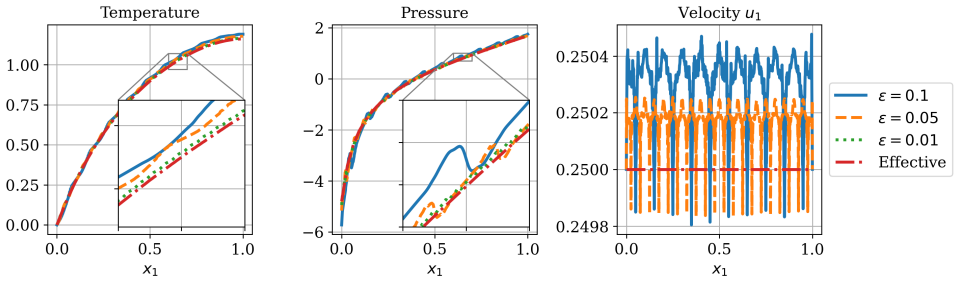
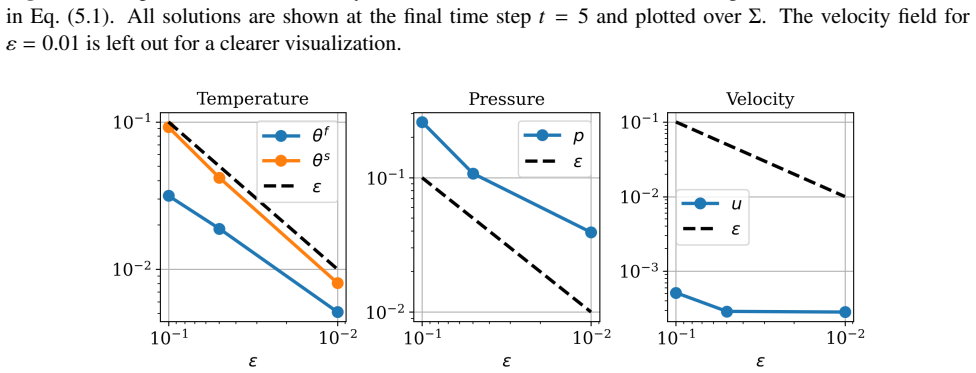
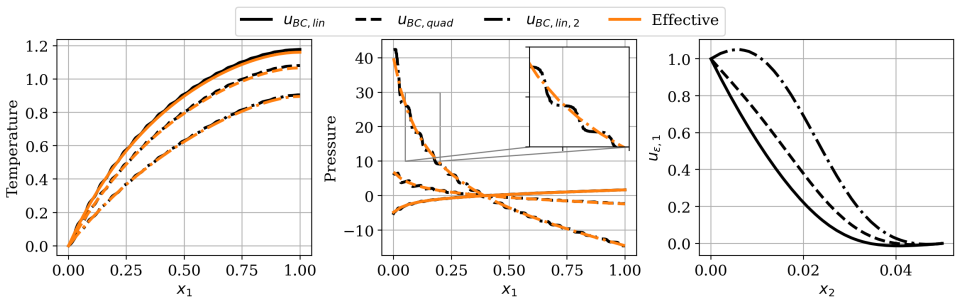
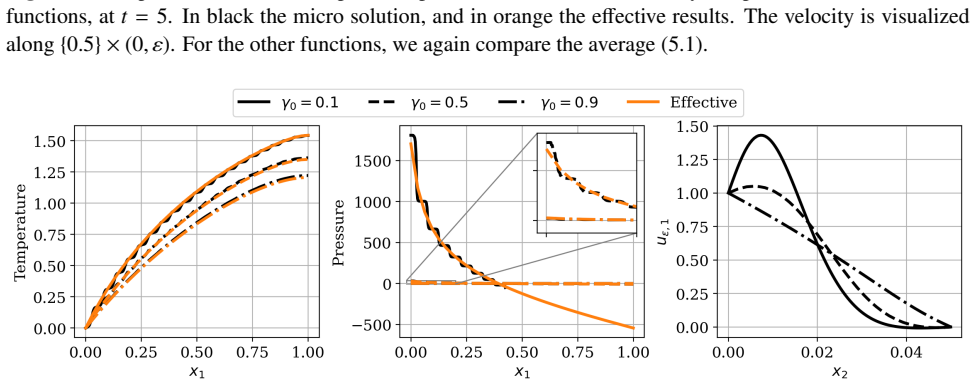
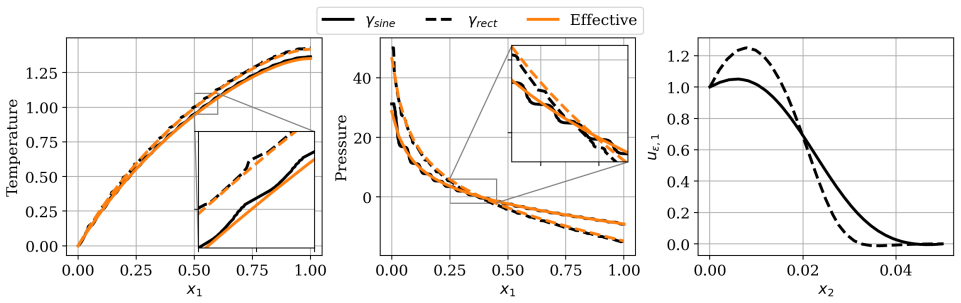
- Numerical comparisons confirm the limit problem matches the micromodel behavior.
- Temperature-dependent viscosity influences the fluid flow and heat transport in the interface model.
- Varying geometrical configurations affect the effective interactions.
Where Pith is reading between the lines
- Similar techniques might apply to other thin-layer problems in lubrication or heat transfer with periodic roughness.
- The model could be extended to include more complex solid-fluid interactions beyond the current setup.
Load-bearing premise
The thin rough layer has both height and roughness periodicity scaled by the same small parameter, allowing two-scale convergence methods to apply to the nonlinear coupled equations.
What would settle it
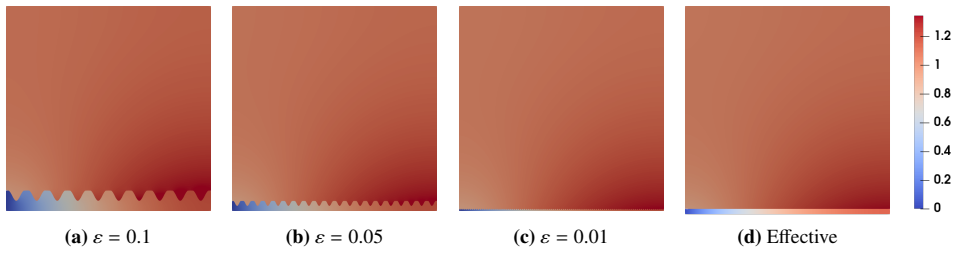
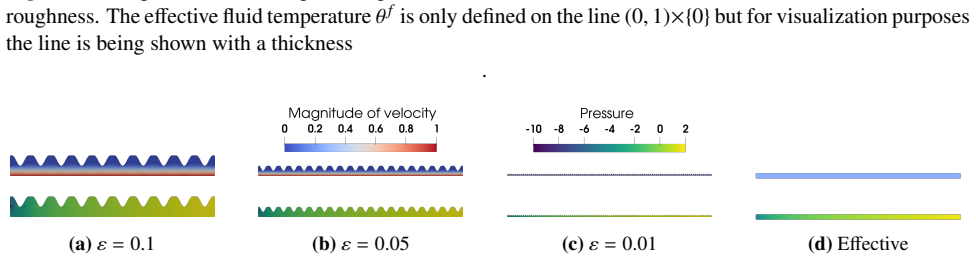
Direct numerical comparison between solutions of the full micromodel and the effective interface model for successively smaller values of the scaling parameter, checking convergence of fluid velocity and temperature fields.
Figures
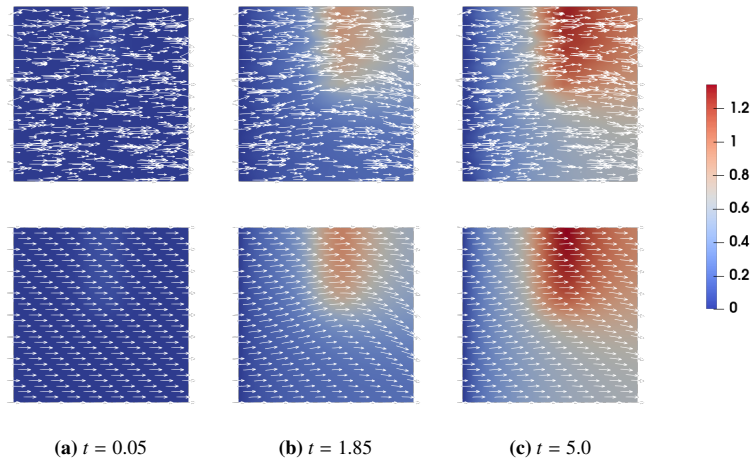
read the original abstract
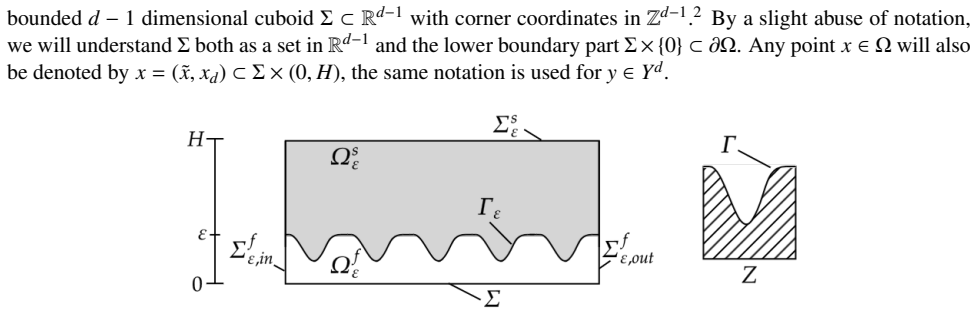
We investigate the effective coupling between heat and fluid dynamics within a thin fluid layer in contact with a solid structure via a rough surface. Moreover, the opposing vertical surfaces of the thin layer are in relative motion. This setup is particularly relevant to grinding processes, where cooling lubricants interact with the rough surface of a rotating grinding wheel. The resulting model is non-linearly coupled through(i) temperature-dependent viscosity and (ii) convective heat transport. The underlying geometry is highly heterogeneous due to the thin, rough surface characterized by a small parameter representing both the height of the layer and the periodicity of the roughness. We analyze this non-linear system for existence, uniqueness, and energy estimates and study the limit behavior within the framework of two-scale convergence in thin domains. In this limit, we derive an effective interface model in 3D (a line in 2D) for the heat and fluid interactions inside the fluid. We implement the system numerically and validate the limit problem through direct comparison with the micromodel. Additionally, we investigate the influence of the temperature-dependent viscosity and various geometrical configurations via simulation experiments. The corresponding numerical code is freely available on GitHub.
Editorial analysis
A structured set of objections, weighed in public.
Referee Report
Summary. The paper analyzes existence, uniqueness, and energy estimates for a nonlinear fluid-heat system (temperature-dependent viscosity, convective transport) in a thin rough layer with relative motion between opposing surfaces. It derives an effective interface model (3D or line in 2D) via two-scale convergence in thin domains as the roughness/height parameter tends to zero, and validates the limit numerically against the micromodel with open-source code.
Significance. If the homogenization limit is rigorously justified, the work supplies a mathematically grounded effective model for heat-fluid coupling in grinding applications, together with reproducible numerics. The combination of analysis for the nonlinear coupled system and direct micromodel validation is a positive feature.
major comments (2)
- [§4 (two-scale convergence analysis)] The central derivation applies two-scale convergence directly to the time-dependent geometry with relative motion of the rough surfaces. Standard results for thin rough domains assume a fixed periodic microstructure; without an explicit change of variables to a fixed reference frame (or equivalent justification), the passage to the limit in the convective term and the nonlinear viscosity term lacks justification. This is load-bearing for the effective interface model.
- [§3 (existence, uniqueness, energy estimates)] The energy estimates in the existence/uniqueness section track the dependence on the small parameter and the relative velocity only at a formal level; it is not shown that these estimates remain uniform enough to pass to the limit in the nonlinear terms after the change of variables (if any).
minor comments (2)
- [§2] Notation for the relative velocity and the thin-domain scaling should be introduced once and used consistently; the abstract and §2 use slightly different symbols for the same quantities.
- [§5] Figure captions for the numerical comparisons should state the precise values of ε used in the micromodel runs and the mesh resolution.
Simulated Author's Rebuttal
We thank the referee for the thorough review and valuable feedback on our analysis of the nonlinear fluid-heat system in thin rough domains with relative motion. The comments highlight important technical points regarding the justification of the two-scale convergence and the uniformity of estimates. We address each major comment below and will incorporate revisions to strengthen the presentation.
read point-by-point responses
-
Referee: [§4 (two-scale convergence analysis)] The central derivation applies two-scale convergence directly to the time-dependent geometry with relative motion of the rough surfaces. Standard results for thin rough domains assume a fixed periodic microstructure; without an explicit change of variables to a fixed reference frame (or equivalent justification), the passage to the limit in the convective term and the nonlinear viscosity term lacks justification. This is load-bearing for the effective interface model.
Authors: We agree that the relative motion introduces a time-dependent geometry, and standard two-scale convergence results for fixed microstructures require adaptation. In the manuscript, the analysis proceeds by first applying a change of variables that maps the moving rough domain to a fixed reference configuration (accounting for the relative velocity between surfaces). This transformation is used to rewrite the convective and nonlinear viscosity terms before passing to the limit. To address the concern, we will add an explicit subsection in §4 detailing the change of variables, verifying that the transformed equations preserve the necessary structure, and confirming that the two-scale convergence applies directly to the fixed-domain formulation. This will include the required a priori bounds to justify the limit passage in the nonlinear terms. revision: yes
-
Referee: [§3 (existence, uniqueness, energy estimates)] The energy estimates in the existence/uniqueness section track the dependence on the small parameter and the relative velocity only at a formal level; it is not shown that these estimates remain uniform enough to pass to the limit in the nonlinear terms after the change of variables (if any).
Authors: The energy estimates in §3 are derived via testing the weak formulation with suitable test functions (velocity and temperature), exploiting the monotonicity of the viscosity and the structure of the convective term to obtain bounds that are independent of the small parameter ε and uniform in the relative velocity (within the range considered). These uniform estimates are then used to extract weakly convergent subsequences and pass to the limit. We acknowledge that the uniformity with respect to ε and the subsequent application after the change of variables could be stated more explicitly. We will revise §3 to include a dedicated paragraph highlighting the ε-independent bounds, their dependence on the relative velocity, and how they carry over to the transformed variables to enable the nonlinear limit passage via compactness arguments. revision: yes
Circularity Check
Derivation is a standard two-scale limit passage with no reduction to inputs by construction
full rationale
The paper starts from a micromodel PDE system on a heterogeneous thin rough domain (with relative motion of surfaces) and applies two-scale convergence in thin domains to pass to the limit, obtaining an effective interface model. No parameters are fitted to data and then relabeled as predictions; no self-citations are invoked as load-bearing uniqueness theorems; the ansatz for the limit equations is not smuggled via prior work by the same authors; and the geometry transformation or convergence justification is presented as part of the analysis rather than presupposed. The numerical validation compares the micromodel directly to the derived limit model, which is an independent check rather than a tautology. This is a self-contained homogenization argument whose central claim does not collapse to its own inputs.
Axiom & Free-Parameter Ledger
Lean theorems connected to this paper
-
IndisputableMonolith/Foundation/AbsoluteFloorClosure.leanreality_from_one_distinction unclear?
unclearRelation between the paper passage and the cited Recognition theorem.
We analyze this nonlinear system for existence, uniqueness, and energy estimates and study the limit behavior ε → 0 within the framework of two-scale convergence in thin domains. In this limit, we derive an effective interface model...
-
IndisputableMonolith/Cost/FunctionalEquation.leanwashburn_uniqueness_aczel unclear?
unclearRelation between the paper passage and the cited Recognition theorem.
the temperature dependent viscosity is given by a Lipschitz continuous function µ : R → R that fulfills µ ≤ µ(x) ≤ µ
What do these tags mean?
- matches
- The paper's claim is directly supported by a theorem in the formal canon.
- supports
- The theorem supports part of the paper's argument, but the paper may add assumptions or extra steps.
- extends
- The paper goes beyond the formal theorem; the theorem is a base layer rather than the whole result.
- uses
- The paper appears to rely on the theorem as machinery.
- contradicts
- The paper's claim conflicts with a theorem or certificate in the canon.
- unclear
- Pith found a possible connection, but the passage is too broad, indirect, or ambiguous to say the theorem truly supports the claim.
Reference graph
Works this paper leans on
- [1]
-
[2]
E. Ahmed, J. Ja ffr´e, and J. E. Roberts. A reduced fracture model for two-phase flow with di fferent rock types. Mathematics and Computers in Simulation , 137:49–70, 2017. MAMERN VI-2015: 6th Inter- national Conference on Approximation Methods and Numerical Modeling in Environment and Natural Resources
work page 2017
-
[3]
G. Allaire. Homogenization of the Stokes flow in a connected porous medium. Asymptotic Analysis, 2:203–222, 1989. 3
work page 1989
-
[4]
G. Allaire. Homogenization and two scale convergence. SIAM J. Math. Anal., 23(6):1482–1518, 1992
work page 1992
-
[5]
A. Almqvist, E. Burtseva, K. Rajagopal, and P. Wall. On lower-dimensional models of thin film flow, part c: Derivation of a Reynolds type of equation for fluids with temperature and pressure dependent viscos- ity. Proceedings of the Institution of Mechanical Engineers, Part J: Journal of Engineering Tribology , 237:135065012211352, 12 2022
work page 2022
-
[6]
A. Almqvist, E. Essel, L.-E. Persson, and P. Wall. Homogenization of the unstationary incompressible reynolds equation. Tribology International, 40(9):1344–1350, 2007
work page 2007
-
[7]
M. S. Alnaes, J. Blechta, J. Hake, A. Johansson, B. Kehlet, A. Logg, C. Richardson, J. Ring, M. E. Rognes, and G. N. Wells. The FEniCS project version 1.5. Arch. Num. Soft., 3, 2015
work page 2015
-
[8]
F. Alouges. Introduction to periodic homogenization. Interdisciplinary Information Sciences, 22:147– 186, 12 2016
work page 2016
-
[9]
S. Bair, J. Jarzynski, and W. O. Winer. The temperature, pressure and time dependence of lubricant viscosity. Tribology International, 34(7):461–468, 2001
work page 2001
-
[10]
A. Basson and D. G ´erard-Varet. Wall laws for fluid flows at a boundary with random roughness.Commu- nications on Pure and Applied Mathematics, 61(7):941–987, 2008
work page 2008
-
[11]
G. Bayada and M. Chambat. The transition between the Stokes equations and the Reynolds equation: A mathematical proof. Applied Mathematics and Optimization, 14(1):73–93, Apr 1986
work page 1986
-
[12]
G. Bayada and M. Chambat. Homogenization of the Stokes system in a thin film flow with rapidly varying thickness. RAIRO. Mod´ elisation Math´ ematique et Analyse Num´ erique, 23, 01 1989
work page 1989
-
[13]
N. Benhaboucha, M. Chambat, and I. Ciuperca. Asymptotic behaviour of pressure and stresses in a thin film flow with a rough boundary. Quarterly of Applied Mathematics, 63(2):369–400, 2005. 36
work page 2005
-
[14]
A. Bhattacharya, M. Gahn, and M. Neuss-Radu. E ffective transmission conditions for reaction–diffusion processes in domains separated by thin channels. Applicable Analysis, 101(6):1896–1910, 2022
work page 1910
-
[15]
A. N. Brooks and T. J. Hughes. Streamline upwind/petrov-galerkin formulations for convection dominated flows with particular emphasis on the incompressible Navier-Stokes equations. Computer Methods in Applied Mechanics and Engineering, 32(1):199–259, 1982
work page 1982
-
[16]
G. A. Chechkin, A. Friedman, and A. L. Piatnitski. The boundary-value problem in domains with very rapidly oscillating boundary. Journal of Mathematical Analysis and Applications, 231(1):213–234, 1999
work page 1999
-
[17]
L. Chupin and S. Martin. Rigorous derivation of the thin film approximation with roughness-induced correctors. SIAM Journal on Mathematical Analysis, 44(4):3041–3070, 2012
work page 2012
-
[18]
R. L. de Paiva, R. de Souza Ruzzi, and R. B. da Silva. An approach to reduce thermal damages on grinding of bearing steel by controlling cutting fluid temperature. Metals, 11(10), 2021
work page 2021
- [19]
-
[20]
M. Eden and T. Freudenberg. E ffective heat transfer between a porous medium and a fluid layer: Homog- enization and simulation. Multiscale Modeling & Simulation, 22(2):752–783, 2024
work page 2024
-
[21]
B. Espenhahn, L. Schumski, D. Meyer, D. St ¨obener, and A. Fischer. Optical measurement approach to analyse the tool-workpiece interacting flow of grinding processes. Flow Measurement and Instrumenta- tion, 93:102407, 2023
work page 2023
-
[22]
J. Fabricius and M. Gahn. Homogenization and dimension reduction of the Stokes problem with Navier- slip condition in thin perforated layers. Multiscale Modeling & Simulation, 21(4):1502–1533, 2023
work page 2023
-
[23]
J. Fabricius, A. Tsandzana, F. Perez-Rafols, and P. Wall. A Comparison of the Roughness Regimes in Hydrodynamic Lubrication. Journal of Tribology, 139(5):051702, 05 2017
work page 2017
-
[24]
Analysis and Simulation of a Coupled Fluid-Heat System in a Thin, Rough Layer
T. Freudenberg. Github repository for “Analysis and Simulation of a Coupled Fluid-Heat System in a Thin, Rough Layer”. https://github.com/TomF98/ Homogenization-thin-layer-with-temperature-dependent-viscosity . July 9, 2024
work page 2024
-
[25]
T. Freudenberg and M. Eden. Homogenization and simulation of heat transfer through a thin grain layer. Networks and Heterogeneous Media, 19(2):569–596, 2024
work page 2024
-
[26]
M. Gahn, W. J ¨ager, and M. Neuss-Radu. Derivation of stokes-plate-equations modeling fluid flow inter- action with thin porous elastic layers. Applicable Analysis, 101(12):4319–4348, 2022
work page 2022
-
[27]
M. Gahn and M. Neuss-Radu. E ffective interface laws for fluid flow and solute transport through thin reactive porous layers, 2024
work page 2024
- [28]
-
[29]
M. Gahn, M. Neuss-Radu, and P. Knabner. Derivation of e ffective transmission conditions for domains separated by a membrane for different scaling of membrane diffusivity. Discrete and Continuous Dynam- ical Systems - Series S, 10:773–797, 04 2017
work page 2017
-
[30]
L. S. Garca-Coln, del Castillo LF, and P. Goldstein. Theoretical basis for the V ogel-Fulcher-Tammann equation. Phys. Rev. B Condens. Matter, 40(10):7040–7044, Oct. 1989
work page 1989
-
[31]
C. Geuzaine and J.-F. Remacle. Gmsh: A 3-d finite element mesh generator with built-in pre- and post- processing facilities. Int. J. Numer. Methods. Eng., 79:1309 – 1331, 09 2009
work page 2009
-
[32]
V . Girault and P.-A. Raviart.Finite element approximation of the Navier-Stokes equations. Springer, 1981
work page 1981
-
[33]
R. Gu, M. Shillor, G. Barber, and T. Jen. Thermal analysis of the grinding process. Mathematical and Computer Modelling, 39(9):991–1003, 2004
work page 2004
-
[34]
V . Gviniashvili, J. Webster, and B. Rowe. Fluid flow and pressure in the grinding wheel-workpiece interface. Journal of Manufacturing Science and Engineering, 127(1):198–205, Feb. 2005
work page 2005
-
[35]
W. Habchi, P. Vergne, S. Bair, O. Andersson, D. Eyheramendy, and G. Morales-Espejel. Influence of pressure and temperature dependence of thermal properties of a lubricant on the behaviour of circular tehd contacts. Tribology International, 43(10):1842–1850, 2010. 36th Leeds–Lyon Symposium Special Issue: Multi-facets of Tribology
work page 2010
-
[36]
C. Heinzel, B. Kirsch, D. Meyer, and J. Webster. Interactions of grinding tool and supplied fluid. CIRP Annals, 69(2):624–645, 2020
work page 2020
-
[37]
W. J ¨ager and A. Mikeli´c. On the effective equations of a viscous incompressible fluid flow through a filter of finite thickness. Communications on Pure and Applied Mathematics, 51(9-10):1073–1121, 1998
work page 1998
-
[38]
F. Klocke and A. Kuchle. Manufacturing Processes 2: Grinding, Honing, Lapping . RWTHedition. Springer Berlin Heidelberg, 2009
work page 2009
-
[39]
M. Krzaczek and J. Tejchman. Hydraulic fracturing process in rocks – small-scale simulations with a novel fully coupled dem/cfd-based thermo-hydro-mechanical approach. Engineering Fracture Mechanics, 289:109424, 2023
work page 2023
- [40]
-
[41]
O. Lady ˇzenskaja, V . Solonniov, and N. Ural’ceva. Linear and quasilinear equations of parabolic type (translated from the russian by S. Smith). American Mathematical Society, 1988
work page 1988
-
[42]
D. Lukkassen, A. Meidell, and P. Wall. Analysis of the effects of rough surfaces in compressible thin film flow by homogenization. International Journal of Engineering Science, 49(5):369–377, 2011
work page 2011
-
[43]
S. Marusic and E. Marusic-Paloka. Two-scale convergence for thin domains and its applications to some lower-dimensional models in fluid mechanics. Asymptotic Analysis, 23:23–57, 05 2000
work page 2000
- [44]
-
[45]
Y . Min, M. Kong, C. Li, Y .-Z. Long, Y . B. Zhang, S. Sharma, R. Li, T. Gao, M. Liu, X. Cui, X. Wang, X. Ma, and Y . Yang. Temperature field model in surface grinding: A comparative assessment. Interna- tional Journal of Extreme Manufacturing, 5, 09 2023
work page 2023
-
[46]
M. Neuss-Radu and W. J ¨ager. E ffective transmission conditions for reaction-di ffusion processes in do- mains separated by an interface. SIAM Journal on Mathematical Analysis, 39(3):687–720, 2007
work page 2007
-
[47]
J. Nevard and J. B. Keller. Homogenization of rough boundaries and interfaces. SIAM Journal on Applied Mathematics, 57(6):1660–1686, 1997
work page 1997
- [48]
-
[49]
I. Pop, J. Bogers, and K. Kumar. Analysis and upscaling of a reactive transport model in fractured porous media with nonlinear transmission condition. Vietnam Journal of Mathematics, 45, 04 2016
work page 2016
-
[50]
C. P ´erez, J.-M. Thomas, S. Blancher, and R. Cre ff. The steady Navier–Stokes /energy system with temperature-dependent viscosity—part 1: Analysis of the continuous problem. International Journal for Numerical Methods in Fluids, 56:63 – 89, 01 2008
work page 2008
- [51]
- [52]
-
[53]
P. Thunich, O. Sch ¨omig, Y . Tong, R. Arafat, C. Herrmann, and M. M¨uller. On the validity of the reynolds equation for the simulation of wet grinding processes. PAMM, 23(3):e202300109, 2023
work page 2023
-
[54]
H. T ¨onshoff, J. Peters, I. Inasaki, and T. Paul. Modelling and simulation of grinding processes. CIRP Annals, 41(2):677–688, 1992
work page 1992
-
[55]
A. Vesali and T. Tawakoli. Study on hydrodynamic pressure in grinding contact zone considering grinding parameters and grinding wheel specifications. Procedia CIRP, 14:13–18, 2014. 6th CIRP International Conference on High Performance Cutting, HPC2014
work page 2014
-
[56]
P. Wiederkehr, A. Grimmert, I. Heining, T. Siebrecht, and F. W ¨oste. Potentials of grinding process sim- ulations for the analysis of individual grain engagement and complete grinding processes. Frontiers in Manufacturing Technology, 2, 2023
work page 2023
-
[57]
F. Wiesener, B. Bergmann, M. Wichmann, M. Eden, T. Freudenberg, and A. Schmidt. Modeling of heat transfer in tool grinding for multiscale simulations. Procedia CIRP, 117:269–274, 2023
work page 2023
- [58]
discussion (0)
Sign in with ORCID, Apple, or X to comment. Anyone can read and Pith papers without signing in.