Modified scattering for the three dimensional Maxwell-Dirac system
Pith reviewed 2026-05-24 00:16 UTC · model grok-4.3
The pith
The massive Maxwell-Dirac system in three dimensions has global solutions exhibiting modified scattering when started from small smooth decaying data.
A machine-rendered reading of the paper's core claim, the machinery that carries it, and where it could break.
Core claim
For initial data that are small in a high-regularity weighted Sobolev norm, the massive Maxwell-Dirac system in the Lorenz gauge possesses global solutions whose behavior inside the light cone is captured by a modified scattering profile obtained through wave-packet testing.
What carries the argument
Wave-packet testing method applied directly to the Dirac equations, combined with the Lorenz gauge to close the estimates for the coupled system.
If this is right
- Solutions exist for all time once the initial data satisfy the smallness condition.
- The electromagnetic and Dirac fields admit explicit asymptotic expansions inside the light cone.
- The proof structure avoids an additional smallness penalty that often appears in similar systems.
- The same testing method yields control on the difference between the nonlinear solution and its linear counterpart at late times.
Where Pith is reading between the lines
- The direct Dirac-level approach may extend to other massive Dirac couplings where the wave-Klein-Gordon analogy is less immediate.
- Modified scattering of this type could serve as a benchmark for numerical schemes that evolve the system to large times.
- Relaxing the smallness assumption would require new ideas for handling possible resonances or slower decay.
Load-bearing premise
The initial data must be small enough in a high-regularity weighted Sobolev norm so that the wave-packet testing closes without extra loss of smallness.
What would settle it
An explicit small initial datum whose solution either ceases to exist globally or whose profile inside the light cone deviates from the predicted modified scattering asymptotics.
Figures
read the original abstract
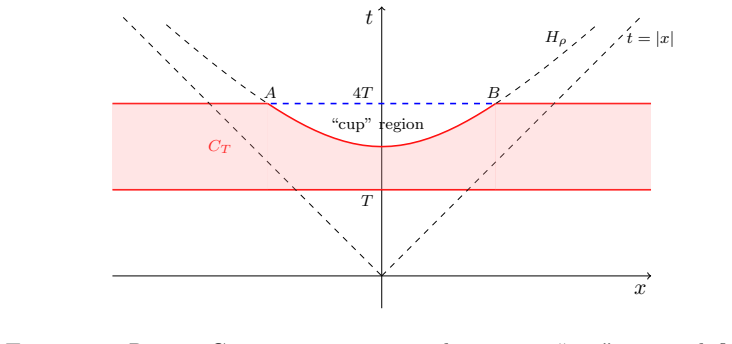
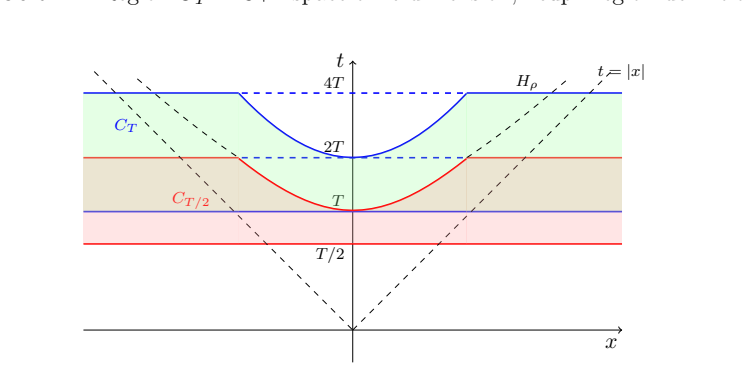
In this work we prove global well-posedness for the massive Maxwell-Dirac system in the Lorenz gauge in $\mathbb{R}^{1+3}$, for small, sufficiently smooth and decaying initial data, as well as modified scattering for the solutions. Heuristically we exploit the close connection between the massive Maxwell-Dirac and the wave-Klein-Gordon equations, while developing a novel approach which applies directly at the level of the Dirac equations. The modified scattering result follows from a precise description of the asymptotic behavior of the solutions inside the light cone, which we derive via the method of testing with wave packets of Ifrim-Tataru.
Editorial analysis
A structured set of objections, weighed in public.
Referee Report
Summary. The manuscript proves global well-posedness for the massive Maxwell-Dirac system in the Lorenz gauge on R^{1+3} for small, sufficiently smooth and decaying initial data, together with modified scattering. The argument proceeds by a direct analysis of the Dirac equations (exploiting their heuristic link to wave-Klein-Gordon systems) and obtains the modified scattering statement from a precise description of the solution asymptotics inside the light cone via the Ifrim-Tataru wave-packet testing method.
Significance. If the estimates close, the result would supply a new direct route to long-time behavior for a physically relevant coupled hyperbolic system, avoiding reduction to a wave-Klein-Gordon formulation. The application of wave-packet testing to obtain modified scattering inside the light cone is a technical strength that could be reusable for other Dirac-type systems.
major comments (1)
- The abstract asserts that the Lorenz gauge is preserved and that the wave-packet testing applies without additional smallness loss, but no explicit verification of gauge preservation or of the precise function-space norms appears in the provided text; this step is load-bearing for the global well-posedness claim.
Simulated Author's Rebuttal
We thank the referee for their careful reading of the manuscript and for highlighting the need for explicit verification of gauge preservation and the function-space norms used in the wave-packet testing argument. We address the comment below and will revise the manuscript to improve clarity on these points.
read point-by-point responses
-
Referee: [—] The abstract asserts that the Lorenz gauge is preserved and that the wave-packet testing applies without additional smallness loss, but no explicit verification of gauge preservation or of the precise function-space norms appears in the provided text; this step is load-bearing for the global well-posedness claim.
Authors: We agree that an explicit verification of Lorenz gauge preservation should appear in the text for self-containedness, even though it follows from the compatibility of the initial constraint with the evolution (the divergence of the current vanishes by the Dirac equation, preserving the Lorenz condition). We will add a dedicated remark or short subsection after the statement of the main theorem that recalls the constraint and verifies preservation along the flow. Regarding wave-packet testing, the norms are precisely those of the Ifrim-Tataru framework (with the same smallness threshold as the data), and no extra loss occurs; we will insert a clarifying sentence in the section introducing the testing method. These additions will be made in the revised version. revision: yes
Circularity Check
Minor self-citation to wave-packet method; derivation remains independent
full rationale
The paper establishes global well-posedness and modified scattering for the massive Maxwell-Dirac system via a direct analytic argument on the Dirac equations combined with the Ifrim-Tataru wave-packet testing method. The sole self-citation is to the cited testing procedure (one co-author overlap), but this is not load-bearing: the central claims are proved against external Sobolev and weighted norms without any reduction of a 'prediction' to a fitted input, self-definition, or ansatz smuggled via citation. No equation or theorem in the derivation chain collapses to its own inputs by construction, and the argument is self-contained against standard PDE benchmarks.
Axiom & Free-Parameter Ledger
axioms (1)
- standard math Standard Sobolev embedding and Strichartz estimates for the wave and Dirac operators hold in 3D
Lean theorems connected to this paper
-
IndisputableMonolith/Foundation/AlexanderDuality.leanalexander_duality_circle_linking unclear?
unclearRelation between the paper passage and the cited Recognition theorem.
We prove global well-posedness for the massive Maxwell-Dirac system in the Lorenz gauge in R^{1+3} ... modified scattering ... via the method of testing with wave packets of Ifrim-Tataru.
-
IndisputableMonolith/Foundation/RealityFromDistinction.leanreality_from_one_distinction unclear?
unclearRelation between the paper passage and the cited Recognition theorem.
The space-time coordinates are denoted by x^α with α=0,3 ... Minkowski metric diag(−1,1,1,1)
What do these tags mean?
- matches
- The paper's claim is directly supported by a theorem in the formal canon.
- supports
- The theorem supports part of the paper's argument, but the paper may add assumptions or extra steps.
- extends
- The paper goes beyond the formal theorem; the theorem is a base layer rather than the whole result.
- uses
- The paper appears to rely on the theorem as machinery.
- contradicts
- The paper's claim conflicts with a theorem or certificate in the canon.
- unclear
- Pith found a possible connection, but the passage is too broad, indirect, or ambiguous to say the theorem truly supports the claim.
Forward citations
Cited by 1 Pith paper
-
A non-linear damping structure and global stability of wave-Klein-Gordon coupled system in $\mathbb{R}^{3+1}$
Establishes global existence for wave-Klein-Gordon systems with nonlinear damping induced by coefficient constraints, proved via bootstrap argument with hyperboloidal foliation and vector field methods.
Reference graph
Works this paper leans on
-
[1]
R. A. Adams and J. J. F. Fournier. Sobolev spaces, volume 140 of Pure Appl. Math., Academic Press . New York, NY: Academic Press, 2nd ed. edition, 2003
work page 2003
-
[2]
P. Bechouche, N. J. Mauser, and S. Selberg. On the asymptotic analysis of the Dirac-Maxwell system in the nonrelativistic limit. J. Hyperbolic Differ. Equ. , 2(1):129–182, 2005
work page 2005
-
[3]
I. Bejenaru and S. Herr. The cubic Dirac equation: small initial data in H 1(R3). Comm. Math. Phys. , 335(1):43–82, 2015
work page 2015
-
[4]
I. Bejenaru and S. Herr. The cubic Dirac equation: small initial data in H 1 2 (R2). Comm. Math. Phys. , 343(2):515–562, 2016
work page 2016
-
[5]
I. Bejenaru and S. Herr. On global well-posedness and scattering for the massive Dirac-Klein-Gordon system. J. Eur. Math. Soc. (JEMS) , 19(8):2445–2467, 2017
work page 2017
-
[6]
N. Bournaveas. Local existence for the Maxwell-Dirac equations in three space dimensions. Comm. Partial Differential Equations , 21(5-6):693–720, 1996
work page 1996
-
[7]
N. Bournaveas and T. Candy. Global well-posedness for the massless cubic Dirac equation. Int. Math. Res. Not. IMRN , (22):6735–6828, 2016
work page 2016
- [8]
-
[9]
C. C. Cloos. On the long-time behavior of the three-dimensional Dirac-Maxwell equation with zero mag- netic field. PhD thesis, Universit¨ at Bielefeld, 2020. URL: http://nbn-resolving.de/urn:nbn:de:0070-pub- 29493984
work page 2020
-
[10]
P. D Ancona, D. Foschi, and S. Selberg. Null structure and almost optimal local well-posedness of the Maxwell-Dirac system. Amer. J. Math. , 132(3):771–839, 2010
work page 2010
-
[11]
P. D’Ancona, D. Foschi, and S. Selberg. Null structure and almost optimal local regularity for the Dirac-Klein-Gordon system. J. Eur. Math. Soc. (JEMS) , 009(4):877–899, 2007
work page 2007
-
[12]
P. D’Ancona and S. Selberg. Global well-posedness of the Maxwell-Dirac system in two space dimensions. J. Funct. Anal., 260(8):2300–2365, 2011
work page 2011
-
[13]
M. J. Esteban, V. Georgiev, and E. S´ er´ e. Stationary solutions of the Maxwell-Dirac and the Klein- Gordon-Dirac equations. Calc. Var. Partial Differ. Equ. , 4(3):265–281, 1996
work page 1996
- [14]
-
[15]
C. Gavrus and S.-J. Oh. Global well-posedness of high dimensional Maxwell-Dirac for small critical data. Mem. Amer. Math. Soc. , 264(1279):v+94, 2020
work page 2020
- [16]
-
[17]
L. Gross. The Cauchy problem for the coupled Maxwell and Dirac equations. Comm. Pure Appl. Math. , 19:1–15, 1966
work page 1966
-
[18]
M. Ifrim and A. Stingo. Almost global well-posedness for quasilinear strongly coupled Wave-Klein- Gordon systems in two space dimensions, 2019. arXiv: 1910.12673, 52 pages
-
[19]
M. Ifrim and D. Tataru. Global bounds for the cubic nonlinear Schr¨ odinger equation (NLS) in one space dimension. Nonlinearity, 28(8):2661–2675, 2015
work page 2015
-
[20]
M. Ifrim and D. Tataru. Two dimensional water waves in holomorphic coordinates II: Global solutions. Bull. Soc. Math. France, 144(2):369–394, 2016
work page 2016
-
[21]
M. Ifrim and D. Tataru. The lifespan of small data solutions in two dimensional capillary water waves. Arch. Ration. Mech. Anal., 225(3):1279–1346, 2017
work page 2017
-
[22]
M. Ifrim and D. Tataru. Testing by wave packets and modified scattering in nonlinear dispersive PDE’s. Trans. Amer. Math. Soc. Ser. B , 11:164–214, 2024
work page 2024
-
[23]
S. Klainerman and M. Machedon. On the Maxwell-Klein-Gordon equation with finite energy. Duke Math. J., 74(1):19–44, 1994
work page 1994
-
[24]
J. Krieger and J. L¨ uhrmann. Concentration compactness for the critical Maxwell-Klein-Gordon equation. Ann. PDE, 1(1):Art. 5, 208, 2015
work page 2015
-
[25]
J. Krieger, J. Sterbenz, and D. Tataru. Global well-posedness for the Maxwell-Klein-Gordon equation in 4 + 1 dimensions: small energy. Duke Math. J. , 164(6):973–1040, 2015
work page 2015
-
[26]
K. Lee. Scattering results for the (1+4) dimensional massive maxwell-dirac system under lorenz gauge condition, 2023
work page 2023
-
[27]
N. Masmoudi and K. Nakanishi. Nonrelativistic limit from Maxwell-Klein-Gordon and Maxwell-Dirac to Poisson-Schr¨ odinger.Int. Math. Res. Not. , (13):697–734, 2003
work page 2003
-
[28]
N. Masmoudi and K. Nakanishi. Uniqueness of finite energy solutions for Maxwell-Dirac and Maxwell- Klein-Gordon equations. Commun. Math. Phys. , 243(1):123–136, 2003
work page 2003
-
[29]
N. Masmoudi and K. Nakanishi. Uniqueness of finite energy solutions for Maxwell-Dirac and Maxwell- Klein-Gordon equations. Comm. Math. Phys. , 243(1):123–136, 2003
work page 2003
-
[30]
J. Metcalfe, D. Tataru, and M. Tohaneanu. Price’s law on nonstationary space–times. Adv. Math. , 230(3):995–1028, 2012
work page 2012
- [31]
- [32]
- [33]
- [34]
- [35]
-
[36]
D. Tataru. Strichartz estimates in the hyperbolic space and global existence for the semilinear wave equation. Trans. Amer. Math. Soc., 353(2):795–807, 2001. 63 (S. Herr) F akult¨at f ¨ur Mathematik, Universit ¨at Bielefeld, Postfach 10 01 31, 33501 Biele- feld, Germany Email address : herr@math.uni-bielefeld.de (M. Ifrim) Department of Mathematics, 480 L...
work page 2001
discussion (0)
Sign in with ORCID, Apple, or X to comment. Anyone can read and Pith papers without signing in.