Spin-liquid-like spin dynamics in the frustrated antiferromagnet TbBO3
Pith reviewed 2026-05-23 23:03 UTC · model grok-4.3
The pith
TbBO3 maintains persistent spin dynamics down to 16 mK with no long-range order or freezing on its frustrated triangular lattice.
A machine-rendered reading of the paper's core claim, the machinery that carries it, and where it could break.
Core claim
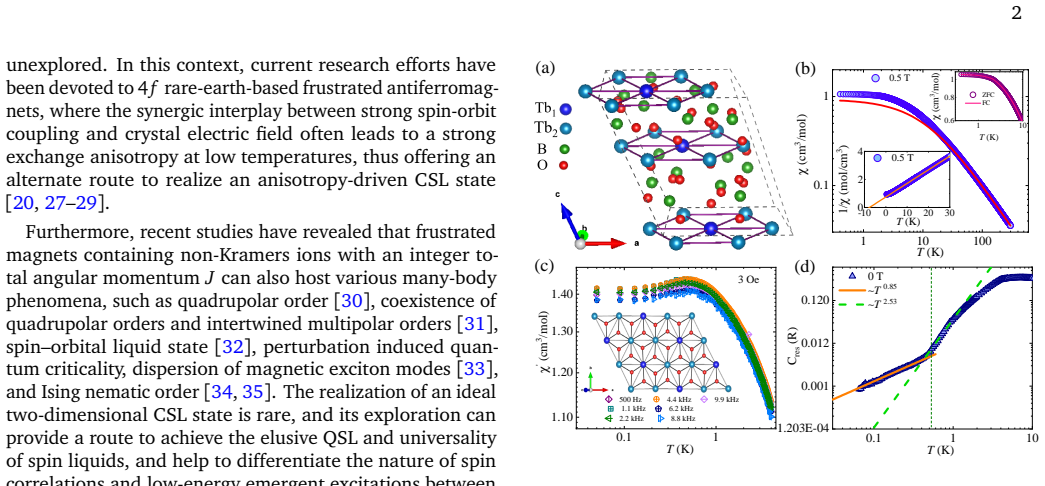
Despite dominant antiferromagnetic interactions, TbBO3 shows no signatures of long-range magnetic order or spin freezing in muon-spin relaxation down to 16 mK, corroborated by specific-heat and ac-susceptibility data to 45 mK. Neutron scattering instead reveals broad magnetic diffuse intensity at low temperatures, confirming short-range two-dimensional antiferromagnetic correlations. The muon relaxation rate scales with the characteristic energy scale in the same way observed for multiple other spin-liquid candidates, supporting the presence of a common underlying mechanism of persistent, spin-liquid-like fluctuations driven by frustration, spin-orbit coupling, and admixture of excited CEF,
What carries the argument
Scaling of the muon relaxation rate against characteristic energy scale across spin-liquid candidates, which places TbBO3 on the same trend and indicates a shared dynamical mechanism.
If this is right
- No long-range order or spin freezing occurs despite sizable antiferromagnetic exchange interactions.
- Persistent spin dynamics remain active to at least 16 mK and are visible in both local and bulk probes.
- Broad diffuse scattering appears in elastic and inelastic neutron channels at Q approximately 1.03 inverse angstroms, indicating short-range two-dimensional correlations.
- The relaxation-rate scaling matches the behavior reported for other spin-liquid candidates, pointing to a shared dynamical origin.
- The fluctuations arise from two-dimensional antiferromagnetic short-range order intertwined with crystal-electric-field admixture and spin-orbit coupling.
Where Pith is reading between the lines
- Similar persistent dynamics may appear in other non-Kramers rare-earth triangular lattices once frustration and CEF mixing are both present.
- Pressure or chemical substitution that tunes the relative strength of exchange versus dipolar terms could drive the system across a boundary into conventional order.
- The scaling relation offers a practical diagnostic that can be applied to screen additional candidate materials for the same class of dynamics.
Load-bearing premise
The scaling collapse of muon relaxation rates across different materials truly reflects one common mechanism rather than an accidental similarity in the measured quantities.
What would settle it
Detection of sharp magnetic Bragg peaks or a clear freezing transition in TbBO3 at any temperature below 16 mK in either neutron scattering or muon relaxation would contradict the claim of persistent dynamics without order.
Figures


read the original abstract
The synergistic interplay between spin correlations, spin-orbit coupling, and competing exchange interactions provides a promising route to realize exotic quantum states with nontrivial excitations in rare-earth based frustrated magnets. Here, by using thermodynamic and local-probe measurements down to 16 mK, we demonstrate the exotic magnetism and spin dynamics in the distorted triangular lattice TbBO3. Thermodynamic experiments reveal the presence of dominant antiferromagnetic exchange and subdominant dipolar interactions. Despite sizable antiferromagnetic exchange interactions between the Tb3+ moments, muon-spin relaxation experiment does not detect any signatures of long-range magnetic order or spin-freezing down to 16 mK, corroborating the specific heat and ac magnetic susceptibility down to 45 mK that suggests a persistent spin dynamics in this frustrated triangular lattice. The scaling of muon relaxation rate as a function of the characteristic energy scale for several spin-liquid candidates, including TbBO3, demonstrates that a common underlying mechanism is at play. The persistent dynamics in this frustrated triangular lattice antiferromagnet is reminiscent of a universal spin-liquid-like spin fluctuations, here attributed to dominant two dimensional (2D) antiferromagnetic short-range spin correlations, confirmed by the presence of a broad magnetic diffuse scattering in the elastic and low-energy inelastic neutron scattering channels at Q ~ 1.03 Ang**$^{-1}$** at low temperatures. Our results demonstrate that non-Kramers ion based triangular lattice hosts spin-liquid-like dynamics of local moments arising from the admixture of excited crystal electric field states into the ground state and intertwining of frustration and spin-orbit interaction.
Editorial analysis
A structured set of objections, weighed in public.
Referee Report
Summary. The manuscript reports thermodynamic, muSR, and neutron scattering measurements on the distorted triangular-lattice antiferromagnet TbBO3. It finds dominant antiferromagnetic exchange with subdominant dipolar interactions, yet no long-range order or spin freezing signatures down to 16 mK in muSR (corroborated by specific heat and ac susceptibility to 45 mK), persistent spin dynamics, and broad diffuse magnetic scattering at Q ≈ 1.03 Å^{-1} indicating 2D short-range correlations. A scaling plot of muon relaxation rate versus characteristic energy scale across several spin-liquid candidates, including TbBO3, is presented as evidence for a common underlying mechanism, with the behavior attributed to admixture of excited CEF states into the non-Kramers ground state together with frustration and spin-orbit coupling.
Significance. If the central experimental observations hold, the work adds a non-Kramers triangular-lattice example to the set of rare-earth frustrated magnets that exhibit persistent low-temperature dynamics without conventional ordering, supported by direct local-probe and scattering data. The scaling relation, if placed on a firmer quantitative footing, could strengthen the case for universality among spin-liquid candidates.
major comments (1)
- [Abstract / scaling discussion] The scaling analysis (abstract and associated figure) asserts that the muon relaxation rate versus characteristic energy scale 'demonstrates that a common underlying mechanism is at play' for TbBO3 and other spin-liquid candidates. The comparison is presented qualitatively without reported uncertainties on the data points, goodness-of-fit metrics, or statistical assessment of the collapse; this weakens the support for the universality claim that underpins the 'spin-liquid-like' interpretation.
minor comments (2)
- [Neutron scattering results] Notation for the wave-vector in the neutron scattering section should be standardized (e.g., consistent use of Å^{-1} with proper superscript formatting).
- [Thermodynamic measurements] The manuscript would benefit from explicit tabulation of the fitted exchange and dipolar interaction strengths extracted from the thermodynamic data, including their uncertainties.
Simulated Author's Rebuttal
We thank the referee for their positive assessment of our work and for the constructive comment regarding the scaling analysis. We address the point below and have prepared revisions accordingly.
read point-by-point responses
-
Referee: The scaling analysis (abstract and associated figure) asserts that the muon relaxation rate versus characteristic energy scale 'demonstrates that a common underlying mechanism is at play' for TbBO3 and other spin-liquid candidates. The comparison is presented qualitatively without reported uncertainties on the data points, goodness-of-fit metrics, or statistical assessment of the collapse; this weakens the support for the universality claim that underpins the 'spin-liquid-like' interpretation.
Authors: We agree that the scaling plot is presented qualitatively and lacks explicit uncertainties or statistical metrics such as goodness-of-fit. The data are compiled from multiple literature sources with heterogeneous reporting standards, which precludes a rigorous quantitative fit. To address this concern, we will revise the manuscript by adding available error bars to the data points in the figure (where reported in the source references) and by modifying the text to describe the collapse as visual evidence of a common trend rather than definitive proof of universality. This change improves transparency while preserving the intended interpretation based on the observed alignment of TbBO3 with other candidates. revision: yes
Circularity Check
No significant circularity; experimental observations only
full rationale
The paper's central claims rest on direct experimental measurements (muSR down to 16 mK showing no LRO or freezing, specific heat and ac susceptibility to 45 mK, diffuse neutron scattering at Q ~ 1.03 Å^{-1}). No derivation chain, equations, fitted parameters renamed as predictions, or self-citation load-bearing steps are present. The scaling comparison of muon relaxation rates across spin-liquid candidates is an empirical observation, not a reduction to inputs by construction. The work is self-contained against external benchmarks with no internal circularity.
Axiom & Free-Parameter Ledger
Forward citations
Cited by 1 Pith paper
-
Topological spin freezing in frustrated quantum materials
Frustrated quantum materials show topological spin-glass behavior with short-range correlations and low-energy excitations, unified by hydrodynamic spin modes and spin-jam states in a framework that bridges experiment...
Reference graph
Works this paper leans on
-
[1]
W . Witczak-Krempa, G. Chen, Y. B. Kim, and L. Balents, Cor- related quantum phenomena in the strong spin-orbit regime, Annu. Rev. Condens. Matter Phys. 5, 57 (2014)
work page 2014
-
[2]
Balents, Spin liquids in frustrated magnets, Nature 464, 199 (2010)
L. Balents, Spin liquids in frustrated magnets, Nature 464, 199 (2010)
work page 2010
-
[3]
S. Jeon, D. Wulferding, Y. Choi, S. Lee, K. Nam, K. H. Kim, M. Lee, T .-H. Jang, J.-H. Park, S. Lee, S. Choi, C. Lee, H. Nojiri, and K.-Y . Choi, One-ninth magnetization plateau stabilized by spin entanglement in a kagome antiferromagnet, Nat. Phys. 20, 435 (2024)
work page 2024
-
[4]
C. Broholm, R. J. Cava, S. A. Kivelson, D. G. Nocera, M. R. Norman, and T . Senthil, Quantum spin liquids, Science367, eaay0668 (2020)
work page 2020
-
[5]
P . Khuntia, M. Velazquez, Q. Barthélemy, F . Bert, E. Kermar- rec, A. Legros, B. Bernu, L. Messio, A. Zorko, and P . Mendels, Gapless ground state in the archetypal quantum kagome an- tiferromagnet ZnCu3(OH6Cl2, Nat. Phys. 16, 469 (2020)
work page 2020
-
[6]
J. Sonnenschein and J. Reuther, Topological spinon bands and vison excitations in spin-orbit coupled quantum spin liquids, Phys. Rev. B 96, 235113 (2017)
work page 2017
-
[7]
Kitaev, Anyons in an exactly solved model and beyond, Ann
A. Kitaev, Anyons in an exactly solved model and beyond, Ann. Phys. 321, 2–111 (2006)
work page 2006
- [8]
- [9]
-
[10]
Capponi, Classical and quantum spin liquids, C
S. Capponi, Classical and quantum spin liquids, C. R. Phys. 26, 91 (2025)
work page 2025
-
[11]
H. Yan, O. Benton, R. Moessner, and A. H. Nevidomskyy, Classification of classical spin liquids: Typology and resulting landscape, Phys. Rev. B 110, L020402 (2024)
work page 2024
-
[12]
N. Niggemann, M. Hering, and J. Reuther, Classical spiral spin liquids as a possible route to quantum spin liquids, J. Phys.: Condens. Matter 32, 024001 (2019)
work page 2019
-
[13]
S. V . Isakov, K. Gregor, R. Moessner, and S. L. Sondhi, Dipolar spin correlations in classical pyrochlore magnets, Phys. Rev. Lett. 93, 167204 (2004)
work page 2004
-
[14]
R. M. Nandkishore and M. Hermele, Fractons, Annu. Rev. Condens. Matter Phys. 10, 295 (2019)
work page 2019
-
[15]
C. L. Henley, The “Coulomb phase” in frustrated systems, Annu. Rev. Condens. Matter Phys. 1, 179 (2010)
work page 2010
-
[16]
C. Castelnovo, R. Moessner, and S. Sondhi, Spin ice, fraction- alization, and topological order, Annu. Rev. Condens. Matter Phys. 3, 35 (2012)
work page 2012
-
[17]
S.-S. Gong, D. N. Sheng, O. I. Motrunich, and M. P . A. Fisher, Phase diagram of the spin- 1 2 J1-J2 Heisenberg model on a honeycomb lattice, Phys. Rev. B 88, 165138 (2013)
work page 2013
-
[18]
M. Pretko and L. Radzihovsky , Fracton-elasticity duality , Phys. Rev. Lett. 120, 195301 (2018)
work page 2018
-
[19]
S. Gao, M. A. McGuire, Y. Liu, D. L. Abernathy, C. d. Cruz, M. Frontzek, M. B. Stone, and A. D. Christianson, Spiral spin liquid on a honeycomb lattice, Phys. Rev. Lett. 128, 227201 (2022)
work page 2022
-
[20]
G. H. Wannier, Antiferromagnetism. The triangular Ising net, Phys. Rev. 79, 357 (1950)
work page 1950
-
[21]
Y. Jiang and T . Emig, String picture for a model of frustrated quantum magnets and dimers, Phys. Rev. Lett. 94, 110604 (2005)
work page 2005
-
[22]
G. C. Lau, R. S. Freitas, B. G. Ueland, B. D. Muegge, E. L. Duncan, P . Schiffer, and R. J. Cava, Zero-point entropy in stuffed spin-ice, Nat. Phys. 2, 249 (2006)
work page 2006
-
[23]
A. Kele¸ s and E. Zhao, Absence of long-range order in a trian- gular spin system with dipolar interactions, Phys. Rev. Lett. 120, 187202 (2018)
work page 2018
- [24]
- [25]
-
[26]
J. Reuther, S.-P . Lee, and J. Alicea, Classification of spin liquids on the square lattice with strong spin-orbit coupling, Phys. Rev. B 90, 174417 (2014)
work page 2014
-
[27]
Z. Y. Meng, T . C. Lang, S. Wessel, F . F . Assaad, and A. Mura- matsu, Quantum spin liquid emerging in two-dimensional correlated Dirac fermions, Nature 464, 847 (2010). 7
work page 2010
-
[28]
M. M. Bordelon, E. Kenney, C. Liu, T . Hogan, L. Posthuma, M. Kavand, Y. Lyu, M. Sherwin, N. P . Butch, C. Brown, M. J. Graf, L. Balents, and S. D. Wilson, Field-tunable quantum dis- ordered ground state in the triangular-lattice antiferromagnet NaYbO2, Nat. Phys. 15, 1058 (2019)
work page 2019
-
[29]
Kitaev, Anyons in an exactly solved model and beyond, Ann
A. Kitaev, Anyons in an exactly solved model and beyond, Ann. Phys. 321, 2 (2006)
work page 2006
-
[30]
K. Hattori and H. Tsunetsugu, Antiferro quadrupole orders in non-Kramers doublet systems, J. Phys. Soc. Jpn. 83, 034709 (2014)
work page 2014
- [31]
-
[32]
N. Tang, Y. Gritsenko, K. Kimura, S. Bhattacharjee, A. Sakai, M. Fu, H. Takeda, H. Man, K. Sugawara, Y. Matsumoto, Y. Shimura, J. Wen, C. Broholm, H. Sawa, M. Takigawa, T . Sakakibara, S. Zherlitsyn, J. Wosnitza, R. Moessner, and S. Nakatsuji, Spin-orbital liquid state and liquid-gas metam- agnetic transition on a pyrochlore lattice, Nat. Phys. 19, 92 (2023)
work page 2023
-
[33]
P . Thalmeier and A. Akbari, Induced quantum magnetism in crystalline electric field singlet ground state models: Thermo- dynamics and excitations, Phys. Rev. B 109, 115110 (2024)
work page 2024
- [34]
-
[35]
I. Vinograd, K. R. Shirer, P . Massat, Z. Wang, T . Kissikov, D. Gar- cia, M. D. Bachmann, M. Horvati´c, I. R. Fisher, and N. J. Curro, Second order zeeman interaction and ferroquadrupolar order in TmVO4, npj Quantum Mater. 7, 68 (2022)
work page 2022
-
[36]
N. Shannon, O. Sikora, F . Pollmann, K. Penc, and P . Fulde, Quantum ice: A quantum monte carlo study , Phys. Rev. Lett. 108, 067204 (2012)
work page 2012
-
[37]
H. Yan, O. Benton, A. H. Nevidomskyy, and R. Moessner, Classification of classical spin liquids: Detailed formalism and suite of examples, Phys. Rev. B 109, 174421 (2024)
work page 2024
-
[38]
E. Z. Zhang, C. Hickey, and Y. B. Kim, Disentangling spin excitation continua in classical and quantum magnets using two-dimensional nonlinear spectroscopy, Phys. Rev. B 110, 104415 (2024)
work page 2024
-
[39]
A. M. Samarakoon, A. Banerjee, S.-S. Zhang, Y. Kamiya, S. E. Nagler, D. A. Tennant, S.-H. Lee, and C. D. Batista, Compre- hensive study of the dynamics of a classical kitaev spin liquid, Phys. Rev. B 96, 134408 (2017)
work page 2017
-
[40]
A. M. Samarakoon, G. Wachtel, Y . Yamaji, D. A. Tennant, C. D. Batista, and Y. B. Kim, Classical and quantum spin dynamics of the honeycomb Γ model, Phys. Rev. B 98, 045121 (2018)
work page 2018
-
[41]
P . Saha, Z. Fan, D. Zhang, and G.-W . Chern, Hidden plaquette order in a classical spin liquid stabilized by strong off-diagonal exchange, Phys. Rev. Lett. 122, 257204 (2019)
work page 2019
-
[42]
M. G. Gonzalez, F . T . Lisandrini, G. G. Blesio, A. E. Trumper, C. J. Gazza, and L. O. Manuel, Correlated partial disorder in a weakly frustrated quantum antiferromagnet, Phys. Rev. Lett. 122, 017201 (2019)
work page 2019
- [43]
-
[44]
J. Sahoo and R. Flint, Symmetric spin liquids on the stuffed honeycomb lattice, Phys. Rev. B 101, 115103 (2020)
work page 2020
- [45]
-
[46]
J. P . Sheckelton, J. R. Neilson, D. G. Soltan, and T . M. Mc- Queen, Possible valence-bond condensation in the frustrated cluster magnet LiZn2Mo3O8, Nat. Mater. 11, 493 (2012)
work page 2012
-
[47]
R. Flint and P . A. Lee, Emergent honeycomb lattice in LiZn2Mo3O8, Phys. Rev. Lett. 111, 217201 (2013)
work page 2013
- [48]
-
[49]
J. Kim, X. Wang, F .-T . Huang, Y. Wang, X. Fang, X. Luo, Y. Li, M. Wu, S. Mori, D. Kwok, E. D. Mun, V . S. Zapf, and S.-W . Cheong, Spin liquid state and topological structural defects in hexagonal TbInO3, Phys. Rev. X 9, 031005 (2019)
work page 2019
-
[50]
N. Yuan, A. Elghandour, W . Hergett, R. Ohlendorf, L. Gries, and R. Klingeler, 1/3 plateau and 3 /5 discontinuity in the magnetization and the magnetic phase diagram of hexagonal GdInO3, Phys. Rev. B 108, 224403 (2023)
work page 2023
-
[51]
H.-K. Jin, W . M. H. Natori, F . Pollmann, and J. Knolle, Unveil- ing the S = 3/2 Kitaev honeycomb spin liquids, Nat. Commun. 13, 3813 (2022)
work page 2022
-
[52]
J. Friedel, XIV . The distribution of electrons round impurities in monovalent metals, Philos. Mag. 43, 153 (1952)
work page 1952
-
[53]
Kondo, Resistance minimum in dilute magnetic alloys, Prog
J. Kondo, Resistance minimum in dilute magnetic alloys, Prog. Theor. Phys. 32, 37 (1964)
work page 1964
-
[54]
W .-H. Kao, N. B. Perkins, and G. B. Halász, Vacancy spec- troscopy of non-abelian Kitaev spin liquids, Phys. Rev. Lett. 132, 136503 (2024)
work page 2024
-
[55]
A. P . Ramirez, B. Hessen, and M. Winklemann, Entropy bal- ance and evidence for local spin singlets in a kagomé-like magnet, Phys. Rev. Lett. 84, 2957 (2000)
work page 2000
-
[56]
See supplementary material (SM) for further details on sam- ple characterization, crystal electric field, additional experi- mental results, and DFT calculations
-
[57]
J. Lin, D. Sheptyakov, Y. Wang, and P . Allenspach, Structures and phase transition of vaterite-type rare earth orthoborates: a neutron diffraction study , Chem. Mater.16, 2418 (2004)
work page 2004
-
[58]
P . Mukherjee,Investigation of the magnetic and magnetocaloric properties of complex lanthanide oxides , Ph.D. thesis, Cam- bridge University (2018)
work page 2018
-
[59]
P . M. Sarte, K. Cruz-Kan, B. R. Ortiz, K. H. Hong, M. M. Borde- lon, D. Reig-i Plessis, M. Lee, E. S. Choi, M. B. Stone, S. Calder, D. M. Pajerowski, L. Mangin-Thro, Y. Qiu, J. P . Attfield, S. D. Wilson, C. Stock, H. D. Zhou, A. M. Hallas, J. A. M. Paddison, A. A. Aczel, and C. R. Wiebe, Dynamical ground state in the XY pyrochlore Yb2GaSbO7, npj Quantum...
work page 2021
-
[60]
E. Kermarrec, R. Kumar, G. Bernard, R. Hénaff, P . Mendels, F . Bert, P . L. Paulose, B. K. Hazra, and B. Koteswararao, Classi- cal spin liquid state in the S = 5 2 Heisenberg kagome antifer- romagnet Li9Fe3(P2O7)3(PO4)2, Phys. Rev. Lett. 127, 157202 (2021)
work page 2021
-
[61]
Y. Ran, W .-H. Ko, P . A. Lee, and X.-G. Wen, Spontaneous spin ordering of a Dirac spin liquid in a magnetic field, Phys. Rev. Lett. 102, 047205 (2009)
work page 2009
-
[62]
R. Bag, S. Xu, N. E. Sherman, L. Yadav, A. I. Kolesnikov, A. A. Podlesnyak, E. S. Choi, I. da Silva, J. E. Moore, and S. Haravi- fard, Evidence of dirac quantum spin liquid in YbZn2GaO5, Phys. Rev. Lett. 133, 266703 (2024)
work page 2024
-
[63]
L. Ding, P . Manuel, S. Bachus, F . Grußler, P . Gegenwart, J. Sin- gleton, R. D. Johnson, H. C. Walker, D. T . Adroja, A. D. Hillier, and A. A. Tsirlin, Gapless spin-liquid state in the structurally disorder-free triangular antiferromagnet NaYbO2, Phys. Rev. B 100, 144432 (2019)
work page 2019
-
[64]
S. Holm-Janas, S. L. Lolk, A. B. A. Andersen, T . Guidi, 8 D. Voneshen, I. Živkovi ´c, U. G. Nielsen, and K. Lef- mann, Diffuse spin waves and classical spin liquid be- havior in the kagomé antiferromagnet chromium jarosite, KCr3(OD)6(SO4)2, Phys. Rev. B 108, 064432 (2023)
work page 2023
-
[65]
R. Moessner and J. T . Chalker, Low-temperature properties of classical geometrically frustrated antiferromagnets, Phys. Rev. B 58, 12049 (1998)
work page 1998
-
[66]
Y. J. Uemura, A. Keren, K. Kojima, L. P . Le, G. M. Luke, W . D. Wu, Y. Ajiro, T . Asano, Y. Kuriyama, M. Mekata, H. Kikuchi, and K. Kakurai, Spin fluctuations in frustrated kagomé lattice system SrCr8Ga4O19 studied by muon spin relaxation, Phys. Rev. Lett. 73, 3306 (1994)
work page 1994
-
[67]
B. Fåk, E. Kermarrec, L. Messio, B. Bernu, C. Lhuillier, F . Bert, P . Mendels, B. Koteswararao, F . Bouquet, J. Ollivier, A. D. Hillier, A. Amato, R. H. Colman, and A. S. Wills, Kapellasite: A kagome quantum spin liquid with competing interactions, Phys. Rev. Lett. 109, 037208 (2012)
work page 2012
-
[68]
S. Lee, T . Zhu, Y. Oshima, T . Shiroka, C. Wang, H. Luetkens, H. Yang, M. Lü, and K.-Y. Choi, Timescale distributions of spin fluctuations in the s = 2 kagome antiferromagnet CsMn3F6(SeO3)2, Phys. Rev. B 105, 094439 (2022)
work page 2022
-
[69]
P . J. Baker, S. J. Blundell, F . L. Pratt, T . Lancaster, M. L. Brooks, W . Hayes, M. Isobe, Y. Ueda, M. Hoinkis, M. Sing, M. Klemm, S. Horn, and R. Claessen, Muon spin relaxation measurements on the dimerized spin 1/2 chains NaTiSi2O6 and TiOCl, Phys. Rev. B 75, 094404 (2007)
work page 2007
-
[70]
P . Khuntia, F . Bert, P . Mendels, B. Koteswararao, A. V . Maha- jan, M. Baenitz, F . C. Chou, C. Baines, A. Amato, and Y. Fu- rukawa, Spin liquid state in the 3D frustrated antiferromagnet PbCuTe2O6: NMR and muon spin relaxation studies, Phys. Rev. Lett. 116, 107203 (2016)
work page 2016
-
[71]
P . Khuntia and D. T . Adroja,Crystal field excitations in the spin liquid candidate on a stuffed honeycomb lattice antiferromagnet: TbBO3, Tech. Rep. (STFC ISIS Neutron and Muon Source, 2025)
work page 2025
discussion (0)
Sign in with ORCID, Apple, or X to comment. Anyone can read and Pith papers without signing in.