Kuramoto model on Sierpinski Gasket I: Harmonic maps
Pith reviewed 2026-05-23 22:51 UTC · model grok-4.3
The pith
For each prescribed degree and suitable boundary conditions there exists a unique harmonic map from the Sierpinski gasket to the circle.
A machine-rendered reading of the paper's core claim, the machinery that carries it, and where it could break.
Core claim
For a prescribed degree and suitable boundary conditions, there exists a unique harmonic map from the Sierpinski gasket to the circle. The degree is realized as a vector of integers that classifies continuous maps up to homotopy, and the map itself is obtained by lifting to a covering space built for that homotopy class, applying the harmonic extension algorithm on the cover, restricting to the fundamental domain, and projecting the range back to the circle. The same lifting-and-projection procedure extends to arbitrary post-critically finite fractals.
What carries the argument
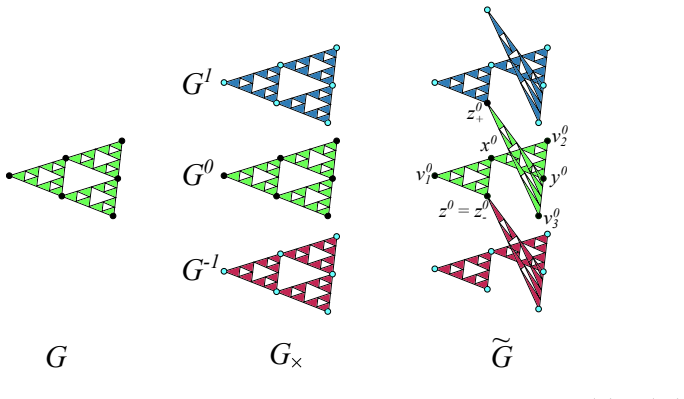
Covering spaces built separately for each homotopy class of maps from the domain to the circle; each cover allows the circle-valued function to lift to a real-valued function whose harmonic extension on the cover, after restriction and projection, yields the desired harmonic map on the original domain.
If this is right
- All identified harmonic maps are stable steady states of the Kuramoto model on graph approximations to the Sierpinski gasket.
- The existence and uniqueness statement extends verbatim to harmonic maps on any post-critically finite fractal.
- Homotopy classes of continuous maps from the Sierpinski gasket to the circle are completely classified by the integer degree vectors.
- Numerical construction of the maps is feasible by solving the linear system that arises from the harmonic extension step on each covering space.
Where Pith is reading between the lines
- The covering-space technique may supply a practical algorithm for computing harmonic maps on other self-similar domains once their fundamental domains and adjacency rules are known.
- If the Kuramoto model on these graphs converges to the identified harmonic maps, then the long-term phase patterns on fractal networks are completely described by the degree vectors.
- The method could be tested on the hexagasket and pentagasket by checking whether the numerically obtained maps satisfy the expected degree and boundary conditions.
Load-bearing premise
The covering spaces built for each homotopy class fully capture the topology of continuous functions from the Sierpinski gasket to the circle.
What would settle it
Exhibit two distinct harmonic maps from the Sierpinski gasket to the circle that share the same degree vector and the same boundary values, or exhibit a degree vector for which the covering-space construction produces no harmonic map.
Figures



read the original abstract
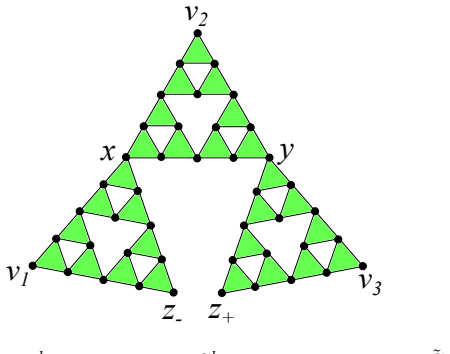
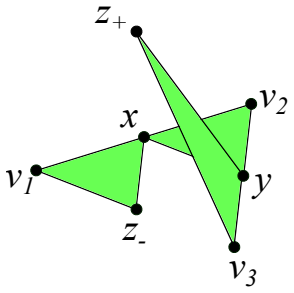
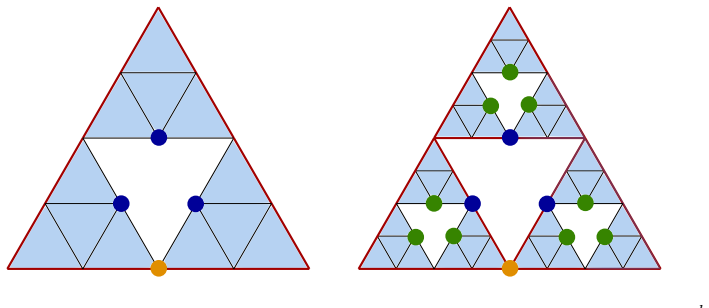
Motivated by the study of attractors in the Kuramoto model (KM) on graphs approximating the Sierpinski gasket (SG), we revisit the problem of harmonic maps (HMs) from SG to the circle, first considered by Strichartz. We provide a geometric proof of Strichartz's theorem, which states that for a prescribed degree and suitable boundary conditions, there exists a unique HM from SG to the circle. We extend this result to HMs on post-critically finite (p.c.f.) fractals. For continuous functions on SG, we define a degree given by vector of integers of arbitrary finite length. We show that the degree determines a homotopy class on SG with values in the circle. This provides an analog of the Hopf degree theorem on SG. We move on to analyze HMs. At the heart of our method lies an original construction of covering spaces. After lifting continuous functions on SG with values in the unit circle to continuous real-valued functions on the covering space, we use the harmonic extension algorithm to obtain a harmonic function on the covering space. The desired HM is obtained by restricting the domain of the harmonic function to the fundamental domain and projecting the range to the circle. Each covering space is constructed separately for HMs of a given homotopy class, capturing its intrinsic topology. We show that with suitable modifications the method applies to p.c.f. fractals, a large class of self-similar domains. We illustrate our method using numerical examples of HMs from SG to the circle and discuss the construction of covering spaces for several representative p.c.f. fractals, including the 3-level SG, hexagasket, and pentagasket. The results of this paper provide the foundation for a follow-up work where we give a complete description of attractors in the KM on graphs approximating p.c.f. fractals. Specifically, we show that all HMs identified in this paper are stable steady states of the KM.
Editorial analysis
A structured set of objections, weighed in public.
Referee Report
Summary. The manuscript provides a geometric proof of Strichartz's theorem asserting existence and uniqueness of harmonic maps from the Sierpinski gasket (SG) to the circle for prescribed degree (an integer vector of finite length) and suitable boundary conditions. It shows that this degree classifies homotopy classes (an analog of the Hopf degree theorem on SG), constructs a covering space separately for each homotopy class, lifts maps to real-valued functions on the cover, applies the harmonic extension algorithm there, then restricts to a fundamental domain and projects to the circle to obtain the desired harmonic map. The construction is extended to post-critically finite fractals and illustrated numerically; the results are positioned as the foundation for a follow-up on Kuramoto-model attractors.
Significance. If the covering-space procedure is shown to produce maps that are harmonic on the original domain, the work supplies a concrete method for constructing and classifying harmonic maps on self-similar fractals, directly enabling the stability analysis of steady states in the Kuramoto model on approximating graphs. The per-homotopy-class covering spaces constitute an original technical device that may be reusable for other topological questions on p.c.f. sets.
major comments (1)
- [Method paragraph on covering-space construction] The existence/uniqueness claim rests on the procedure described in the paragraph beginning 'At the heart of our method lies an original construction of covering spaces.' It is not shown that restriction of the harmonic function from the cover to the fundamental domain preserves the Dirichlet-energy minimality property among maps with the given boundary values and degree, nor that the subsequent projection to the circle yields a map satisfying the Euler-Lagrange equation on the original SG at the identification points. An explicit relation between the energy on the cover and the energy on the quotient is required to confirm that the output is harmonic on SG.
minor comments (1)
- [Numerical examples section] The numerical examples in the final section should state explicitly how the length of the degree vector is selected for each illustrated map and how the boundary conditions are imposed on the approximating graphs.
Simulated Author's Rebuttal
We thank the referee for the careful reading and for identifying a point that requires clarification in our geometric construction. We address the major comment below and will revise the manuscript to include the requested energy relation.
read point-by-point responses
-
Referee: The existence/uniqueness claim rests on the procedure described in the paragraph beginning 'At the heart of our method lies an original construction of covering spaces.' It is not shown that restriction of the harmonic function from the cover to the fundamental domain preserves the Dirichlet-energy minimality property among maps with the given boundary values and degree, nor that the subsequent projection to the circle yields a map satisfying the Euler-Lagrange equation on the original SG at the identification points. An explicit relation between the energy on the cover and the energy on the quotient is required to confirm that the output is harmonic on SG.
Authors: We agree that the manuscript does not contain an explicit derivation relating the Dirichlet energy on the covering space to the energy on the quotient SG, nor a direct verification that the projected map satisfies the Euler-Lagrange equation at identification points. This constitutes a genuine gap in the current exposition. In the revision we will add a dedicated subsection deriving the energy identity: because the covering map is a local isometry on the interiors of cells and the lift is harmonic, the energy of the projected map equals the energy of the lift divided by the degree of the cover; minimality among maps of fixed degree and boundary values then follows by the uniqueness of the harmonic extension on the cover. At the finitely many identification points we will verify the Euler-Lagrange condition by showing that the left- and right-derivatives match after projection, using the periodicity built into the covering space. These additions will make the proof that the output map is harmonic on SG complete. revision: yes
Circularity Check
No significant circularity detected in derivation
full rationale
The paper's central claim is proved via an explicit constructive procedure: an original per-homotopy-class covering space is built, continuous maps are lifted to real-valued functions on the cover, the standard harmonic extension algorithm is applied on the cover, and the result is restricted to a fundamental domain then projected to the circle. This chain does not reduce the existence/uniqueness statement to a definition of the output in terms of itself, nor does it rename a fitted parameter as a prediction. The covering-space construction is presented as original rather than imported via self-citation; the harmonic-extension step is the well-known algorithm on SG (external to the paper). No load-bearing self-citation, ansatz smuggling, or uniqueness theorem imported from the authors' prior work appears in the provided text. The derivation therefore remains self-contained against external benchmarks and receives the default non-circularity finding.
Axiom & Free-Parameter Ledger
axioms (2)
- domain assumption The harmonic extension algorithm on post-critically finite fractals produces the unique energy-minimizing function with given boundary values.
- domain assumption Continuous functions from SG to the circle are classified up to homotopy by the integer vector degree defined in the paper.
invented entities (1)
-
Covering space constructed separately for each homotopy class
no independent evidence
Reference graph
Works this paper leans on
-
[1]
Martin T. Barlow, Diffusions on fractals , Lectures on probability theory and statistics (Saint-Flour, 1995), Lecture Notes in Math., vol. 1690, Springer, Berlin, 1998, pp. 1–121
work page 1995
-
[2]
Martin T. Barlow and Edwin A. Perkins, Brownian motion on the Sierpi ´nski gasket, Probab. Theory Related Fields 79 (1988), no. 4, 543–623
work page 1988
-
[3]
Reinhard Diestel, Graph theory, Springer (print edition); Reinhard Diestel (eBooks), 2024
work page 2024
-
[4]
James Eells, Jr. and J. H. Sampson, Harmonic mappings of Riemannian manifolds, Amer. J. Math. 86 (1964), 109–160
work page 1964
-
[5]
Kenneth Falconer, Fractal geometry, third ed., John Wiley & Sons, Ltd., Chichester, 2014, Mathemat- ical foundations and applications. 24
work page 2014
-
[6]
Sheldon Goldstein, Random walks and diffusions on fractals , Percolation theory and ergodic theory of infinite particle systems (Minneapolis, Minn., 1984–1985), IMA V ol. Math. Appl., vol. 8, Springer, New York, 1987, pp. 121–129
work page 1984
-
[7]
Jun Kigami, Harmonic calculus on p.c.f. self-similar sets, Trans. Amer. Math. Soc. 335 (1993), no. 2, 721–755
work page 1993
-
[8]
143, Cambridge University Press, Cambridge, 2001
, Analysis on fractals , Cambridge Tracts in Mathematics, vol. 143, Cambridge University Press, Cambridge, 2001
work page 2001
-
[9]
Shigeo Kusuoka, A diffusion process on a fractal , Probabilistic methods in mathematical physics (Katata/Kyoto, 1985), Academic Press, Boston, MA, 1987, pp. 251–274
work page 1985
-
[10]
Georgi S. Medvedev, Galerkin approximation of a nonlocal diffusion equation on euclidean and fractal domains, arXiv:2306.15844, 2023
- [11]
-
[12]
S ´aenz, Introduction to harmonic analysis, Student Mathematical Library, vol
Ricardo A. S ´aenz, Introduction to harmonic analysis, Student Mathematical Library, vol. 105, Ameri- can Mathematical Society, Providence, RI; Institute for Advanced Study (IAS), Princeton, NJ, [2023] ©2023, IAS/Park City Mathematical Subseries
work page 2023
-
[13]
Strichartz, Harmonic mappings of the Sierpinski gasket to the circle, Proc
Robert S. Strichartz, Harmonic mappings of the Sierpinski gasket to the circle, Proc. Amer. Math. Soc. 130 (2002), no. 3, 805–817. MR 1866036
work page 2002
-
[14]
, Differential equations on fractals, Princeton University Press, Princeton, NJ, 2006, A tutorial
work page 2006
-
[15]
Donglei Tang, Harmonic mappings of the hexagasket to the circle , Anal. Theory Appl. 27 (2011), no. 4, 377–386. 25
work page 2011
discussion (0)
Sign in with ORCID, Apple, or X to comment. Anyone can read and Pith papers without signing in.