Discrete Laplacians on the hyperbolic space -- a comparative study
Pith reviewed 2026-05-23 21:16 UTC · model grok-4.3
The pith
Two finite-difference Laplacians on hyperbolic space approximate the Laplace-Beltrami operator and yield convergent discrete heat equations with matching Poincaré decay.
A machine-rendered reading of the paper's core claim, the machinery that carries it, and where it could break.
Core claim
Two variants of discrete finite-difference operators are developed for the hyperbolic space H^2 as approximations to the Laplace-Beltrami operator. Both lead to stable discrete heat equations that converge to the continuous problem, with solutions exhibiting exponential decay equal to that from the Poincaré inequality. The operator specifically designed for the hyperbolic geometry yields a more precise approximation and has advantages in theory and computation, with potential generalization to H^3.
What carries the argument
Finite-difference discrete Laplacians tailored to the constant negative curvature of hyperbolic space.
Load-bearing premise
The two finite-difference operators are valid L2 approximations to the continuous Laplace-Beltrami operator on H^2 and the stability and convergence proofs carry over without additional restrictions on the mesh or time step.
What would settle it
A numerical computation on a concrete mesh and time step showing that a discrete heat solution fails to approach the continuous solution or decays at a rate different from the Poincaré constant on H^2.
Figures
read the original abstract
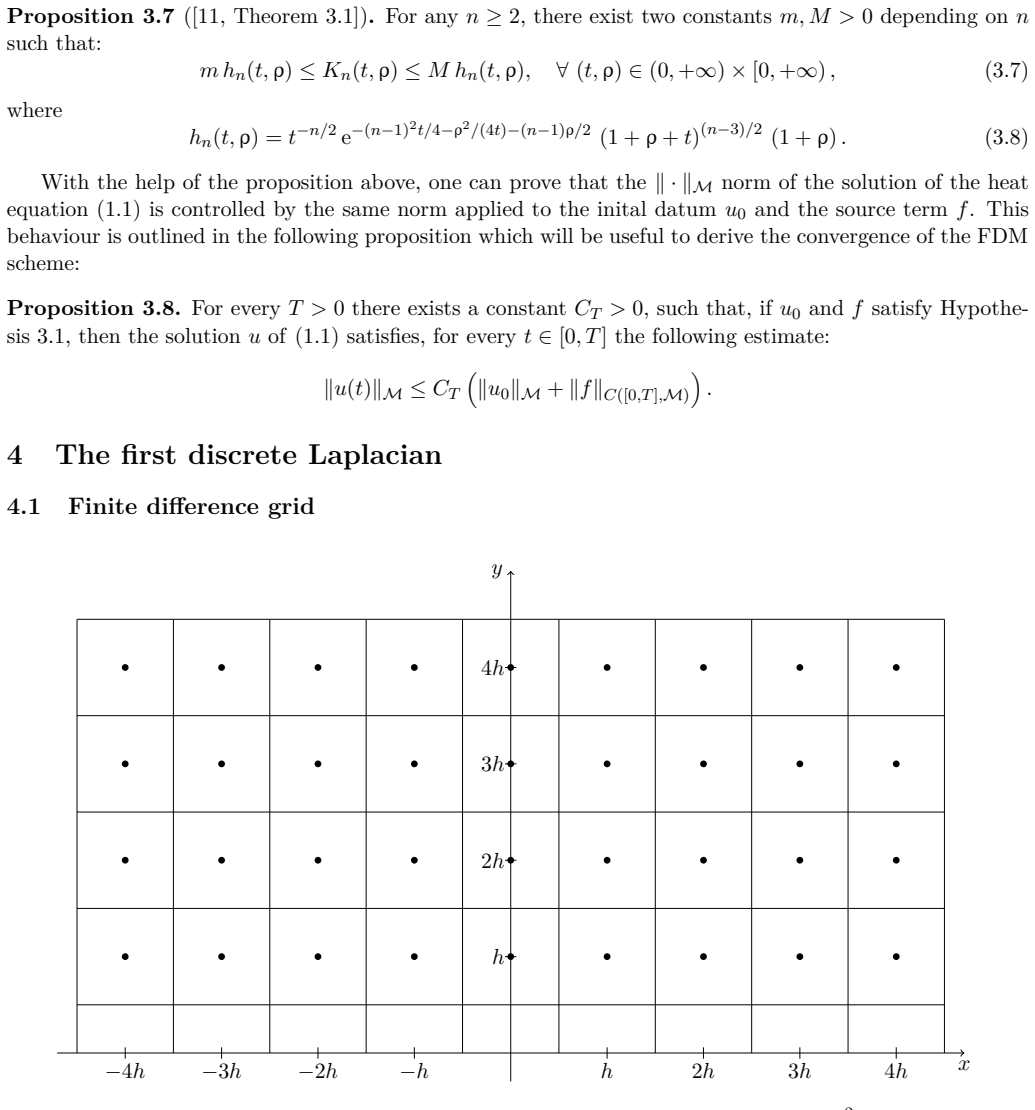
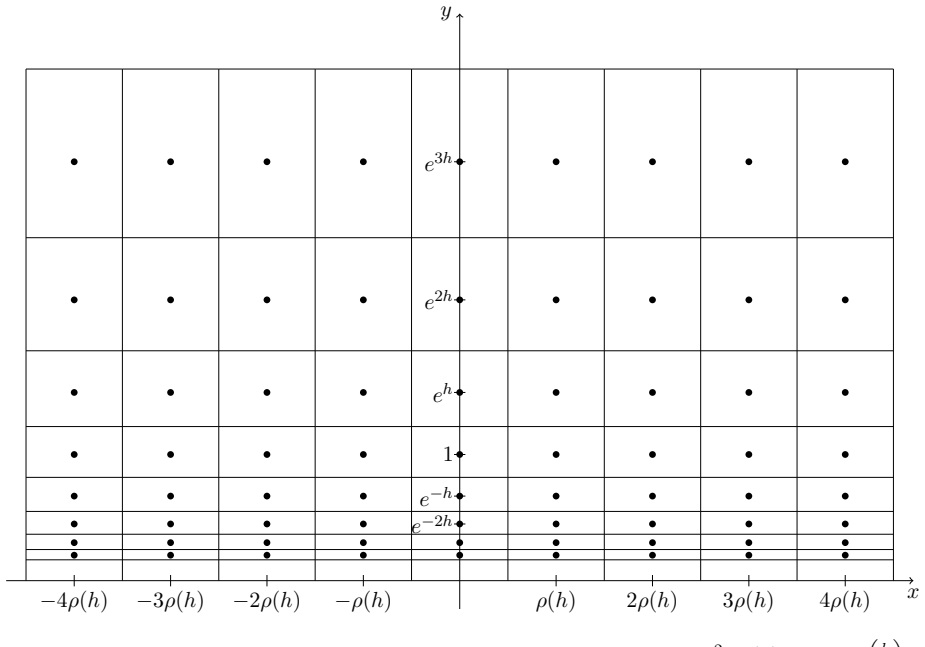
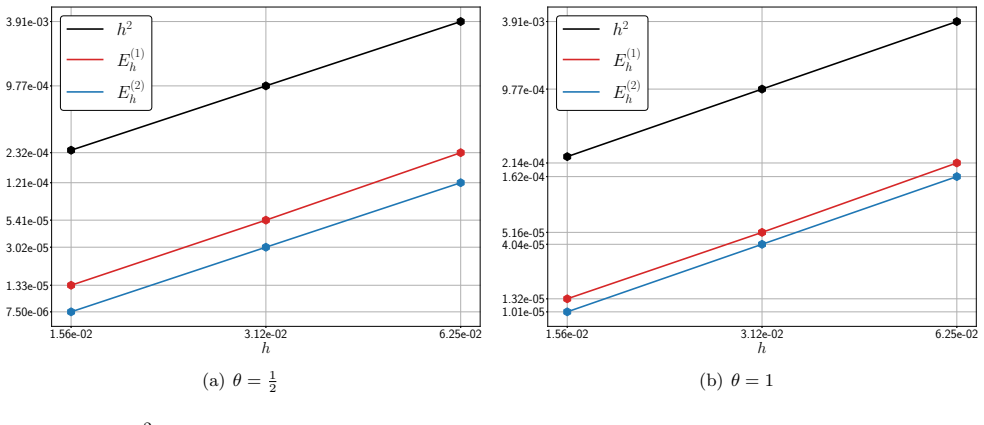
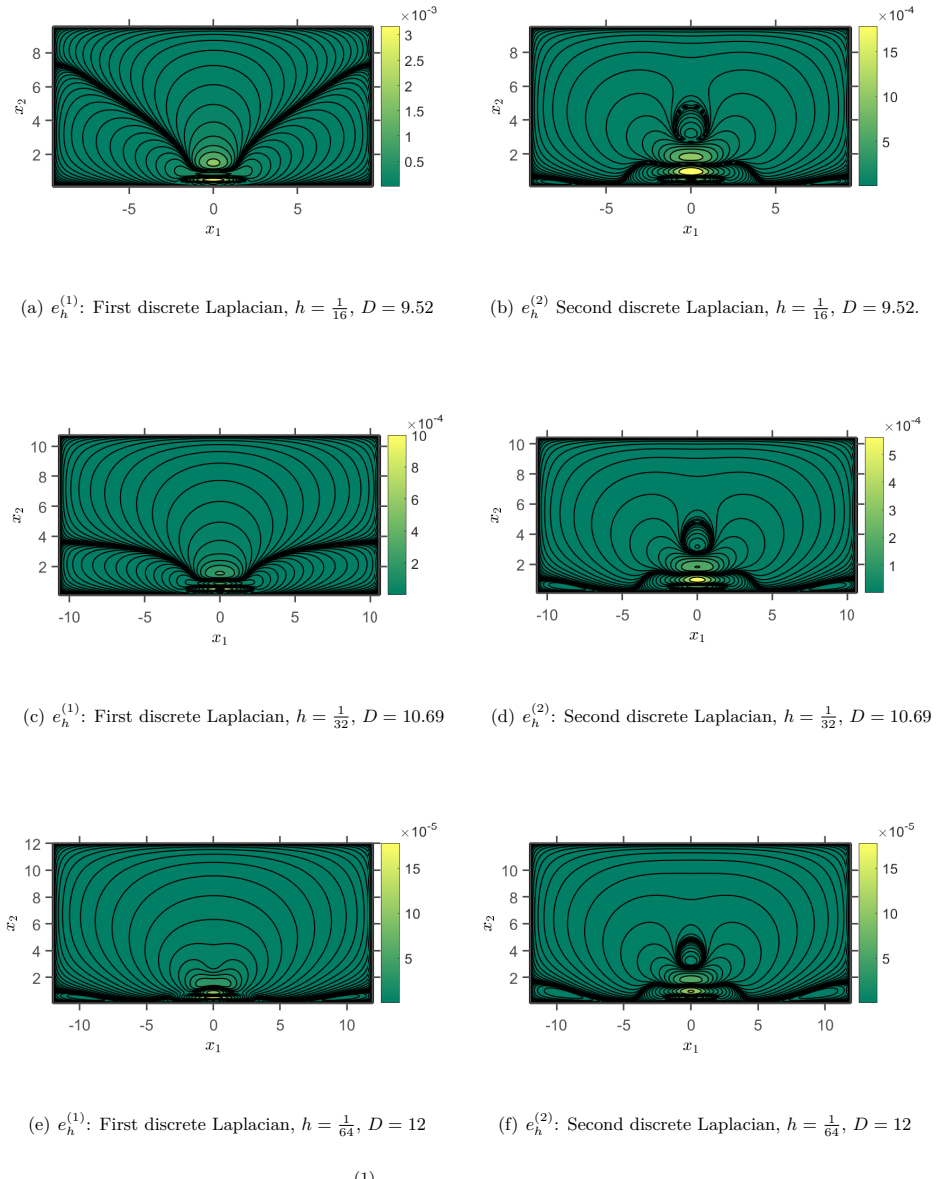
This paper is concerned with the construction of discrete counterparts of the Laplace-Beltrami operator on Riemannian manifolds that can be effectively used in the numerical solution of partial differential equations. Since existing constructions often lack rigorous convergence guarantees or imply a significant computational effort, we focus on designing operators that are both computationally feasible and supported by convergence results. We consider as a starting point the two-dimensional hyperbolic space $\mathbb{H}^2$, one of the simplest non-Euclidean settings, and develop two variants of discrete finite-difference operator tailored to this constant negatively curved space, both serving as approximations to the (continuous) Laplace-Beltrami operator within the $\mathrm{L}^2$ framework. We prove that the discrete heat equation associated with both operators mentioned above exhibits stability and converges towards the continuous heat-Beltrami Cauchy problem on $\mathbb{H}^2$. Moreover, using techniques inspired from the sharp analysis of discrete functional inequalities, we prove that the solutions of the discrete heat equations corresponding to both variants of discrete Laplacian exhibit an exponential decay asymptotically equal to the one induced by the Poincar\'e inequality on $\mathbb{H}^2$. Eventually, we illustrate that a discrete Laplacian specifically designed for the geometry of the hyperbolic space yields a more precise approximation and offers advantages from both theoretical and computational perspectives. Furthermore, this discrete operator can be effectively generalized to the three-dimensional hyperbolic space.
Editorial analysis
A structured set of objections, weighed in public.
Referee Report
Summary. The paper constructs two finite-difference discrete Laplacians on the two-dimensional hyperbolic space H^2 that serve as L2 approximations to the Laplace-Beltrami operator. It proves stability and L2 convergence of the associated discrete heat equations to the continuous heat-Beltrami Cauchy problem on H^2. It further shows that solutions to both discrete heat equations exhibit exponential decay asymptotically matching the rate induced by the Poincaré inequality on H^2. The geometry-tailored variant is claimed to be more precise and generalizable to H^3.
Significance. If the L2 approximation property, mesh-independent stability, and exact matching of the Poincaré decay rate are rigorously established, the results would provide a useful contribution to numerical methods for PDEs on constant-curvature manifolds, combining theoretical guarantees with computational feasibility.
major comments (2)
- [Abstract and convergence/stability proofs] The central claim that both discrete operators are valid L2 approximations to the Laplace-Beltrami operator (abstract) and that the stability/convergence proofs for the discrete heat equations hold without additional mesh or time-step restrictions is load-bearing; any implicit dependence on local quasi-uniformity or hyperbolic angle bounds would prevent direct transfer of the continuous Poincaré decay estimate to the discrete setting.
- [Section on exponential decay analysis] The proof that the discrete exponential decay rate is asymptotically equal to the continuous Poincaré rate (abstract) must be checked for whether the discrete functional inequalities are derived independently of the fitted mesh parameters or reduce by construction to the continuous case.
minor comments (1)
- [Construction of discrete operators] Ensure all notation for the two discrete operators is introduced with explicit formulas before the convergence statements.
Simulated Author's Rebuttal
We thank the referee for their detailed and insightful comments on our manuscript. We address each major comment below and clarify the aspects of our proofs that ensure the claims hold as stated.
read point-by-point responses
-
Referee: [Abstract and convergence/stability proofs] The central claim that both discrete operators are valid L2 approximations to the Laplace-Beltrami operator (abstract) and that the stability/convergence proofs for the discrete heat equations hold without additional mesh or time-step restrictions is load-bearing; any implicit dependence on local quasi-uniformity or hyperbolic angle bounds would prevent direct transfer of the continuous Poincaré decay estimate to the discrete setting.
Authors: We confirm that our stability and convergence proofs in Sections 3 and 4 are established without requiring additional mesh quasi-uniformity or angle bounds beyond the uniform discretization in the hyperbolic metric. The finite-difference stencils are constructed using the exact hyperbolic geometry, allowing the L2 error estimates and stability to hold uniformly. Consequently, the discrete Poincaré inequality transfers directly with the same asymptotic rate. We will add a clarifying sentence in the abstract and introduction to explicitly state the absence of such restrictions. revision: partial
-
Referee: [Section on exponential decay analysis] The proof that the discrete exponential decay rate is asymptotically equal to the continuous Poincaré rate (abstract) must be checked for whether the discrete functional inequalities are derived independently of the fitted mesh parameters or reduce by construction to the continuous case.
Authors: In the exponential decay analysis (Section 5), the discrete functional inequalities are derived independently using discrete integration by parts on the grid and properties specific to the hyperbolic Laplacian approximations. They do not reduce to the continuous case by construction but are shown to converge to it, with the decay rate matching asymptotically as the mesh parameter h → 0. The proofs are self-contained and independent of specific fitted parameters. We can provide additional details or lemmas if needed to address any specific step in the proof. revision: no
Circularity Check
No circularity: claims rest on independent operator analysis and proofs
full rationale
The paper constructs two finite-difference operators as L2 approximations to the Laplace-Beltrami operator on H^2, then proves stability, convergence of the discrete heat equations to the continuous problem, and asymptotic exponential decay matching the Poincaré inequality rate via techniques from discrete functional inequalities. No quoted step reduces a claimed result to a fitted input, self-citation chain, or definitional equivalence; the derivation chain is self-contained against external benchmarks of operator approximation and inequality analysis.
Axiom & Free-Parameter Ledger
Reference graph
Works this paper leans on
-
[1]
A unifying local convergence result for Newton’s method in Riemannian manifolds
F. Alvarez, J. Bolte, and J. Munier. “A unifying local convergence result for Newton’s method in Riemannian manifolds”. In: Found. Comput. Math. 8.2 (2008), pp. 197–226
work page 2008
-
[2]
Hyperbolic conservation laws on manifolds: total variation estimates and the finite volume method
P. Amorim, M. Ben-Artzi, and P. G. LeFloch. “Hyperbolic conservation laws on manifolds: total variation estimates and the finite volume method”. In: Methods Appl. Anal. 12.3 (2005), pp. 291–323
work page 2005
-
[3]
Asymptotic behavior of solutions to the heat equation on noncompact symmetric spaces
J.-P. Anker, E. Papageorgiou, and H.-W. Zhang. “Asymptotic behavior of solutions to the heat equation on noncompact symmetric spaces”. In: J. Funct. Anal. 284.6 (2023), Paper No. 109828, 43
work page 2023
-
[4]
A nonlocal diffusion problem on manifolds
C. Bandle, M. d. M. Gonz´ alez, M. A. Fontelos, and N. Wolanski. “A nonlocal diffusion problem on manifolds”. In: Comm. Partial Differential Equations 43.4 (2018), pp. 652–676
work page 2018
-
[5]
The nonlinear Schr¨ odinger equation on hyperbolic space
V. Banica. “The nonlinear Schr¨ odinger equation on hyperbolic space”. In: Comm. Partial Differential Equations 32.10-12 (2007), pp. 1643–1677
work page 2007
-
[6]
Stable discretizations of elastic flow in Riemannian manifolds
J. W. Barrett, H. Garcke, and R. N¨ urnberg. “Stable discretizations of elastic flow in Riemannian manifolds”. In: SIAM J. Numer. Anal. 57.4 (2019), pp. 1987–2018
work page 2019
-
[7]
An optimal improvement for the Hardy in- equality on the hyperbolic space and related manifolds
E. Berchio, D. Ganguly, G. Grillo, and Y. Pinchover. “An optimal improvement for the Hardy in- equality on the hyperbolic space and related manifolds”. In: Proc. Roy. Soc. Edinburgh Sect. A 150.4 (2020), pp. 1699–1736
work page 2020
-
[8]
A graph discretization of the Laplace-Beltrami operator
D. Burago, S. Ivanov, and Y. Kurylev. “A graph discretization of the Laplace-Beltrami operator”. In: J. Spectr. Theory 4.4 (2014), pp. 675–714. 25
work page 2014
-
[9]
T. Cazenave and A. Haraux. An Introduction to Semilinear Evolution Equations . Oxford University Press, 1998
work page 1998
-
[10]
Numerical approximation of diffusions in Rd using normal charts of a Riemaannian manifold
A. B. Cruzeiro and P. Malliavin. “Numerical approximation of diffusions in Rd using normal charts of a Riemaannian manifold”. In: Stochastic Process. Appl. 116.7 (2006), pp. 1088–1095
work page 2006
-
[11]
Heat Kernel Bounds on Hyperbolic Space and Kleinian Groups
E. B. Davies and N. Mandouvalos. “Heat Kernel Bounds on Hyperbolic Space and Kleinian Groups”. In: Proceedings of the London Mathematical Society s3-57.1 (1988), pp. 182–208
work page 1988
-
[12]
Nonlinear damped oscillators on Riemannian manifolds: numerical simulation
S. Fiori. “Nonlinear damped oscillators on Riemannian manifolds: numerical simulation”. In: Commun. Nonlinear Sci. Numer. Simul. 47 (2017), pp. 207–222
work page 2017
-
[13]
Synthetic nonlinear second-order oscillators on Riemannian manifolds and their numerical simulation
S. Fiori, I. Cervigni, M. Ippoliti, and C. Menotta. “Synthetic nonlinear second-order oscillators on Riemannian manifolds and their numerical simulation”. In: Discrete Contin. Dyn. Syst. Ser. B 27.3 (2022), pp. 1227–1262
work page 2022
-
[14]
An improved discrete p-Hardy inequality
F. Fischer, M. Keller, and F. Pogorzelski. “An improved discrete p-Hardy inequality”. In: Integral Equations Operator Theory 95.4 (2023), Paper No. 24, 17
work page 2023
-
[15]
H. Garcke and R. N¨ urnberg. “Numerical approximation of boundary value problems for curvature flow and elastic flow in Riemannian manifolds”. In: Numer. Math. 149.2 (2021), pp. 375–415
work page 2021
- [16]
-
[17]
A convergence result for finite volume schemes on Riemannian manifolds
J. Giesselmann. “A convergence result for finite volume schemes on Riemannian manifolds”. In: M2AN Math. Model. Numer. Anal. 43.5 (2009), pp. 929–955
work page 2009
-
[18]
Concentration limit for non-local dis- sipative convection–diffusion kernels on the hyperbolic space
M. d. M. Gonz´ alez, L. I. Ignat, D. Manea, and S. Moroianu. “Concentration limit for non-local dis- sipative convection–diffusion kernels on the hyperbolic space”. In: Nonlinear Anal. 248 (2024), Paper No. 113618
work page 2024
-
[19]
The Heat Kernel on Hyperbolic Space
A. Grigor’yan and M. Noguchi. “The Heat Kernel on Hyperbolic Space”. In: Bulletin of the London Mathematical Society 30.6 (1998), pp. 643–650
work page 1998
- [20]
-
[21]
Adaptive numerical treatment of elliptic systems on manifolds
M. Holst. “Adaptive numerical treatment of elliptic systems on manifolds”. In: Adv. Comput. Math. 15.1-4 (2001), pp. 139–191
work page 2001
-
[22]
An improved discrete Hardy inequality
M. Keller, Y. Pinchover, and F. Pogorzelski. “An improved discrete Hardy inequality”. In: Amer. Math. Monthly 125.4 (2018), pp. 347–350
work page 2018
-
[23]
A sharp form of the discrete Hardy inequality and the Keller-Pinchover- Pogorzelski inequality
D. Krejˇ ciˇ r´ ık and F.ˇStampach. “A sharp form of the discrete Hardy inequality and the Keller-Pinchover- Pogorzelski inequality”. In: Amer. Math. Monthly 129.3 (2022), pp. 281–283
work page 2022
-
[24]
New features of the first eigenvalue on negatively curved spaces
A. Krist´ aly. “New features of the first eigenvalue on negatively curved spaces”. In: Adv. Calc. Var. 15.3 (2022), pp. 475–495
work page 2022
-
[25]
B. Loustau. Hyperbolic geometry. 2020
work page 2020
-
[26]
Sobolev inequalities in 2-D hyperbolic space: a borderline case
F. Mugelli and G. Talenti. “Sobolev inequalities in 2-D hyperbolic space: a borderline case”. In: J. Inequal. Appl. 2.3 (1998), pp. 195–228
work page 1998
-
[27]
Sobolev inequalities in 2-dimensional hyperbolic space
F. Mugelli and G. Talenti. “Sobolev inequalities in 2-dimensional hyperbolic space”. In: General in- equalities, 7 (Oberwolfach, 1995) . Vol. 123. Internat. Ser. Numer. Math. Birkh¨ auser, Basel, 1997, pp. 201–216
work page 1995
-
[28]
Sharp constant for Poincar´ e-type inequalities in the hyperbolic space
Q. A. Ngˆ o and V. H. Nguyen. “Sharp constant for Poincar´ e-type inequalities in the hyperbolic space”. In: Acta Math. Vietnam. 44.3 (2019), pp. 781–795
work page 2019
-
[29]
The sharp Poincar´ e-Sobolev type inequalities in the hyperbolic spaces Hn
V. H. Nguyen. “The sharp Poincar´ e-Sobolev type inequalities in the hyperbolic spaces Hn”. In: J. Math. Anal. Appl. 462.2 (2018), pp. 1570–1584. 26
work page 2018
-
[30]
G. Pang, Y. Yang, and S. Tang. “Exact boundary condition for semi-discretized Schr¨ odinger equation and heat equation in a rectangular domain”. In: J. Sci. Comput. 72.1 (2017), pp. 1–13
work page 2017
-
[31]
A discrete Helgason-Fourier transform for Sobolev and Besov functions on noncompact symmetric spaces
I. Pesenson. “A discrete Helgason-Fourier transform for Sobolev and Besov functions on noncompact symmetric spaces”. In: Radon transforms, geometry, and wavelets . Vol. 464. Contemp. Math. Amer. Math. Soc., Providence, RI, 2008, pp. 231–247
work page 2008
-
[32]
Strichartz estimates in the hyperbolic space and global existence for the semilinear wave equation
D. Tataru. “Strichartz estimates in the hyperbolic space and global existence for the semilinear wave equation”. In: Trans. Amer. Math. Soc. 353.2 (2001), pp. 795–807
work page 2001
-
[33]
A. Terras. Harmonic analysis on symmetric spaces—Euclidean space, the sphere, and the Poincar´ e upper half-plane. Second. Springer, New York, 2013, pp. xviii+413
work page 2013
-
[34]
Asymptotic behaviour for the heat equation in hyperbolic space
J. L. V´ azquez. “Asymptotic behaviour for the heat equation in hyperbolic space”. In: Comm. Anal. Geom. 30.9 (2022), pp. 2123–2156
work page 2022
-
[35]
X. Wu and Z.-Z. Sun. “Convergence of difference scheme for heat equation in unbounded domains using artificial boundary conditions”. In: Appl. Numer. Math. 50.2 (2004), pp. 261–277
work page 2004
-
[36]
Numerically Accurate Hyperbolic Embeddings Using Tiling-Based Mod- els
T. Yu and C. M. De Sa. “Numerically Accurate Hyperbolic Embeddings Using Tiling-Based Mod- els”. In: Advances in Neural Information Processing Systems . Ed. by H. Wallach, H. Larochelle, A. Beygelzimer, F. d’Alch´ e-Buc, E. Fox, and R. Garnett. Vol. 32. Curran Associates, Inc., 2019
work page 2019
-
[37]
Fast artificial boundary method for the heat equation on unbounded domains with strip tails
C. Zheng and J. Xie. “Fast artificial boundary method for the heat equation on unbounded domains with strip tails”. In: J. Comput. Appl. Math. 425 (2023), Paper No. 115032, 17. 27
work page 2023
discussion (0)
Sign in with ORCID, Apple, or X to comment. Anyone can read and Pith papers without signing in.