Exploring nontrivial topology at quantum criticality in a superconducting processor
Pith reviewed 2026-05-23 05:36 UTC · model grok-4.3
The pith
Preparing low-energy states of the cluster Ising model on a 100-qubit processor reveals nontrivial topology at criticality through boundary measurements.
A machine-rendered reading of the paper's core claim, the machinery that carries it, and where it could break.
Core claim
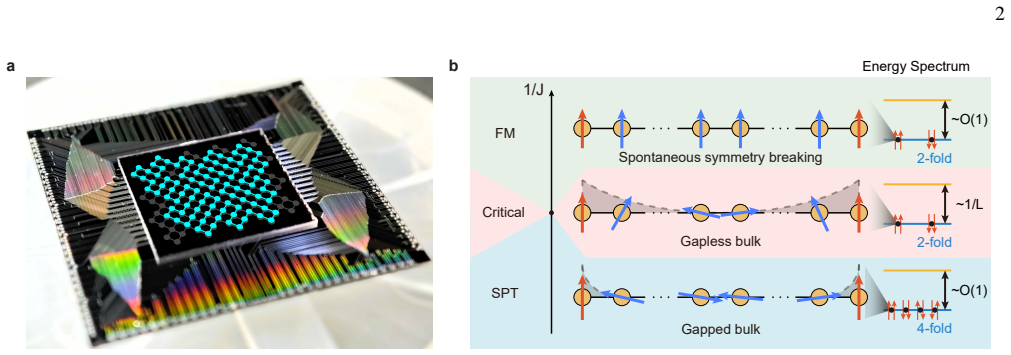
By preparing low-lying critical states of the cluster Ising model on a superconducting processor with up to 100 qubits and probing the boundary g-function together with two-fold topological degeneracy in the entanglement spectrum under periodic boundary conditions, the work experimentally verifies the universal bulk-boundary correspondence in topological critical systems.
What carries the argument
The boundary g-function extracted from prepared low-energy states, together with entanglement-spectrum degeneracy under periodic boundaries, which together identify the topological content of the critical cluster Ising model.
If this is right
- Low-lying critical states can serve as resources for studying topology without requiring a bulk gap.
- Programmable processors enable direct access to the interplay of topology and criticality in models with many qubits.
- The bulk-boundary correspondence holds for the tested critical cluster Ising model, extending the correspondence beyond gapped topological phases.
Where Pith is reading between the lines
- The same preparation and measurement approach could be applied to other critical Hamiltonians to test whether additional models host topological criticality.
- If the method scales, it opens a route to classifying quantum phase transitions by their topological signatures rather than by symmetry alone.
- Critical states prepared this way might be usable in hybrid quantum protocols that combine criticality with boundary topological protection.
Load-bearing premise
The states prepared on the processor remain close enough to the ideal low-energy eigenstates of the critical cluster Ising Hamiltonian that the measured g-function and entanglement degeneracy still reflect the intended topological properties.
What would settle it
A measurement on a well-calibrated processor that yields a g-function value matching the trivial case or an entanglement spectrum lacking the expected two-fold degeneracy at the critical point would falsify the verification of bulk-boundary correspondence.
Figures


read the original abstract
The discovery of nontrivial topology in quantum critical states has introduced a new paradigm for classifying quantum phase transitions and challenges the conventional belief that topological phases are typically associated with a bulk energy gap. However, realizing and characterizing such topologically nontrivial quantum critical states with large particle numbers remains an outstanding experimental challenge in statistical and condensed matter physics. Programmable quantum processors can directly prepare and manipulate exotic quantum many-body states, offering a powerful path for exploring the physics behind these states. Here, we present an experimental exploration of the critical cluster Ising model by preparing its low-lying critical states on a superconducting processor with up to $100$ qubits. We develop an efficient method to probe the boundary $g$-function based on prepared low-energy states, which allows us to uniquely identify the nontrivial topology of the critical systems under study. Furthermore, by adapting the entanglement Hamiltonian tomography technique, we recognize two-fold topological degeneracy in the entanglement spectrum under periodic boundary condition, experimentally verifying the universal bulk-boundary correspondence in topological critical systems. Our results demonstrate the low-lying critical states as useful quantum resources for investigating the interplay between topology and quantum criticality.
Editorial analysis
A structured set of objections, weighed in public.
Referee Report
Summary. The manuscript reports an experimental study of the critical cluster Ising model on a superconducting quantum processor with up to 100 qubits. Low-lying critical states are prepared, a method is developed to probe the boundary g-function for identifying nontrivial topology, and entanglement Hamiltonian tomography is used to observe two-fold degeneracy in the entanglement spectrum under periodic boundary conditions, thereby claiming experimental verification of the universal bulk-boundary correspondence in topological critical systems.
Significance. If the measured signatures are shown to be robust against hardware imperfections, the work would be significant as one of the first large-scale experimental realizations (N=100) of topology at quantum criticality, using programmable quantum hardware to access states that are difficult to prepare classically and providing direct tests of bulk-boundary correspondence beyond small-system numerics.
major comments (1)
- [State preparation and tomography sections] State-preparation and tomography sections: The central claim that the prepared states are faithful low-energy eigenstates of the ideal critical cluster Ising Hamiltonian (required for the g-function and entanglement degeneracy to reflect topology) lacks quantitative bounds on energy variance or overlap with the true critical states for N=100. Typical superconducting-processor error rates make this load-bearing; without such bounds or scaling analysis, the observed two-fold degeneracy and g-function could arise from non-critical or topologically trivial states mixed by noise.
Simulated Author's Rebuttal
We thank the referee for their careful reading of the manuscript and for identifying this important point regarding the characterization of the prepared states. We address the concern below.
read point-by-point responses
-
Referee: [State preparation and tomography sections] State-preparation and tomography sections: The central claim that the prepared states are faithful low-energy eigenstates of the ideal critical cluster Ising Hamiltonian (required for the g-function and entanglement degeneracy to reflect topology) lacks quantitative bounds on energy variance or overlap with the true critical states for N=100. Typical superconducting-processor error rates make this load-bearing; without such bounds or scaling analysis, the observed two-fold degeneracy and g-function could arise from non-critical or topologically trivial states mixed by noise.
Authors: We agree that quantitative bounds on preparation fidelity would strengthen the central claim. Direct computation of energy variance or overlap with the exact critical eigenstate is intractable for N=100. However, the manuscript demonstrates that the measured boundary g-function and the two-fold entanglement-spectrum degeneracy match the universal predictions for the topologically nontrivial critical point of the cluster Ising model. These signatures are highly sensitive to deviations from criticality or loss of topology and are unlikely to appear in generic noisy or trivial states. We have performed supporting numerical checks on smaller systems (where exact diagonalization is feasible) that confirm the preparation protocol yields states with the expected topological features. We will revise the manuscript to include an expanded discussion of these smaller-system benchmarks together with a qualitative error analysis based on the observed robustness of the signatures. revision: partial
Circularity Check
No circularity: experimental measurements on hardware
full rationale
The paper's central claims rest on direct state preparation and tomography on a superconducting processor (up to 100 qubits), followed by measurement of the boundary g-function and entanglement spectrum degeneracy. These are empirical observations, not mathematical derivations. No equations reduce a prediction to a fitted input by construction, no self-citation chain carries the load-bearing premise, and no ansatz or uniqueness theorem is smuggled in. The bulk-boundary correspondence verification is data-driven and externally falsifiable via hardware results, placing the work in the self-contained experimental category.
Axiom & Free-Parameter Ledger
Lean theorems connected to this paper
-
IndisputableMonolith/Foundation/RealityFromDistinction.leanreality_from_one_distinction unclear?
unclearRelation between the paper passage and the cited Recognition theorem.
preparing its low-lying critical states on a superconducting processor with up to 100 qubits... probe the boundary g-function... two-fold topological degeneracy in the entanglement spectrum
-
IndisputableMonolith/Cost/FunctionalEquation.leanwashburn_uniqueness_aczel unclear?
unclearRelation between the paper passage and the cited Recognition theorem.
variational quantum circuits... entanglement Hamiltonian tomography
What do these tags mean?
- matches
- The paper's claim is directly supported by a theorem in the formal canon.
- supports
- The theorem supports part of the paper's argument, but the paper may add assumptions or extra steps.
- extends
- The paper goes beyond the formal theorem; the theorem is a base layer rather than the whole result.
- uses
- The paper appears to rely on the theorem as machinery.
- contradicts
- The paper's claim conflicts with a theorem or certificate in the canon.
- unclear
- Pith found a possible connection, but the passage is too broad, indirect, or ambiguous to say the theorem truly supports the claim.
Forward citations
Cited by 6 Pith papers
-
Anomalous Dynamical Scaling at Topological Quantum Criticality
Topological quantum critical points exhibit anomalous dynamical scaling in boundary dynamics and defect production due to edge modes, beyond conventional Kibble-Zurek scaling.
-
PT symmetry-enriched non-unitary criticality
PT symmetry enriches non-Hermitian critical points with topological nontriviality, robust edge modes, and a quantized imaginary subleading term in entanglement entropy scaling.
-
Topology and edge modes surviving criticality in non-Hermitian Floquet systems
Non-Hermitian Floquet systems host gapless symmetry-protected topological phases with unified winding numbers and robust edge modes surviving at criticality.
-
Generalized Li-Haldane Correspondence in Critical Dirac-Fermion Systems
An exact relation is derived between bulk entanglement spectrum and boundary energy spectrum at topological criticality in free-fermion systems, allowing edge-mode degeneracy to be read from bulk data in arbitrary dimensions.
-
Generalized Li-Haldane Correspondence in Critical Dirac-Fermion Systems
Derives exact bulk-boundary correspondence allowing extraction of edge-mode degeneracy from bulk entanglement spectrum in critical free-fermion systems of arbitrary dimensions.
-
Deconfined criticality as intrinsically gapless topological state in one dimension
Deconfined criticality in a 1D lattice model is shown to be an intrinsically gapless topological state whose mixed anomaly enforces robust edge modes without gapped counterparts.
Reference graph
Works this paper leans on
- [1]
-
[2]
M. Z. Hasan and C. L. Kane, Rev. Mod. Phys.82, 3045 (2010)
work page 2010
- [3]
- [4]
-
[5]
T.Scaffidi,D.E.Parker, andR.Vasseur,Phys.Rev.X 7,041048 (2017)
work page 2017
-
[6]
R.Verresen,N.G.Jones, andF.Pollmann,Phys.Rev.Lett. 120, 057001 (2018)
work page 2018
-
[7]
R.Verresen,R.Thorngren,N.G.Jones, andF.Pollmann,Phys. Rev. X11, 041059 (2021)
work page 2021
- [8]
-
[9]
R. Thorngren, A. Vishwanath, and R. Verresen, Phys. Rev. B 104, 075132 (2021)
work page 2021
-
[10]
C. M. Duque, H.-Y. Hu, Y.-Z. You, V. Khemani, R. Verresen, and R. Vasseur, Phys. Rev. B103, L100207 (2021)
work page 2021
-
[11]
X.-J. Yu, S. Yang, H.-Q. Lin, and S.-K. Jian, Phys. Rev. Lett. 133, 026601 (2024)
work page 2024
- [12]
-
[13]
S. Yang, H.-Q. Lin, and X.-J. Yu, “Gifts from long-range in- teraction: Emergent gapless topological behaviors in quantum spin chain,” (2024), arXiv:2406.01974 [cond-mat.str-el]
-
[14]
W.-H.Zhong,W.-L.Li,Y.-C.Chen, andX.-J.Yu,Phys.Rev.A 110, 022212 (2024)
work page 2024
-
[15]
Intrinsically/purelygapless- spt from non-invertible duality transformations,
L.Li,M.Oshikawa, andY.Zheng,“Intrinsically/purelygapless- spt from non-invertible duality transformations,” (2023), arXiv:2307.04788 [cond-mat.str-el]
-
[16]
S.-J. Huang and M. Cheng, “Topological holography, quan- tumcriticality,andboundarystates,” (2023),arXiv:2310.16878 [cond-mat.str-el]
- [17]
- [18]
- [19]
-
[20]
H.-L.Zhang,H.-Z.Li,S.Yang, andX.-J.Yu,Phys.Rev.A 109, 062226 (2024)
work page 2024
-
[21]
Abanin, Laleh Aghababaie-Beni, Igor Aleiner, Trond I
R. Acharya, D. A. Abanin, L. Aghababaie-Beni,et al., Nature (2024), 10.1038/s41586-024-08449-y
-
[22]
Y. Kim, A. Eddins, S. Anand,et al., Nature618, 500 (2023)
work page 2023
- [23]
- [24]
- [25]
-
[26]
J. R. McClean, J. Romero, R. Babbush, and A. Aspuru-Guzik, New Journal of Physics18, 023023 (2016)
work page 2016
- [27]
-
[28]
F.Arute,K.Arya,R.Babbush, etal.,Science 369,1084(2020)
work page 2020
-
[29]
M. Larocca, S. Thanasilp, S. Wang, et al., “A review of barren plateaus in variational quantum computing,” (2024), arXiv:2405.00781 [quant-ph]
-
[30]
J. R. McClean, S. Boixo, V. N. Smelyanskiy, R. Babbush, and H. Neven, Nature Communications9, 4812 (2018)
work page 2018
- [31]
-
[32]
C.Kokail,R.vanBijnen,A.Elben,B.Vermersch, andP.Zoller, Nature Physics17, 936 (2021)
work page 2021
-
[33]
W. Ren, W. Li, S. Xu,et al., Nature Computational Science2, 711 (2022)
work page 2022
-
[34]
W. Son, L. Amico, R. Fazio, A. Hamma, S. Pascazio, and V. Vedral, Europhysics Letters95, 50001 (2011)
work page 2011
- [35]
-
[36]
J. B. Kogut, Rev. Mod. Phys.51, 659 (1979)
work page 1979
-
[37]
Applied Conformal Field Theory
P. Ginsparg, “Applied conformal field theory,” (1988), arXiv:hep-th/9108028 [hep-th]
work page internal anchor Pith review Pith/arXiv arXiv 1988
- [38]
-
[39]
J. L. Cardy, Nuclear Physics B240, 514 (1984)
work page 1984
- [40]
-
[41]
S. R. White, Phys. Rev. Lett.69, 2863 (1992)
work page 1992
-
[42]
Z. Zhou, D. Gaiotto, Y.-C. He, and Y. Zou, SciPost Phys.17, 021 (2024)
work page 2024
- [43]
-
[44]
F. Pollmann, A. M. Turner, E. Berg, and M. Oshikawa, Phys. Rev. B81, 064439 (2010)
work page 2010
-
[45]
J. J. Bisognano and E. H. Wichmann, Journal of Mathemati- cal Physics16, 985 (1975), https://pubs.aip.org/aip/jmp/article- pdf/16/4/985/19024093/985_1_online.pdf
work page 1975
- [46]
-
[47]
X.Chen,Y.-M.Lu, andA.Vishwanath,Naturecommunications 5, 3507 (2014)
work page 2014
-
[48]
T. Song, Y. Jia, G. Yu, ,et al., Nature Physics20, 269 (2024)
work page 2024
-
[49]
P. Calabrese and J. Cardy, Journal of Statistical Mechanics: Theory and Experiment2004, P06002 (2004)
work page 2004
-
[50]
R.Islam,R.Ma,P.M.Preiss,M.EricTai,A.Lukin,M.Rispoli, and M. Greiner, Nature528, 77 (2015). 7
work page 2015
- [51]
- [52]
-
[53]
E.Brillaux,A.A.Fedorenko, andI.A.Gruzberg,Phys.Rev.B 109, 174204 (2024)
work page 2024
-
[54]
M.OshikawaandI.Affleck,NuclearPhysicsB 495,533(1997)
work page 1997
-
[55]
M.Fishman,S.R.White, andE.M.Stoudenmire,SciPostPhys. Codebases , 4 (2022)
work page 2022
-
[56]
Gray, Journal of Open Source Software3, 819 (2018)
J. Gray, Journal of Open Source Software3, 819 (2018)
work page 2018
-
[57]
PennyLane: Automatic differentiation of hybrid quantum-classical computations
V. Bergholm, J. Izaac, M. Schuld,et al., “Pennylane: Au- tomatic differentiation of hybrid quantum-classical computa- tions,” (2022), arXiv:1811.04968 [quant-ph]
work page internal anchor Pith review Pith/arXiv arXiv 2022
- [58]
- [59]
-
[60]
TensorFlow: Large- scale machine learning on heterogeneous systems,
M. Abadi, A. Agarwal, P. Barham,et al., “TensorFlow: Large- scale machine learning on heterogeneous systems,” (2015), software available from tensorflow.org
work page 2015
- [61]
-
[62]
Probing many-body bell correlation depth with superconducting qubits,
K. Wang, W. Li, S. Xu, et al., “Probing many-body bell correlation depth with superconducting qubits,” (2024), arXiv:2406.17841 [quant-ph]
-
[63]
Y. Li and S. C. Benjamin, Phys. Rev. X7, 021050 (2017). 8 Supplementary Materials: Exploring nontrivial topology at quantum criticality in a superconducting processor I. THEORETICAL UNDERSTANDING A. Introduction to the gapless symmetry-protected topological phases To provide a more intuitive understanding of symmetry-protected topological properties in cr...
work page 2017
-
[64]
Zero Noise Extrapolation Tomitigatetheeffectsofnoiseinthequantumcircuits,weapplyZeroNoiseExtrapolation(ZNE)inconjunctionwithrandom Pauli twirls. We estimate the error-free outcome by running unitary-equivalent quantum circuits at different noise levels. Due to the regular structure of our state preparation circuit, it is particularly well-suited for apply...
-
[65]
Circuit Simplification During the measurement of state energies and overlaps, the circuit can be further simplified according to the commutation relations between CZ gates and single-qubit Pauli operators, as depicted in Fig. S7. Z X Z I ≡ I X Z I Z Z Z Z ≡ Z Z Z Z a b c ≡ X X X X 𝑼𝑼𝑶𝑶𝑶𝑶𝑶𝑶 ′ 𝑼𝑼𝑷𝑷𝑶𝑶𝑶𝑶 ′ † Y Y Y Y 𝑼𝑼𝑶𝑶𝑶𝑶𝑶𝑶 ′ 𝑼𝑼𝑷𝑷𝑶𝑶𝑶𝑶 ′ † FIG. S7.Circuit sim...
-
[66]
Intrinsic Noise Resistance The boundary𝑔-function measurement and EHT-based entanglement spectrum detection are naturally resistant to noise. For the boundary 𝑔-function, both the numerator and denominator overlaps will decrease under decoherent noise, but their ratio remainsnearlyconstant. InFig.S8,WesimulatetheeffectofCZdepolarizationerroronthemeasureme...
discussion (0)
Sign in with ORCID, Apple, or X to comment. Anyone can read and Pith papers without signing in.