Robust Set Partitioning Strategy for Malicious Information Detection in Large-Scale Internet of Things
Pith reviewed 2026-05-23 03:12 UTC · model grok-4.3
The pith
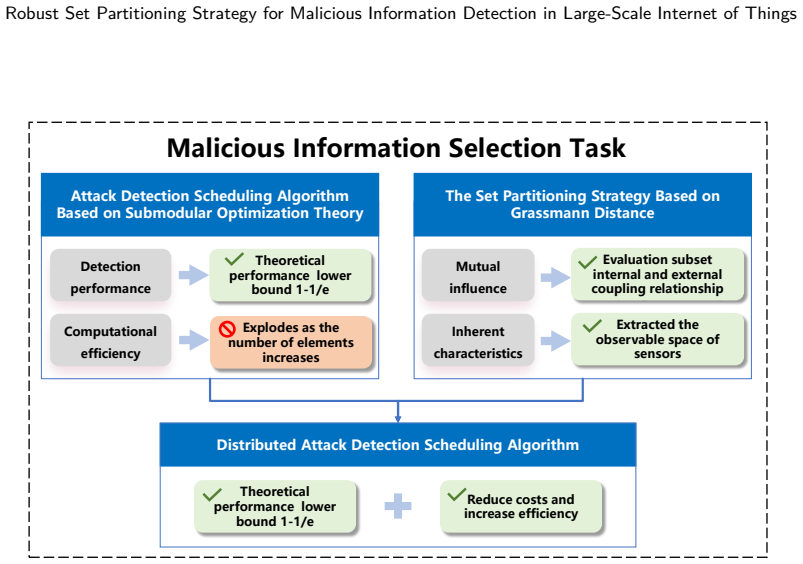
A Grassmann-distance set partitioning strategy lets distributed IoT attack detection match the centralized performance bound while reducing computation by a factor of m.
A machine-rendered reading of the paper's core claim, the machinery that carries it, and where it could break.
Core claim
The set partitioning strategy based on Grassmann distance ensures that the distributed setting under subset partitioning preserves the same theoretical performance bound as the baseline algorithm, while the computational cost of gain updates decreases at an order of O(1/m) with the number of subsets m, and the performance gap is limited to no more than 1.648%.
What carries the argument
The gain mutual influence metric, which characterizes inter-subset interference, combined with the Grassmann-distance-based set partitioning strategy that groups sensors by their intrinsic observational features to reduce that interference.
Load-bearing premise
The intrinsic observational features of sensors permit a partitioning that keeps inter-subset interference low enough to preserve the original performance bound by construction.
What would settle it
A counter-example dataset or network where applying the Grassmann-distance partitioning produces a performance gap larger than 1.648% while still using the same gain-update rule.
Figures
read the original abstract
With the rapid development of the Internet of Things (IoT), the risks of data tampering and malicious information injection have intensified, making efficient threat detection in large-scale distributed sensor networks a pressing challenge. To address the decline in malicious information detection efficiency as network scale expands, this paper investigates a robust set partitioning strategy and, on this basis, develops a distributed attack detection framework with theoretical guarantees. Specifically, we introduce a gain mutual influence metric to characterize the inter-subset interference arising during gain updates, thereby revealing the fundamental reason for the performance gap between distributed and centralized algorithms. Building on this insight, the set partitioning strategy based on Grassmann distance is proposed, which significantly reduces the computational cost of gain updates while maintaining detection performance, and ensures that the distributed setting under subset partitioning preserves the same theoretical performance bound as the baseline algorithm. Unlike conventional clustering methods, the proposed set partitioning strategy leverages the intrinsic observational features of sensors for robust partitioning, thereby enhancing resilience to noise and interference. Simulation results demonstrate that the proposed method limits the performance gap between distributed and centralized detection to no more than 1.648$\%$, while the computational cost decreases at an order of $O(1/m)$ with the number of subsets $m$. Therefore, the proposed algorithm effectively reduces computational overhead while preserving detection accuracy, offering a practical low-cost and highly reliable security detection solution for edge nodes in large-scale IoT systems.
Editorial analysis
A structured set of objections, weighed in public.
Referee Report
Summary. The paper introduces a gain mutual influence metric to quantify inter-subset interference in distributed malicious information detection for large-scale IoT sensor networks. It then proposes a Grassmann-distance-based set partitioning strategy that leverages intrinsic sensor observational features to reduce this interference, claiming that the resulting distributed algorithm preserves the same theoretical performance bound as the centralized baseline while lowering computational cost by a factor of O(1/m). Simulations are reported to limit the distributed-centralized performance gap to at most 1.648%.
Significance. If the theoretical bound preservation is shown to hold independently of the partitioning construction, the approach would offer a scalable, low-overhead method for edge-based attack detection with formal guarantees, addressing a practical bottleneck in expanding IoT deployments.
major comments (2)
- [§4] §4 (theoretical analysis section): the claim that Grassmann partitioning 'ensures' preservation of the baseline bound must be supported by an explicit derivation showing the bound is maintained independently of the partitioning definition rather than following tautologically from the gain mutual influence metric; the current presentation leaves open whether the bound is verified or built in by construction.
- [§5] Simulation results (reported in §5): the 1.648% gap is presented without accompanying methodology details, dataset descriptions, error bars, or statistical significance tests, which is required to substantiate the empirical support for the theoretical claim.
minor comments (2)
- The definition of the gain mutual influence metric should include an explicit formula or pseudocode to allow reproduction.
- Notation for the number of subsets m and the Grassmann distance should be introduced consistently in the abstract and early sections.
Simulated Author's Rebuttal
We thank the referee for the constructive comments, which help strengthen the manuscript. We will revise the paper to provide the requested explicit derivation in the theoretical section and to expand the simulation results with full methodological details.
read point-by-point responses
-
Referee: [§4] §4 (theoretical analysis section): the claim that Grassmann partitioning 'ensures' preservation of the baseline bound must be supported by an explicit derivation showing the bound is maintained independently of the partitioning definition rather than following tautologically from the gain mutual influence metric; the current presentation leaves open whether the bound is verified or built in by construction.
Authors: We agree that the current presentation requires clarification. In the revised §4, we will add an explicit derivation showing that the performance bound is preserved whenever the gain mutual influence metric remains below a derived threshold. The Grassmann-distance partitioning is shown to enforce this threshold condition through its use of intrinsic sensor features, and the derivation establishes the bound independently of any particular partition as long as the metric criterion holds. This separates the bound preservation from the specific construction of the partitioning. revision: yes
-
Referee: [§5] Simulation results (reported in §5): the 1.648% gap is presented without accompanying methodology details, dataset descriptions, error bars, or statistical significance tests, which is required to substantiate the empirical support for the theoretical claim.
Authors: We acknowledge the need for greater transparency in the empirical evaluation. The revised §5 will include full descriptions of the simulation methodology, the IoT sensor datasets employed, error bars computed over repeated trials, and statistical significance tests (such as paired t-tests) confirming that the observed performance gap of at most 1.648% is reliable. revision: yes
Circularity Check
No significant circularity identified
full rationale
The paper introduces a gain mutual influence metric to characterize inter-subset interference and proposes a Grassmann-distance partitioning strategy that is asserted to preserve the baseline theoretical performance bound while reducing computational cost. The abstract presents the bound preservation as a property ensured by the partitioning's use of intrinsic sensor features, with the 1.648% empirical gap supplied only as simulation support. No equation, derivation step, or self-citation in the provided text reduces the bound claim to a fitted input, self-definition, or prior author result by construction. The argument structure remains independent of the target result and is therefore self-contained.
Axiom & Free-Parameter Ledger
free parameters (1)
- number of subsets m
axioms (1)
- domain assumption Grassmann distance between sensor observation subspaces provides a robust measure for partitioning that preserves detection bounds
invented entities (1)
-
gain mutual influence metric
no independent evidence
Reference graph
Works this paper leans on
-
[1]
author Aljumaiah, O. , author Jiang, W. , author Addula, S.R. , author Almaiah, M.A. , year 2025 . title Analyzing cybersecurity risks and threats in it infrastructure based on nist framework . journal J. Cyber Secur. Risk Audit volume 2025 , pages 12--26
work page 2025
-
[2]
author Alsalem, T. , author Amin, M. , year 2023 . title Towards trustworthy iot systems: Cybersecurity threats, frameworks, and future directions . journal Journal of Cyber Security and Risk Auditing volume 2023 , pages 3--18
work page 2023
-
[3]
author An, L. , author Yang, G.H. , year 2022 . title Fast state estimation under sensor attacks: A sensor categorization approach . journal Automatica volume 142 , pages 110395
work page 2022
-
[4]
author Balta, E.C. , author Pease, M. , author Moyne, J. , author Barton, K. , author Tilbury, D.M. , year 2023 . title Digital twin-based cyber-attack detection framework for cyber-physical manufacturing systems . journal IEEE Transactions on Automation Science and Engineering volume 21 , pages 1695--1712
work page 2023
-
[5]
author Ding, D. , author Han, Q.L. , author Ge, X. , author Wang, J. , year 2020 . title Secure state estimation and control of cyber-physical systems: A survey . journal IEEE Transactions on Systems, Man, and Cybernetics: Systems volume 51 , pages 176--190
work page 2020
-
[6]
author Ding, H. , author Chen, L. , author Dong, L. , author Fu, Z. , author Cui, X. , year 2022 . title Imbalanced data classification: A knn and generative adversarial networks-based hybrid approach for intrusion detection . journal Future Generation Computer Systems volume 131 , pages 240--254
work page 2022
-
[7]
author Edelman, A. , author Arias, T.A. , author Smith, S.T. , year 1998 . title The geometry of algorithms with orthogonality constraints . journal SIAM journal on Matrix Analysis and Applications volume 20 , pages 303--353
work page 1998
-
[8]
title ENISA Threat Landscape Report 2018
author European Union Agency for Network and Information Security (ENISA) , year 2019 . title ENISA Threat Landscape Report 2018 . type Technical Report . ENISA. https://www.enisa.europa.eu/publications/enisa-threat-landscape-report-2018. note accessed: 2019-1-28
work page 2019
-
[9]
author Ge, X. , author Han, Q.L. , author Zhong, M. , author Zhang, X.M. , year 2019 . title Distributed krein space-based attack detection over sensor networks under deception attacks . journal Automatica volume 109 , pages 108557
work page 2019
-
[10]
author Halgamuge, M.N. , author Niyato, D. , year 2025 . title Adaptive edge security framework for dynamic iot security policies in diverse environments . journal Computers & Security volume 148 , pages 104128
work page 2025
-
[11]
author Han, J. , author Pei, J. , author Tong, H. , year 2022 . title Data mining: concepts and techniques . publisher Morgan kaufmann
work page 2022
-
[12]
author Humphreys, E. , year 2016 . title Implementing the ISO/IEC 27001: 2013 ISMS Standard . publisher Artech house
work page 2016
-
[13]
author Kwon, C. , author Liu, W. , author Hwang, I. , year 2013 . title Security analysis for cyber-physical systems against stealthy deception attacks , in: booktitle 2013 American control conference , organization IEEE . pp. pages 3344--3349
work page 2013
-
[14]
author Leander, B. , author C au s evi \'c , A. , author Hansson, H. , year 2019 . title Applicability of the iec 62443 standard in industry 4.0/iiot , in: booktitle Proceedings of the 14th International Conference on Availability, Reliability and Security , pp. pages 1--8
work page 2019
-
[15]
author Li, T. , author Chen, B. , author Liu, S. , author Wang, Z. , author Zhang, W.A. , author Yu, L. , year 2023 . title Fast attack detection for cyber--physical systems using dynamic data encryption . journal IEEE Transactions on Cybernetics
work page 2023
-
[16]
author Li, Z. , author Chen, X. , author Chen, Y. , author Li, S. , author Wang, H. , author Lv, S. , author Sun, L. , year 2024 . title Detecting cyber-attacks against cyber-physical manufacturing system: A machining process invariant approach . journal IEEE Internet of Things Journal
work page 2024
-
[17]
author Lu, A.Y. , author Yang, G.H. , year 2023 a. title A polynomial-time algorithm for the secure state estimation problem under sparse sensor attacks via state decomposition technique . journal IEEE Transactions on Automatic Control volume 68 , pages 7451--7465
work page 2023
-
[18]
author Lu, A.Y. , author Yang, G.H. , year 2023 b. title Secure state estimation under sparse sensor attacks via saturating adaptive technique . journal IEEE Transactions on Control of Network Systems volume 10 , pages 1890--1898
work page 2023
-
[19]
author Masud, M.T. , author Keshk, M. , author Moustafa, N. , author Turnbull, B. , author Susilo, W. , year 2025 . title Vulnerability defence using hybrid moving target defence in internet of things systems . journal Computers & Security volume 153 , pages 104380
work page 2025
-
[20]
author Mathews, S.P. , author Gondkar, R.R. , year 2019 . title Protocol recommendation for message encryption in mqtt , in: booktitle 2019 International Conference on Data Science and Communication (IconDSC) , organization IEEE . pp. pages 1--5
work page 2019
-
[21]
author Matsuoka, T. , author Ito, S. , author Ohsaka, N. , year 2021 . title Tracking regret bounds for online submodular optimization , in: booktitle International Conference on Artificial Intelligence and Statistics , organization PMLR . pp. pages 3421--3429 . :None
work page 2021
-
[22]
author Mirzasoleiman, B. , author Karbasi, A. , author Sarkar, R. , author Krause, A. , year 2016 . title Distributed submodular maximization . journal The Journal of Machine Learning Research volume 17 , pages 8330--8373
work page 2016
-
[23]
author Mouha, N. , author Mouha, N. , year 2021 . title Review of the advanced encryption standard . publisher US Department of Commerce, National Institute of Standards and Technology
work page 2021
-
[24]
author Mustafa, A. , author Mazouchi, M. , author Modares, H. , year 2022 . title Secure event-triggered distributed kalman filters for state estimation over wireless sensor networks . journal IEEE Transactions on Systems, Man, and Cybernetics: Systems volume 53 , pages 1268--1283
work page 2022
-
[25]
author Pang, Z.H. , author Fan, L.Z. , author Dong, Z. , author Han, Q.L. , author Liu, G.P. , year 2021 . title False data injection attacks against partial sensor measurements of networked control systems . journal IEEE Transactions on Circuits and Systems II: Express Briefs volume 69 , pages 149--153
work page 2021
-
[26]
author Pascoe, C.E. , year 2023 . title Public draft: The nist cybersecurity framework 2.0 . journal National Institute of Standards and Technology
work page 2023
-
[27]
author Pavithran, D. , author Shaalan, K. , author Al-Karaki, J.N. , author Gawanmeh, A. , year 2020 . title Towards building a blockchain framework for iot . journal Cluster Computing volume 23 , pages 2089--2103
work page 2020
-
[28]
author Qaddos, A. , author Yaseen, M.U. , author Al-Shamayleh, A.S. , author Imran, M. , author Akhunzada, A. , author Alharthi, S.Z. , year 2024 . title A novel intrusion detection framework for optimizing iot security . journal Scientific Reports volume 14 , pages 21789
work page 2024
-
[29]
author Shoukry, Y. , author Nuzzo, P. , author Puggelli, A. , author Sangiovanni-Vincentelli, A.L. , author Seshia, S.A. , author Tabuada, P. , year 2017 . title Secure state estimation for cyber-physical systems under sensor attacks: A satisfiability modulo theory approach . journal IEEE Transactions on Automatic Control volume 62 , pages 4917--4932
work page 2017
-
[30]
author Smith, K.J. , author Dhillon, G. , author Carter, L. , year 2021 . title User values and the development of a cybersecurity public policy for the iot . journal International Journal of Information Management volume 56 , pages 102123
work page 2021
-
[31]
author Sugiharto, F. , author Kaburuan, E. , year 2023 . title Architecture design of iot-based system using iso/iec 30141: 2018 for indoor agriculture . journal ICIC Express Letters volume 17 , pages 397--408
work page 2023
-
[32]
Cost-Aware Distributed Online Learning with Strict Rejection Behavior against Adversarial Agents
author Suo, Y. , author Chai, R. , author Chai, S. , author Farhan, I. , author Zhao, X. , author Xia, Y. , year 2024 a. title Opinion dynamic under malicious agent influence in multi-agent systems: From the perspective of opinion evolution cost . journal arXiv preprint arXiv:2412.01524
work page internal anchor Pith review Pith/arXiv arXiv 2024
-
[33]
author Suo, Y. , author Chai, R. , author Chai, S. , author Farhan, I.M. , author Xia, Y. , author Liu, G.P. , year 2024 b. title Attack detection and secure state estimation of collectively observable cyber-physical systems under false data injection attacks . journal IEEE Transactions on Automatic Control volume 69 , pages 2067--2074 . :10.1109/TAC.2023.3316160
-
[34]
author Suo, Y. , author Chai, R. , author Chen, K. , author Chai, S. , author Liang, W. , author Xia, Y. , year 2025 . title Efficient malicious information detection method based on set partitioning for large-scale internet of things . journal arXiv preprint arXiv:2502.11538
work page internal anchor Pith review Pith/arXiv arXiv 2025
-
[35]
author Suo, Y. , author Chai, S. , author Chai, R. , author Pang, Z.H. , author Xia, Y. , author Liu, G.P. , year 2024 c. title Security defense of large-scale networks under false data injection attacks: An attack detection scheduling approach . journal IEEE Transactions on Information Forensics and Security volume 19 , pages 1908--1921 . :10.1109/TIFS.2...
-
[36]
author Thakkar, A. , author Lohiya, R. , year 2023 . title Attack classification of imbalanced intrusion data for iot network using ensemble-learning-based deep neural network . journal IEEE Internet of Things Journal volume 10 , pages 11888--11895
work page 2023
-
[37]
author Vlachos, I. , author Pascazzi, R.M. , author Ntotis, M. , author Spanaki, K. , author Despoudi, S. , author Repoussis, P. , year 2024 . title Smart and flexible manufacturing systems using autonomous guided vehicles (agvs) and the internet of things (iot) . journal International Journal of Production Research volume 62 , pages 5574--5595
work page 2024
-
[38]
author Wang, Y. , author Lu, Z. , author Ma, J. , author Jin, Q. , year 2025 . title Locational false data injection attack detection in smart grid using recursive variational graph auto-encoder . journal IEEE Internet of Things Journal
work page 2025
-
[39]
author Wang, Z. , author Chen, H. , author Yang, X. , author Wan, J. , author Li, T. , author Luo, C. , year 2023 . title Fuzzy rough dimensionality reduction: a feature set partition-based approach . journal Information Sciences volume 644 , pages 119266
work page 2023
-
[40]
author Xia, S. , author Zheng, S. , author Wang, G. , author Gao, X. , author Wang, B. , year 2021 . title Granular ball sampling for noisy label classification or imbalanced classification . journal IEEE Transactions on Neural Networks and Learning Systems volume 34 , pages 2144--2155
work page 2021
-
[41]
author Xia, W. , author Zhou, M. , year 2025 . title Resilient distributed kalman filtering against malicious cyber attacks . journal IEEE Transactions on Aerospace and Electronic Systems
work page 2025
-
[42]
author Xie, H. , author Yan, Z. , author Yao, Z. , author Atiquzzaman, M. , year 2018 . title Data collection for security measurement in wireless sensor networks: A survey . journal IEEE Internet of Things Journal volume 6 , pages 2205--2224
work page 2018
-
[43]
author Xin, L. , author He, G. , author Long, Z. , year 2025 . title Secure state estimation for multi-sensor cyber-physical systems using virtual sensor and deep reinforcement learning under multiple attacks on major sensor . journal IEEE Transactions on Network Science and Engineering
work page 2025
-
[44]
author Yang, T. , author Lv, C. , year 2021 . title Secure estimation and attack isolation for connected and automated driving in the presence of malicious vehicles . journal IEEE Transactions on Vehicular Technology volume 70 , pages 8519--8528
work page 2021
-
[45]
author Yousefnezhad, N. , author Malhi, A. , author Fr \"a mling, K. , year 2020 . title Security in product lifecycle of iot devices: A survey . journal Journal of Network and Computer Applications volume 171 , pages 102779
work page 2020
-
[46]
author Zhang, J. , author Pan, L. , author Han, Q.L. , author Chen, C. , author Wen, S. , author Xiang, Y. , year 2021 . title Deep learning based attack detection for cyber-physical system cybersecurity: A survey . journal IEEE/CAA Journal of Automatica Sinica volume 9 , pages 377--391
work page 2021
-
[47]
author Zhang, J. , author Tao, D. , year 2020 . title Empowering things with intelligence: a survey of the progress, challenges, and opportunities in artificial intelligence of things . journal IEEE Internet of Things Journal volume 8 , pages 7789--7817
work page 2020
-
[48]
author Zhang, L. , author Xie, X. , author Xiao, K. , author Bai, W. , author Liu, K. , author Dong, P. , year 2022 . title Manomaly: Mutual adversarial networks for semi-supervised anomaly detection . journal Information Sciences volume 611 , pages 65--80
work page 2022
-
[49]
author Zhao, Z. , author Xu, Y. , author Li, Y. , author Zhao, Y. , author Wang, B. , author Wen, G. , year 2023 . title Sparse actuator attack detection and identification: A data-driven approach . journal IEEE Transactions on Cybernetics volume 53 , pages 4054--4064
work page 2023
-
[50]
author Zhou, J. , author Yang, W. , author Zhang, H. , author Zheng, W.X. , author Xu, Y. , author Tang, Y. , year 2022 . title Security analysis and defense strategy of distributed filtering under false data injection attacks . journal Automatica volume 138 , pages 110151
work page 2022
-
[51]
" write newline "" before.all 'output.state := FUNCTION n.dashify 't := "" t empty not t #1 #1 substring "-" = t #1 #2 substring "--" = not "--" * t #2 global.max substring 't := t #1 #1 substring "-" = "-" * t #2 global.max substring 't := while if t #1 #1 substring * t #2 global.max substring 't := if while FUNCTION word.in bbl.in ":" * " " * FUNCTION f...
discussion (0)
Sign in with ORCID, Apple, or X to comment. Anyone can read and Pith papers without signing in.