Human brain state classification via permutation entropy of EEG phase dynamics across consciousness levels and inattentive-type ADHD
Pith reviewed 2026-05-23 00:33 UTC · model grok-4.3
The pith
Permutation entropy of EEG phase dynamics distinguishes conscious from unconscious states but not ADHD groups.
A machine-rendered reading of the paper's core claim, the machinery that carries it, and where it could break.
Core claim
Permutation entropy distributions from the principal mode of EEG phase dynamics exhibit a clear dependence on brain state. Conscious, inattentive-type ADHD, and eyes-closed conditions show lower mean values and larger standard deviations. Classification models using this entropy as input reliably capture conscious versus unconscious states in the anesthesia dataset and eyes-open versus eyes-closed in the resting-state dataset, but do not show clear separability between control and inattentive-type ADHD groups, indicating that original time-series values may be more crucial for ADHD detection.
What carries the argument
Permutation entropy applied to ordinal patterns of the principal mode of EEG phase dynamics reflecting anterior-posterior information flow.
If this is right
- Conscious and unconscious states are reliably distinguishable in general anesthesia EEG data.
- Eyes-open and eyes-closed conditions are distinguishable in resting-state EEG.
- Control and inattentive-type ADHD groups show no clear separability using this measure.
- Conscious, ADHD, and eyes-closed conditions have lower mean permutation entropy with larger standard deviations.
Where Pith is reading between the lines
- The finding that amplitude information may be needed for ADHD suggests combining ordinal and amplitude features could improve detection.
- This approach might apply to monitoring other altered states of consciousness beyond anesthesia.
- Limitations in ADHD classification point to the need for multi-feature models in clinical diagnostics.
Load-bearing premise
Restricting analysis to the principal mode of EEG phase dynamics and applying permutation entropy to its ordinal patterns is sufficient to capture the disorder relevant to brain-state discrimination without the original time-series amplitude values.
What would settle it
Testing whether classification accuracy for ADHD improves when including the original EEG time-series amplitude values alongside the permutation entropy.
Figures



read the original abstract
We analyze electroencephalography (EEG) signals using the ordinal pattern framework to investigate whether different human brain states can be distinguished based on the disorder of EEG dynamics. Rather than analyzing raw EEG signals, we focus on the principal mode of EEG phase dynamics, reflecting anterior-posterior information flow, and quantify disorder using permutation entropy. We apply this to two datasets: (i) EEG recordings from a general anesthesia protocol, and (ii) EEG recordings acquired in the resting state from healthy control subjects and individuals with inattentive-type attention deficit hyperactivity disorder (ADHD), including eyes-open and eyes-closed conditions. We find that the permutation entropy distributions exhibit a clear dependence on brain state. In particular, conscious, inattentive-type ADHD, and eyes closed conditions show lower mean values and larger standard deviations of permutation entropy. To evaluate the discriminative power of permutation entropy, we train classification models using permutation entropy as an input feature. The results show that the distinction between conscious and unconscious states can be reliably captured in the general-anesthesia dataset. In the resting-state dataset, eyes-open and eyes-closed conditions are distinguishable, whereas classification between control and inattentive-type ADHD groups does not show clear separability. This indicates that information not captured in ordinal patterns, such as the original time-series values, may play a more crucial role in detecting inattentive-type ADHD. Our findings demonstrate that permutation entropy derived from EEG phase dynamics provides an effective indicator of brain states, particularly in relation to consciousness, while also highlighting its limitations for identifying individuals with inattentive-type ADHD.
Editorial analysis
A structured set of objections, weighed in public.
Referee Report
Summary. The manuscript analyzes EEG signals by extracting the principal mode of phase dynamics (intended to capture anterior-posterior information flow) and computing permutation entropy on its ordinal patterns. It applies this to a general-anesthesia dataset and a resting-state dataset (controls vs. inattentive-type ADHD, eyes-open vs. eyes-closed). The central claims are that permutation-entropy distributions differ by brain state (lower mean, larger SD for conscious/ADHD/eyes-closed), that classification models trained on these values reliably separate conscious from unconscious states and eyes-open from eyes-closed, but fail to separate ADHD from controls, implying that amplitude information (absent from ordinal patterns) is required for the ADHD distinction.
Significance. If the reported classification results can be substantiated with quantitative metrics, the work would supply a computationally lightweight, ordinal-pattern-based marker for consciousness level that avoids direct use of signal amplitude. The negative ADHD result would then usefully highlight a limitation of phase-only ordinal analysis. At present the absence of performance numbers prevents any assessment of practical utility or comparison with existing EEG complexity or connectivity markers.
major comments (3)
- [Results] Results section (classification experiments): the statements that conscious/unconscious states 'can be reliably captured' and that eyes-open/closed conditions 'are distinguishable' are unsupported by any reported accuracy, AUC, F1, confusion matrix, cross-validation scheme, or statistical test; without these quantities the distributional differences cannot be translated into a claim of discriminative power.
- [Methods] Methods (phase-dynamics extraction and permutation-entropy calculation): the procedure for isolating the 'principal mode of EEG phase dynamics' is described only at a high level; no explicit algorithm, decomposition method, or definition of anterior-posterior flow is given, rendering both the positive consciousness results and the negative ADHD conclusion non-reproducible and preventing evaluation of whether amplitude information was truly excluded.
- [Abstract / Results] Abstract and Results: the claim that 'information not captured in ordinal patterns, such as the original time-series values, may play a more crucial role in detecting inattentive-type ADHD' is an interpretation of a negative classification result; because no positive performance metrics are supplied for the other tasks, it is impossible to judge whether the ADHD failure is due to the feature choice or to insufficient model capacity or data quality.
minor comments (2)
- [Abstract] The abstract states that 'permutation entropy distributions exhibit a clear dependence on brain state' yet supplies no numerical means, standard deviations, or p-values; these should be added to the corresponding results paragraph or table.
- [Methods / Datasets] No statement is made about the number of subjects, channels, or recording lengths in either dataset; these basic sample-size details are required for interpreting the reported standard deviations of permutation entropy.
Simulated Author's Rebuttal
We thank the referee for the constructive comments. The feedback correctly identifies that quantitative classification metrics and expanded methodological details are needed to support the claims. We will revise the manuscript to address these issues directly.
read point-by-point responses
-
Referee: [Results] Results section (classification experiments): the statements that conscious/unconscious states 'can be reliably captured' and that eyes-open/closed conditions 'are distinguishable' are unsupported by any reported accuracy, AUC, F1, confusion matrix, cross-validation scheme, or statistical test; without these quantities the distributional differences cannot be translated into a claim of discriminative power.
Authors: We agree that the current presentation relies on distributional differences without reporting performance metrics. In the revised manuscript we will add accuracy, AUC, F1, confusion matrices, a description of the cross-validation scheme, and appropriate statistical tests for the consciousness and eyes-open/closed distinctions. revision: yes
-
Referee: [Methods] Methods (phase-dynamics extraction and permutation-entropy calculation): the procedure for isolating the 'principal mode of EEG phase dynamics' is described only at a high level; no explicit algorithm, decomposition method, or definition of anterior-posterior flow is given, rendering both the positive consciousness results and the negative ADHD conclusion non-reproducible and preventing evaluation of whether amplitude information was truly excluded.
Authors: We acknowledge the description is high-level. The revised Methods section will supply the explicit algorithm, the decomposition technique employed to isolate the principal mode, and a precise definition of the anterior-posterior flow measure, thereby allowing full reproducibility and confirmation that amplitude information was excluded. revision: yes
-
Referee: [Abstract / Results] Abstract and Results: the claim that 'information not captured in ordinal patterns, such as the original time-series values, may play a more crucial role in detecting inattentive-type ADHD' is an interpretation of a negative classification result; because no positive performance metrics are supplied for the other tasks, it is impossible to judge whether the ADHD failure is due to the feature choice or to insufficient model capacity or data quality.
Authors: We accept that the interpretation cannot be fully evaluated without the missing metrics. Once the quantitative results for the consciousness and eyes-open/closed tasks are added (as noted in the first response), the negative ADHD outcome can be placed in proper context; the revised text will qualify the interpretation accordingly. revision: yes
Circularity Check
No circularity; empirical application of pre-defined measure with no derivations or self-referential reductions
full rationale
The paper applies the standard permutation entropy measure (a known ordinal-pattern complexity metric) to the principal mode of EEG phase dynamics extracted from two datasets. No equations, derivations, or parameter-fitting steps are described that would reduce any reported classification performance or separability claim to a fitted input or self-citation chain. The work consists of straightforward group comparisons and model training on the pre-computed entropy values; the negative ADHD result and positive consciousness/eyes-open-closed results are presented as direct empirical outcomes without any load-bearing self-definition or renaming of known results. This is the most common honest non-finding for purely empirical studies.
Axiom & Free-Parameter Ledger
axioms (1)
- standard math Permutation entropy computed on ordinal patterns of a time series is a valid scalar measure of its disorder.
Forward citations
Cited by 1 Pith paper
-
Morphological complexity of NGC 628 - a multiwavelength multiscale analysis using the ordinal pattern framework
Multiwavelength analysis of NGC 628 using ordinal pattern measures finds a ~200 pc characteristic scale separating star-formation-driven structures from larger dynamical morphology, with C-H trajectories converging to...
Reference graph
Works this paper leans on
-
[1]
For a time series X = {xi ; i = 1 , 2, 3, . . . , M} of given length M, we divide it into overlapping partitions m = M −(dx−1)τ with embedding delay τ. Our analysis take consecutive time units (τ = 1)
-
[2]
, xp+(dx−1)) with partition index p = 1 , 2, 3,
Next, for each data partition Dp = (xp, xp+1, . . . , xp+(dx−1)) with partition index p = 1 , 2, 3, . . . , m, we determine a permutation state πp = ( u0, u1, . . . , udx−1) of (0 , 1, . . . , dx − 1) by sorting the elements in ascending order. The inequality xp+u0 ≤ xp+u1 ≤ · · · ≤ xp+udx−1 defines the permutation of the index numbers
-
[3]
Now, we generate the symbolic sequence {πp}p=1,2,3,...,m known as ordinal sequence
-
[4]
Then we calculate the relative frequency of all pos- sible patterns as: ρj(πj) = # patterns of type πj in permutation {πp} m , (2) where P = {ρj(πj)} is the ordinal probability dis- tribution with j = 1, 2, 3, . . . , dx!. Permutation entropy S[P ] [17] is defined as: S[P ] = − dx!X j=1 ρj(πj) logρj(πj). (3) The normalized permutation entropy H[P ] [44] i...
-
[5]
Firstly, we calculate the profile, Z(i) ≡ iX n=1 (xn − ⟨x⟩), i = 1, 2, . . . , M. (10)
-
[6]
If M is not a multiple of s, we repeat from the end resulting in 2 Ms segments
We then divide Z(i) into Ms ≡ int M s non- overlapping segments of equal scale length s. If M is not a multiple of s, we repeat from the end resulting in 2 Ms segments
-
[7]
We now determine the variance of each segment ν: F 2(ν, s) ≡ 1 s sX i=1 {Z[(ν − 1)s + i] − zν(i)}2, (11) for ν = 1, 2, . . . , Ms, and F 2(ν, s) ≡ 1 s sX i=1 {Z[M − (ν − Ms)s + i] − zν(i)}2, for ν = Ms + 1, ...,2Ms, where zν(i) is the fitting polynomial in segment ν
-
[8]
Next, we compute the qth order fluctuation function Fq(s) by averaging over all the segments as Fq(s) ≡ ( 1 2Ms 2M sX ν=1 [F 2(ν, s)]q/2 )1/q , (12) for different time scales s and statistical moments q
-
[9]
If the time series {xi} is long-range power-law cor- related, then Fq(s) follows a power-law with the scale length s as, Fq(s) ∼ sh(q), (13) where the power-law exponent h(q) is known as the generalized Hurst exponent. In the log-log plot of Fq(s) versus s for different values ofq, the exponent h(q) corresponds to the slopes of the graphs. Since Fq=0(s) i...
-
[10]
General Anesthesia Dataset (University of Michigan) The dataset I consists of EEG recordings from eigh- teen healthy volunteers (aged 20-40 years) collected at the University of Michigan [53, 54]. Nine participants underwent general anesthesia administration, while the remaining were recorded without anesthesia. The study was reviewed in accordance with t...
-
[11]
Attention Deficit Hyperactivity Disorder (Healthy Brain Network) The Healthy Brain Network (HBN) dataset is released by the Child Mind Institute [55]. Attention Deficit Hy- peractivity Disorder (ADHD) is typically categorized into three main subtypes: inattentive, hyperactive-impulsive, and combined. To establish a more robust sample, we have selected ind...
-
[12]
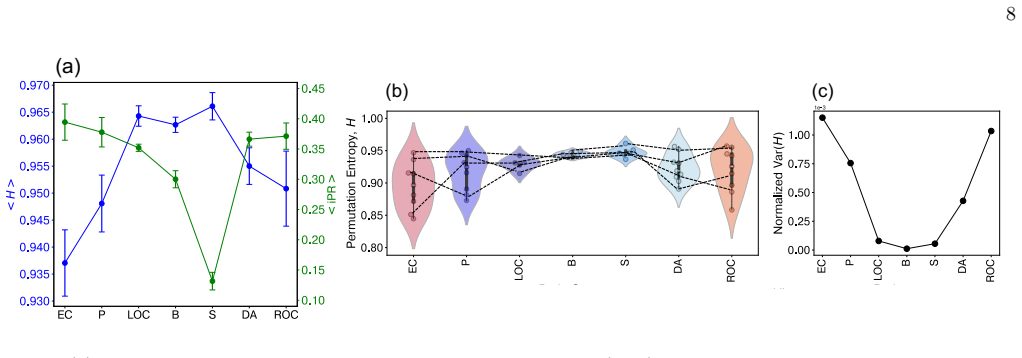
Permutation entropy and depth of anesthesia The general anesthesia dataset I comprises seven dis- tinct brain states that reflect varying levels of conscious- ness: eyes closed (EC), propofol injection (P), loss of consciousness (LOC), burst (B), suppression (S), deep anesthesia (DA), and recovery of consciousness (ROC). The development of robust indicato...
-
[13]
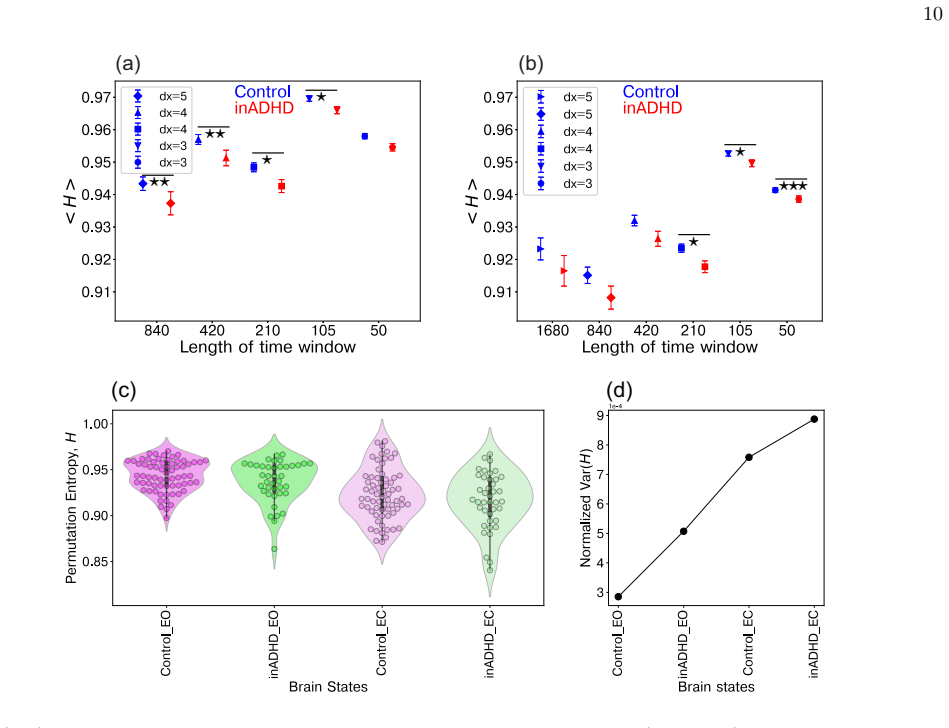
Comparison of inattentive ADHD with control groups Building on previous research that permutation en- tropy provides reliable estimates related to normal and disordered brain functioning [34, 35], we now compare between healthy controls and inattentive type of ADHD (inADHD) subjects using our EEG-relative phase time series β1(t). The upper panels of Fig. ...
work page 2023
-
[14]
Mitchell, Complexity: A guided tour, Oxford university press (2009)
M. Mitchell, Complexity: A guided tour, Oxford university press (2009)
work page 2009
-
[15]
J. Gonz´ alez-Miranda, Complex bifurcation structures in the hindmarsh–rose neuron model, International Journal of Bifurcation and Chaos 17 (2007) 3071
work page 2007
-
[16]
Y. Penn, M. Segal and E. Moses, Network synchronization in hippocampal neurons, Proceedings of the National Academy of Sciences 113 (2016) 3341
work page 2016
- [17]
- [18]
- [19]
-
[20]
A.C. Yang and S.-J. Tsai, Is mental illness complex? from behavior to brain, Progress in Neuro-Psychopharmacology and Biological Psychiatry 45 (2013) 253
work page 2013
-
[21]
J. Frohlich, J. Moser, K. Sippel, P.A. Mediano, H. Preissl and A. Gharabaghi, Sex differences in prenatal development of neural complexity in the human brain, Nature Mental Health 2 (2024) 401
work page 2024
-
[22]
K. Shen, A. McFadden and A.R. McIntosh, Signal complexity indicators of health status in clinical eeg, Scientific Reports 11 (2021) 20192
work page 2021
-
[23]
R. Friedrich, J. Peinke, M. Sahimi and M.R.R. Tabar, Approaching complexity by stochastic methods: From biological systems to turbulence, Physics Reports 506 (2011) 87
work page 2011
-
[24]
A. Roli, A. Ligot and M. Birattari, Complexity measures: open questions and novel opportunities in the automatic design and analysis of robot swarms, Frontiers in Robotics and AI 6 (2019) 130
work page 2019
-
[25]
Lloyd, Measures of complexity: a nonexhaustive list, IEEE Control Systems Magazine 21 (2001) 7
S. Lloyd, Measures of complexity: a nonexhaustive list, IEEE Control Systems Magazine 21 (2001) 7
work page 2001
-
[26]
S.H. Strogatz, Nonlinear dynamics and chaos: with applications to physics, biology, chemistry, and engineering, Chapman and Hall/CRC (2024)
work page 2024
-
[27]
S. Thurner, B. Corominas-Murtra and R. Hanel, Three faces of entropy for complex systems: Information, thermodynamics, and the maximum entropy principle, Physical Review E 96 (2017) 032124
work page 2017
-
[28]
G. Datseris, I. Kottlarz, A.P. Braun and U. Parlitz, Estimating fractal dimensions: A comparative review and open source implementations, Chaos: An Interdisciplinary Journal of Nonlinear Science 33 (2023) 102101
work page 2023
-
[29]
Shannon, A mathematical theory of communication, The Bell system technical journal 27 (1948) 379
C.E. Shannon, A mathematical theory of communication, The Bell system technical journal 27 (1948) 379
work page 1948
-
[30]
C. Bandt and B. Pompe, Permutation entropy: a natural complexity measure for time series, Physical review letters 88 (2002) 174102
work page 2002
-
[31]
A.A.Pessa and H.V. Ribeiro, ordpy: A python package for data analysis with permutation entropy and ordinal network methods, Chaos: An Interdisciplinary Journal of Nonlinear Science 31 (2021) 063110
work page 2021
-
[32]
R. Lopez-Ruiz, H.L. Mancini and X. Calbet, A statistical measure of complexity, Physics letters A 209 (1995) 321
work page 1995
-
[33]
A. Daffertshofer, R. Ton, M.L. Kringelbach, M. Woolrich and G. Deco, Distinct criticality of phase and amplitude dynamics in the resting brain, Neuroimage 180 (2018) 442
work page 2018
-
[34]
A. Alamia and R. VanRullen, Alpha oscillations and 16 traveling waves: Signatures of predictive coding?, PLoS Biology 17 (2019) e3000487
work page 2019
-
[35]
H. Zhang, A.J. Watrous, A. Patel and J. Jacobs, Theta and alpha oscillations are traveling waves in the human neocortex, Neuron 98 (2018) 1269
work page 2018
- [36]
- [37]
-
[38]
Y. Park, Y. Cha, H. Kim, Y. Kim, J.H. Woo, H. Cho et al., Sub-second fluctuation between top-down and bottom-up modes distinguishes diverse human brain states, bioRxiv DOI: 10.1101/2025.03.12.642768 (2025)
-
[39]
C.J. Stam and E.C.W. van Straaten, Go with the flow: use of a directed phase lag index (dpli) to characterize patterns of phase relations in a large-scale model of brain dynamics, NeuroImage 62 (2012) 1415–1428
work page 2012
-
[40]
J.-Y. Moon, U. Lee, S. Blain-Moraes and G.A. Mashour, General relationship of global topology, local dynamics, and directionality in large-scale brain networks, PLoS Computational Biology 11 (2015) e1004225
work page 2015
-
[41]
R.M. Hern´ andez, J.C. Ponce-Meza, M.´A. Saavedra-L´ opez, W.A.C. Ugaz, R.M. Chanduvi and W.C. Monteza, Brain complexity and psychiatric disorders, Iranian Journal of Psychiatry 18 (2023) 493
work page 2023
- [42]
- [43]
-
[44]
H. Pallathadka, Z.R. Gardanova, A.R. Al-Tameemi, A.M.B. Al-Dhalimy, E.H. Kadhum and A.H. Redhee, Investigating cortical complexity in mixed dementia through nonlinear dynamic analyses: A resting-state eeg study, Iranian Journal of Psychiatry 19 (2024) 327
work page 2024
-
[45]
A. Al-Ezzi, A.A. Al-Shargabi, F. Al-Shargie and A.T. Zahary, Complexity analysis of eeg in patients with social anxiety disorder using fuzzy entropy and machine learning techniques, IEEE Access 10 (2022) 39926
work page 2022
-
[46]
C. Gu, T. Chou, A.S. Widge and D.D. Dougherty, Eeg complexity in emotion conflict task in individuals with psychiatric disorders, Behavioural Brain Research 467 (2024) 114997
work page 2024
-
[47]
R. Catherine Joy, S. Thomas George, A. Albert Rajan and M. Subathra, Detection of adhd from eeg signals using different entropy measures and ann, Clinical EEG and Neuroscience 53 (2022) 12
work page 2022
-
[48]
Y. Niu, J. Sun, B. Wang, W. Hussain, C. Fan, R. Cao et al., Comparing test-retest reliability of entropy methods: Complexity analysis of resting-state fmri, IEEE Access 8 (2020) 124437
work page 2020
- [49]
-
[50]
D. Notarmuzi, C. Castellano, A. Flammini, D. Mazzilli and F. Radicchi, Universality, criticality and complexity of information propagation in social media, Nature communications 13 (2022) 1308
work page 2022
-
[51]
S. Chatterjee, P. Barat and I. Mukherjee, Universality in the dynamical properties of seismic vibrations, Physica A: Statistical Mechanics and its Applications 492 (2018) 1352
work page 2018
-
[52]
R.D. Malmgren, D.B. Stouffer, A.S. Campanharo and L.A.N. Amaral, On universality in human correspondence activity, science 325 (2009) 1696
work page 2009
-
[53]
D. Plenz, T.L. Ribeiro, S.R. Miller, P.A. Kells, A. Vakili and E.L. Capek, Self-organized criticality in the brain, Frontiers in Physics 9 (2021) 639389
work page 2021
-
[54]
G. Werner, Metastability, criticality and phase transitions in brain and its models, Biosystems 90 (2007) 496
work page 2007
-
[55]
L. Dalla Porta and M. Copelli, Modeling neuronal avalanches and long-range temporal correlations at the emergence of collective oscillations: Continuously varying exponents mimic m/eeg results, PLoS computational biology 15 (2019) e1006924
work page 2019
-
[56]
D. Van de Ville, J. Britz and C.M. Michel, Eeg microstate sequences in healthy humans at rest reveal scale-free dynamics, Proceedings of the National Academy of Sciences 107 (2010) 18179
work page 2010
- [57]
- [58]
-
[59]
A. Kowalski, M. Martin, A. Plastino and O. Rosso, Entropic non-triviality, the classical limit and geometry-dynamics correlations, International Journal of Modern Physics B 19 (2005) 2273
work page 2005
- [60]
-
[61]
N. Smaal and J.R.C. Piqueira, Complexity measures for maxwell–boltzmann distribution, Complexity 2021 (2021) 1
work page 2021
-
[62]
A.L. Chanu, R.B. Singh and J.-H. Jeon, Exploring the interplay of intrinsic fluctuation and complexity in intracellular calcium dynamics, Chaos, Solitons & Fractals 185 (2024) 115138
work page 2024
-
[63]
B. Mandelbrot, A. Fisher and L. Calvet, A Multifractal Model of Asset Returns, Cowles Foundation Discussion Papers 1164, Cowles Foundation for Research in Economics, Yale University, New Haven, CT (Sep, 1997)
work page 1997
-
[64]
J.W. Kantelhardt, S.A. Zschiegner, E. Koscielny-Bunde, S. Havlin, A. Bunde and H.E. Stanley, Multifractal detrended fluctuation analysis of nonstationary time series, Phys. A: Stat. 316 (2002) 87
work page 2002
- [65]
-
[66]
M. Kim, H. Kim, Z. Huang, G.A. Mashour, D. Jordan, 17 R. Ilg et al., Criticality creates a functional platform for network transitions between internal and external processing modes in the human brain, Frontiers in Systems Neuroscience 15 (2021) 657809
work page 2021
-
[67]
H. Lee, D. Golkowski, D. Jordan, S. Berger, R. Ilg, J. Lee et al., Relationship of critical dynamics, functional connectivity, and states of consciousness in large-scale human brain networks, Neuroimage 188 (2019) 228
work page 2019
-
[68]
L.M. Alexander, J. Escalera, L. Ai, C. Andreotti, K. Febre, A. Mangone et al., An open resource for transdiagnostic research in pediatric mental health and learning disorders, Scientific data 4 (2017) 1
work page 2017
- [69]
-
[70]
A. Delorme and S. Makeig, Eeglab: an open source toolbox for analysis of single-trial eeg dynamics including independent component analysis, Journal of neuroscience methods 134 (2004) 9
work page 2004
-
[71]
U. Lee, S. Ku, G. Noh, S. Baek, B. Choi and G.A. Mashour, Disruption of frontal–parietal communication by ketamine, propofol, and sevoflurane, Anesthesiology 118 (2013) 1264
work page 2013
-
[72]
Freeman, Hilbert transform for brain waves, Scholarpedia 2 (2007) 1338
W.J. Freeman, Hilbert transform for brain waves, Scholarpedia 2 (2007) 1338
work page 2007
- [73]
-
[74]
J.-Y. Moon, J. Kim, T.-W. Ko, M. Kim, Y. Iturria-Medina, J.-H. Choi et al., Structure shapes dynamics and directionality in diverse brain networks: mathematical principles and empirical confirmation in three species, Scientific reports 7 (2017) 46606
work page 2017
-
[75]
D. Jordan, G. Stockmanns, E.F. Kochs, S. Pilge and G. Schneider, Electroencephalographic order pattern analysis for the separation of consciousness and unconsciousness: an analysis of approximate entropy, permutation entropy, recurrence rate, and phase coupling of order recurrence plots, 2008
work page 2008
-
[76]
S. Guan, D. Wan, R. Zhao, E. Canario, C. Meng and B.B. Biswal, The complexity of spontaneous brain activity changes in schizophrenia, bipolar disorder, and adhd was examined using different variations of entropy, Human Brain Mapping 44 (2023) 94
work page 2023
-
[77]
M.O. Sokunbi, W. Fung, V. Sawlani, S. Choppin, D.E. Linden and J. Thome, Resting state fmri entropy probes complexity of brain activity in adults with adhd, Psychiatry Research: Neuroimaging 214 (2013) 341
work page 2013
- [78]
-
[79]
H. Chen, W. Chen, Y. Song, L. Sun and X. Li, Eeg characteristics of children with attention-deficit/hyperactivity disorder, Neuroscience 406 (2019) 444
work page 2019
-
[80]
H. Sohn, I. Kim, W. Lee, B.S. Peterson, H. Hong, J.-H. Chae et al., Linear and non-linear eeg analysis of adolescents with attention-deficit/hyperactivity disorder during a cognitive task, Clinical Neurophysiology 121 (2010) 1863
work page 2010
discussion (0)
Sign in with ORCID, Apple, or X to comment. Anyone can read and Pith papers without signing in.