Joint Optimization of Handoff and Video Rate in LEO Satellite Networks
Pith reviewed 2026-05-22 21:13 UTC · model grok-4.3
The pith
Joint satellite handoff and video bitrate selection optimizes quality of experience in LEO networks.
A machine-rendered reading of the paper's core claim, the machinery that carries it, and where it could break.
Core claim
The paper introduces a video-aware mobility management framework for LEO satellite networks that jointly optimizes satellite handoff and video bitrate selection. Model predictive control and reinforcement learning algorithms are proposed for single-user cases, with an extension to multiple competing users that employs centralized training and distributed inference to inform local policies from a global perspective. Effectiveness is demonstrated through trace-driven simulation and testbed experiments.
What carries the argument
Joint handoff and bitrate optimization using model predictive control for single users and reinforcement learning with centralized training and distributed inference for multiple users.
Load-bearing premise
The simulation models and throughput prediction algorithms accurately capture real LEO satellite channel dynamics and user behavior.
What would settle it
A controlled comparison in a live LEO satellite testbed measuring rebuffering time, average bitrate, and quality switches when running the joint algorithms versus independent handoff and rate control.
Figures


read the original abstract
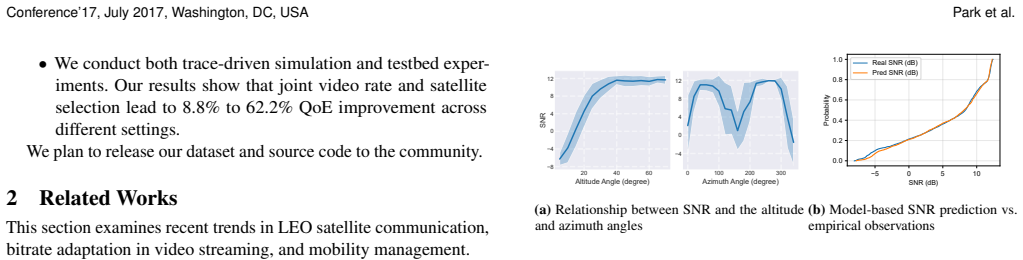
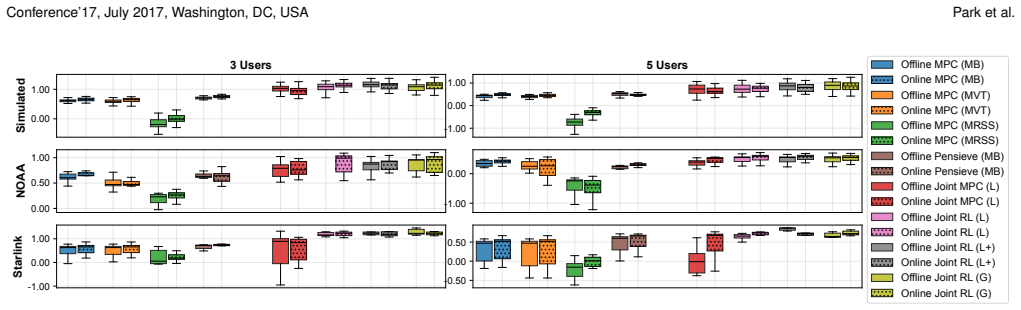
Low Earth Orbit (LEO) satellite communication is a promising approach to providing Internet connectivity to users in many remote areas. As videos are likely to account for most traffic in the LEO satellite network, as in the rest of the Internet, this work introduces a novel video-aware mobility management framework tailored for LEO satellite networks. Utilizing simulation models alongside real-world datasets, we show the importance of handoff strategy and throughput prediction algorithms in single-user and multi-user video streaming scenarios. Motivated by these observations, we propose a set of novel algorithms that can jointly choose the satellite and video bitrate to optimize the Quality of Experience (QoE). We first develop Model Predictive Control (MPC) and Reinforcement Learning (RL) based algorithms for a single user, and then extend them to accommodate multiple competing users that may share the same satellite. We introduce centralized training and distributed inference for our RL design, enabling a distributed policy informed by a global perspective. We demonstrate the effectiveness of our proposed models using trace-driven simulation and testbed experiments. We share our code and data with the research community.
Editorial analysis
A structured set of objections, weighed in public.
Referee Report
Summary. The paper proposes a video-aware mobility management framework for LEO satellite networks that jointly optimizes satellite handoff decisions and video bitrate selection. Using simulation models and real-world datasets, it motivates the need for joint optimization in single-user and multi-user video streaming scenarios. It develops MPC and RL algorithms for single users, extends them to multi-user cases with centralized training and distributed inference for the RL policy, and evaluates the approaches via trace-driven simulations and testbed experiments, claiming QoE improvements over non-joint baselines while sharing code and data publicly.
Significance. If the simulation models and throughput predictors accurately reflect real LEO channel dynamics and user behavior, the work provides practical joint-optimization algorithms that address an emerging challenge in LEO networks where video traffic will dominate. The centralized-training/distributed-inference RL design and the public release of code and data are explicit strengths that support reproducibility and potential follow-on work.
major comments (1)
- [Abstract and Evaluation sections] Abstract and Evaluation sections: the central claim that the proposed MPC and RL algorithms deliver reliable QoE gains rests on the fidelity of the simulation models and throughput prediction algorithms to real LEO satellite channel dynamics and contention behavior. No sensitivity analysis to prediction error or cross-validation against held-out real traces is described as part of the core argument, which is load-bearing for interpreting the reported improvements versus baselines.
minor comments (2)
- Clarify the exact definition of the QoE metric and how it incorporates handoff latency in the single-user and multi-user formulations.
- Ensure all figures include error bars or confidence intervals consistent with the number of runs or traces used.
Simulated Author's Rebuttal
We thank the referee for the constructive feedback on the evaluation methodology. We address the single major comment below and will revise the manuscript to incorporate the suggested analyses.
read point-by-point responses
-
Referee: [Abstract and Evaluation sections] Abstract and Evaluation sections: the central claim that the proposed MPC and RL algorithms deliver reliable QoE gains rests on the fidelity of the simulation models and throughput prediction algorithms to real LEO satellite channel dynamics and contention behavior. No sensitivity analysis to prediction error or cross-validation against held-out real traces is described as part of the core argument, which is load-bearing for interpreting the reported improvements versus baselines.
Authors: We agree that sensitivity analysis to prediction error and cross-validation on held-out traces are important to substantiate the robustness of the reported QoE gains. The manuscript already uses real-world datasets for trace-driven simulations and includes testbed experiments, but does not explicitly include these analyses in the core evaluation. In the revised version, we will add a dedicated subsection to the Evaluation section performing (1) sensitivity analysis by injecting controlled prediction errors (e.g., additive Gaussian noise at varying standard deviations) into the throughput predictor and quantifying impact on QoE for both MPC and RL policies, and (2) cross-validation by partitioning the real traces into training and held-out test sets, retraining predictors on the former and reporting QoE improvements on the latter. These results will also be referenced in the Abstract to support the central claims. revision: yes
Circularity Check
No load-bearing circularity; algorithms motivated by simulations but evaluated on external traces and testbeds without reduction to fitted inputs.
full rationale
The paper uses simulation models and real-world datasets to motivate observations about handoff and throughput prediction, then proposes MPC and RL algorithms for joint optimization. These are evaluated via trace-driven simulation and testbed experiments. No equations, self-citations, or derivations are presented that reduce the claimed QoE gains to quantities defined by the paper's own fitted parameters or inputs by construction. The central claims remain independent of the motivating models, yielding only a minor score for the general reliance on simulation fidelity.
Axiom & Free-Parameter Ledger
Lean theorems connected to this paper
-
IndisputableMonolith/Cost/FunctionalEquation.leanwashburn_uniqueness_aczel unclear?
unclearRelation between the paper passage and the cited Recognition theorem.
We propose a set of novel algorithms that can jointly choose the satellite and video bitrate to optimize the Quality of Experience (QoE). ... MPC and RL based algorithms
-
IndisputableMonolith/Foundation/RealityFromDistinction.leanreality_from_one_distinction unclear?
unclearRelation between the paper passage and the cited Recognition theorem.
We develop Model Predictive Control (MPC) and Reinforcement Learning (RL) based algorithms for a single user, and then extend them to accommodate multiple competing users
What do these tags mean?
- matches
- The paper's claim is directly supported by a theorem in the formal canon.
- supports
- The theorem supports part of the paper's argument, but the paper may add assumptions or extra steps.
- extends
- The paper goes beyond the formal theorem; the theorem is a base layer rather than the whole result.
- uses
- The paper appears to rely on the theorem as machinery.
- contradicts
- The paper's claim conflicts with a theorem or certificate in the canon.
- unclear
- Pith found a possible connection, but the passage is too broad, indirect, or ambiguous to say the theorem truly supports the claim.
Forward citations
Cited by 1 Pith paper
-
Safety-Aware AoI Scheduling for LEO Satellite-Assisted Autonomous Driving
SafeScale-MATD3 is a two-timescale AoI scheduler with drift-plus-penalty safety enforcement and proactive handover that meets a 1% collision-alert violation budget in LEO satellite scenarios while cutting critical AoI by 35%.
Reference graph
Works this paper leans on
- [1]
-
[2]
Akyildiz, Huseyin Uzunalio, and Michael D
Ian F. Akyildiz, Huseyin Uzunalio, and Michael D. Bender. 1999. Handover Management in Low Earth Orbit (LEO) Satellite Networks. In Mobile Networks and Applications
work page 1999
-
[3]
Prakash Chitre and Ferit Yegenoglu. 1999. Next-generation satellite networks: architectures and implementations. In IEEE Communications Magazine
work page 1999
-
[4]
Joseph Coffey. 2023. Latency in Optical Fiber Systems. https: //www.commscope.com/globalassets/digizuite/2799-latency-in-optical-fiber- systems-wp-111432-en.pdf
work page 2023
-
[5]
Florin Dobrian, Vyas Sekar, Asad Awan, Ion Stoica, Dilip Joseph, Aditya Ganjam, Jibin Zhan, and Hui Zhang. 2011. Understanding the impact of video quality on user engagement. In ACM SIGCOMM
work page 2011
-
[6]
Mark Handley. 2018. Delay is not an option: Low latency routing in space. In ACM HotNets
work page 2018
-
[7]
Jian He, Mubashir Adnan Qureshi, Lili Qiu, Jin Li, Feng Li, and Lei Han. 2018. Favor: Fine-grained video rate adaptation. In ACM MMSys
work page 2018
-
[8]
Cuong Manh Ho, Anh Tien Tran, Chunghyun Lee, Duc Thien Hua, and Sungrae Cho. 2022. Handover in mobility-aware caching strategy for LEO satellite-based overlay system with content delivery network. In ACM MobiHoc
work page 2022
-
[9]
Te-Yuan Huang, Ramesh Johari, Nick McKeown, Matthew Trunnell, and Mark Watson. 2014. A buffer-based approach to rate adaptation: Evidence from a large video streaming service. In ACM SIGCOMM
work page 2014
-
[10]
Abbas Jamalipour and Tracy Tung. 2001. The role of satellites in global IT: trends and implications. In IEEE Personal Communications
work page 2001
-
[11]
Junchen Jiang, Vyas Sekar, and Hui Zhang. 2012. Improving fairness, effi- ciency, and stability in http-based adaptive video streaming with festive. InACM CoNEXT
work page 2012
-
[12]
Enric Juan, Mads Lauridsen, Jeroen Wigard, and Preben Mogensen. 2022. Han- dover solutions for 5G low-earth orbit satellite networks. In IEEE Access
work page 2022
-
[13]
Zeqi Lai, Hewu Li, Qi Zhang, Qian Wu, and Jianping Wu. 2021. Cooperatively constructing cost-effective content distribution networks upon emerging low earth orbit satellites and clouds. In IEEE ICNP
work page 2021
-
[14]
Zeqi Lai, Qian Wu, Hewu Li, Mingyang Lv, and Jianping Wu. 2021. Orbitcast: Exploiting mega-constellations for low-latency earth observation. In IEEE ICNP
work page 2021
-
[15]
Xu Li, Feilong Tang, Long Chen, and Jie Li. 2017. A state-aware and load- balanced routing model for LEO satellite networks. In IEEE GLOBECOM
work page 2017
-
[16]
Po-Hsun Lin and Wanjiun Liao. 2023. Space-Centric Adaptive Video Streaming with Quality of Experience Optimization in Low Earth Orbit Satellite Networks. In IEEE ICC
work page 2023
-
[17]
Vikalp Mandawaria, Neha Sharma, Diwakar Sharma, Chitradeep Majumdar, An- shuman Nigam, Seungil Park, and Jungsoo Jung. 2022. Uplink zone-based sched- uling for LEO satellite based Non-Terrestrial Networks. In IEEE WCNC
work page 2022
-
[18]
Hongzi Mao, Ravi Netravali, and Mohammad Alizadeh. 2017. Neural adaptive video streaming with pensieve. In ACM SIGCOMM
work page 2017
-
[19]
Jonathan C McDowell. 2020. The low earth orbit satellite population and impacts of the SpaceX Starlink constellation. In The Astrophysical Journal Letters
work page 2020
-
[20]
V olodymyr Mnih, Adria Puigdomenech Badia, Mehdi Mirza, Alex Graves, Tim- othy Lillicrap, Tim Harley, David Silver, and Koray Kavukcuoglu. 2016. Asyn- chronous methods for deep reinforcement learning. In PMLR ICML. Joint Optimization of Handoff and Video Rate in LEO Satellite Networks Conference’17, July 2017, Washington, DC, USA
work page 2016
-
[21]
Hoang Nam Nguyen, Salem Lepaja, Jon Schuringa, and Harmen R van As. 2001. Handover management in low earth orbit satellite IP networks. In IEEE GLOBE- COM
work page 2001
-
[22]
Kyoungjun Park, Myungchul Kim, and Laihyuk Park. 2022. NeuSaver: Neural Adaptive Power Consumption Optimization for Mobile Video Streaming. In IEEE Transactions on Mobile Computing
work page 2022
-
[23]
Lerrel Pinto, Marcin Andrychowicz, Peter Welinder, Wojciech Zaremba, and Pieter Abbeel. 2017. Asymmetric actor critic for image-based robot learning. arXiv:1710.06542 (2017)
work page internal anchor Pith review Pith/arXiv arXiv 2017
-
[24]
Stefan Schneider, Holger Karl, Ramin Khalili, and Artur Hecker. 2022. Deep- CoMP: Coordinated Multipoint Using Multi-Agent Deep Reinforcement Learn- ing
work page 2022
-
[25]
John Schulman, Filip Wolski, Prafulla Dhariwal, Alec Radford, and Oleg Klimov
-
[26]
Proximal Policy Optimization Algorithms
Proximal policy optimization algorithms. arXiv:1707.06347 (2017)
work page internal anchor Pith review Pith/arXiv arXiv 2017
-
[27]
Kevin Spiteri, Rahul Urgaonkar, and Ramesh K Sitaraman. 2020. BOLA: Near- optimal bitrate adaptation for online videos. In IEEE/ACM Transactions on Net- working
work page 2020
-
[28]
Yi Sun, Xiaoqi Yin, Junchen Jiang, Vyas Sekar, Fuyuan Lin, Nanshu Wang, Tao Liu, and Bruno Sinopoli. 2016. CS2P: Improving video bitrate selection and adaptation with data-driven throughput prediction. In ACM SIGCOMM
work page 2016
-
[29]
Deepak Vasisht, Jayanth Shenoy, and Ranveer Chandra. 2021. L2D2: Low latency distributed downlink for LEO satellites. In ACM SIGCOMM
work page 2021
-
[30]
Bowei Yang, Yue Wu, Xiaoli Chu, and Guanghua Song. 2016. Seamless handover in software-defined satellite networking. In IEEE Communications Letters
work page 2016
-
[31]
Xiaoqi Yin, Abhishek Jindal, Vyas Sekar, and Bruno Sinopoli. 2015. A control- theoretic approach for dynamic adaptive video streaming over HTTP. In ACM SIGCOMM
work page 2015
-
[32]
Chao Yu, Akash Velu, Eugene Vinitsky, Jiaxuan Gao, Yu Wang, Alexandre Bayen, and Yi Wu. 2022. The surprising effectiveness of ppo in cooperative multi-agent games. In Advances in Neural Information Processing Systems
work page 2022
-
[33]
Haoyuan Zhao, Hao Fang, Feng Wang, and Jiangchuan Liu. 2023. Realtime Multimedia Services over Starlink: A Reality Check. In NOSSDA V
work page 2023
discussion (0)
Sign in with ORCID, Apple, or X to comment. Anyone can read and Pith papers without signing in.