Bio-crafting Architecture: Experiences of growing mycelium in minimal surface molds
Pith reviewed 2026-05-22 22:59 UTC · model grok-4.3
The pith
3D-printed minimal surfaces from wood-based filaments function as structural cores for mycelium composites that bind to the filament.
A machine-rendered reading of the paper's core claim, the machinery that carries it, and where it could break.
Core claim
3D-printed minimal surfaces with wood-based filaments can function as structural cores for mycelium-based composites, mycelium binds to the filament, workshop participants show stronger feelings toward living materials than non-living ones, and members of the public weigh pragmatic issues against positive expectations for bio-technology.
What carries the argument
Minimal surface molds 3D-printed from wood-based filaments that serve as both growth forms and structural cores for mycelium composites.
If this is right
- Mycelium composites can be combined directly with 3D-printed wood-filament forms for architectural elements.
- Designers and users experience stronger emotional engagement with living materials than with inert ones.
- Public discussion of bio-materials centers on practical drawbacks yet remains optimistic about their future role in daily life.
- Ethical considerations may shape research directions even when overall attitudes toward the technology stay favorable.
Where Pith is reading between the lines
- Scaling the same minimal-surface approach to larger building components would require testing long-term structural performance and moisture resistance.
- Public acceptance of mycelium products may depend more on addressing visible issues like mold than on technical performance alone.
- Similar workshop formats could be used to compare mycelium growth across other filament types or surface geometries.
Load-bearing premise
The specific workshop conditions, growth results, and interview answers from a small self-selected group of students and exhibition visitors represent transferable insights about mycelium behavior and wider public perceptions of bio-materials.
What would settle it
Repeated trials under the same printing and growth conditions in which mycelium fails to bind to the wood filament or produces consistently different structural outcomes.
Figures
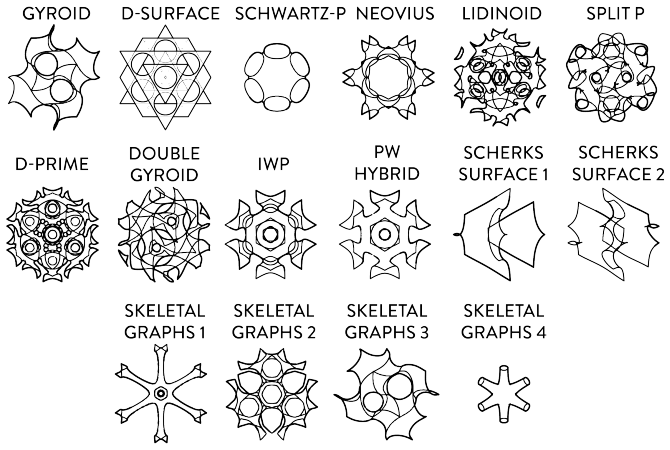

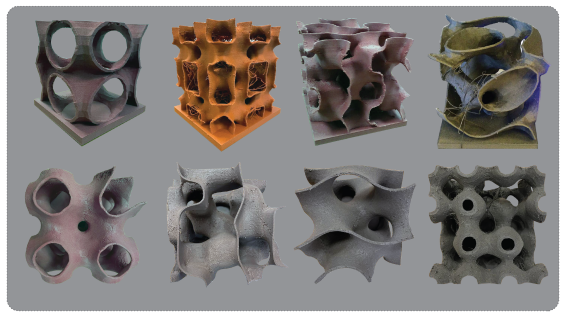
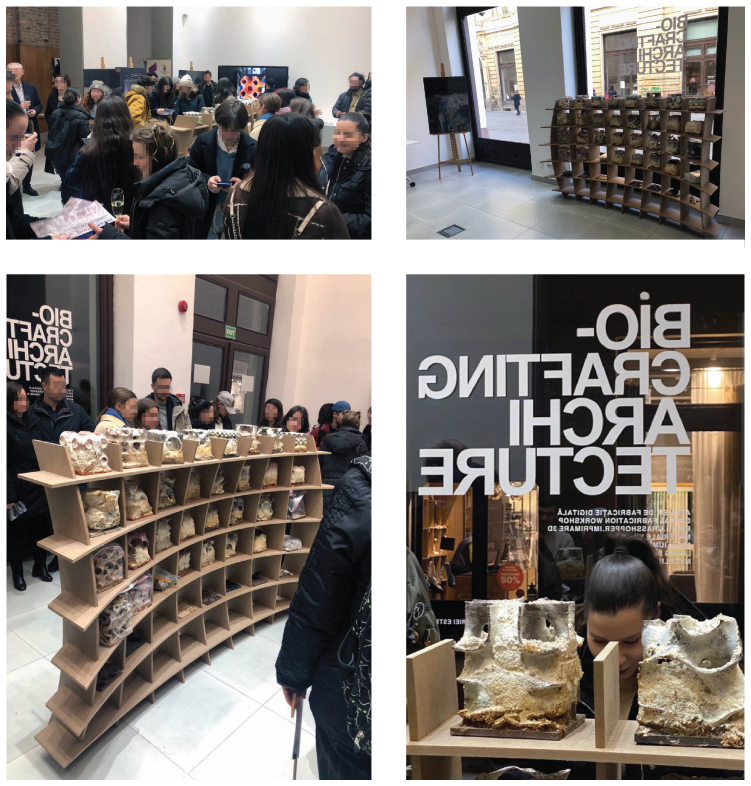
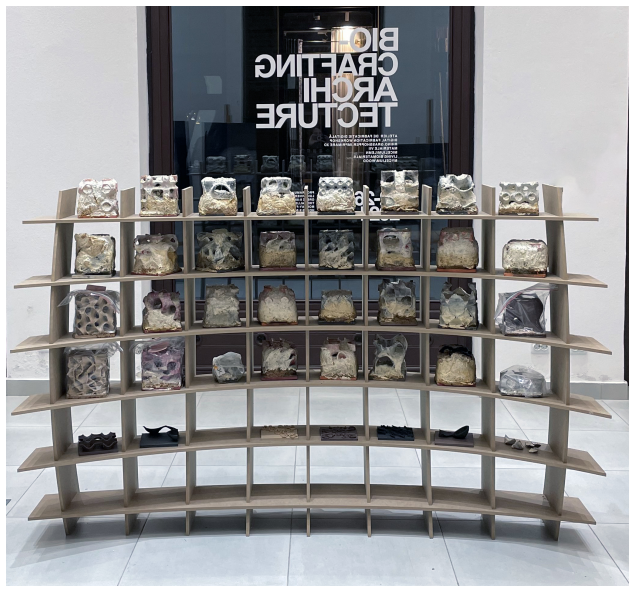

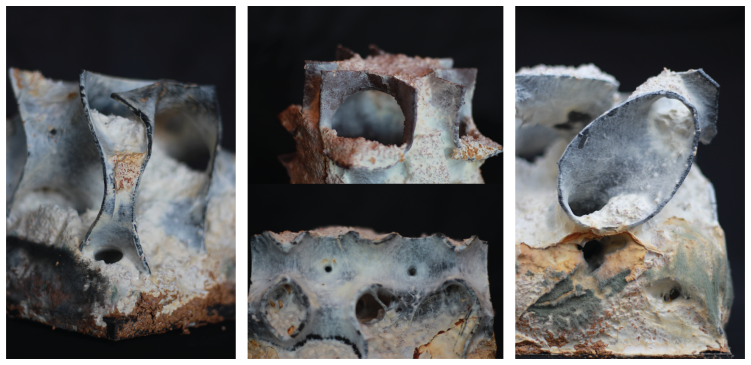


read the original abstract
This study documents a three-week workshop with architecture students, where we designed and 3D printed various minimal surfaces using wood-based filaments, and used them as molds in which to grow mycelium. We detail the design process and the growth of the mycelium in different shapes, together with participants' experiences of working with a living material. After exhibiting the results of the work in a public-facing exhibition, we conducted interviews with members of the general public about their perceptions on interacting with a material such as mycelium in design. Our findings show that 3D-printed minimal surfaces with wood-based filaments can function as structural cores for mycelium-based composites and mycelium binds to the filament. Participants in the workshop exhibited stronger feelings for living materials compared to non-living ones, displaying both biophilia and, to a lesser extent, biophobia when interacting with the mycelium. Members of the general public discuss pragmatic aspects including mold, fragility, or production costs, and speculate on the future of bio-technology and its impact on everyday life. While all are positive about the impact on bio-technologies on the future, they have diverging opinions on how much ethical considerations should influence research directions.
Editorial analysis
A structured set of objections, weighed in public.
Referee Report
Summary. The paper reports on a three-week workshop with architecture students who designed and 3D-printed minimal surfaces from wood-based filaments to serve as molds for mycelium growth. It describes the fabrication process, observed mycelium growth in the molds, student participants' experiential responses to the living material, and follow-up interviews with exhibition visitors on public perceptions of mycelium in design. The headline findings are that the printed minimal surfaces function as structural cores with mycelium binding to the filament, that workshop participants displayed stronger emotional engagement (biophilia and some biophobia) with living versus non-living materials, and that the public raises pragmatic concerns (mold, fragility, cost) while remaining positive about bio-technology futures with divergent views on ethical oversight.
Significance. If the methodological gaps are addressed, the work offers a useful exploratory case study at the intersection of digital fabrication, bio-materials, and human-material interaction. Documenting both the technical outcomes of mycelium growth on wood-filament minimal surfaces and the qualitative experiential data from a design workshop plus public engagement provides concrete examples that could inform future bio-design curricula and public-facing applications. The integration of fabrication experiments with interview themes is a constructive contribution to the human-centered aspects of living materials research.
major comments (2)
- [Abstract / Findings] Abstract (findings paragraph) and workshop/interview sections: The claims that 'participants in the workshop exhibited stronger feelings for living materials' and that 'members of the general public discuss pragmatic aspects' rest on qualitative observations, yet the manuscript supplies no participant counts, recruitment details, interview protocol, duration, or analysis method (e.g., thematic coding approach). These omissions are load-bearing because they prevent evaluation of whether the reported themes are representative or transferable beyond the specific self-selected cohort.
- [Workshop description / Results] Growth and exhibition sections: The assertion that '3D-printed minimal surfaces with wood-based filaments can function as structural cores for mycelium-based composites and mycelium binds to the filament' is presented as a finding, but the text provides no environmental controls, growth duration consistency, replication across prints, or any metric (qualitative or quantitative) of binding strength or structural performance. Without these, the claim reduces to an unverified observation from a single workshop run.
minor comments (2)
- [Abstract] The abstract and introduction could more explicitly separate the technical fabrication outcomes from the experiential and interview findings to improve readability.
- [Figures] Figure captions and captions for growth photographs should include scale bars, filament type, and growth time to allow readers to interpret the visual evidence.
Simulated Author's Rebuttal
We thank the referee for the constructive feedback highlighting areas where methodological transparency can be strengthened. We address each major comment point by point below, indicating planned revisions to the manuscript.
read point-by-point responses
-
Referee: [Abstract / Findings] Abstract (findings paragraph) and workshop/interview sections: The claims that 'participants in the workshop exhibited stronger feelings for living materials' and that 'members of the general public discuss pragmatic aspects' rest on qualitative observations, yet the manuscript supplies no participant counts, recruitment details, interview protocol, duration, or analysis method (e.g., thematic coding approach). These omissions are load-bearing because they prevent evaluation of whether the reported themes are representative or transferable beyond the specific self-selected cohort.
Authors: We agree these details are necessary for assessing the scope and transferability of the qualitative findings. We will add a dedicated Methods section (or subsection) that reports the number of student participants and public interviewees, describes the recruitment process, provides the interview protocol and approximate durations, and outlines the thematic analysis approach (including how codes were developed and applied). This will allow readers to better evaluate the reported themes. revision: yes
-
Referee: [Workshop description / Results] Growth and exhibition sections: The assertion that '3D-printed minimal surfaces with wood-based filaments can function as structural cores for mycelium-based composites and mycelium binds to the filament' is presented as a finding, but the text provides no environmental controls, growth duration consistency, replication across prints, or any metric (qualitative or quantitative) of binding strength or structural performance. Without these, the claim reduces to an unverified observation from a single workshop run.
Authors: The growth observations derive from a single exploratory workshop iteration conducted under standard ambient conditions without systematic environmental controls, repeated trials, or quantitative testing of binding or structural properties. We will revise the relevant findings and abstract language to frame these as preliminary observational outcomes from the described process rather than generalizable claims. We will also add an explicit Limitations subsection noting the absence of controlled replication and mechanical metrics. We cannot supply new quantitative data or replication results that were not collected during the original workshop. revision: partial
Circularity Check
No circularity: purely descriptive qualitative report with no derivations or fitted claims
full rationale
The paper reports a three-week student workshop, mycelium growth observations in 3D-printed molds, and public interviews. It contains no equations, parameters, predictions, or derivations of any kind. All statements are direct descriptions of observed processes and collected opinions; none reduce by construction to prior inputs, self-citations, or fitted values. The transferability limitation noted by the skeptic is a standard external-validity concern for small qualitative studies, not an instance of circular reasoning within the paper's own logic.
Axiom & Free-Parameter Ledger
Reference graph
Works this paper leans on
-
[1]
Abdelhady, O., Spyridonos, E., Dahy, H., 2023. Bio-modules: Mycelium- based composites forming a modular interlocking system through a computational design towards sustainable architecture. Designs 27
work page 2023
-
[2]
URL: https://www.mdpi.com/2411-9660/7/1/20, doi: 10.3390/ designs7010020
-
[3]
Sustainable packaging ap- plications from mycelium to substitute polystyrene: a review
Abhijith, R., Ashok, A., Rejeesh, C., 2018. Sustainable packaging ap- plications from mycelium to substitute polystyrene: a review. Materials today: proceedings 5, 2139–2145
work page 2018
-
[4]
Building renovation: where circular economy and climate meet
Agency, E.E., . Building renovation: where circular economy and climate meet. URL: https://www.eea.europa.eu/publications/ building-renovation-where-circular-economy?utm_source= chatgpt.com
-
[5]
Aiduang, W., Chanthaluck, A., Kumla, J., Jatuwong, K., Srinuanpan, S., Waroonkun, T., Oranratmanee, R., Lumyong, S., Suwannarach, N.,
-
[6]
Amazing fungi for eco-friendly composite materials: A compre- hensive review. Journal of Fungi 8, 842
-
[7]
Bio scaffolds: The orches- tration of biological growth through robotic intervention
Alima, N., Snooks, R., McCormack, J., 2022. Bio scaffolds: The orches- tration of biological growth through robotic intervention. International Journal of Intelligent Robotics and Applications 6, 522–529
work page 2022
-
[8]
A re- view on architecture with fungal biomaterials: the desired and the fea- sible
Almpani-Lekka, D., Pfeiffer, S., Schmidts, C., Seo, S.i., 2021. A re- view on architecture with fungal biomaterials: the desired and the fea- sible. Fungal Biology and Biotechnology 8. URL: https://doi.org/ 10.1186/s40694-021-00124-5
-
[9]
Appels, F.V., Camere, S., Montalti, M., Karana, E., Jansen, K.M., Dijksterhuis, J., Krijgsheld, P., W¨ osten, H.A., 2019. Fabrication fac- tors influencing mechanical, moisture-and water-related properties of mycelium-based composites. Materials & Design 161, 64–71
work page 2019
-
[10]
Armstrong, R., 2023. Towards the microbial home: an overview of devel- opments in next-generation sustainable architecture. Microbial Biotech- nology 16, 1112–1130
work page 2023
-
[11]
Attias, N., Danai, O., Abitbol, T., Tarazi, E., Ezov, N., Pereman, I., Grobman, Y.J., 2020. Mycelium bio-composites in industrial design and architecture: Comparative review and experimental analysis. Journal of Cleaner Production 246, 119037. URL: https://www.sciencedirect.com/science/article/ 28 pii/S0959652619339071, doi:https://doi.org/10.1016/j.jclep...
-
[12]
Human–nature connectedness as a pathway to sus- tainability: A global meta-analysis
Barragan-Jason, G., de Mazancourt, C., Parmesan, C., Singer, M.C., Loreau, M., 2022. Human–nature connectedness as a pathway to sus- tainability: A global meta-analysis. Conservation Letters 15, e12852
work page 2022
-
[13]
Matters of Care: Speculative Ethics in More than Human Worlds
BELLACASA, M.P.D.L., 2017. Matters of Care: Speculative Ethics in More than Human Worlds. University of Minnesota Press. URL: http://www.jstor.org/stable/10.5749/j.ctt1mmfspt
-
[14]
Learning about climate change in, with and through art
Bentz, J., 2020. Learning about climate change in, with and through art. Climatic Change 162, 1595–1612. doi: 10.1007/s10584-020-02804-4
-
[15]
Biological growth as an alternative approach to on and off-earth construction
Brandi´ c Lipi´ nska, M., Maurer, C., Cadogan, D., Head, J., Dade- Robertson, M., Paulino-Lima, I.G., Liu, C., Morrow, R., Senesky, D.G., Theodoridou, M., Rheinst¨ adter, M.C., Zhang, M., Roth- schild, L.J., 2022. Biological growth as an alternative approach to on and off-earth construction. Frontiers in Built Environment
work page 2022
-
[16]
2022.965145, doi:10.3389/fbuil.2022.965145
URL: https://www.frontiersin.org/articles/10.3389/fbuil. 2022.965145, doi:10.3389/fbuil.2022.965145
-
[17]
Mycelium-based ma- terials for the ecodesign of bioeconomy
Butu, A., Rodino, S., Miu, B.A., Butu, M., 2020. Mycelium-based ma- terials for the ecodesign of bioeconomy. Digest Journal of Nanomaterials and Biostructures
work page 2020
-
[18]
Packaging Applications of Fungal Mycelium-Based Biodegradable Composites
C R, R., 2022. Packaging Applications of Fungal Mycelium-Based Biodegradable Composites. Springer. pp. 189–208. doi: 10.1007/ 978-981-19-1000-5_11
work page 2022
-
[19]
Cig´ anik, O., Vele, J., Roth, M., S` ysov´ a, K., 2023. Mycelium in archi- tectural education: Digital fabrication reconsidered, in: Proceedings of the 9th eCAADe Regional International Symposium, pp. 169–174
work page 2023
-
[20]
Making the hypar up pavilion: (in)efficiencies of upcycling surplus timber products
Colabella, S., Pugnale, A., Halls, J., Park, M.M., Mangli´ ar, L., Hudert, M., 2024. Making the hypar up pavilion: (in)efficiencies of upcycling surplus timber products. Architectural Intelligence
work page 2024
-
[21]
URL: https://doi.org/10.1007/s44223-024-00074-z , doi: 10. 1007/s44223-024-00074-z . 29
-
[22]
Colmo, C., Ayres, P., 2020. 3d printed bio-hybrid structures - inves- tigating the architectural potentials of mycoremediation, in: Werner, L., Koering, D. (Eds.), Anthropologic: Architecture and Fabrication in the cognitive age - Proceedings of the 38th eCAADe Conference, pp. 573–582. doi: https://doi.org/10.52842/conf.ecaade.2020.1.573
-
[23]
Remediating architecture: A bio-hybrid approach employing fungal mycelium
Colmo, C., Ayres, P., 2022. Remediating architecture: A bio-hybrid approach employing fungal mycelium
work page 2022
-
[24]
Commission, E., . Construction sector. URL: https:// single-market-economy.ec.europa.eu/sectors/construction_en
-
[25]
Designing conditions for coexistence
Cotsaftis, O., Williams, N., Chyon, G., Sadar, J., Va Pesaran, D.M., Wines, S., Naarden, S., 2023. Designing conditions for coexistence. Design Studies 87, 101199. URL: https://www. sciencedirect.com/science/article/pii/S0142694X23000406, doi:https://doi.org/10.1016/j.destud.2023.101199
-
[26]
Duarte Poblete, S.S., Romani, A., Rognoli, V., 2024. Emerging materials for transition: A taxonomy proposal from a design per- spective. Sustainable Futures 7, 100155. URL: https://www. sciencedirect.com/science/article/pii/S2666188824000054, doi:https://doi.org/10.1016/j.sftr.2024.100155
-
[27]
Feminism or Death - How the Women’s Movement Can Save the Planet
d ´Eaubonne, F., 2022 (original 1974). Feminism or Death - How the Women’s Movement Can Save the Planet. Verso Books
work page 2022
- [28]
-
[29]
Elsacker, E., Peeters, E., De Laet, L., 2019. Mycelium-based materials at the dawn of the anthropocene, in: Structures and Architecture-Bridging the Gap and Crossing Borders. CRC Press, pp. 1083–1090
work page 2019
-
[30]
Fillamentum, 2025. Timberfill. URL: https://fillamentum.com/ wp-content/uploads/2020/10/Technical-Data-Sheet_Timberfill_ 03012019.pdf
work page 2025
-
[31]
Biomimetic gyroid nanostructures exceeding their natural origins
Gan, Z., Turner, M.D., Gu, M., 2016. Biomimetic gyroid nanostructures exceeding their natural origins. Science Ad- vances 2, e1600084. URL: https://www.science.org/doi/ 30 abs/10.1126/sciadv.1600084, doi: 10.1126/sciadv.1600084, arXiv:https://www.science.org/doi/pdf/10.1126/sciadv.1600084
-
[32]
Garc´ ıa-Gasc´ on, C., Castell´ o-Pedrero, P., Garc´ ıa-Manrique, J.A., 2022. Minimal surfaces as an innovative solution for the design of an addi- tive manufactured solar-powered unmanned aerial vehicle (uav). Drones
work page 2022
-
[33]
URL: https://www.mdpi.com/2504-446X/6/10/285, doi: 10.3390/ drones6100285
-
[34]
Ghazvinian, A., Farrokhsiar, P., Vieira, F., Pecchia, J., Gursoy, B..,
-
[35]
Study on the sound absorption properties of mycelium-based composites cultivated on waste paper-based substrates, in: Proceed- ings of 37 eCAADe and XXIII SIGraDi Joint Conference, “Architecture in the Age of the 4Th Industrial Revolution“, Blucher. pp. 505–514. doi:10.5151/proceedings-ecaadesigradi2019_465
-
[36]
Ghazvinian, A., Gursoy, B., 2022. Basics of building with mycelium- based bio-composites: a review of built projects and related material research. Journal of Green Building 17, 37–69
work page 2022
-
[37]
Ghazvinian, A., Khalilbeigi, A., Mottaghi, E., G¨ ursoy, B., 2022. The design and fabrication of mycocreate 2.0: A spatial structure built with load-bearing mycelium-based composite components. Journal of the International Association for Shell and Spatial Structures 63, 85–97. doi:doi:10.20898/j.iass.2022.012
-
[38]
Giaccardi, E., Karana, E., 2015. Foundations of materials experience: An approach for hci, in: Proceedings of the 33rd Annual ACM Confer- ence on Human Factors in Computing Systems, Association for Com- puting Machinery, New York, NY, USA. p. 2447–2456. URL: https:// doi.org/10.1145/2702123.2702337, doi:10.1145/2702123.2702337
-
[39]
Goidea, A., Floudas, D., Andr´ een, D., 2020. Pulp faction: 3d printed material assemblies through microbial biotransformation, in: Fabricate 2020, UCL Press. pp. 42–49
work page 2020
-
[40]
Contextual Design: Defining Customer- Centered Systems
Holtzblatt, K., Beyer, H., 1998. Contextual Design: Defining Customer- Centered Systems. Morgan Kaufmann, San Diego, CA. 31
work page 1998
-
[41]
Horvath, A.S., Jochum, E., L¨ ochtefeld, M., Vissonova, K., Merritt, T., 2023a. Soft Robotics Workshops: Supporting Experiential Learn- ing About Design, Movement, and Sustainability. Springer, Germany. Springer Series on Cultural Computing, pp. 189–218. doi: 10.1007/ 978-3-031-28138-9_13
-
[42]
Horvath, A.S., L¨ ochtefeld, M., Heinrich, F., Bemman, B., 2023b. Steam matters for sustainability: 10 years of art and technology student re- search on sustainability through problem-based learning. Journal of Problem Based Learning in Higher Education 11, 1–33. doi: 10.54337/ ojs.jpblhe.v11i2.7768
-
[43]
Horvath, A.S., R¨ uhse, V., Raptis, D., 2020. Soundsculpt: A design framework for 3d modelling and digitally fabricating sound patterns, in: OzCHI 2020, Association for Computing Machinery (ACM), United States. pp. 572–581. URL: http://www.ozchi.org/ 2020/, doi:10.1145/3441000.3441017. 32nd Australian Conference on Human-Computer Interaction, OzCHI ’20 ; ...
-
[44]
Artful sustainability: Queer-convivialist life-art and the artistic turn in sustainability research
Kagan, S., 2017. Artful sustainability: Queer-convivialist life-art and the artistic turn in sustainability research. Transdisciplinary Journal of Engineering; Science 8. URL: https://www.atlas-tjes.org/index. php/tjes/article/view/98, doi:10.22545/2017/00092
-
[45]
Mate- rial driven design (mdd): A method to design for material experiences
Karana, E., Barati, B., Rognoli, V., van der Laan, A.Z., 2015a. Mate- rial driven design (mdd): A method to design for material experiences. International Journal of Design 9. URL: https://www.ijdesign.org/ index.php/IJDesign/article/view/1965
work page 1965
-
[46]
When the material grows: A case study on designing (with) mycelium-based materials
Karana, E., Blauwhoff, D., Hultink, E.J., Camere, S., 2018. When the material grows: A case study on designing (with) mycelium-based materials. International Journal of Design 12. URL: https://www. ijdesign.org/index.php/IJDesign/article/view/2918
work page 2018
-
[47]
Karana, E., Pedgley, O., Rognoli, V., 2015b. On materials experience. Design Issues 31, 16–27. URL: https://doi.org/10.1162/DESI_a_ 00335, doi:10.1162/DESI_a_00335
-
[48]
Kineco, 2025. Kineco. URL: https://www.kineco.bio/. 32
work page 2025
-
[49]
Mycelium-based biomimetic composite structures as a sustain- able leather alternative
Kniep, J., Graupner, N., Reimer, J.J., M¨ ussig, J., 2024. Mycelium-based biomimetic composite structures as a sustain- able leather alternative. Materials Today Communications 39, 109100. URL: https://www.sciencedirect.com/science/article/ pii/S235249282401081X, doi: https://doi.org/10.1016/j.mtcomm. 2024.109100
-
[50]
Kontovourkis, O., Stylianou, S., Kyriakides, G., 2020. An open-source bio-based material system development for sustainable digital fabrica- tion, in: Werner, L., Koering, D. (Eds.), Anthropologic: Architecture and Fabrication in the cognitive age - Proceedings of the 38th eCAADe Conference, pp. 31–40. doi:https://doi.org/10.52842/conf.ecaade. 2020.2.031
-
[51]
Design studies and applications of mycelium biocomposites in architecture
Kırd¨ ok, O., Akyol Altun, D., Dahy, H., Strobel, L., Hame¸ s Tuna, E., K¨ okt¨ urk, G., Andi¸ c C ¸ akır,¨O., Toku¸ c, A., ¨Ozkaban, F., S ¸endemir, A., 2022. Design studies and applications of mycelium biocomposites in architecture. Elsevier Editora, Brazil. pp. 489–527. doi: 10.1016/ B978-0-12-821053-6.00004-7 . publisher Copyright: © 2022 Elsevier Inc...
work page 2022
-
[52]
Research Methods in Human- Computer Interaction
Lazar, J., Feng, J.H., Hochheiser, H., 2010. Research Methods in Human- Computer Interaction. Wiley Publishing, West Sussex, UK
work page 2010
-
[53]
Lesna, J.M., Nicholas, P., 2020. De gradus - programming hetero- geneous performance of functionally graded bio-polymers for degrad- able agricultural shading structures, in: RE: Anthropocene, Design in the Age of Humans - Proceedings of the 25th CAADRIA Conference. doi:https://doi.org/10.52842/conf.caadria.2020.2.383
-
[54]
Lim, A., Thomsen, M.R., 2021. Multi-material fabrication for biodegradable structures - enabling the printing of porous mycelium composite structures, in: eCAADe 2021: Towards a New, Configurable Architecture. doi: 10.52842/conf.ecaade.2021.1.085
-
[55]
Tangled tales of mycelium and architecture: Learning from failure
McGaw, J., Andrianopoulos, A., Liuti, A., 2022. Tangled tales of mycelium and architecture: Learning from failure. Frontiers in Built Environment 8. URL: https://www.frontiersin.org/articles/10. 3389/fbuil.2022.805292, doi:10.3389/fbuil.2022.805292. 33
-
[56]
Living me- dia interfaces: a multi-perspective analysis of biological materials for interaction
Merritt, T., Hamidi, F., Alistar, M., DeMenezes, M., 2020. Living me- dia interfaces: a multi-perspective analysis of biological materials for interaction. Digital Creativity 31, 1–21. doi: 10.1080/14626268.2019. 1707231
-
[57]
A step-by-step process of thematic analysis to develop a concep- tual model in qualitative research
Naeem, M., Ozuem, W., Howell, K., Ranfagni, S., 2023. A step-by-step process of thematic analysis to develop a concep- tual model in qualitative research. International Journal of Qual- itative Methods 22, 16094069231205789. URL: https://doi. org/10.1177/16094069231205789, doi: 10.1177/16094069231205789, arXiv:https://doi.org/10.1177/16094069231205789
-
[58]
Mycomerge: Fabrication of mycelium-based natural fiber reinforced composites on a rattan framework
Nguyen, M.T., Solueva, D., Spyridonos, E., Dahy, H., 2022. Mycomerge: Fabrication of mycelium-based natural fiber reinforced composites on a rattan framework. Biomimetics 7. URL: https://www.mdpi.com/ 2313-7673/7/2/42, doi:10.3390/biomimetics7020042
-
[59]
Olsen, C.S., 2023. From architectures of capital to architectures of care: the arts of dreaming otherwise in the Oslo Architecture Triennale. UCL Press. pp. 27–37
work page 2023
-
[60]
Wood-veneer- reinforced mycelium composites for sustainable building components
¨Ozdemir, E., Saeidi, N., Javadian, A., Rossi, A., Nolte, N., Ren, S., Dwan, A., Acosta, I., Hebel, D.E., Wurm, J., et al., 2022. Wood-veneer- reinforced mycelium composites for sustainable building components. Biomimetics 7, 39
work page 2022
-
[61]
Materials experience as a foundation for materials and design education
Pedgley, O., Rognoli, V., Karana, E., 2016. Materials experience as a foundation for materials and design education. International Journal of Technology and Design Education 26, 613 – 630. URL: https://doi. org/10.1007/s10798-015-9327-y , doi:10.1007/s10798-015-9327-y
-
[62]
Pohan, J., Kusumawati, Y., Radhitanti, A., 2023. Mushroom mycelium- based biodegradable packaging material: A promising sustainable solu- tion for food industry. E3S Web of Conferences 426. doi: 10.1051/ e3sconf/202342602128
-
[63]
A new golden age of minimal surfaces
P´ erez, J., 2017. A new golden age of minimal surfaces. Notices of the American Mathematical Society 64, 347–358. doi: http://dx.doi.org/ 10.1090/noti1500. 34
-
[64]
R¨ uhse, V., Horvath, A.S., 2025. Fungi matters: A comparison of contem- porary fungi imagery between art, design, and architecture, in: Proceed- ings of Politics of the Machines: Lifelikeness and Beyond 2024, ”BCS Learning & Development Ltd. URL: https://www.pomconference. org/pom-aachen-2024/
work page 2025
-
[65]
Revived beauty: Research into aesthetic appreciation of materials to valorise materials from waste
Sauerwein, M., Karana, E., Rognoli, V., 2017. Revived beauty: Research into aesthetic appreciation of materials to valorise materials from waste. Sustainability 9. URL: https://www.mdpi.com/2071-1050/9/4/529, doi:10.3390/su9040529
-
[66]
Roof for munich olympic stadium 1972
Schlaich Bergermann, P., 2025. Roof for munich olympic stadium 1972. URL: https://www.sbp.de/en/project/ roof-for-munich-olympic-stadium-1972/
work page 2025
-
[67]
Schmidt, K., . Chromodoris. URL: https://www.food4rhino.com/en/ app/chromodoris
-
[68]
Schoen, A.H., 1970. Infinite periodic minimal surfaces without self- intersections: Three dimensional euclidean space partitioned into inter- penetrating labyrinths by infinite periodic minimal surfaces without self intersections. NASA Technical note URL: https://ntrs.nasa.gov/ api/citations/19700020472/downloads/19700020472.pdf
-
[69]
Entangled Life: How fungi make our worlds
Sheldrake, M., 2020. Entangled Life: How fungi make our worlds. Ran- dom House
work page 2020
-
[70]
Biophobia: What it is, how it works and why it matters
Soga, M., Evans, M.J., 2024. Biophobia: What it is, how it works and why it matters. People and Nature 6, 922–931. doi: https://doi.org/ 10.1002/pan3.10647
-
[71]
Soga, M., Gaston, K.J., Fukano, Y., Evans, M.J., 2023. The vicious cycle of biophobia. Trends in Ecology & Evolution 38, 512–520. URL: https://www.sciencedirect.com/science/ article/pii/S0169534722003603, doi:https://doi.org/10.1016/j. tree.2022.12.012
work page doi:10.1016/j 2023
-
[72]
Life cycle assessment of fungal-based composite bricks
Stelzer, L., Hoberg, F., Bach, V., Schmidt, B., Pfeiffer, S., Meyer, V., Finkbeiner, M., 2021. Life cycle assessment of fungal-based composite bricks. Sustainability 13. URL: https://www.mdpi.com/2071-1050/ 13/21/11573, doi:10.3390/su132111573. 35
-
[73]
Stephen R. Kellert, Judith H. Heerwagen, M.L.M., 2008. Biophilic De- sign: The theory, science and practice of bringing buildings to life. John Wiley&Sons
work page 2008
-
[74]
Superflux, 2009. Mycotecture (phil ross). URL: https://www. moma.org/interactives/exhibitions/2013/designandviolence/ mycotecture-phil-ross/
work page 2009
-
[75]
A new material practice: Integrating design and material behavior, in: Nikolovska, L., Attar, R
Tamke, M., Lafuente Hern´ andez, E., Deleuran, A., Gengnagel, C., Burry, M., Ramsgaard Thomsen, M., 2012. A new material practice: Integrating design and material behavior, in: Nikolovska, L., Attar, R. (Eds.), SimAUD 2012, pp. 5–12
work page 2012
-
[76]
Tan, Y.Y., Chia, P.Z., Quek, Y.H., Tracy, K.J., Yogiaman, C., 2022. Multimaterial knit skins: A design-to-fabrication workflow for mass customized freeform membrane panels. Technology—Architecture + Design 6, 184–199. URL: https://doi.org/10.1080/ 24751448.2022.2116239, doi: 10.1080/24751448.2022.2116239, arXiv:https://doi.org/10.1080/24751448.2022.2116239
-
[77]
minima — maxima world expo pavilion
TheVeryMany, M.F., 2017. minima — maxima world expo pavilion. URL: https://theverymany.com/world-expo-17-astana-kz-1
work page 2017
-
[78]
The orb — google - charleston east campus - plaza anchoring artwork
TheVeryMany, M.F., 2023. The orb — google - charleston east campus - plaza anchoring artwork. URL: https://theverymany.com/google
work page 2023
-
[79]
Miniature chiral beamsplitter based on gyroid photonic crystals
Turner, M.D., Saba, M., Zhang, Q., Cumming, B.P., Schr¨ oder-Turk, G.E., Gu, M., 2013. Miniature chiral beamsplitter based on gyroid photonic crystals. Nature Photonics 7, 801–805. URL: https://doi. org/10.1038/nphoton.2013.233, doi:10.1038/nphoton.2013.233
-
[80]
Vandelook, S., Elsacker, E., Van Wylick, A., De Laet, L., Peeters, E.,
discussion (0)
Sign in with ORCID, Apple, or X to comment. Anyone can read and Pith papers without signing in.