Accelerated Decentralized Constraint-Coupled Optimization: A Dual² Approach
Pith reviewed 2026-05-22 15:54 UTC · model grok-4.3
The pith
A dual squared approach produces two accelerated algorithms for decentralized optimization with shared constraints that converge under milder conditions on the public cost function.
A machine-rendered reading of the paper's core claim, the machinery that carries it, and where it could break.
Core claim
Building on a novel dual² approach, the paper develops the inexact Dual² Accelerated gradient method and the Multi-consensus inexact Dual² Accelerated gradient method. Both iD2A and MiD2A guarantee asymptotic convergence under a milder condition on h compared to existing algorithms. Under additional assumptions they establish linear convergence rates and significantly lower communication and computational complexity bounds.
What carries the argument
The dual² approach, which applies dualization twice to the constraint-coupled problem so that local dual updates can coordinate the shared equality constraint across the network while supporting acceleration and inexact steps.
If this is right
- The algorithms reach the optimal solution asymptotically whenever h meets the stated milder condition.
- Linear convergence holds when extra assumptions such as strong convexity are added.
- Communication rounds and per-agent computations drop below the bounds reported for earlier decentralized solvers of the same problem class.
- Multi-consensus steps in one variant further cut the number of neighbor exchanges needed for coordination.
Where Pith is reading between the lines
- The dual² construction could extend to problems with inequality constraints or time-varying networks if the connectivity requirement is relaxed.
- Lower complexity bounds suggest these methods might run on battery-limited sensors or edge devices that cannot afford frequent messaging.
- Similar dualization tricks may help other multi-agent problems where only partial information is shared among neighbors.
Load-bearing premise
The communication network must be undirected and connected so that information about the shared constraint propagates to every agent.
What would settle it
A numerical test or analytic counterexample in which iD2A or MiD2A fails to converge asymptotically on a problem where h satisfies only the paper's milder condition but not the stronger conditions used by prior methods.
Figures


read the original abstract
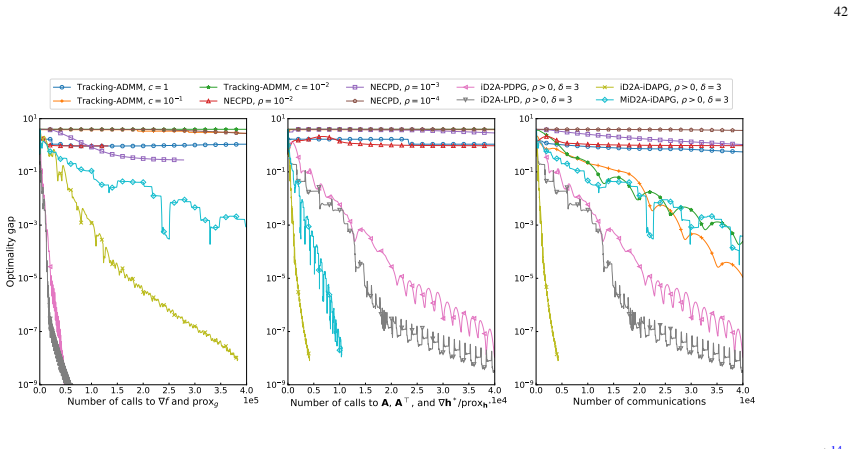
In this paper, we focus on a class of decentralized constraint-coupled optimization problem: $\min_{x_i \in \mathbb{R}^{d_i}, i \in \mathcal{I}; y \in \mathbb{R}^p}$ $\sum_{i=1}^n\left(f_i(x_i) + g_i(x_i)\right) + h(y) \ \text{s.t.} \ \sum_{i=1}^{n}A_ix_i = y$, over an undirected and connected network of $n$ agents. Here, $f_i$, $g_i$, and $A_i$ represent private information of agent $i \in \mathcal{I} = \{1, \cdots, n\}$, while $h$ is public for all agents. Building on a novel dual$^2$ approach, we develop two accelerated algorithms to solve this problem: the inexact Dual$^2$ Accelerated (iD2A) gradient method and the Multi-consensus inexact Dual$^2$ Accelerated (MiD2A) gradient method. We demonstrate that both iD2A and MiD2A can guarantee asymptotic convergence under a milder condition on $h$ compared to existing algorithms. Furthermore, under additional assumptions, we establish linear convergence rates and derive significantly lower communication and computational complexity bounds than those of existing algorithms. Several numerical experiments validate our theoretical analysis and demonstrate the practical superiority of the proposed algorithms.
Editorial analysis
A structured set of objections, weighed in public.
Referee Report
Summary. The manuscript addresses a class of decentralized constraint-coupled optimization problems: minimize sum_i (f_i(x_i) + g_i(x_i)) + h(y) subject to sum_i A_i x_i = y, where f_i, g_i, A_i are private to agents on an undirected connected network and h is public. It introduces a dual² approach yielding two accelerated methods—the inexact Dual² Accelerated (iD2A) gradient method and the Multi-consensus inexact Dual² Accelerated (MiD2A) gradient method. The central claims are asymptotic convergence under a milder condition on h than prior algorithms, plus linear convergence rates and improved communication/computational complexity bounds under additional assumptions, supported by Lyapunov-style analysis and numerical experiments.
Significance. If the derivations hold, the work is significant for distributed optimization because it relaxes conditions on the public coupling function h while delivering lower complexity, which is valuable for scalable networked systems. The reliance on standard Lyapunov arguments for inexact accelerated updates and the explicit focus on communication efficiency are strengths; the post-hoc numerical validation helps but would be stronger with quantitative baseline comparisons.
major comments (2)
- [§4.2] §4.2, convergence theorem for iD2A: the milder condition on h is load-bearing for the headline claim; the proof sketch should explicitly isolate the step where the dual² construction relaxes the requirement relative to standard dual methods (e.g., by contrasting the Lipschitz or strong-convexity assumption on h).
- [Table 2] Table 2 (complexity comparison): the reported communication complexity for MiD2A is O(1/ε) versus O(1/√ε) for baselines; the table should include the precise dependence on network size n and the condition number to substantiate the 'significantly lower' claim.
minor comments (3)
- [Abstract] Abstract: the milder condition on h is mentioned but not stated explicitly; adding one sentence summarizing the precise relaxation would improve readability.
- [§5] §5, numerical experiments: the figures show practical superiority but lack error bars or multiple random seeds; including these would strengthen the validation of the complexity claims.
- [Notation] Notation section: the dual variables introduced in the dual² reformulation should be defined at first appearance rather than deferred to the algorithm box.
Simulated Author's Rebuttal
We thank the referee for the constructive comments and positive assessment of our manuscript. We address each major comment point by point below, indicating the revisions we will incorporate to improve clarity.
read point-by-point responses
-
Referee: [§4.2] §4.2, convergence theorem for iD2A: the milder condition on h is load-bearing for the headline claim; the proof sketch should explicitly isolate the step where the dual² construction relaxes the requirement relative to standard dual methods (e.g., by contrasting the Lipschitz or strong-convexity assumption on h).
Authors: We agree that an explicit isolation of the relaxation step would strengthen the presentation. In the revised version, we will expand the proof sketch in §4.2 to include a direct contrast with standard dual methods. We will highlight the precise point in the Lyapunov analysis where the dual² construction permits milder conditions on h (without requiring strong convexity or Lipschitz continuity as in conventional dual approaches), thereby clarifying how the nested dual structure achieves the claimed relaxation. revision: yes
-
Referee: [Table 2] Table 2 (complexity comparison): the reported communication complexity for MiD2A is O(1/ε) versus O(1/√ε) for baselines; the table should include the precise dependence on network size n and the condition number to substantiate the 'significantly lower' claim.
Authors: We will update Table 2 to explicitly report the dependence on network size n and the condition number for all compared algorithms. This revision will provide a more detailed and substantiated comparison, confirming that MiD2A achieves O(1/ε) communication complexity with improved scaling in n and the condition number relative to the O(1/√ε) bounds of the baselines. revision: yes
Circularity Check
No significant circularity; derivation self-contained
full rationale
The paper develops iD2A and MiD2A via a novel dual² construction and proves asymptotic convergence under a milder condition on h (plus linear rates and complexity bounds under extra assumptions) using standard Lyapunov arguments for inexact accelerated updates. Network connectivity is invoked only to ensure dual coordination propagates, which is a conventional assumption rather than a fitted or self-referential step. No load-bearing claim reduces by construction to a parameter fit, self-citation chain, or renamed input; the central results remain independent of the target convergence statements.
Axiom & Free-Parameter Ledger
axioms (2)
- domain assumption The communication network is undirected and connected.
- domain assumption The local functions f_i, g_i and public function h satisfy conditions sufficient for the dual updates to converge (convexity or smoothness implied).
Lean theorems connected to this paper
-
IndisputableMonolith/Cost/FunctionalEquation.leanwashburn_uniqueness_aczel unclear?
unclearRelation between the paper passage and the cited Recognition theorem.
Building on a novel dual² approach, we develop two accelerated algorithms... guarantee asymptotic convergence under a milder condition on h... linear convergence rates and significantly lower communication and computational complexity bounds
-
IndisputableMonolith/Foundation/AlphaCoordinateFixation.leancostAlphaLog_high_calibrated_iff unclear?
unclearRelation between the paper passage and the cited Recognition theorem.
F_ρ(y) = H^*(−√C y) ... Condition 1: F_ρ is convex and L_Fρ-smooth
What do these tags mean?
- matches
- The paper's claim is directly supported by a theorem in the formal canon.
- supports
- The theorem supports part of the paper's argument, but the paper may add assumptions or extra steps.
- extends
- The paper goes beyond the formal theorem; the theorem is a base layer rather than the whole result.
- uses
- The paper appears to rely on the theorem as machinery.
- contradicts
- The paper's claim conflicts with a theorem or certificate in the canon.
- unclear
- Pith found a possible connection, but the passage is too broad, indirect, or ambiguous to say the theorem truly supports the claim.
discussion (0)
Sign in with ORCID, Apple, or X to comment. Anyone can read and Pith papers without signing in.