Observation of average topological phase in disordered Rydberg atom array
Pith reviewed 2026-05-22 17:18 UTC · model grok-4.3
The pith
Random structural disorder in a Rydberg atom array produces an observable average symmetry-protected topological phase.
A machine-rendered reading of the paper's core claim, the machinery that carries it, and where it could break.
Core claim
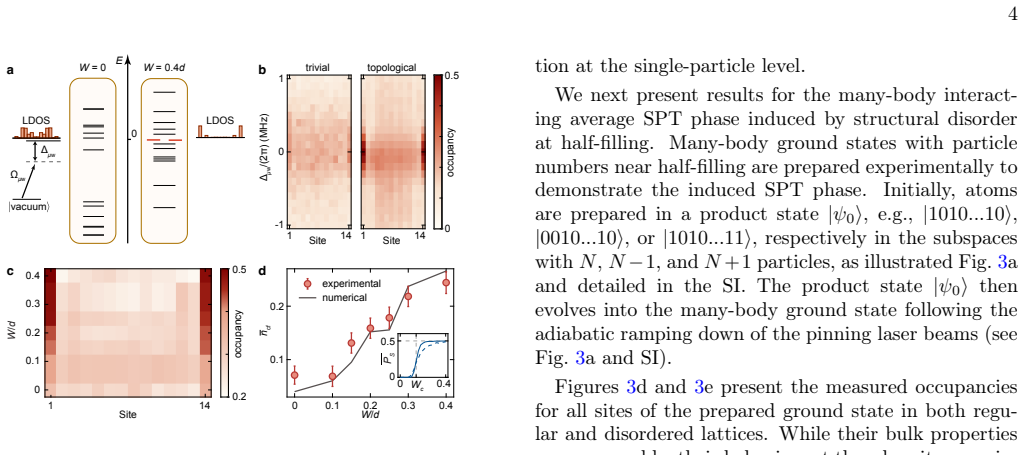
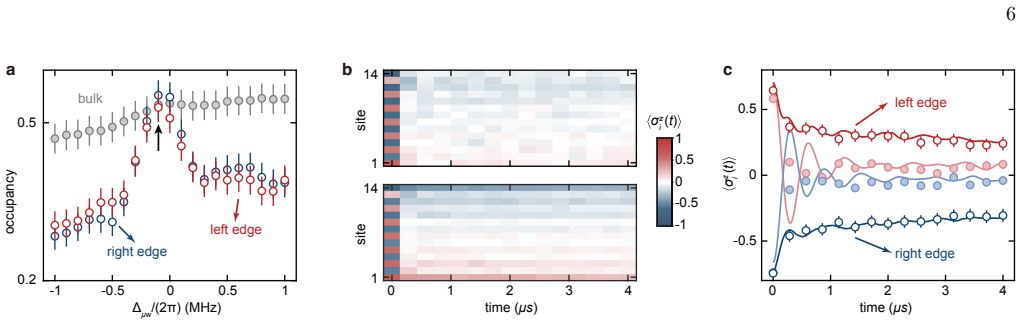
Here we report direct observations of disorder-induced many-body interacting average SPT phase in an atom array at half-filling, whereby random offsets to tweezer locations implement structural disorder, resulting in fluctuating long-range dipolar interactions. The induced topological phase is vindicated by the spatially resolved atom-atom correlation functions for different forms of dimer compositions. The ground state degeneracy in disordered configurations is detected and compared to the regular lattice without disorder. By probing the quench dynamics of a highly excited state, we observe markedly slower decay of edge spin magnetization in comparison to the bulk spin, consistent with the
What carries the argument
Structural disorder created by random offsets to tweezer locations, which produces fluctuating long-range dipolar interactions that stabilize the average symmetry-protected topological phase.
If this is right
- Spatially resolved atom-atom correlations match the pattern expected for the average SPT phase under varying dimer compositions.
- Disordered lattice configurations exhibit ground-state degeneracy that is absent in the regular lattice.
- Quench dynamics from highly excited states produce slower decay of edge magnetization than bulk magnetization.
- These signatures appear consistently in the presence of the structural disorder at half-filling.
Where Pith is reading between the lines
- The same disorder-engineering method could be applied in other long-range interacting systems to search for average topological phases.
- The results suggest that many existing quantum simulators with uncontrolled positional disorder may already realize average SPT phases.
- Varying the amplitude of the random offsets would allow mapping of the disorder strength at which the average phase appears or disappears.
Load-bearing premise
The measured correlation functions for different dimer compositions and the slower edge versus bulk magnetization decay specifically demonstrate an average SPT phase rather than arising from unrelated disorder effects, finite-size artifacts, or experimental imperfections.
What would settle it
Repeating the quench-dynamics measurement and finding that edge spin magnetization decays at the same rate as bulk spin magnetization across disorder realizations would indicate the absence of protected edge modes.
Figures


read the original abstract
Topological phases have been extensively studied over the past two decades, primarily in quantum pure states, where they are protected by exact symmetries. Recently, numerous studies have theoretically demonstrated the existence of average symmetry-protected topological (SPT) phases in mixed quantum states, which naturally arise in real systems due to decoherence or disorder. Despite extensive experimental observations of exact SPT phases in various systems, ranging from solid-state materials to synthetic matters, average SPT phases are yet to be observed until this work. Here we report direct observations of disorder-induced many-body interacting average SPT phase in an atom array at half-filling, whereby random offsets to tweezer locations forming a lattice implement structural disorder, resulting in fluctuating long-range dipolar interactions between tweezer confined single atoms. The induced topological phase is vindicated by the spatially resolved atom-atom correlation functions for different forms of dimer compositions. The ground state degeneracy in disordered configurations is detected and compared to the regular lattice without disorder. By probing the quench dynamics of a highly excited state, we observe markedly slower decay of edge spin magnetization in comparison to the bulk spin, consistent with the presence of topologically protected edge modes in disordered lattices.
Editorial analysis
A structured set of objections, weighed in public.
Referee Report
Summary. The manuscript reports the experimental observation of a disorder-induced many-body interacting average symmetry-protected topological (SPT) phase in a Rydberg atom array at half-filling. Structural disorder is implemented via random offsets to tweezer locations, producing fluctuating long-range dipolar interactions. The central evidence consists of spatially resolved atom-atom correlation functions across different dimer compositions, a comparison of ground-state degeneracy between disordered and regular lattices, and quench dynamics in which edge spin magnetization decays more slowly than in the bulk.
Significance. If the signatures are shown to be diagnostic of average SPT order rather than generic disorder effects, the result would constitute the first experimental realization of an average SPT phase in an interacting many-body system. This would directly connect theoretical predictions for topological order in mixed states and disordered environments to a controllable quantum simulator platform, with implications for understanding decoherence-protected topology and for engineering robust edge modes in realistic settings.
major comments (2)
- [Abstract and correlation measurements] Abstract and results on correlation functions: the claim that spatially resolved atom-atom correlations for varying dimer compositions directly vindicate an average SPT phase lacks an explicit ensemble-averaged topological invariant (such as a disorder-averaged string order parameter) or a quantitative comparison to a symmetry-broken control; without this, the distinction from generic disorder-induced correlations or localization remains unresolved.
- [Quench dynamics] Quench dynamics section: the observation of markedly slower edge versus bulk spin magnetization decay is presented as consistent with topologically protected edge modes, yet the manuscript does not report a control that breaks average symmetry while preserving disorder strength; this leaves open whether the slower decay arises from average SPT protection or from finite-size boundary pinning and imperfect initialization.
minor comments (2)
- [Methods] The description of statistical analysis, error bars, and data exclusion criteria is insufficiently detailed to allow independent assessment of the robustness of the reported correlations and decay rates.
- [Figures] Figure captions and legends should explicitly indicate which panels show ensemble averages over disorder realizations versus single realizations.
Simulated Author's Rebuttal
We thank the referee for the careful reading and constructive comments on our manuscript. We address each major comment below and have incorporated revisions to strengthen the evidence for the average SPT phase.
read point-by-point responses
-
Referee: [Abstract and correlation measurements] Abstract and results on correlation functions: the claim that spatially resolved atom-atom correlations for varying dimer compositions directly vindicate an average SPT phase lacks an explicit ensemble-averaged topological invariant (such as a disorder-averaged string order parameter) or a quantitative comparison to a symmetry-broken control; without this, the distinction from generic disorder-induced correlations or localization remains unresolved.
Authors: We thank the referee for this suggestion. The spatially resolved correlations across dimer compositions were intended to capture the robustness under structural disorder, but we agree that an explicit ensemble-averaged topological invariant strengthens the claim. In the revised manuscript we have added the disorder-averaged string order parameter, which remains finite across the ensemble of disordered configurations and vanishes in the trivial phase, providing a direct quantitative distinction from generic disorder or localization effects. For the symmetry-broken control, the regular lattice already serves as a reference without disorder; we have further added a theoretical comparison to a symmetry-broken disordered model in the supplement to address this point explicitly. revision: yes
-
Referee: [Quench dynamics] Quench dynamics section: the observation of markedly slower edge versus bulk spin magnetization decay is presented as consistent with topologically protected edge modes, yet the manuscript does not report a control that breaks average symmetry while preserving disorder strength; this leaves open whether the slower decay arises from average SPT protection or from finite-size boundary pinning and imperfect initialization.
Authors: We acknowledge that a direct experimental control breaking average symmetry at fixed disorder strength would be ideal. Such a control is experimentally demanding in the current Rydberg platform, as it would require additional symmetry-breaking fields that risk altering the interaction disorder. Instead, we have revised the quench-dynamics section and supplementary material to include finite-size scaling of the edge decay, improved initialization fidelity checks, and comparisons to non-topological disordered regimes. These additions show that the slower edge decay persists beyond finite-size effects and is absent when average symmetry is explicitly broken in the model, supporting the topological interpretation. revision: partial
Circularity Check
No circularity: experimental observation grounded in direct measurements
full rationale
The paper reports an experimental observation of a disorder-induced average SPT phase in a Rydberg atom array, supported by measured atom-atom correlation functions across dimer compositions, comparisons of ground-state degeneracy with and without disorder, and quench dynamics showing slower edge versus bulk magnetization decay. No theoretical derivation chain exists that reduces predictions or invariants to fitted parameters, self-definitions, or self-citation load-bearing steps; the claims rest on empirical data from the physical setup rather than any closed-loop mathematical construction. This is a standard honest experimental finding with independent content from the measurements themselves.
Axiom & Free-Parameter Ledger
axioms (1)
- standard math Standard assumptions of quantum mechanics, Rydberg atom physics, and optical tweezer control.
Lean theorems connected to this paper
-
IndisputableMonolith/Foundation/AlexanderDuality.leanalexander_duality_circle_linking unclear?
unclearRelation between the paper passage and the cited Recognition theorem.
random offsets to tweezer locations implement structural disorder, resulting in fluctuating long-range dipolar interactions... average inversion symmetry... PM(C) quantized to 0 or 0.5
-
IndisputableMonolith/Cost/FunctionalEquation.leanwashburn_uniqueness_aczel unclear?
unclearRelation between the paper passage and the cited Recognition theorem.
disorder-induced many-body interacting average SPT phase... correlation functions for different dimer compositions... slower decay of edge spin magnetization
What do these tags mean?
- matches
- The paper's claim is directly supported by a theorem in the formal canon.
- supports
- The theorem supports part of the paper's argument, but the paper may add assumptions or extra steps.
- extends
- The paper goes beyond the formal theorem; the theorem is a base layer rather than the whole result.
- uses
- The paper appears to rely on the theorem as machinery.
- contradicts
- The paper's claim conflicts with a theorem or certificate in the canon.
- unclear
- Pith found a possible connection, but the passage is too broad, indirect, or ambiguous to say the theorem truly supports the claim.
Forward citations
Cited by 3 Pith papers
-
Bridging Krylov Complexity and Universal Analog Quantum Simulator
Generalized Krylov complexity predicts the minimum time to realize target operations in analog quantum simulators such as Rydberg atom arrays.
-
Many-Body Amplified Nonclassical Photon Emission in Cavity-Coupled Atomic Arrays
Cavity-mediated many-body interactions in atomic arrays with programmable phase φ enable switching between high-purity single-photon emission (φ=0) and bright photon-pair bundles (φ=π).
-
Recent progress on disorder-induced topological phases
A review summarizing theoretical and experimental progress on disorder-induced topological phases including TAIs, quasiperiodic extensions, non-Hermitian systems, and many-body realizations.
Reference graph
Works this paper leans on
-
[1]
M. Z. Hasan and C. L. Kane, Colloquium: Topological insulators, Reviews of Modern Physics82, 3045 (2010)
work page 2010
-
[2]
X.-L. Qi and S.-C. Zhang, Topological insulators and superconductors, Reviews of Modern Physics83, 1057 (2011)
work page 2011
-
[3]
F. D. M. Haldane, Nonlinear field theory of large-spin heisenberg antiferromagnets: Semiclassically quantized solitons of the one-dimensional easy-axis néel state, Physical Review Letters50, 1153 (1983)
work page 1983
-
[4]
X. Chen, Z.-C. Gu, and X.-G. Wen, Classification of gapped symmetric phases in one-dimensional spin sys- tems, Physical Review B83, 035107 (2011)
work page 2011
- [5]
-
[6]
F. Pollmann, A. M. Turner, E. Berg, and M. Oshikawa, Entanglement spectrum of a topological phase in one dimension, Physical Review B81, 064439 (2010)
work page 2010
-
[7]
X. Chen, Z.-C. Gu, Z.-X. Liu, and X.-G. Wen, Symmetry-protected topological orders in interacting bosonic systems, Science338, 1604 (2012)
work page 2012
-
[8]
X.Chen, Z.-C.Gu, Z.-X.Liu,andX.-G.Wen,Symmetry protected topological orders and the group cohomology of their symmetry group, Physical Review B87, 155114 (2013)
work page 2013
-
[9]
T. Senthil, Symmetry-protected topological phases of quantum matter, Annual Review of Condensed Matter Physics6, 299 (2015)
work page 2015
-
[10]
Preskill, Quantum computing in the nisq era and be- yond, Quantum2, 79 (2018)
J. Preskill, Quantum computing in the nisq era and be- yond, Quantum2, 79 (2018)
work page 2018
-
[11]
Z.Ringel, Y.E.Kraus,andA.Stern,Strongsideofweak topological insulators, Phys. Rev. B86, 045102 (2012)
work page 2012
-
[12]
R. S. K. Mong, J. H. Bardarson, and J. E. Moore, Quan- tum transport and two-parameter scaling at the surface of a weak topological insulator, Phys. Rev. Lett.108, 076804 (2012)
work page 2012
- [13]
- [14]
-
[15]
J.-H. Wang, Y.-B. Yang, N. Dai, and Y. Xu, Structural- Disorder-Induced Second-Order Topological Insulators in Three Dimensions, Physical Review Letters126, 7 206404 (2021)
work page 2021
- [16]
-
[17]
J. Y. Lee, Y.-Z. You, and C. Xu, Symmetry protected topological phases under decoherence, Quantum9, 1607 (2025)
work page 2025
- [18]
- [19]
-
[20]
S. Chirame, F. J. Burnell, S. Gopalakrishnan, and A. Prem, Stable symmetry-protected topological phases in systems with heralded noise, Phys. Rev. Lett.134, 010403 (2025)
work page 2025
- [21]
- [22]
- [23]
-
[24]
S.Sun, J.-H.Zhang, Z.Bi,andY.You,Holographicview of mixed-state symmetry-protected topological phases in open quantum systems, PRX Quantum6, 020333 (2025)
work page 2025
- [25]
- [26]
- [27]
- [28]
- [29]
- [30]
- [31]
-
[32]
S. De Léséleuc, V. Lienhard, P. Scholl, D. Barredo, S. Weber, N. Lang, H. P. Büchler, T. Lahaye, and A. Browaeys, Observation of a symmetry-protected topological phase of interacting bosons with rydberg atoms, Science365, 775 (2019)
work page 2019
- [33]
- [34]
-
[35]
C. Zhao, G. Catarina, J.-J. Zhang, J. C. Henriques, L. Yang, J. Ma, X. Feng, O. Gröning, P. Ruffieux, J. Fernández-Rossier,et al., Tunable topological phases in nanographene-based spin-1/2 alternating-exchange heisenberg chains, Nature Nanotechnology19, 1789 (2024)
work page 2024
-
[36]
M. Kiczynski, S. Gorman, H. Geng, M. Donnelly, Y. Chung, Y. He, J. Keizer, and M. Simmons, Engi- neering topological states in atom-based semiconductor quantum dots, Nature606, 694 (2022)
work page 2022
-
[37]
H. Wang, P. Fan, J. Chen, L. Jiang, H.-J. Gao, J. L. Lado, and K. Yang, Construction of topological quan- tum magnets from atomic spins on surfaces, Nature Nanotechnology19, 1782 (2024)
work page 2024
- [38]
- [39]
-
[40]
S. Stützer, Y. Plotnik, Y. Lumer, P. Titum, N. H. Lind- ner, M. Segev, M. C. Rechtsman, and A. Szameit, Pho- tonic topological anderson insulators, Nature560, 461 (2018)
work page 2018
-
[41]
T. Dai, A. Ma, J. Mao, Y. Ao, X. Jia, Y. Zheng, C. Zhai, Y. Yang, Z. Li, B. Tang, J. Luo, B. Zhang, X. Hu, Q. Gong, and J. Wang, A programmable topological photonic chip, Nature Materials23, 928 (2024)
work page 2024
-
[42]
X.-D. Chen, Z.-X. Gao, X. Cui, H.-C. Mo, W.-J. Chen, R.-Y. Zhang, C. T. Chan, and J.-W. Dong, Realization of time-reversal invariant photonic topological anderson insulators, Physical Review Letters133, 133802 (2024)
work page 2024
-
[43]
G.-G. Liu, Y. Yang, X. Ren, H. Xue, X. Lin, Y.-H. Hu, H.-x. Sun, B. Peng, P. Zhou, Y. Chong,et al., Topolog- ical anderson insulator in disordered photonic crystals, Physical Review Letters125, 133603 (2020)
work page 2020
-
[44]
M. Ren, Y. Yu, B. Wu, X. Qi, Y. Wang, X. Yao, J. Ren, Z. Guo, H. Jiang, H. Chen,et al., Realization of gapped and ungapped photonic topological anderson insulators, Physical Review Letters132, 066602 (2024)
work page 2024
-
[45]
F. Zangeneh-Nejad and R. Fleury, Disorder-induced sig- nal filtering with topological metamaterials, Advanced Materials32, 2001034 (2020)
work page 2020
-
[46]
H. Liu, B. Xie, H. Wang, W. Liu, Z. Li, H. Cheng, J. Tian, Z. Liu, and S. Chen, Acoustic spin-chern topo- logical anderson insulators, Physical Review B108, L161410 (2023)
work page 2023
-
[47]
E. J. Meier, F. A. An, A. Dauphin, M. Maffei, P. Massig- nan, T. L. Hughes, and B. Gadway, Observation of the topological anderson insulator in disordered atomic wires, Science362, 929 (2018)
work page 2018
-
[48]
X. Li, H. Xu, J. Wang, L.-Z. Tang, D.-W. Zhang, C. Yang, T. Su, C. Wang, Z. Mi, W. Sun, X. Liang, M. Chen, C. Li, Y. Zhang, K. Linghu, J. Han, W. Liu, Y. Feng, P. Liu, G. Xue, J. Zhang, Y. Jin, S.-L. 8 Zhu, H. Yu, S. P. Zhao, and Q.-K. Xue, Mapping the topology-localization phase diagram with quasiperiodic disorder using a programmable superconducting sim...
work page 2024
-
[49]
D. Barredo, S. de Léséleuc, V. Lienhard, T. Lahaye, and A. Browaeys, An atom-by-atom assembler of defect-free arbitrary two-dimensional atomic arrays, Science354, 1021 (2016)
work page 2016
- [50]
-
[51]
H. Kim, W. Lee, H.-g. Lee, H. Jo, Y. Song, and J. Ahn, In situ single-atom array synthesis using dynamic holo- graphic optical tweezers, Nature Communications7, 13317 (2016)
work page 2016
-
[52]
C. Chen, G. Bornet, M. Bintz, G. Emperauger, L. Leclerc, V. S. Liu, P. Scholl, D. Barredo, J. Hauschild, S. Chatterjee, M. Schuler, A. M. Läuchli, M. P. Zaletel, T. Lahaye, N. Y. Yao, and A. Browaeys, Continuous symmetry breaking in a two-dimensional Rydberg ar- ray, Nature616, 691 (2023)
work page 2023
-
[53]
A. Browaeys, D. Barredo, and T. Lahaye, Experimen- tal investigations of dipole-dipole interactions between a few rydberg atoms, Journal of Physics B: Atomic, Molecular and Optical Physics49, 152001 (2016)
work page 2016
- [54]
- [55]
-
[56]
G. Semeghini, H. Levine, A. Keesling, S. Ebadi, T. T. Wang, D. Bluvstein, R. Verresen, H. Pichler, M. Kali- nowski, R. Samajdar, A. Omran, S. Sachdev, A. Vish- wanath, M. Greiner, V. Vuletić, and M. D. Lukin, Prob- ing topological spin liquids on a programmable quantum simulator, Science374, 1242 (2021)
work page 2021
-
[57]
S. Ebadi, A. Keesling, M. Cain, T. T. Wang, H. Levine, D. Bluvstein, G. Semeghini, A. Omran, J.-G. Liu, R. Samajdar, X.-Z. Luo, B. Nash, X. Gao, B. Barak, E. Farhi, S. Sachdev, N. Gemelke, L. Zhou, S. Choi, H. Pichler, S.-T. Wang, M. Greiner, V. Vuletić, and M. D. Lukin, Quantum optimization of maximum in- dependent set using Rydberg atom arrays, Science3...
work page 2022
-
[58]
C.-K. Chiu, J. C. Y. Teo, A. P. Schnyder, and S. Ryu, Classification of topological quantum matter with sym- metries, Reviews of Modern Physics88, 035005 (2016)
work page 2016
-
[59]
R. Resta, Quantum-mechanical position operator in extended systems, Physical Review Letters80, 1800 (1998)
work page 1998
-
[60]
E. Manousakis, The spin-½heisenberg antiferromagnet on a square lattice and its application to the cuprous oxides, Reviews of Modern Physics63, 1 (1991)
work page 1991
-
[61]
K. Hida, Crossover between the haldane-gap phase and the dimer phase in the spin-1/2 alternating heisenberg chain, Physical Review B45, 2207 (1992)
work page 1992
-
[62]
M. Nakamura and S. Todo, Order parameter to charac- terize valence-bond-solid states in quantum spin chains, Physical Review Letters89, 077204 (2002)
work page 2002
-
[63]
H. Tasaki, Topological phase transition and𭟋2 index fors= 1quantum spin chains, Physical Review Letters 121, 140604 (2018)
work page 2018
- [64]
- [65]
-
[66]
X. Zhang, W. Jiang, J. Deng, K. Wang, J. Chen, P. Zhang, W. Ren, H. Dong, S. Xu, Y. Gao, F. Jin, X. Zhu, Q. Guo, H. Li, C. Song, A. V. Gorshkov, T. Iadecola, F. Liu, Z.-X. Gong, Z. Wang, D.-L. Deng, and H. Wang, Digital quantum simulation of floquet symmetry-protected topological phases, Nature607, 468 (2022)
work page 2022
-
[67]
X. Mi, M. Sonner, M. Y. Niu, K. W. Lee, B. Foxen, R. Acharya, I. Aleiner, T. I. Andersen, F. Arute, K. Arya, A. Asfaw, J. Atalaya, J. C. Bardin, J. Basso, A. Bengtsson, G. Bortoli, A. Bourassa, L. Brill, M. Broughton, B. B. Buckley, D. A. Buell, B. Bur- kett, N. Bushnell, Z. Chen, B. Chiaro, R. Collins, P. Conner, W. Courtney, A. L. Crook, D. M. Debroy, S...
work page 2022
-
[68]
A. Agarwala and V. B. Shenoy, Topological insulators in amorphous systems, Physical Review Letters118, 236402 (2017)
work page 2017
-
[69]
N. P. Mitchell, L. M. Nash, D. Hexner, A. M. Turner, andW.T.Irvine,Amorphoustopologicalinsulatorscon- structed from random point sets, Nature Physics14, 380 (2018)
work page 2018
-
[70]
A. Agarwala, V. Juričić, and B. Roy, Higher-order topo- logical insulators in amorphous solids, Physical Review Research2, 012067 (2020)
work page 2020
-
[71]
A. G. Grushin and C. Repellin, Amorphous and poly- crystalline routes toward a chiral spin liquid, Physical Review Letters130, 186702 (2023). 9
work page 2023
-
[72]
G. Cassella, P. d’Ornellas, T. Hodson, W. M. Natori, and J. Knolle, An exact chiral amorphous spin liquid, Nature Communications14, 6663 (2023)
work page 2023
- [73]
-
[74]
A. S. Aramthottil, P. Sierant, M. Lewenstein, and J. Za- krzewski, Phenomenology of many-body localization in bond-disordered spin chains, Physical Review Letters 133, 196302 (2024)
work page 2024
- [75]
-
[76]
Efficient numerical simulations with Tensor Networks: Tensor Network Python (TeNPy)
J. Hauschild and F. Pollmann, Efficient numerical simulations with Tensor Networks: Tensor Network Python (TeNPy), SciPost Phys. Lect. Notes , 5 (2018), code available fromhttps://github.com/tenpy/tenpy, arXiv:1805.00055
work page internal anchor Pith review Pith/arXiv arXiv 2018
-
[77]
T. L. Hughes, E. Prodan, and B. A. Bernevig, Inversion- symmetric topological insulators, Physical Review B83, 245132 (2011)
work page 2011
-
[78]
C.-K. Chiu, H. Yao, and S. Ryu, Classification of topo- logical insulators and superconductors in the presence of reflection symmetry, Physical Review B88, 075142 (2013)
work page 2013
-
[79]
X. Chen, Z.-C. Gu, and X.-G. Wen, Complete classifica- tion of one-dimensional gapped quantum phases in in- teracting spin systems, Phys. Rev. B84, 235128 (2011)
work page 2011
-
[80]
R. Thorngren and D. V. Else, Gauging spatial sym- metries and the classification of topological crystalline phases, Physical Review X8, 011040 (2018). We acknowledge significant help and enlightening dis- cussions with Cheng Chen and Songtao Huang, and helpful contributions by Yuanjiang Tang, Chao Liang, Xiangliang Li, Xiaoling Wu, Boyang Wang, and Yifan ...
work page 2018
discussion (0)
Sign in with ORCID, Apple, or X to comment. Anyone can read and Pith papers without signing in.