Distributed Realization of Color Codes for Quantum Error Correction
Pith reviewed 2026-05-22 14:13 UTC · model grok-4.3
The pith
Color codes distributed across quantum processors retain error thresholds under uneven noise with suitable decoding.
A machine-rendered reading of the paper's core claim, the machinery that carries it, and where it could break.
Core claim
By interconnecting patches of the (6.6.6) color code via entangled pairs and modeling higher bit-flip noise on seam qubits, the paper establishes that the concatenated minimum weight perfect matching decoder maintains the error threshold without notable change under asymmetric noise conditions.
What carries the argument
The seam qubits at patch boundaries subject to elevated bit-flip noise in a distributed color code, decoded using tensor-network methods or concatenated MWPM.
If this is right
- The concatenated MWPM decoder remains effective even with asymmetric noise from interconnects.
- Color codes support distributed fault-tolerant quantum computing with noisy links between units.
- The tensor-network decoder experiences only minor threshold reduction from seam noise.
- Distributed architectures can realize large color codes without major threshold penalties.
Where Pith is reading between the lines
- This modeling of interconnect noise could be tested in other code families like surface codes for comparison.
- Reducing entanglement noise might allow even better performance in multi-processor setups.
- The robustness suggests scaling to more patches could be feasible for larger logical qubits.
Load-bearing premise
The effects of noisy interconnects between patches are accurately represented by increasing only the bit-flip error rate on boundary seam qubits.
What would settle it
Running simulations with noise applied uniformly versus only on seams and observing whether the threshold difference matches the reported values for each decoder.
Figures




read the original abstract
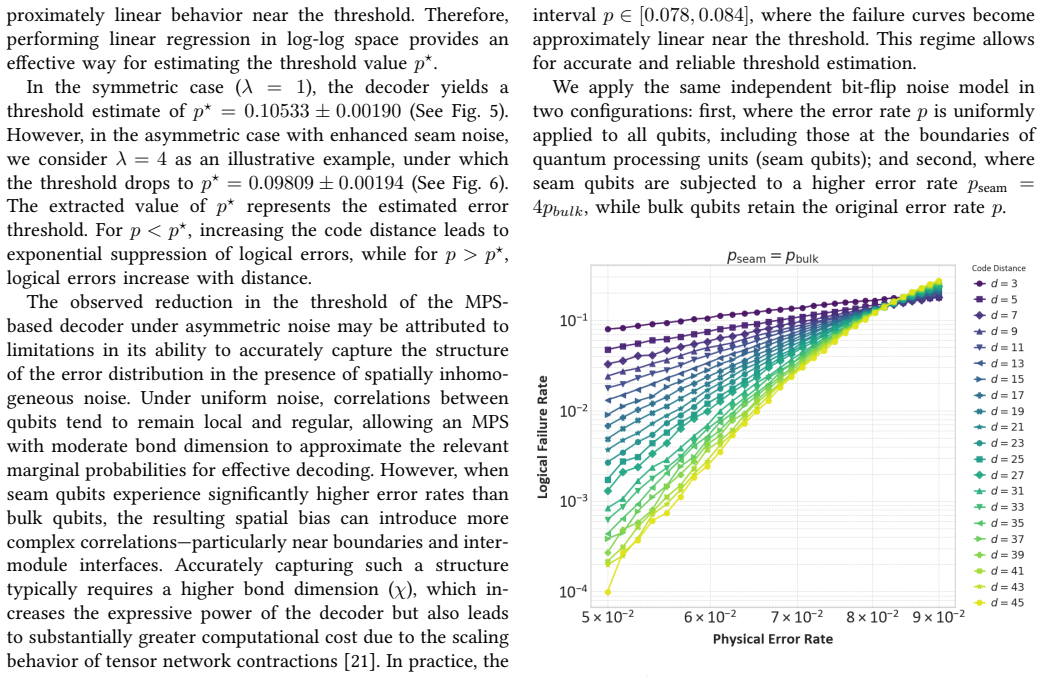
Color codes are a leading class of topological quantum error-correcting codes with modest error thresholds and structural compatibility with two-dimensional architectures, which make them well-suited for fault-tolerant quantum computing (FTQC). Here, we propose and analyze a distributed architecture for realizing the (6.6.6) color code. The architecture involves interconnecting patches of the color code housed in different quantum processing units (QPUs) via entangled pairs. To account for noisy interconnects, we model the qubits in the color code as being subject to a bit-flip noise channel, where the qubits on the boundary (seam) between patches experience elevated noise compared to those in the bulk. We investigate the error threshold of the distributed color code under such asymmetric noise conditions by employing two decoders: a tensor-network-based decoder and a recently introduced concatenated Minimum Weight Perfect Matching (MWPM) algorithm. Our simulations demonstrate that elevated noise on seam qubits leads to a slight reduction in threshold for the tensor-network decoder, whereas the concatenated MWPM decoder shows no significant change in the error threshold, underscoring its effectiveness under asymmetric noise conditions. Our findings thus highlight the robustness of color codes in distributed architectures and provide valuable insights into the practical realization of FTQC involving noisy interconnects between QPUs.
Editorial analysis
A structured set of objections, weighed in public.
Referee Report
Summary. The manuscript proposes a distributed architecture for realizing the (6.6.6) color code by interconnecting patches housed in separate QPUs via entangled pairs. Noisy interconnects are modeled by applying an elevated bit-flip noise channel exclusively to boundary seam qubits while bulk qubits experience standard noise. Error thresholds are computed via Monte Carlo simulations for two decoders—a tensor-network decoder and a concatenated MWPM decoder—under this asymmetric noise. The central result is that increased seam noise produces a slight threshold reduction for the tensor-network decoder but no significant change for the concatenated MWPM decoder.
Significance. If the noise model and simulation results hold, the work demonstrates that color codes remain viable in distributed multi-QPU settings and that the concatenated MWPM decoder is particularly robust to boundary-dominated noise. The explicit comparison of two decoder families and the focus on asymmetric noise provide concrete guidance for FTQC architectures. The numerical threshold extraction itself constitutes a falsifiable prediction that can be tested against more detailed physical interconnect models.
major comments (2)
- [Modeling section (abstract and §III)] Modeling section (abstract and §III): the claim that interconnect noise is captured by an elevated bit-flip channel applied only to seam qubits is load-bearing for all threshold conclusions, yet the model omits correlated two-qubit errors, phase noise on virtual links, and loss channels that arise in entanglement generation, distribution, and fusion. If these additional channels are present at comparable rates, both decoders’ thresholds could shift in ways not captured by the reported runs.
- [Results section (abstract and §V)] Results section (abstract and §V): no simulation parameters, decoder implementation details, Monte Carlo sample counts, or statistical error bars on the reported thresholds are provided. Without these, it is impossible to assess whether the “slight reduction” for the tensor-network decoder and “no significant change” for concatenated MWPM are statistically distinguishable from zero or from each other.
minor comments (2)
- [Abstract] Abstract: the phrase “elevated noise on seam qubits” should be accompanied by the explicit ratio or functional form used for the seam-to-bulk noise rate.
- [Figure captions (throughout)] Figure captions (throughout): ensure all threshold plots include both the fitted curves and the raw data points with error bars so that the “no significant change” statement can be visually verified.
Simulated Author's Rebuttal
We thank the referee for their careful reading of the manuscript and for the constructive comments. We address each major point below and describe the changes we will incorporate in the revised version.
read point-by-point responses
-
Referee: Modeling section (abstract and §III): the claim that interconnect noise is captured by an elevated bit-flip channel applied only to seam qubits is load-bearing for all threshold conclusions, yet the model omits correlated two-qubit errors, phase noise on virtual links, and loss channels that arise in entanglement generation, distribution, and fusion. If these additional channels are present at comparable rates, both decoders’ thresholds could shift in ways not captured by the reported runs.
Authors: We agree that the noise model is a deliberate simplification chosen to isolate the impact of elevated seam noise arising from interconnects. The bit-flip channel on boundary qubits is intended to represent the dominant error mechanism in this initial study rather than a complete physical model of entanglement distribution. In the revised manuscript we will expand Section III with an explicit discussion of the model assumptions, including the omission of correlated errors, phase noise, and loss channels, and we will add a forward-looking statement that more detailed interconnect models remain an important topic for subsequent work. This clarification will not alter the numerical results but will better contextualize their scope. revision: yes
-
Referee: Results section (abstract and §V): no simulation parameters, decoder implementation details, Monte Carlo sample counts, or statistical error bars on the reported thresholds are provided. Without these, it is impossible to assess whether the “slight reduction” for the tensor-network decoder and “no significant change” for concatenated MWPM are statistically distinguishable from zero or from each other.
Authors: The referee is correct that the current manuscript does not supply the requested numerical details. We will revise Section V to include a new subsection that reports the Monte Carlo sample counts, decoder hyperparameters (including tensor-network bond dimension and MWPM concatenation depth), the precise method used for threshold extraction, and statistical error bars on all threshold values. These additions will allow readers to evaluate the statistical significance of the observed differences between the two decoders under asymmetric seam noise. revision: yes
Circularity Check
No significant circularity: thresholds from direct simulations under explicit noise model
full rationale
The paper selects an explicit modeling ansatz (elevated bit-flip noise applied only to seam qubits) to represent interconnect errors and then reports numerical thresholds obtained by running two decoders on instances generated from that model. These thresholds are computed outputs of the simulation procedure rather than quantities fitted to or predicted from the same data set. No self-definitional reduction, fitted-input-called-prediction, load-bearing self-citation, or ansatz smuggled via prior work appears in the derivation chain. The results remain self-contained numerical experiments on the stated noise model and are therefore not circular.
Axiom & Free-Parameter Ledger
Lean theorems connected to this paper
-
IndisputableMonolith/Cost/FunctionalEquation.leanwashburn_uniqueness_aczel unclear?
unclearRelation between the paper passage and the cited Recognition theorem.
We model the qubits in the color code as being subject to a bit-flip noise channel, where the qubits on the boundary (seam) between patches experience elevated noise compared to those in the bulk.
-
IndisputableMonolith/Foundation/DimensionForcing.leanalexander_duality_circle_linking unclear?
unclearRelation between the paper passage and the cited Recognition theorem.
Our simulations demonstrate that elevated noise on seam qubits leads to a slight reduction in threshold for the tensor-network decoder, whereas the concatenated MWPM decoder shows no significant change in the error threshold.
What do these tags mean?
- matches
- The paper's claim is directly supported by a theorem in the formal canon.
- supports
- The theorem supports part of the paper's argument, but the paper may add assumptions or extra steps.
- extends
- The paper goes beyond the formal theorem; the theorem is a base layer rather than the whole result.
- uses
- The paper appears to rely on the theorem as machinery.
- contradicts
- The paper's claim conflicts with a theorem or certificate in the canon.
- unclear
- Pith found a possible connection, but the passage is too broad, indirect, or ambiguous to say the theorem truly supports the claim.
Forward citations
Cited by 3 Pith papers
-
Boundary-Aware Stabilizer Scheduling for Distributed Quantum Error Correction
SS-τ and AST scheduling policies for seam checks in distributed triangular color codes reduce remote-operation overhead and achieve lower logical error rates with fault-tolerant scaling in specific EGR regimes under c...
-
Near-Term Reduction in Nonlocal Gate Count from Distributed Logical Qubits
Qubit allocation techniques for distributed color-code logical qubits achieve a 10% reduction in nonlocal gates that scales with more qubits, plus evaluations of methods for universal gate sets including a logical-swa...
-
Architectural Approaches to Fault-Tolerant Distributed Quantum Computing and Their Entanglement Overheads
Three architectural types for fault-tolerant distributed quantum computing exhibit distinct scaling of Bell-pair consumption and generation attempts with code distance in planar surface and toric codes.
Reference graph
Works this paper leans on
-
[1]
M. A. Nielsen and I. L. Chuang, Quantum Computation and Quantum Information. Cambridge University Press, 2002
work page 2002
-
[2]
J. Preskill, “Reliable quantum computers, ” Proceedings of the Royal Society of London. Series A: Mathematical, Physical and Engineering Sciences, vol. 454, no. 1969, pp. 385–410, 1998
work page 1969
-
[3]
Quantum Error Correction for Quantum Memories
B. M. Terhal, “Quantum error correction for quantum memories, ” Rev. Mod. Phys. , vol. 87, pp. 307–346, Apr 2015. [Online]. Available: https://link.aps.org/doi/10.1103/RevModPhys.87.307
-
[4]
Shor (1995): Scheme for reducing decoherence in quantum computer memory
P. W. Shor, “Scheme for reducing decoherence in quantum computer memory, ”Phys. Rev. A , vol. 52, pp. R2493–R2496, Oct 1995. [Online]. Available: https://link.aps.org/doi/10.1103/PhysRevA.52.R2493
-
[5]
Stabilizer Codes and Quantum Error Correction
D. Gottesman, “Stabilizer codes and quantum error correction, ” 1997. [Online]. Available: https://arxiv.org/abs/quant-ph/9705052
work page internal anchor Pith review Pith/arXiv arXiv 1997
-
[6]
Shor, SIAM Journal on Computing 26, 1484 (1997), https://doi.org/10.1137/S0097539795293172
P. W. Shor, “Polynomial-time algorithms for prime factorization and discrete logarithms on a quantum computer, ” SIAM Journal on Computing, vol. 26, no. 5, pp. 1484–1509, 1997. [Online]. Available: https://doi.org/10.1137/S0097539795293172
-
[7]
L. K. Grover, “A fast quantum mechanical algorithm for database search, ” inProceedings of the Twenty-Eighth Annual ACM Symposium on Theory of Computing , ser. STOC ’96. New York, NY, USA: Association for Computing Machinery, 1996, p. 212–219. [Online]. Available: https://doi.org/10.1145/237814.237866
-
[8]
Quantum algorithms: an overview,
A. Montanaro, “Quantum algorithms: an overview, ” npj Quantum Information, vol. 2, no. 1, p. 15023, 2016. [Online]. Available: https://doi.org/10.1038/npjqi.2015.23
-
[9]
D. A. Lidar and T. A. Brun, Quantum error correction . Cambridge university press, 2013
work page 2013
-
[10]
Fault-tolerant quantum computation by anyons,
A. Kitaev, “Fault-tolerant quantum computation by anyons, ” Annals of Physics , vol. 303, no. 1, pp. 2–30, 2003. [Online]. Available: https://www.sciencedirect.com/science/article/pii/S0003491602000180
work page 2003
-
[11]
H. Bombin and M. A. Martin-Delgado, “Topological quantum distillation, ”Phys. Rev. Lett. , vol. 97, p. 180501, Oct 2006. [Online]. Available: https://link.aps.org/doi/10.1103/PhysRevLett.97.180501
-
[12]
Suppressing quantum errors by scaling a surface code logical qubit,
“Suppressing quantum errors by scaling a surface code logical qubit, ” Nature, vol. 614, no. 7949, pp. 676–681, 2023
work page 2023
-
[13]
Realization of an error-correcting surface code with superconducting qubits,
Y. Zhao, Y. Ye, H.-L. Huang, Y. Zhang, D. Wu, H. Guan, Q. Zhu, Z. Wei, T. He, S. Cao, F. Chen, T.-H. Chung, H. Deng, D. Fan, M. Gong, C. Guo, S. Guo, L. Han, N. Li, S. Li, Y. Li, F. Liang, J. Lin, H. Qian, H. Rong, H. Su, L. Sun, S. Wang, Y. Wu, Y. Xu, C. Ying, J. Yu, C. Zha, K. Zhang, Y.-H. Huo, C.-Y. Lu, C.-Z. Peng, X. Zhu, and J.-W. Pan, “Realization o...
-
[14]
Fault-tolerant quantum computing with color codes
A. J. Landahl, J. T. Anderson, and P. R. Rice, “Fault-tolerant quantum computing with color codes, ” 2011. [Online]. Available: https://arxiv.org/abs/1108.5738
work page internal anchor Pith review Pith/arXiv arXiv 2011
-
[15]
Y. Takada and K. Fujii, “Improving threshold for fault-tolerant color-code quantum computing by flagged weight optimization, ” PRX Quantum , vol. 5, p. 030352, Sep 2024. [Online]. Available: https://link.aps.org/doi/10.1103/PRXQuantum.5.030352
-
[16]
Facilitating practical fault- tolerant quantum computing based on color codes,
J. Zhang, Y.-C. Wu, and G.-P. Guo, “Facilitating practical fault- tolerant quantum computing based on color codes, ” Phys. Rev. Res., vol. 6, p. 033086, Jul 2024. [Online]. Available: https: //link.aps.org/doi/10.1103/PhysRevResearch.6.033086
-
[17]
Decoding algorithms for surface codes,
A. deMarti iOlius, P. Fuentes, R. Or ´us, P. M. Crespo, and J. Etxezarreta Martinez, “Decoding algorithms for surface codes, ” Quantum, vol. 8, p. 1498, Oct. 2024. [Online]. Available: http: //dx.doi.org/10.22331/q-2024-10-10-1498
-
[18]
A series of fast-paced advances in quantum error correction,
E. Campbell, “A series of fast-paced advances in quantum error correction, ”Nature Reviews Physics , vol. 6, no. 3, pp. 160–161, 2024
work page 2024
-
[19]
Decoding color codes by projection onto surface codes,
N. Delfosse, “Decoding color codes by projection onto surface codes, ” Phys. Rev. A , vol. 89, p. 012317, Jan 2014. [Online]. Available: https://link.aps.org/doi/10.1103/PhysRevA.89.012317
-
[20]
Almost-linear time decoding algo- rithm for topological codes,
N. Delfosse and N. H. Nickerson, “Almost-linear time decoding algo- rithm for topological codes, ” Quantum, vol. 5, p. 595, 2021
work page 2021
-
[21]
General tensor network decoding of 2d pauli codes,
C. T. Chubb, “General tensor network decoding of 2d pauli codes, ”
-
[22]
Available: https://arxiv.org/abs/2101.04125
[Online]. Available: https://arxiv.org/abs/2101.04125
-
[23]
Tensor-network decoding beyond 2d,
C. Piveteau, C. T. Chubb, and J. M. Renes, “Tensor-network decoding beyond 2d, ” PRX Quantum , vol. 5, p. 040303, Oct 2024. [Online]. Available: https://link.aps.org/doi/10.1103/PRXQuantum.5.040303
-
[24]
Color code decoder with improved scaling for correcting circuit-level noise,
S.-H. Lee, A. Li, and S. D. Bartlett, “Color code decoder with improved scaling for correcting circuit-level noise, ”Quantum, vol. 9, p. 1609, 2025
work page 2025
-
[25]
N. H. Nickerson, J. F. Fitzsimons, and S. C. Benjamin, “Freely scalable quantum technologies using cells of 5-to-50 qubits with very lossy and noisy photonic links, ” Phys. Rev. X , vol. 4, p. 041041, Dec 2014. [Online]. Available: https://link.aps.org/doi/10.1103/PhysRevX.4.041041
-
[26]
C. Monroe, R. Raussendorf, A. Ruthven, K. R. Brown, P. Maunz, L.-M. Duan, and J. Kim, “Large-scale modular quantum-computer architecture with atomic memory and photonic interconnects, ” Phys. Rev. A , vol. 89, p. 022317, Feb 2014. [Online]. Available: https://link.aps.org/doi/10.1103/PhysRevA.89.022317
-
[27]
N. K. Chandra, S. Guha, and K. P. Seshadreesan, “Multiplexed bi-layered realization of fault-tolerant quantum computation over optically net- worked trapped-ion modules, ”arXiv preprint arXiv:2411.08616 , 2024
work page internal anchor Pith review arXiv 2024
-
[28]
Fault-tolerant structures for measurement-based quantum computation on a network,
Y. van Montfort, S. de Bone, and D. Elkouss, “Fault-tolerant structures for measurement-based quantum computation on a network, ” 2024. [Online]. Available: https://arxiv.org/abs/2402.19323
-
[29]
Plankton: Reconciling binary code and debug information
J. Kim, D. Min, J. Cho, H. Jeong, I. Byun, J. Choi, J. Hong, and J. Kim, “A fault-tolerant million qubit-scale distributed quantum computer, ” in Proceedings of the 29th ACM International Conference on Architectural Support for Programming Languages and Operating Systems, Volume 2 , ser. ASPLOS ’24. New York, NY, USA: Association for Computing Machinery, ...
-
[30]
H. Leone, S. Srikara, P. P. Rohde, and S. Devitt, “Upper bounds for the clock speeds of fault-tolerant distributed quantum computation using satellites to supply entangled photon pairs, ” Phys. Rev. Res., vol. 5, p. 043302, Dec 2023. [Online]. Available: https: //link.aps.org/doi/10.1103/PhysRevResearch.5.043302
-
[31]
Entanglement purification on quantum networks,
M. Victora, S. Tserkis, S. Krastanov, A. S. de la Cerda, S. Willis, and P. Narang, “Entanglement purification on quantum networks, ” Phys. Rev. Res. , vol. 5, p. 033171, Sep 2023. [Online]. Available: https://link.aps.org/doi/10.1103/PhysRevResearch.5.033171
-
[32]
Low-overhead quantum computing with the color code,
F. Thomsen, M. S. Kesselring, S. D. Bartlett, and B. J. Brown, “Low-overhead quantum computing with the color code, ” Phys. Rev. Res. , vol. 6, p. 043125, Nov 2024. [Online]. Available: https://link.aps.org/doi/10.1103/PhysRevResearch.6.043125
-
[33]
Fault-tolerant connection of error-corrected qubits with noisy links,
J. Ramette, J. Sinclair, N. P. Breuckmann, and V. Vuleti ´c, “Fault-tolerant connection of error-corrected qubits with noisy links, ” npj Quantum Information, vol. 10, no. 1, p. 58, Jun 2024. [Online]. Available: https://doi.org/10.1038/s41534-024-00855-4
-
[34]
S. de Bone, P. M ¨oller, C. E. Bradley, T. H. Taminiau, and D. Elkouss, “Thresholds for the distributed surface code in the presence of memory decoherence, ”A VS Quantum Science, vol. 6, no. 3, p. 033801, 07 2024. [Online]. Available: https://doi.org/10.1116/5.0200190
-
[35]
E. Sutcliffe, B. Jonnadula, C. L. Gall, A. E. Moylett, and C. M. Westoby, “Distributed quantum error correction based on hyperbolic floquet codes, ” 2025. [Online]. Available: https://arxiv.org/abs/2501.14029
-
[36]
Good quantum error-correcting codes exist,
A. R. Calderbank and P. W. Shor, “Good quantum error-correcting codes exist, ”Physical Review A , vol. 54, no. 2, p. 1098, 1996
work page 1996
-
[37]
M. A. Nielsen and I. L. Chuang, Quantum Computation and Quantum Information: 10th Anniversary Edition . Cambridge University Press, 2010
work page 2010
-
[38]
Multiple-particle interference and quantum error correc- tion,
A. Steane, “Multiple-particle interference and quantum error correc- tion, ”Proceedings of the Royal Society of London. Series A: Mathematical, Physical and Engineering Sciences , vol. 452, no. 1954, pp. 2551–2577, 1996
work page 1954
-
[39]
Ultrafast fault-tolerant long-distance quantum communication with static linear optics,
F. Ewert and P. van Loock, “Ultrafast fault-tolerant long-distance quantum communication with static linear optics, ” Phys. Rev. A, vol. 95, p. 012327, Jan 2017. [Online]. Available: https: //link.aps.org/doi/10.1103/PhysRevA.95.012327
-
[40]
Synchronization and coexistence in quantum networks,
I. A. Burenkov, A. Semionov, Hala, T. Gerrits, A. Rahmouni, D. Anand, Y.-S. Li-Baboud, O. Slattery, A. Battou, and S. V. Polyakov, “Synchronization and coexistence in quantum networks, ”Opt. Express, vol. 31, no. 7, pp. 11 431–11 446, Mar 2023. [Online]. Available: https://opg.optica.org/oe/abstract.cfm?URI=oe-31-7-11431
work page 2023
-
[41]
Fault-tolerant optical interconnects for neutral-atom arrays,
J. Sinclair, J. Ramette, B. Grinkemeyer, D. Bluvstein, M. D. Lukin, and V. Vuleti ´c, “Fault-tolerant optical interconnects for neutral-atom arrays, ”Phys. Rev. Res. , vol. 7, p. 013313, Mar 2025. [Online]. Available: https://link.aps.org/doi/10.1103/PhysRevResearch.7.013313
-
[42]
Tailoring surface codes for highly biased noise,
D. K. Tuckett, A. S. Darmawan, C. T. Chubb, S. Bravyi, S. D. Bartlett, and S. T. Flammia, “Tailoring surface codes for highly biased noise, ”Phys. Rev. X , vol. 9, p. 041031, Nov 2019. [Online]. Available: https://link.aps.org/doi/10.1103/PhysRevX.9.041031
-
[43]
Efficient algorithms for maximum likelihood decoding in the surface code,
S. Bravyi, M. Suchara, and A. Vargo, “Efficient algorithms for maximum likelihood decoding in the surface code, ” Phys. Rev. A, vol. 90, p. 032326, Sep 2014. [Online]. Available: https: //link.aps.org/doi/10.1103/PhysRevA.90.032326
-
[44]
Tensor networks and quantum error correction,
A. J. Ferris and D. Poulin, “Tensor networks and quantum error correction, ”Phys. Rev. Lett. , vol. 113, p. 030501, Jul 2014. [Online]. Available: https://link.aps.org/doi/10.1103/PhysRevLett.113.030501
-
[45]
T. Farrelly, D. K. Tuckett, and T. M. Stace, “Local tensor-network codes, ”New Journal of Physics , vol. 24, no. 4, p. 043015, apr 2022. [Online]. Available: https://dx.doi.org/10.1088/1367-2630/ac5e87
-
[46]
Pymatching: A python package for decoding quantum codes with minimum-weight perfect matching,
O. Higgott, “Pymatching: A python package for decoding quantum codes with minimum-weight perfect matching, ” ACM Transactions on Quantum Computing , vol. 3, no. 3, Jun. 2022. [Online]. Available: https://doi.org/10.1145/3505637
-
[47]
Sparse blossom: correcting a million errors per core second with minimum-weight matching,
O. Higgott and C. Gidney, “Sparse blossom: correcting a million errors per core second with minimum-weight matching, ” Quantum, vol. 9, p. 1600, 2025
work page 2025
-
[48]
M. E. Beverland, A. Kubica, and K. M. Svore, “Cost of universality: A comparative study of the overhead of state distillation and code switching with color codes, ” PRX Quantum , vol. 2, p. 020341, Jun 2021. [Online]. Available: https://link.aps.org/doi/10.1103/ PRXQuantum.2.020341
work page 2021
-
[49]
Decoder for the triangular color code by matching on a m ¨obius strip,
K. Sahay and B. J. Brown, “Decoder for the triangular color code by matching on a m ¨obius strip, ” PRX Quantum , vol. 3, p. 010310, Jan 2022. [Online]. Available: https://link.aps.org/doi/10.1103/ PRXQuantum.3.010310
work page 2022
-
[50]
Review of distributed quantum computing: From single qpu to high performance quantum computing,
D. Barral, F. J. Cardama, G. D ´ıaz-Camacho, D. Fa ´ılde, I. F. Llovo, M. Mussa-Juane, J. V ´azquez-P´erez, J. Villasuso, C. Pi ˜neiro, N. Costas, J. C. Pichel, T. F. Pena, and A. G ´omez, “Review of distributed quantum computing: From single qpu to high performance quantum computing, ” Computer Science Review , vol. 57, p. 100747, 2025. [Online]. Availab...
work page 2025
-
[51]
Network operations scheduling for distributed quantum computing,
N. K. Chandra, E. Kaur, and K. P. Seshadreesan, “Network operations scheduling for distributed quantum computing, ” in 2024 IEEE 6th International Conference on Trust, Privacy and Security in Intelligent Systems, and Applications (TPS-ISA) , 2024, pp. 506–515
work page 2024
-
[52]
Tailoring surface codes: Improvements in quantum error correction with biased noise,
D. K. Tuckett, “Tailoring surface codes: Improvements in quantum error correction with biased noise, ” Ph.D. dissertation, University of Sydney, 2020, (qecsim: https://github.com/qecsim/qecsim)
work page 2020
discussion (0)
Sign in with ORCID, Apple, or X to comment. Anyone can read and Pith papers without signing in.