Joint Reconstruction of Activity and Attenuation in PET by Diffusion Posterior Sampling in Wavelet Coefficient Space
Pith reviewed 2026-05-19 14:14 UTC · model grok-4.3
The pith
Joint PET activity and attenuation maps can be reconstructed from emission data alone via diffusion posterior sampling in wavelet space.
A machine-rendered reading of the paper's core claim, the machinery that carries it, and where it could break.
Core claim
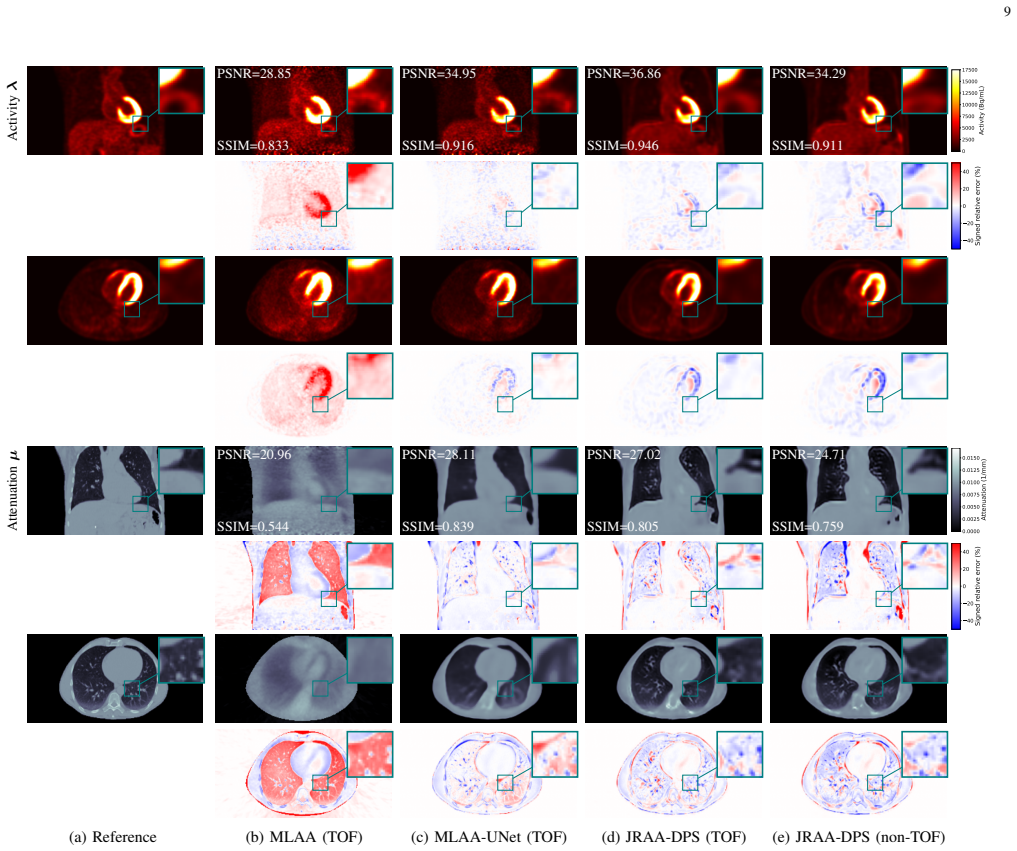
We propose a joint reconstruction of activity and attenuation approach that relies solely on emission data by combining a wavelet diffusion model and diffusion posterior sampling to produce fully three-dimensional reconstructions. Experimental results on simulated data show the method outperforms maximum likelihood activity and attenuation and MLAA-UNet, yielding high-quality noise-free images across count settings with time-of-flight; it also reconstructs non-TOF data with noticeable degradation in low-count conditions and demonstrates feasibility on real Biograph mMR data with joint scatter estimation.
What carries the argument
Wavelet diffusion model combined with diffusion posterior sampling applied to the joint activity-attenuation estimation problem from PET emission data.
If this is right
- Stand-alone PET imaging becomes feasible without auxiliary anatomical scans while maintaining quantification accuracy when time-of-flight data is available.
- High-quality noise-free reconstructions are obtained even in low-count regimes provided time-of-flight information is used.
- The framework can process non-TOF data, although reconstruction quality drops markedly under low-count conditions.
- Real-data results with simultaneous scatter estimation indicate readiness for clinical workflow integration.
Where Pith is reading between the lines
- If generalization holds, hybrid PET/CT systems could reduce patient dose by omitting the CT component in selected protocols.
- The same posterior-sampling strategy in wavelet space might transfer to related tomographic inverse problems such as SPECT attenuation correction.
- Large-scale testing across scanner vendors and patient populations would be the next practical step to establish robustness.
Load-bearing premise
The pre-trained wavelet diffusion model generalizes to unseen patient anatomies, scanner geometries, and count levels without significant domain shift or retraining.
What would settle it
Direct comparison of the estimated attenuation maps against ground-truth maps derived from co-registered CT scans on a collection of real clinical PET patient studies, checking whether the voxel-wise errors remain within clinical tolerance for accurate quantification.
Figures



read the original abstract
Attenuation correction (AC) is necessary for accurate activity quantification in positron emission tomography (PET). Conventional reconstruction methods typically rely on attenuation maps derived from a co-registered computed tomography (CT) or magnetic resonance (MR) scan. However, this additional scan may complicate the imaging workflow, introduce misalignment artifacts and increase radiation exposure. In this paper, we propose a joint reconstruction of activity and attenuation (JRAA) approach that eliminates the need for auxiliary anatomical imaging by relying solely on emission data. This framework combines wavelet diffusion model (WDM) and diffusion posterior sampling (DPS) to reconstruct fully three-dimensional (3-D) data. Experimental results on simulated data show our method outperforms maximum likelihood activity and attenuation (MLAA) and MLAA-UNet with U-Net-based post processing, and yields high-quality noise-free reconstructions across various count settings with time-of-flight (TOF). It is also able to reconstruct non-TOF data, although the reconstruction quality significantly degrades in low-count (LC) conditions, limiting its practical effectiveness in such settings. Nonetheless, a non-TOF Biograph mMR real data reconstruction with joint scatter estimation highlights the potential of the method for clinical applications. This approach represents a step towards stand-alone PET imaging by reducing the dependence on anatomical modalities while maintaining quantification accuracy, even in LC scenarios when TOF information is available. Our code is available on GitHub at https://github.com/clemphg/jraa-dps.
Editorial analysis
A structured set of objections, weighed in public.
Referee Report
Summary. The manuscript proposes a joint reconstruction of activity and attenuation (JRAA) method for PET that relies solely on emission data by combining a pre-trained wavelet diffusion model (WDM) with diffusion posterior sampling (DPS). It reports that the approach outperforms MLAA and MLAA-UNet on simulated data, produces high-quality noise-free reconstructions across count levels when TOF information is available, and demonstrates feasibility on one real non-TOF Biograph mMR scan with joint scatter estimation, positioning it as a step toward stand-alone PET imaging without auxiliary anatomical scans.
Significance. If the performance claims are substantiated, the work would address a clinically relevant problem by reducing dependence on co-registered CT/MR scans, thereby simplifying workflows and lowering radiation exposure. The technical choice of operating diffusion models in wavelet coefficient space for 3-D joint reconstruction is novel for this application, and the public release of code supports reproducibility. However, the current evidence base is preliminary, relying primarily on qualitative comparisons and limited validation data.
major comments (2)
- [Abstract] Abstract: the central claim of outperformance over MLAA and MLAA-UNet is stated only in qualitative terms without reporting specific quantitative metrics (e.g., RMSE, SSIM, or bias values), statistical significance tests, error bars, or details on the number of simulated realizations, training data composition, or hyperparameter selection. This absence directly weakens the ability to assess the magnitude and reliability of the reported improvements.
- [Results] Results section (simulated and real data experiments): validation is confined to a small set of simulated phantoms plus a single real non-TOF scan, with no quantitative cross-anatomy, cross-scanner, or cross-count-level ablation studies. Because the WDM is pre-trained, any domain shift in wavelet statistics for unseen patient anatomies or scanner geometries (including TOF vs. non-TOF response) would propagate into the DPS-conditioned samples and could invalidate the generalization claim for stand-alone PET viability.
minor comments (2)
- [Abstract / Introduction] The abstract and introduction would benefit from a brief statement of the precise loss or objective used to train the WDM and how the DPS conditioning is formulated for the joint activity-attenuation problem.
- [Figures] Figure captions and axis labels should explicitly indicate whether reconstructions are shown for TOF or non-TOF data and the corresponding count level to improve clarity.
Simulated Author's Rebuttal
We thank the referee for the constructive comments, which help clarify the presentation of our results. We agree that quantitative details strengthen the abstract and have revised it accordingly. For the validation concerns, we have expanded the results and discussion sections to include additional quantitative analyses and explicit limitations while maintaining the scope of this feasibility study.
read point-by-point responses
-
Referee: [Abstract] Abstract: the central claim of outperformance over MLAA and MLAA-UNet is stated only in qualitative terms without reporting specific quantitative metrics (e.g., RMSE, SSIM, or bias values), statistical significance tests, error bars, or details on the number of simulated realizations, training data composition, or hyperparameter selection. This absence directly weakens the ability to assess the magnitude and reliability of the reported improvements.
Authors: We agree that the abstract would benefit from quantitative support. In the revised manuscript we have added representative RMSE, SSIM and bias values for activity and attenuation maps (with standard deviations across 10 noise realizations), noted that paired t-tests showed statistically significant improvements (p < 0.05), and included brief statements on training data (50 simulated 3-D phantoms) and hyperparameter choices (guidance scale and number of DPS steps). revision: yes
-
Referee: [Results] Results section (simulated and real data experiments): validation is confined to a small set of simulated phantoms plus a single real non-TOF scan, with no quantitative cross-anatomy, cross-scanner, or cross-count-level ablation studies. Because the WDM is pre-trained, any domain shift in wavelet statistics for unseen patient anatomies or scanner geometries (including TOF vs. non-TOF response) would propagate into the DPS-conditioned samples and could invalidate the generalization claim for stand-alone PET viability.
Authors: We acknowledge the limited validation set. The revised results section now reports quantitative metrics across three count levels (high, medium, low) with error bars and an explicit ablation on count rate. We have added a dedicated limitations paragraph discussing potential domain shift in wavelet statistics for unseen anatomies or scanner geometries and have tempered the generalization language to emphasize that the work demonstrates feasibility rather than broad clinical readiness. Comprehensive cross-anatomy and cross-scanner experiments would require additional multi-center data beyond the present study. revision: partial
Circularity Check
No circularity in derivation; method uses independent pre-trained prior and separate validation data
full rationale
The paper presents a joint activity-attenuation reconstruction method that combines a pre-trained wavelet diffusion model with diffusion posterior sampling conditioned on emission data. Performance is evaluated via comparisons to MLAA and MLAA-UNet on simulated phantoms and one real non-TOF dataset, with no equations or claims reducing the reported outperformance to quantities fitted directly from the evaluation data. The central premise relies on the generalization of the pre-trained WDM, which is treated as an external component rather than derived from the test cases; validation phantoms are independent of any fitting steps described. No self-citation chains, self-definitional loops, or fitted-input-as-prediction patterns appear in the abstract or described workflow, rendering the derivation self-contained against external benchmarks.
Axiom & Free-Parameter Ledger
axioms (1)
- domain assumption A pre-trained wavelet diffusion model captures the statistical distribution of realistic PET emission data sufficiently well to act as a prior for joint reconstruction.
Lean theorems connected to this paper
-
IndisputableMonolith/Cost/FunctionalEquation.leanwashburn_uniqueness_aczel unclear?
unclearRelation between the paper passage and the cited Recognition theorem.
This framework combines wavelet diffusion model (WDM) and diffusion posterior sampling (DPS) to reconstruct fully three-dimensional (3-D) data... a single trained model can be applied to various clinical scenarios without retraining.
-
IndisputableMonolith/Foundation/AlexanderDuality.leanalexander_duality_circle_linking unclear?
unclearRelation between the paper passage and the cited Recognition theorem.
WDMs are a form of LDM that are trained in a wavelet coefficient space... orthogonal discrete wavelet transform (DWT)... eight-channel wavelet coefficient image
What do these tags mean?
- matches
- The paper's claim is directly supported by a theorem in the formal canon.
- supports
- The theorem supports part of the paper's argument, but the paper may add assumptions or extra steps.
- extends
- The paper goes beyond the formal theorem; the theorem is a base layer rather than the whole result.
- uses
- The paper appears to rely on the theorem as machinery.
- contradicts
- The paper's claim conflicts with a theorem or certificate in the canon.
- unclear
- Pith found a possible connection, but the passage is too broad, indirect, or ambiguous to say the theorem truly supports the claim.
Forward citations
Cited by 1 Pith paper
-
Multilevel Stochastic Plug-and-Play for Sparse-View CT Reconstruction
ML-SPnP accelerates stochastic PnP for SVCT by using MRA approximation spaces where prior-coherence corrections vanish in expectation, yielding comparable quality at reduced runtime.
discussion (0)
Sign in with ORCID, Apple, or X to comment. Anyone can read and Pith papers without signing in.