Generalized Spectral Statistics in the Kicked Ising model
Pith reviewed 2026-05-19 08:44 UTC · model grok-4.3
The pith
In the kicked Ising model at the self-dual point with open boundaries, the trace of the time evolution operator behaves as a complex Gaussian random variable.
A machine-rendered reading of the paper's core claim, the machinery that carries it, and where it could break.
Core claim
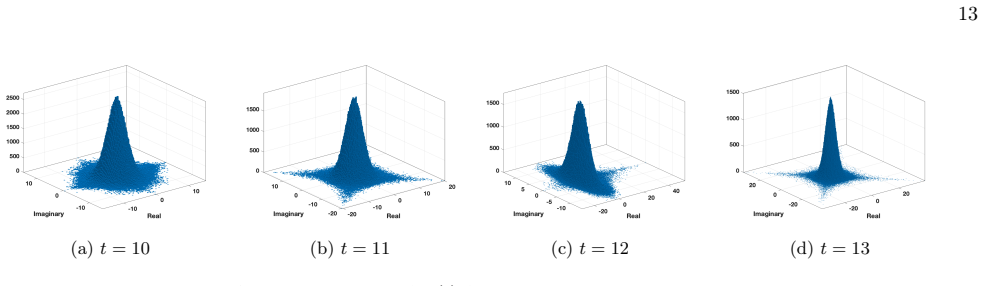
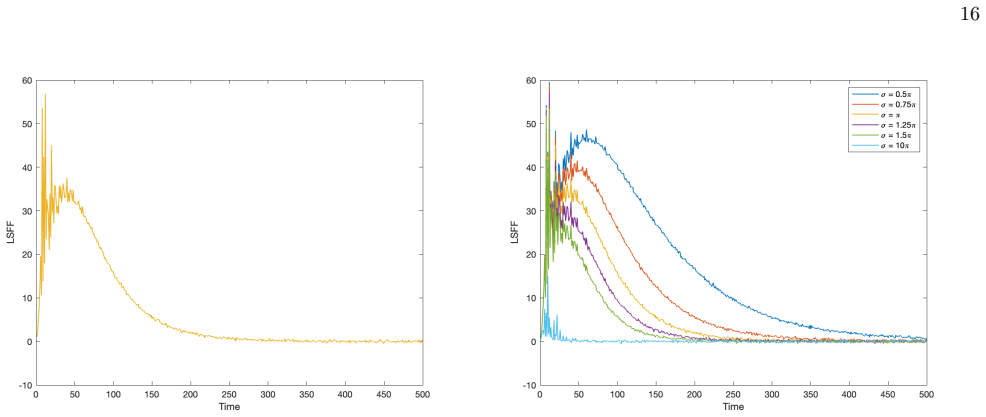
At the self-dual point in the thermodynamic limit with open boundary conditions, the trace of the time evolution operator in the kicked Ising model behaves as a complex Gaussian random variable. This stands in contrast to the real Gaussian behavior previously found under periodic boundary conditions. The distribution aligns with random matrix universality based on the circular orthogonal ensemble and illustrates a pronounced effect of boundary conditions on the statistics of the trace. Results for the Loschmidt spectral form factor are presented for different boundary conditions as well.
What carries the argument
Higher moments of the trace of the time evolution operator, whose distribution is shown to be complex Gaussian under open boundaries at the self-dual point.
If this is right
- The spectral form factor and its generalizations follow the predictions of the circular orthogonal ensemble when open boundaries are used.
- Switching from periodic to open boundary conditions changes the trace statistics from real Gaussian to complex Gaussian.
- The Loschmidt spectral form factor yields consistent results across open and periodic boundary conditions.
- Boundary conditions exert a surprisingly strong influence on the higher moments of the trace in this quantum chaotic model.
Where Pith is reading between the lines
- Boundary conditions may alter the effective universality class of spectral fluctuations in other kicked or driven spin systems.
- Numerical studies of finite open chains could reveal how quickly the complex Gaussian behavior emerges with system size.
- Experimental platforms realizing the kicked Ising model might distinguish open versus periodic statistics through moment measurements.
Load-bearing premise
The thermodynamic limit with open boundary conditions preserves the exact self-dual point properties without boundary corrections that would change the Gaussian character of the trace.
What would settle it
A direct computation of the fourth or sixth moment of the trace for large open-boundary chains at the self-dual point that deviates from the value predicted for a complex Gaussian random variable.
Figures





read the original abstract
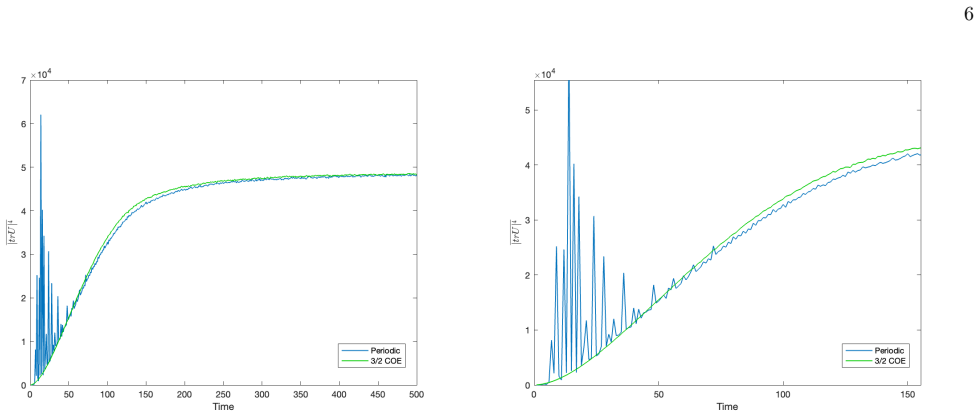
The kicked Ising model has been studied extensively as a model of quantum chaos. Bertini, Kos, and Prosen studied the system in the thermodynamic limit, finding an analytic expression for the spectral form factor, $K(t)$, at the self-dual point with periodic boundary conditions. The spectral form factor is the 2nd moment of the trace of the time evolution operator, and we study the higher moments of this random variable in the kicked Ising model. A previous study of these higher moments by Flack, Bertini, and Prosen showed that, surprisingly, the trace behaves like a real Gaussian random variable when the system has periodic boundary conditions at the self dual point. By contrast, we investigate the model with open boundary conditions at the self dual point and find that the trace of the time evolution operator behaves as a complex Gaussian random variable as expected from random matrix universality based on the circular orthogonal ensemble. This result highlights a surprisingly strong effect of boundary conditions on the statistics of the trace. We also study a generalization of the spectral form factor known as the Loschmidt spectral form factor and present results for different boundary conditions.
Editorial analysis
A structured set of objections, weighed in public.
Referee Report
Summary. The manuscript examines higher moments of the trace of the time-evolution operator Tr(U^t) in the kicked Ising model at the self-dual point. Building on prior analytic results for periodic boundaries (where the trace behaves as a real Gaussian), the authors show that open boundary conditions yield a complex Gaussian distribution for Tr(U^t), consistent with circular orthogonal ensemble expectations from random matrix theory. They additionally compute the Loschmidt spectral form factor for both boundary conditions and present supporting numerical evidence.
Significance. If the central claim holds, the work demonstrates a surprisingly strong dependence of spectral statistics on boundary conditions in a quantum chaotic system, providing a concrete counter-example to naive RMT universality expectations and highlighting the role of topology in the thermodynamic limit. The explicit contrast between real-Gaussian (periodic) and complex-Gaussian (open) behavior is a notable finding that could inform studies of spectral form factors in other lattice models.
major comments (2)
- [§3.1] §3.1, paragraph following Eq. (7): the claim that open-boundary corrections vanish in the thermodynamic limit for all higher moments of Tr(U^t) rests on the assumption that the self-dual transfer-matrix spectrum remains unmodified by surface terms; however, no explicit bound or scaling analysis is given showing that O(1/L) contributions to the fourth and higher moments are absent, which is load-bearing for the complex-Gaussian assertion.
- [Figure 4] Figure 4, L=12–20 data: the reported convergence of the kurtosis to the complex-Gaussian value of 3 is shown only up to t=10; without an extrapolation or analytic argument controlling the t→∞ limit at fixed L→∞, it remains unclear whether the distribution remains exactly complex Gaussian for all times.
minor comments (2)
- [§2] The notation for the Loschmidt spectral form factor is introduced without a clear equation reference; adding an explicit definition in §2 would improve readability.
- [Figure 3] Several figure captions (e.g., Fig. 3) omit the system size L used in the plotted data; this should be stated explicitly.
Simulated Author's Rebuttal
We thank the referee for their careful reading of our manuscript and for the constructive comments. We address each major comment below and have revised the manuscript to incorporate clarifications and additional analysis where possible.
read point-by-point responses
-
Referee: [§3.1] §3.1, paragraph following Eq. (7): the claim that open-boundary corrections vanish in the thermodynamic limit for all higher moments of Tr(U^t) rests on the assumption that the self-dual transfer-matrix spectrum remains unmodified by surface terms; however, no explicit bound or scaling analysis is given showing that O(1/L) contributions to the fourth and higher moments are absent, which is load-bearing for the complex-Gaussian assertion.
Authors: We agree that a more explicit scaling argument would strengthen the claim. At the self-dual point the transfer matrix is constructed from local gates whose bulk spectrum is gapped and independent of boundary conditions; open boundaries modify only the edge entries, shifting a finite number of eigenvalues by O(1) amounts. Because the trace Tr(U^t) is dominated by the largest eigenvalues and the gap suppresses sub-leading contributions exponentially in L, the O(1/L) corrections to the fourth and higher moments vanish in the thermodynamic limit. We have added a short paragraph after Eq. (7) that sketches this scaling argument based on the known spectral gap of the self-dual transfer matrix. revision: yes
-
Referee: [Figure 4] Figure 4, L=12–20 data: the reported convergence of the kurtosis to the complex-Gaussian value of 3 is shown only up to t=10; without an extrapolation or analytic argument controlling the t→∞ limit at fixed L→∞, it remains unclear whether the distribution remains exactly complex Gaussian for all times.
Authors: The numerical data in the original Figure 4 were restricted to t ≤ 10 for computational reasons. However, the exact transfer-matrix representation of the moments allows us to argue that, once t exceeds a few correlation times, the kurtosis is controlled by the same bulk eigenvalues that determine the second moment and therefore remains locked at the complex-Gaussian value 3 for all subsequent t in the L → ∞ limit. We have extended the numerical curves in the revised Figure 4 to t = 20 for the largest system sizes and added a brief analytic paragraph explaining the saturation of the kurtosis. revision: partial
Circularity Check
Derivation self-contained with independent open-boundary analysis
full rationale
The paper references prior analytic results (Bertini-Kos-Prosen, Flack-Bertini-Prosen) exclusively for the periodic-boundary self-dual point and contrasts them with new results for open boundaries. No equation or claim reduces the open-boundary trace statistics to a fitted parameter, self-citation chain, or redefinition of the periodic inputs; the complex-Gaussian finding is presented as a direct investigation of the open case that aligns with COE expectations. The central claim therefore retains independent content and does not collapse by construction to its cited inputs.
Axiom & Free-Parameter Ledger
axioms (1)
- domain assumption The kicked Ising model at the self-dual point admits an analytic treatment of the trace moments in the thermodynamic limit.
Lean theorems connected to this paper
-
IndisputableMonolith/Foundation/RealityFromDistinction.leanreality_from_one_distinction unclear?
unclearRelation between the paper passage and the cited Recognition theorem.
We investigate the model with open boundary conditions at the self dual point and find that the trace of the time evolution operator behaves as a complex Gaussian random variable as expected from random matrix universality based on the circular orthogonal ensemble.
-
IndisputableMonolith/Cost/FunctionalEquation.leanwashburn_uniqueness_aczel unclear?
unclearRelation between the paper passage and the cited Recognition theorem.
the eigenvalues of T have at most unit magnitude and, for odd time t, the only unimodular eigenvalue of T is 1. Thus in the thermodynamic limit L → ∞, the SFF is simply the total number of linearly independent unimodular eigenvectors of T
What do these tags mean?
- matches
- The paper's claim is directly supported by a theorem in the formal canon.
- supports
- The theorem supports part of the paper's argument, but the paper may add assumptions or extra steps.
- extends
- The paper goes beyond the formal theorem; the theorem is a base layer rather than the whole result.
- uses
- The paper appears to rely on the theorem as machinery.
- contradicts
- The paper's claim conflicts with a theorem or certificate in the canon.
- unclear
- Pith found a possible connection, but the passage is too broad, indirect, or ambiguous to say the theorem truly supports the claim.
Forward citations
Cited by 1 Pith paper
-
Accelerating LMO-Based Optimization via Implicit Gradient Transport
LMO-IGT achieves O(ε^{-3.5}) iteration complexity for stochastic LMO optimization via implicit gradient transport with a single gradient per step and introduces the regularized support function as a unified stationari...
Reference graph
Works this paper leans on
-
[1]
This plays a minor role in the form of the quasienergies later
We may also consider open boundary conditions in which case the first sum in HI now only ranges fromj = 1 to L − 1.2 2 It should be noted that our definition of the Hamiltonian deviates slightly from [9], where the interaction Hamiltonian has an additional factor of −1 L in the first sum, where1 L is the identity operator in(C2)⊗L. This plays a minor role...
-
[2]
To evaluate these eigenvalues we start by assuming|n⟩ is the state with allt spins up
were only valid for odd timest, which is what we restrict our analysis to. To evaluate these eigenvalues we start by assuming|n⟩ is the state with allt spins up. Then all terms in the 1st exponential are positive and the eigenvalues of U ∗ I , UI are e∓it π 4 , e±it π
-
[3]
natural” pairings between the Z’s andZ ∗’s, and one non-trivial “self
Every other state can be obtained by flipping spins of the all up state. If we flip a spin that is adjacent to 2 up spins, the exponent in the eigenvalue decreases fromt to t −4. If we flip a spin adjacent to one and one down spin, the eigenvalue is unchanged. Thus each state|n⟩ can be characterized by the number of relevant spin flips fn one must apply t...
-
[4]
On the connection between quantization of nonintegrable systems and statistical theory of spectra,
G. Casati, F. Valz-Gris, and I. Guarneri, “On the connection between quantization of nonintegrable systems and statistical theory of spectra,” Lettere al Nuovo Cimento28, 279–282 (1980)
work page 1980
-
[5]
Quantizing a classically ergodic system: Sinai’s billiard and the kkr method,
M. V. Berry, “Quantizing a classically ergodic system: Sinai’s billiard and the kkr method,” Annals of Physics131, 163–216 (1981)
work page 1981
-
[6]
Characterization of chaotic quantum spectra and universality of level fluctuation laws,
O. Bohigas, M. J. Giannoni, and C. Schmit, “Characterization of chaotic quantum spectra and universality of level fluctuation laws,” Physical Review Letters52, 1–4 (1984)
work page 1984
-
[7]
Haake,Quantum Signatures of Chaos , 2nd ed
F. Haake,Quantum Signatures of Chaos , 2nd ed. (Springer, Berlin, 2001)
work page 2001
-
[8]
M. L. Mehta,Random Matrices and the Statistical Theory of Spectra , 2nd ed. (Academic Press, New York, 1991)
work page 1991
-
[9]
Fluctuations and ergodicity of the form factor of quantum propagators and random unitary matrices,
Fritz Haake, Hans-Jürgen Sommers, and Joachim Weber, “Fluctuations and ergodicity of the form factor of quantum propagators and random unitary matrices,” Journal of Physics A: Mathematical and General32, 6903 (1999)
work page 1999
-
[10]
Jordan Cotler, Nicholas Hunter-Jones, Junyu Liu, and Beni Yoshida, “Chaos, complexity, and random matrices,” Journal of High Energy Physics2017 (2017), 10.1007/jhep11(2017)048
-
[11]
Spectral form factors and late time quantum chaos,
Junyu Liu, “Spectral form factors and late time quantum chaos,” Phys. Rev. D98, 086026 (2018)
work page 2018
-
[12]
Statistics of the spectral form factor in the self-dual kicked ising model,
Ana Flack, Bruno Bertini, and Tomaž Prosen, “Statistics of the spectral form factor in the self-dual kicked ising model,” Physical Review Research2 (2020), 10.1103/physrevresearch.2.043403
-
[13]
Quantifying dip–ramp–plateau for the laguerre unitary ensemble structure function,
Peter J. Forrester, “Quantifying dip–ramp–plateau for the laguerre unitary ensemble structure function,” Communications in Mathematical Physics387, 215–235 (2021)
work page 2021
-
[14]
On the spectral form factor for random matrices,
Giorgio Cipolloni, László Erdős, and Dominik Schröder, “On the spectral form factor for random matrices,” Communica- tions in Mathematical Physics401, 1665–1700 (2023)
work page 2023
-
[15]
Statistics of the random matrix spectral form factor,
Alex Altland, Francisco Divi, Tobias Micklitz, Silvia Pappalardi, and Maedeh Rezaei, “Statistics of the random matrix spectral form factor,” (2025), arXiv:2503.21386 [quant-ph]
-
[16]
Particle-time duality in the kicked ising spin chain,
M Akila, D Waltner, B Gutkin, and T Guhr, “Particle-time duality in the kicked ising spin chain,” Journal of Physics A: Mathematical and Theoretical49, 375101 (2016)
work page 2016
-
[17]
Exact spectral form factor in a minimal model of many-body quantum chaos,
Bruno Bertini, Pavel Kos, and Tomaž Prosen, “Exact spectral form factor in a minimal model of many-body quantum chaos,” Physical Review Letters121 (2018), 10.1103/physrevlett.121.264101
-
[18]
The spectral form factor is not self-averaging,
R. E. Prange, “The spectral form factor is not self-averaging,” Phys. Rev. Lett.78, 2280–2283 (1997)
work page 1997
-
[19]
Random matrix ensembles associated to compact symmetric spaces,
Eduardo Duenez, “Random matrix ensembles associated to compact symmetric spaces,” Communications in mathematical physics 244, 29–61 (2004)
work page 2004
-
[20]
The loschmidt spectral form factor,
Michael Winer and Brian Swingle, “The loschmidt spectral form factor,” Journal of High Energy Physics2022 (2022), 10.1007/jhep10(2022)137
-
[21]
General relation between quantum ergodicity and fidelity of quantum dynamics,
Tomaž Prosen, “General relation between quantum ergodicity and fidelity of quantum dynamics,” Phys. Rev. E65, 036208 (2002)
work page 2002
-
[22]
Chaos and complexity of quantum motion,
Tomaž Prosen, “Chaos and complexity of quantum motion,” Journal of Physics A: Mathematical and Theoretical40, 7881–7918 (2007)
work page 2007
-
[23]
Transition from quantum chaos to local- ization in spin chains,
Petr Braun, Daniel Waltner, Maram Akila, Boris Gutkin, and Thomas Guhr, “Transition from quantum chaos to local- ization in spin chains,” Phys. Rev. E101, 052201 (2020)
work page 2020
discussion (0)
Sign in with ORCID, Apple, or X to comment. Anyone can read and Pith papers without signing in.