The Multiplicative Instrumental Variable Model
Pith reviewed 2026-05-19 04:34 UTC · model grok-4.3
The pith
The MIV model identifies the average treatment effect on the treated by assuming no multiplicative interaction between the instrument and hidden confounders in treatment uptake.
A machine-rendered reading of the paper's core claim, the machinery that carries it, and where it could break.
Core claim
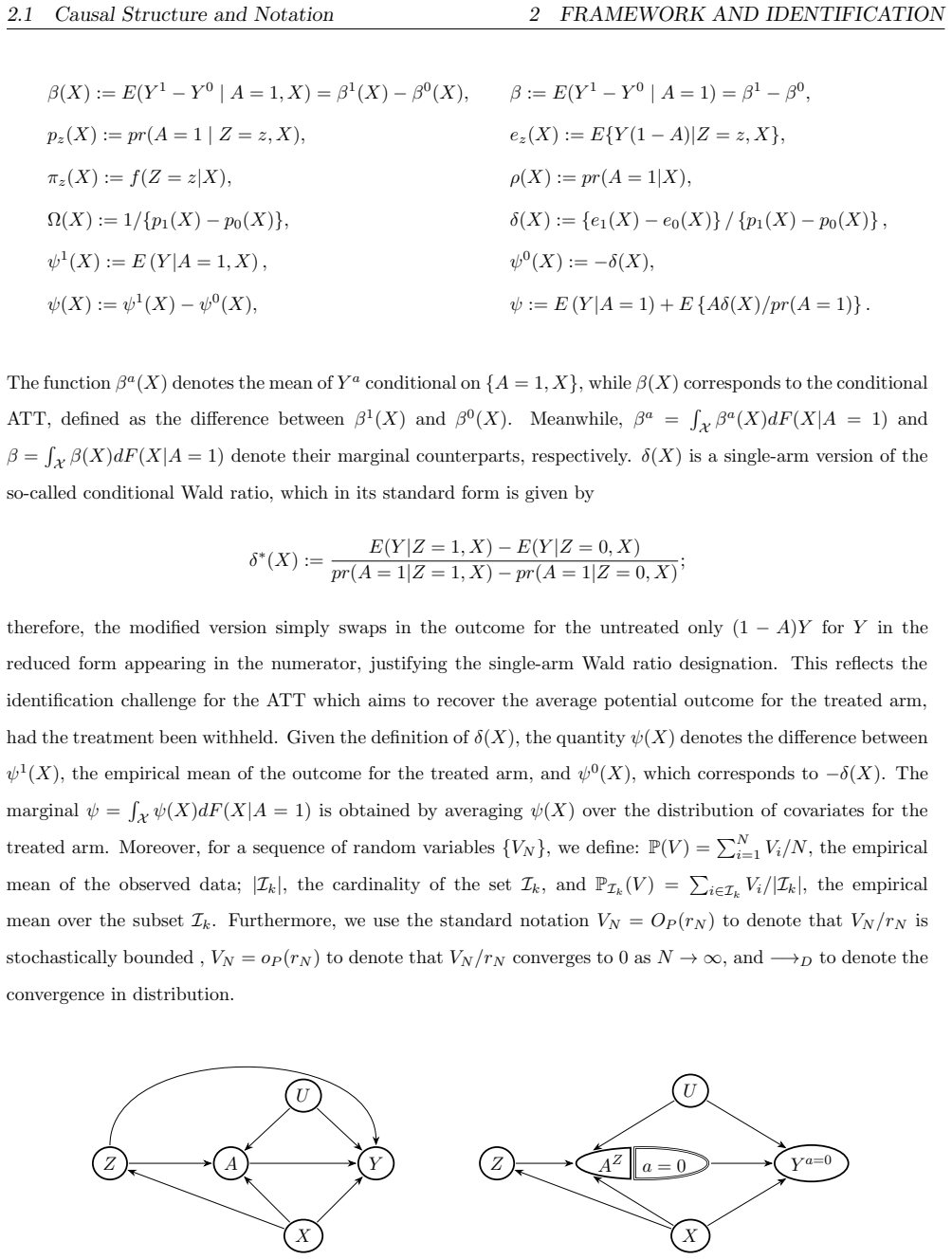
The MIV model encodes a condition of no multiplicative interaction between the instrument and an unmeasured confounder in the treatment propensity score model, thereby providing nonparametric identification of the population average treatment effect on the treated via a single-arm version of the classical Wald ratio IV estimand, for which multiply robust and semiparametric efficient estimators are proposed.
What carries the argument
The no-multiplicative-interaction condition in the treatment propensity score, which isolates the instrument's effect on treatment uptake from that of hidden confounders and turns the single-arm Wald ratio into an identifier of the ATT.
If this is right
- The ATT becomes identifiable without monotonicity or additive effect homogeneity assumptions.
- Multiply robust estimators can be constructed that remain consistent under multiple combinations of correct model specifications.
- The same identification strategy applies directly to settings such as evaluating job training programs on earnings among participants.
- Semiparametric efficiency bounds can be achieved for the resulting ATT estimator.
Where Pith is reading between the lines
- Similar multiplicative separability assumptions might identify other causal parameters such as effects on the untreated in related designs.
- The model could be tested or relaxed by allowing limited forms of interaction and checking sensitivity of the ATT estimate.
- Connections may exist to other IV relaxations that replace homogeneity with scale-specific independence conditions.
Load-bearing premise
The instrument and any unmeasured confounder act on treatment uptake through mechanisms that do not interact multiplicatively.
What would settle it
Empirical evidence that the ratio of treatment probabilities under different instrument values changes systematically with the level of an unmeasured confounder in a manner inconsistent with multiplicative separability.
Figures

read the original abstract
The instrumental variable (IV) design is a common approach to address hidden confounding bias. For validity, an IV must impact the outcome only through its association with the treatment. In addition, IV identification has required a homogeneity condition such as monotonicity or no unmeasured common effect modifier between the additive effect of the treatment on the outcome, and that of the IV on the treatment. In this work, we introduce the Multiplicative Instrumental Variable Model (MIV), which encodes a condition of no multiplicative interaction between the instrument and an unmeasured confounder in the treatment propensity score model. Thus, the MIV provides a novel formalization of the core IV independence condition interpreted as independent mechanisms of action, by which the instrument and hidden confounders influence treatment uptake, respectively. As we formally establish, MIV provides nonparametric identification of the population average treatment effect on the treated (ATT) via a single-arm version of the classical Wald ratio IV estimand, for which we propose a novel class of estimators that are multiply robust and semiparametric efficient. Finally, we illustrate the methods in extended simulations and an application on the causal impact of a job training program on subsequent earnings.
Editorial analysis
A structured set of objections, weighed in public.
Referee Report
Summary. The manuscript proposes the Multiplicative Instrumental Variable (MIV) model defined by the absence of a multiplicative interaction between the instrument Z and unmeasured confounder U in the treatment propensity score P(T=1|Z,U). Under the standard IV exclusion restriction, the authors claim this assumption nonparametrically identifies the average treatment effect on the treated (ATT) via a single-arm version of the classical Wald ratio IV estimand. They develop a class of multiply robust and semiparametrically efficient estimators for the ATT and illustrate the approach through simulations and an empirical application to the effect of job training on earnings.
Significance. Should the identification result hold, this contribution offers a fresh interpretation of IV validity in terms of independent mechanisms of action for the instrument and confounders. It enables ATT estimation under a multiplicative no-interaction condition that may be plausible in certain contexts and avoids reliance on monotonicity or additive effect modification assumptions. The development of multiply robust estimators adds practical value and aligns with best practices in semiparametric inference.
major comments (1)
- [§3] §3 (Identification), main theorem: The algebraic steps mapping the no-multiplicative-interaction restriction on P(T|Z,U) to nonparametric identification of ATT = E[Y(1)-Y(0)|T=1] via the single-arm Wald ratio must be expanded to show explicitly how the confounding bias term involving U cancels in the treated subpopulation. The current presentation leaves open whether this cancellation holds without implicit support conditions on U or restrictions on the outcome model, which is load-bearing for the nonparametric claim.
minor comments (2)
- [Introduction] Introduction: Add a concise comparison of MIV to monotonicity and no-additive-interaction assumptions to clarify the distinctiveness of the multiplicative restriction.
- [Simulations] Simulation section: Include explicit standard error estimates or variability bands in figures to substantiate the semiparametric efficiency claims.
Simulated Author's Rebuttal
We are grateful to the referee for their careful reading and constructive feedback on our manuscript. We address the major comment below and will revise the manuscript to improve the clarity of the identification result.
read point-by-point responses
-
Referee: [§3] §3 (Identification), main theorem: The algebraic steps mapping the no-multiplicative-interaction restriction on P(T|Z,U) to nonparametric identification of ATT = E[Y(1)-Y(0)|T=1] via the single-arm version of the classical Wald ratio IV estimand must be expanded to show explicitly how the confounding bias term involving U cancels in the treated subpopulation. The current presentation leaves open whether this cancellation holds without implicit support conditions on U or restrictions on the outcome model, which is load-bearing for the nonparametric claim.
Authors: We thank the referee for this suggestion. We agree that the current presentation would benefit from expanded algebraic detail. In the revised manuscript, we will augment the proof of the main identification result (Theorem 1 in §3) with an explicit step-by-step derivation. Starting from the MIV assumption that log-odds(P(T=1|Z,U)) = g(Z) + h(U) (equivalently, P(T=1|Z,U) = g(Z)·h(U) after reparameterization), combined with the IV exclusion restriction, we will show that the U-dependent terms factor out of the conditional expectations E[Y|Z,T=1] and cancel exactly in the single-arm Wald ratio when restricted to the treated subpopulation. The derivation will confirm that this cancellation occurs under the standard positivity and support conditions already stated for the instrument and treatment (no additional support restrictions on U are required), and without any further restrictions on the outcome model beyond the exclusion restriction. We will also add a short appendix subsection with the full expanded algebra for readers who wish to verify each cancellation step. revision: yes
Circularity Check
No circularity: identification follows directly from stated MIV assumption
full rationale
The paper defines the MIV model via an explicit no-multiplicative-interaction restriction on the propensity score P(T|Z,U) and then derives nonparametric ATT identification as a consequence of that restriction combined with standard IV exclusion. No step reduces the target estimand to a fitted parameter by construction, renames a known result, or relies on a load-bearing self-citation whose content is itself unverified. The single-arm Wald ratio is obtained algebraically from the model rather than imposed; the proposed estimators are constructed to be multiply robust with respect to the same identifying assumptions. The derivation is therefore self-contained against external benchmarks and receives the default non-circularity finding.
Axiom & Free-Parameter Ledger
axioms (2)
- domain assumption Instrument affects treatment and outcome only through the stated channels (standard IV exclusion and relevance).
- ad hoc to paper No multiplicative interaction between instrument and unmeasured confounder in the treatment propensity score.
Lean theorems connected to this paper
-
IndisputableMonolith/Cost/FunctionalEquation.leanwashburn_uniqueness_aczel (J(x) uniqueness from reciprocal functional equation) echoes?
echoesECHOES: this paper passage has the same mathematical shape or conceptual pattern as the Recognition theorem, but is not a direct formal dependency.
Assumption 4 (MIV Model) The latent propensity score for treatment satisfies the following multiplicative model: pr(A=1|Z,X,U)=exp{α1(Z,X)+α2(U,X)} ... rules out any multiplicative interaction between the IV and an unmeasured confounder
-
IndisputableMonolith/Foundation/BranchSelection.leanbranch_selection (coupling combiner forces bilinear/multiplicative branch) refines?
refinesRelation between the paper passage and the cited Recognition theorem.
Table 1: ... Multiplicative IV Model Implied by Az=I{g(z)×U≥ϵz} ... E(Y0|A=1)
What do these tags mean?
- matches
- The paper's claim is directly supported by a theorem in the formal canon.
- supports
- The theorem supports part of the paper's argument, but the paper may add assumptions or extra steps.
- extends
- The paper goes beyond the formal theorem; the theorem is a base layer rather than the whole result.
- uses
- The paper appears to rely on the theorem as machinery.
- contradicts
- The paper's claim conflicts with a theorem or certificate in the canon.
- unclear
- Pith found a possible connection, but the passage is too broad, indirect, or ambiguous to say the theorem truly supports the claim.
Forward citations
Cited by 2 Pith papers
-
The Multiplicative Quasi-Instrumental Variable Model
The MQIV framework identifies the ATT in the presence of unmeasured confounding and exclusion restriction violations by assuming a multiplicative treatment model with respect to the quasi-instrument and hidden confounder.
-
The Multiplicative Quasi-Instrumental Variable Model
The MQIV model identifies the ATT via a modified Wald ratio under a multiplicative treatment model that permits direct effects of the quasi-instrument on the outcome.
Reference graph
Works this paper leans on
-
[1]
" write newline "" before.all 'output.state := FUNCTION fin.entry add.period write newline FUNCTION new.block output.state before.all = 'skip after.block 'output.state := if FUNCTION new.sentence output.state after.block = 'skip output.state before.all = 'skip after.sentence 'output.state := if if FUNCTION not #0 #1 if FUNCTION and 'skip pop #0 if FUNCTIO...
-
[2]
angrist2009mostly APACrefauthors Angrist, J D. \ Pischke, J S. APACrefauthors \ 2009 . Mostly harmless econometrics: An empiricist's companion Mostly harmless econometrics: An empiricist's companion . Princeton University Press
work page 2009
-
[3]
baker1994paired APACrefauthors Baker, S G. \ Lindeman, K S. APACrefauthors \ 1994 . The paired availability design: a proposal for evaluating epidural analgesia during labor The paired availability design: a proposal for evaluating epidural analgesia during labor . Statistics in Medicine 13 21 2269--2278
work page 1994
-
[4]
causalweight APACrefauthors Bodory, H. , Huber, M. \ Kueck, J. APACrefauthors \ 2024 . causalweight: Estimation Methods for Causal Inference Based on Inverse Probability Weighting causalweight: Estimation methods for causal inference based on inverse probability weighting \ [ ]. APACrefURL https://CRAN.R-project.org/package=causalweight APACrefURL R packa...
work page 2024
-
[5]
bollen2012instrumental APACrefauthors Bollen, K A. APACrefauthors \ 2012 . Instrumental variables in sociology and the social sciences Instrumental variables in sociology and the social sciences . Annual Review of Sociology 38 1 37--72
work page 2012
-
[6]
breiman2001random APACrefauthors Breiman, L. APACrefauthors \ 2001 . Random forests Random forests . Machine Learning 45 5--32
work page 2001
-
[7]
chen2016xgboost APACrefauthors Chen, T. \ Guestrin, C. APACrefauthors \ 2016 . Xgboost: A scalable tree boosting system Xgboost: A scalable tree boosting system . Proceedings of the 22nd ACM SIGKDD International Conference on Knowledge Discovery and Data Mining Proceedings of the 22nd acm sigkdd international conference on knowledge discovery and data min...
work page 2016
-
[8]
chen2018going APACrefauthors Chen, X. , Flores, C A. \ Flores-Lagunes, A. APACrefauthors \ 2018 . Going beyond LATE: bounding average treatment effects of Job Corps training Going beyond late: bounding average treatment effects of job corps training . Journal of Human Resources 53 4 1050--1099
work page 2018
-
[9]
chernozhukov2018double APACrefauthors Chernozhukov, V. , Chetverikov, D. , Demirer, M. , Duflo, E. , Hansen, C. , Newey, W. \ Robins, J. APACrefauthors \ 2018 . Double/debiased machine learning for treatment and structural parameters Double/debiased machine learning for treatment and structural parameters . The Econometrics Journal 21 1 C1--C68
work page 2018
-
[10]
cui2021semiparametric APACrefauthors Cui, Y. \ Tchetgen Tchetgen, E J. APACrefauthors \ 2021 . A semiparametric instrumental variable approach to optimal treatment regimes under endogeneity A semiparametric instrumental variable approach to optimal treatment regimes under endogeneity . Journal of the American Statistical Association 116 533 162--173
work page 2021
-
[11]
dunn2005estimating APACrefauthors Dunn, G. , Maracy, M. \ Tomenson, B. APACrefauthors \ 2005 . Estimating treatment effects from randomized clinical trials with noncompliance and loss to follow-up: the role of instrumental variable methods Estimating treatment effects from randomized clinical trials with noncompliance and loss to follow-up: the role of in...
work page 2005
-
[12]
friedman2010regularization APACrefauthors Friedman, J. , Hastie, T. \ Tibshirani, R. APACrefauthors \ 2010 . Regularization paths for generalized linear models via coordinate descent Regularization paths for generalized linear models via coordinate descent . Journal of Statistical Software 33 1 1
work page 2010
-
[13]
greenland2000introduction APACrefauthors Greenland, S. APACrefauthors \ 2000 . An introduction to instrumental variables for epidemiologists An introduction to instrumental variables for epidemiologists . International Journal of Epidemiology 29 4 722--729
work page 2000
-
[14]
heckman1979sample APACrefauthors Heckman, J J. APACrefauthors \ 1979 . Sample selection bias as a specification error Sample selection bias as a specification error . Econometrica: Journal of the econometric society 153--161
work page 1979
-
[15]
hernan2006instruments APACrefauthors Hern \'a n, M A. \ Robins, J M. APACrefauthors \ 2006 . Instruments for causal inference: An epidemiologist's dream? Instruments for causal inference: An epidemiologist's dream? Epidemiology 17 4 360--372
work page 2006
-
[16]
imbens2014instrumental APACrefauthors Imbens, G W. APACrefauthors \ 2014 . Instrumental variables: An econometrician's perspective Instrumental variables: An econometrician's perspective \ . National Bureau of Economic Research
work page 2014
-
[17]
imbens1994identification APACrefauthors Imbens, G W. \ Angrist, J D. APACrefauthors \ 1994 . Identification and Estimation of Local Average Treatment Effects Identification and estimation of local average treatment effects . Econometrica 62 2 467--475
work page 1994
-
[18]
levis2024nonparametric APACrefauthors Levis, A W. , Kennedy, E H. \ Keele, L. APACrefauthors \ 2024 . Nonparametric identification and efficient estimation of causal effects with instrumental variables Nonparametric identification and efficient estimation of causal effects with instrumental variables . arXiv preprint arXiv:2402.09332
-
[19]
liu2020identification APACrefauthors Liu, L. , Miao, W. , Sun, B. , Robins, J. \ Tchetgen Tchetgen, E J. APACrefauthors \ 2020 . Identification and inference for marginal average treatment effect on the treated with an instrumental variable Identification and inference for marginal average treatment effect on the treated with an instrumental variable . St...
work page 2020
-
[20]
newey1990semiparametric APACrefauthors Newey, W K. APACrefauthors \ 1990 . Semiparametric efficiency bounds Semiparametric efficiency bounds . Journal of applied econometrics 5 2 99--135
work page 1990
-
[21]
permutt1989simultaneous APACrefauthors Permutt, T. \ Hebel, J R. APACrefauthors \ 1989 . Simultaneous-equation estimation in a clinical trial of the effect of smoking on birth weight Simultaneous-equation estimation in a clinical trial of the effect of smoking on birth weight . Biometrics 619--622
work page 1989
-
[22]
qiu2021optimal APACrefauthors Qiu, H. , Carone, M. , Sadikova, E. , Petukhova, M. , Kessler, R C. \ Luedtke, A. APACrefauthors \ 2021 . Optimal individualized decision rules using instrumental variable methods Optimal individualized decision rules using instrumental variable methods . Journal of the American Statistical Association 116 533 174--191
work page 2021
-
[23]
richardson2013single APACrefauthors Richardson, T S. \ Robins, J M. APACrefauthors \ 2013 . Single world intervention graphs (SWIGs) : A unification of the counterfactual and graphical approaches to causality Single world intervention graphs (SWIGs) : A unification of the counterfactual and graphical approaches to causality . Center for the Statistics and...
work page 2013
-
[24]
robins1994correcting APACrefauthors Robins, J M. APACrefauthors \ 1994 . Correcting for non-compliance in randomized trials using structural nested mean models Correcting for non-compliance in randomized trials using structural nested mean models . Communications in Statistics-Theory and methods 23 8 2379--2412
work page 1994
-
[25]
schochet2008does APACrefauthors Schochet, P Z. , Burghardt, J. \ McConnell, S. APACrefauthors \ 2008 . Does job corps work? Impact findings from the national job corps study Does job corps work? impact findings from the national job corps study . American Economic Review 98 5 1864--1886
work page 2008
-
[26]
su2008nonparametric APACrefauthors Su, L. \ White, H. APACrefauthors \ 2008 . A nonparametric Hellinger metric test for conditional independence A nonparametric hellinger metric test for conditional independence . Econometric Theory 24 4 829--864
work page 2008
-
[27]
tchetgen2024nudge APACrefauthors Tchetgen Tchetgen, E J. APACrefauthors \ 2024 . The Nudge Average Treatment Effect The nudge average treatment effect . arXiv preprint arXiv:2410.23590
-
[28]
tchetgen2013alternative APACrefauthors Tchetgen Tchetgen, E J. \ Vansteelandt, S. APACrefauthors \ 2013 . Alternative identification and inference for the effect of treatment on the treated with an instrumental variable Alternative identification and inference for the effect of treatment on the treated with an instrumental variable
work page 2013
-
[29]
tsiatis2006semiparametric APACrefauthors Tsiatis, A A. APACrefauthors \ 2006 . Semiparametric theory and missing data Semiparametric theory and missing data \ ( 4). Springer
work page 2006
-
[30]
van2007super APACrefauthors van der Laan, M J. , Polley, E C. \ Hubbard, A E. APACrefauthors \ 2007 . Super learner Super learner . Statistical Applications in Genetics and Molecular Biology 6 1
work page 2007
-
[31]
vytlacil2002independence APACrefauthors Vytlacil, E. APACrefauthors \ 2002 . Independence, monotonicity, and latent index models: An equivalence result Independence, monotonicity, and latent index models: An equivalence result . Econometrica 70 1 331--341
work page 2002
-
[32]
wang2018bounded APACrefauthors Wang, L. \ Tchetgen Tchetgen, E J. APACrefauthors \ 2018 . Bounded, efficient and multiply robust estimation of average treatment effects using instrumental variables Bounded, efficient and multiply robust estimation of average treatment effects using instrumental variables . Journal of the Royal Statistical Society Series B...
work page 2018
-
[33]
wright1928tariff APACrefauthors Wright, P G. APACrefauthors \ 1928 . The tariff on animal and vegetable oils The tariff on animal and vegetable oils \ ( 26). Macmillan
work page 1928
-
[34]
yang2023forster APACrefauthors Yang, Y. , Kuchibhotla, A K. \ Tchetgen Tchetgen, E J. APACrefauthors \ 2023 . Forster-Warmuth Counterfactual Regression: A Unified Learning Approach Forster-warmuth counterfactual regression: A unified learning approach . arXiv preprint arXiv:2307.16798
discussion (0)
Sign in with ORCID, Apple, or X to comment. Anyone can read and Pith papers without signing in.