Light-induced Odd-parity Magnetism in Conventional Collinear Antiferromagnets
Pith reviewed 2026-05-19 03:07 UTC · model grok-4.3
The pith
Periodic light can induce odd-parity magnetism in conventional two-dimensional collinear antiferromagnets.
A machine-rendered reading of the paper's core claim, the machinery that carries it, and where it could break.
Core claim
Using symmetry arguments and effective model analysis, Floquet engineering offers a universal strategy for achieving odd-parity magnetism in two-dimensional collinear antiferromagnets under irradiation of periodic driving light fields such as circularly polarized light, elliptically polarized light, and bicircular light. The light-induced odd-parity spin splitting can be flexibly controlled by adjusting the crystalline symmetry or the polarization state of incident light.
What carries the argument
Floquet engineering of periodic driving light fields in collinear antiferromagnetic monolayers and bilayers, which induces effective odd-parity spin splitting.
If this is right
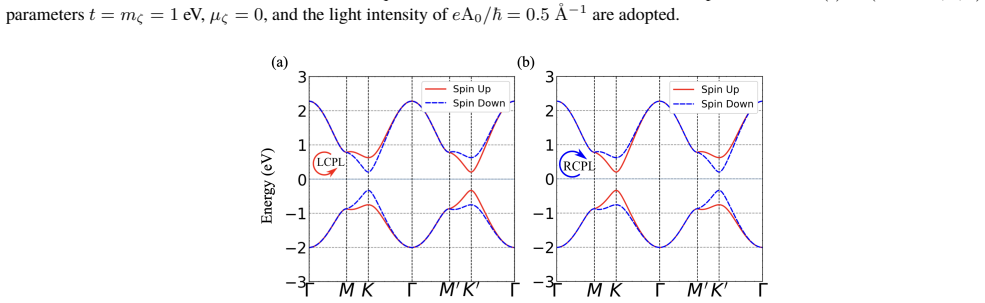
- The spin splitting can be reversed or converted by changing the polarization state of the incident light.
- Collinear antiferromagnets can exhibit odd-parity magnetism typically associated with non-collinear configurations.
- A comprehensive classification of potential candidate materials for this effect is established.
- First-principles calculations verify the phenomenon in illustrative 2D AFM materials.
Where Pith is reading between the lines
- This could provide a light-based method to engineer spintronic properties in common magnetic materials.
- Further studies might explore whether similar effects occur in three-dimensional systems or under different driving frequencies.
- Experimental realization would require checking if the magnetic order survives the light irradiation in real samples.
Load-bearing premise
Symmetry arguments and effective models remain valid when real collinear antiferromagnetic materials are subjected to continuous periodic light driving without the magnetic order being destabilized or unaccounted dissipation appearing.
What would settle it
An experiment that irradiates a classified 2D collinear antiferromagnet with circularly polarized light and measures no odd-parity spin splitting in the electronic bands, or finds that the antiferromagnetic order is destroyed.
Figures





read the original abstract
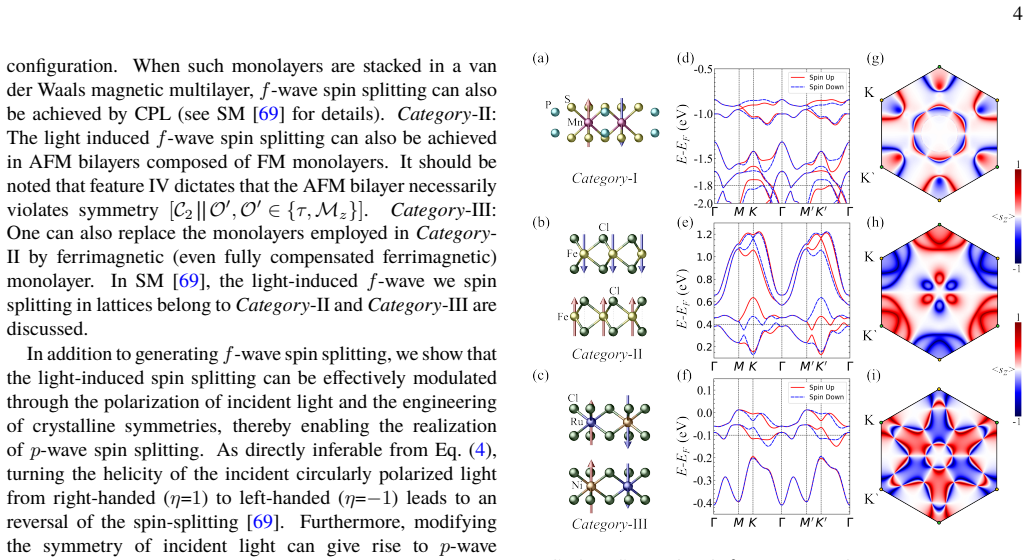
Recent studies have drawn growing attention on non-relativistic odd-parity magnetism in the wake of altermagnets. Nevertheless, odd-parity spin splitting is often believed to appear in non-collinear magnetic configurations. Here, using symmetry arguments and effective model analysis, we show that Floquet engineering offers a universal strategy for achieving odd-parity magnetism in two-dimensional (2D) collinear antiferromagnets under irradiation of periodic driving light fields such as circularly polarized light, elliptically polarized light, and bicircular light. A comprehensive classification of potential candidates for collinear monolayer or bilayer antiferromagnets is established. Strikingly, the light-induced odd-parity spin splitting can be flexibly controlled by adjusting the crystalline symmetry or the polarization state of incident light, enabling the reversal or conversion of spin-splitting. By combining first-principles calculations and Floquet theorem, we present illustrative examples of 2D collinear antiferromagnetic (AFM) materials to verify the light-induced odd-parity magnetism. Our work not only offers a powerful approach for uniquely achieving odd-parity spin-splitting with high tunability, but also expands the potential of Floquet engineering in designing unconventional compensated magnetism.
Editorial analysis
A structured set of objections, weighed in public.
Referee Report
Summary. The manuscript proposes that Floquet engineering with periodic driving light fields (circularly polarized, elliptically polarized, and bicircular light) offers a universal strategy to induce odd-parity magnetism and spin splitting in two-dimensional collinear antiferromagnets. Using symmetry arguments and effective model analysis, the authors establish a classification of candidate monolayer and bilayer materials, demonstrate tunability including reversal or conversion of the splitting by adjusting crystalline symmetry or light polarization, and verify the effect with first-principles calculations combined with the Floquet theorem for illustrative examples.
Significance. If the central claims hold, the work provides a tunable route to odd-parity spin splitting in conventional collinear AFMs, which are not expected to exhibit such effects in equilibrium. The classification of candidates and the explicit demonstration of control via light polarization state represent concrete advances that expand Floquet engineering applications to compensated magnetism in 2D materials.
major comments (2)
- [Symmetry arguments and effective model analysis section] Symmetry arguments and effective model analysis section: the derivation of the light-induced odd-parity term relies on the high-frequency Floquet approximation remaining valid while preserving the underlying collinear AFM order. No quantitative bounds are given on driving intensity or frequency to ensure that heating, multi-photon spin-flip rates, or phonon-assisted dissipation remain negligible for the proposed monolayer/bilayer candidates.
- [First-principles calculations and Floquet theorem examples] First-principles calculations and Floquet theorem examples: the illustrative DFT+Floquet results for specific 2D collinear AFM materials do not report error estimates or convergence checks with respect to the truncation of the Floquet sidebands or the assumed driving amplitude, leaving open whether the reported spin-splitting magnitudes survive realistic experimental conditions.
minor comments (2)
- [Abstract] The abstract states that the effect 'can be flexibly controlled' but does not specify the range of polarization parameters over which reversal occurs; a brief quantitative example would improve clarity.
- [effective model analysis] Notation for the effective Hamiltonian terms in the model analysis could be made more explicit by labeling the odd-parity component with a distinct symbol to distinguish it from equilibrium terms.
Simulated Author's Rebuttal
We thank the referee for the constructive comments and positive evaluation of the significance of our work. We address the two major comments point by point below, agreeing that additional discussion and checks will improve the manuscript.
read point-by-point responses
-
Referee: [Symmetry arguments and effective model analysis section] Symmetry arguments and effective model analysis section: the derivation of the light-induced odd-parity term relies on the high-frequency Floquet approximation remaining valid while preserving the underlying collinear AFM order. No quantitative bounds are given on driving intensity or frequency to ensure that heating, multi-photon spin-flip rates, or phonon-assisted dissipation remain negligible for the proposed monolayer/bilayer candidates.
Authors: We agree that explicit quantitative bounds would strengthen the presentation of the high-frequency approximation. In the revised manuscript we will add a dedicated paragraph in the symmetry and effective-model section that provides order-of-magnitude estimates for the driving frequency (much larger than the electronic bandwidth and exchange scale) and intensity (below the threshold for significant heating or multi-photon processes) drawn from typical experimental conditions in 2D materials. These bounds will be tied to the preservation of the collinear AFM order and will reference relevant literature on Floquet-driven 2D magnets. revision: yes
-
Referee: [First-principles calculations and Floquet theorem examples] First-principles calculations and Floquet theorem examples: the illustrative DFT+Floquet results for specific 2D collinear AFM materials do not report error estimates or convergence checks with respect to the truncation of the Floquet sidebands or the assumed driving amplitude, leaving open whether the reported spin-splitting magnitudes survive realistic experimental conditions.
Authors: We acknowledge the absence of explicit convergence data and error estimates in the current DFT+Floquet results. In the revision we will include additional panels and tables showing the spin-splitting magnitude as a function of the number of retained Floquet sidebands (e.g., N=3,5,10) and as a function of driving amplitude within the perturbative regime. We will also report numerical convergence with respect to k-point sampling and basis-set size, together with a brief discussion of how the reported values remain robust under realistic experimental conditions such as finite pulse length and weak substrate coupling. revision: yes
Circularity Check
No circularity: symmetry classification plus Floquet application to collinear AFMs is self-contained
full rationale
The derivation proceeds from standard symmetry arguments and effective-model analysis under periodic driving (Floquet theorem) to classify candidates and illustrate with first-principles examples. No load-bearing step reduces by construction to a fitted parameter, self-citation chain, or renamed input; the central claim is a proposal that applies established theorems to a new materials context without internal redefinition or statistical forcing.
Axiom & Free-Parameter Ledger
axioms (2)
- domain assumption Symmetry arguments establish that periodic light driving can induce odd-parity spin splitting in collinear antiferromagnets
- domain assumption Effective model analysis and Floquet theorem accurately capture the light-induced magnetism in 2D materials
Lean theorems connected to this paper
-
IndisputableMonolith/Foundation/RealityFromDistinctionreality_from_one_distinction unclear?
unclearRelation between the paper passage and the cited Recognition theorem.
using symmetry arguments and effective model analysis, we show that Floquet engineering offers a universal strategy for achieving odd-parity magnetism in two-dimensional (2D) collinear antiferromagnets under irradiation of periodic driving light fields
-
IndisputableMonolith/Cost/FunctionalEquationwashburn_uniqueness_aczel unclear?
unclearRelation between the paper passage and the cited Recognition theorem.
Heff(k) = H0 (k) + [H1 (k) , H−1 (k)] / ω + O(1/ω²)
What do these tags mean?
- matches
- The paper's claim is directly supported by a theorem in the formal canon.
- supports
- The theorem supports part of the paper's argument, but the paper may add assumptions or extra steps.
- extends
- The paper goes beyond the formal theorem; the theorem is a base layer rather than the whole result.
- uses
- The paper appears to rely on the theorem as machinery.
- contradicts
- The paper's claim conflicts with a theorem or certificate in the canon.
- unclear
- Pith found a possible connection, but the passage is too broad, indirect, or ambiguous to say the theorem truly supports the claim.
Forward citations
Cited by 6 Pith papers
-
Mixed-Parity Altermagnetism in Collinear Spin-Orbital Magnets
Collinear spin-orbital magnets host mixed-parity altermagnetism as an intermediate regime between even- and odd-parity forms, inducible by circularly polarized light in a two-sublattice two-orbital model.
-
Tunable Odd-Parity Spin Splittings in Altermagnets
Collinear altermagnets can exhibit tunable mixed-parity spin textures and new dissipationless spin Hall responses when driven by two-color light or coupled to P-odd loop-current order, creating (P,T)=(-,-) or (+,+) states.
-
Anomalous thermoelectric and thermal Hall effects in irradiated altermagnets
Elliptically polarized light irradiation converts d-wave altermagnets into Chern insulators, yielding quantized thermal Hall conductivity and gap-edge peaks in the thermoelectric Hall response.
-
Layer Hall effect induced by altermagnetism
D-wave altermagnets on Bi2Se3 surfaces induce a layer Hall effect with zero net Hall conductance for antiparallel Néel vectors and a quantized Chern state for parallel vectors.
-
Odd-Parity Altermagnetism Originated from Orbital Orders
A symmetry-based stacking strategy with layer-flip realizes odd-parity altermagnetism from nonrelativistic orbital orders, hosting quantum spin Hall phases with helical edge states.
-
Quantum Geometry-Driven Nonlinear Spin Currents in Floquet Non-Hermitian Altermagnets
Nonlinear spin conductivity in Floquet non-Hermitian d-wave altermagnets separates into quantum-metric, Berry-curvature and dipole terms and is dominated by the bare quantum metric, with polarization reversing both lo...
Reference graph
Works this paper leans on
- [2]
-
[3]
H. Bai, L. Han, X. Y. Feng, Y. J. Zhou, R. X. Su, Q. Wang, L. Y. Liao, W. X. Zhu, X. Z. Chen, F. Pan, X. L. Fan, and C. Song, Observation of spin splitting torque in a collinear antiferromagnet RuO2, Phys. Rev. Lett.128, 197202 (2022)
work page 2022
-
[4]
Mazin (The PRX Editors), Editorial: Altermagnetism—a new punch line of fundamental magnetism, Phys
I. Mazin (The PRX Editors), Editorial: Altermagnetism—a new punch line of fundamental magnetism, Phys. Rev. X12, 040002 (2022)
work page 2022
-
[6]
R. D. Gonzalez Betancourt, J. Zub ´aˇc, R. Gonzalez- Hernandez, K. Geishendorf, Z. ˇSob´aˇn, G. Springholz, K. Olejn ´ık, L. ˇSmejkal, J. Sinova, T. Jungwirth, S. T. B. Goennenwein, A. Thomas, H. Reichlov ´a, J. ˇZelezn´y, and D. Kriegner, Spontaneous anomalous hall effect arising from an unconventional compensated magnetic phase in a semiconductor, Phys....
work page 2023
-
[9]
J. Krempask `y, L. ˇSmejkal, S. D’souza, M. Hajlaoui, G. Springholz, K. Uhl ´ıˇrov´a, F. Alarab, P. Constantinou, V. Strocov, D. Usanov,et al., Altermagnetic lifting of kramers spin degeneracy, Nature626, 517 (2024)
work page 2024
-
[10]
L. Bai, W. Feng, S. Liu, L.ˇSmejkal, Y. Mokrousov, and Y. Yao, Altermagnetism: Exploring new frontiers in magnetism and spintronics, Adv. Funct. Mater34, 2409327 (2024)
work page 2024
-
[12]
S.-W. Cheong and F.-T. Huang, Altermagnetism classification, npj Quantum Mater. 10, 38 (2025)
work page 2025
-
[14]
M. Hu, X. Cheng, Z. Huang, and J. Liu, Catalog ofc-paired spin- momentum locking in antiferromagnetic systems, Phys. Rev. X 15, 021083 (2025)
work page 2025
-
[15]
W. Brinkman and R. J. Elliott, Theory of spin-space groups, Proc. R. Soc. A 294, 343 (1966)
work page 1966
- [19]
-
[20]
L. ˇSmejkal, R. Gonz ´alez-Hern´andez, T. Jungwirth, and J. Sinova, Crystal time-reversal symmetry breaking and spontaneous hall effect in collinear antiferromagnets, Sci. Adv. 6, eaaz8809 (2020)
work page 2020
-
[21]
L. ˇSmejkal, J. Sinova, and T. Jungwirth, Beyond conventional ferromagnetism and antiferromagnetism: A phase with nonrelativistic spin and crystal rotation symmetry, Phys. Rev. X 12, 031042 (2022)
work page 2022
-
[22]
L. ˇSmejkal, A. B. Hellenes, R. Gonz´alez-Hern´andez, J. Sinova, 6 and T. Jungwirth, Giant and tunneling magnetoresistance in unconventional collinear antiferromagnets with nonrelativistic spin-momentum coupling, Phys. Rev. X12, 011028 (2022)
work page 2022
-
[23]
D.-F. Shao, S.-H. Zhang, M. Li, C.-B. Eom, and E. Y. Tsymbal, Spin-neutral currents for spintronics, Nat. Commun. 12, 7061 (2021)
work page 2021
-
[24]
X. Zhou, W. Feng, X. Yang, G.-Y. Guo, and Y. Yao, Crystal chirality magneto-optical effects in collinear antiferromagnets, Phys. Rev. B104, 024401 (2021)
work page 2021
-
[29]
B. Pan, P. Zhou, P. Lyu, H. Xiao, X. Yang, and L. Sun, General stacking theory for altermagnetism in bilayer systems, Phys. Rev. Lett.133, 166701 (2024)
work page 2024
-
[30]
Y. Liu, J. Yu, and C.-C. Liu, Twisted magnetic van der waals bilayers: An ideal platform for altermagnetism, Phys. Rev. Lett. 133, 206702 (2024)
work page 2024
-
[32]
X. Zhu, X. Huo, S. Feng, S.-B. Zhang, S. A. Yang, and H. Guo, Design of altermagnetic models from spin clusters, Phys. Rev. Lett. 134, 166701 (2025)
work page 2025
- [35]
-
[36]
M. Gu, Y. Liu, H. Zhu, K. Yananose, X. Chen, Y. Hu, A. Stroppa, and Q. Liu, Ferroelectric switchable altermagnetism, Phys. Rev. Lett.134, 106802 (2025)
work page 2025
-
[39]
J. Sødequist and T. Olsen, Two-dimensional altermagnets from high throughput computational screening: Symmetry requirements, chiral magnons, and spin-orbit effects, Appl. Phys. Lett. 124 (2024)
work page 2024
-
[41]
R. Bhattarai, P. Minch, and T. D. Rhone, High-throughput screening of altermagnetic materials, Phys. Rev. Mater. 9, 064403 (2025)
work page 2025
-
[43]
Q. Song, S. Stavri ´c, P. Barone, A. Droghetti, D. S. Antonenko, J. W. Venderbos, C. A. Occhialini, B. Ilyas, E. Ergec ¸en, N. Gedik,et al., Electrical switching of ap-wave magnet, Nature , 1 (2025)
work page 2025
-
[44]
Y. Yu, M. B. Lyngby, T. Shishidou, M. Roig, A. Kreisel, M. Weinert, B. M. Andersen, and D. F. Agterberg, Odd-parity magnetism driven by antiferromagnetic exchange, Phys. Rev. Lett. 135, 046701 (2025)
work page 2025
- [45]
-
[46]
M. Ezawa, Third-order and fifth-order nonlinear spin-current generation in g-wave and i-wave altermagnets and perfectly nonreciprocal spin current inf-wave magnets, Phys. Rev. B111, 125420 (2025)
work page 2025
-
[48]
I. ˇZuti´c, J. Fabian, and S. Das Sarma, Spintronics: Fundamentals and applications, Rev. Mod. Phys. 76, 323 (2004)
work page 2004
- [49]
-
[50]
A. Manchon, H. C. Koo, J. Nitta, S. M. Frolov, and R. A. Duine, New perspectives for rashba spin–orbit coupling, Nat. Phys.14, 871 (2015)
work page 2015
-
[51]
H. C. Koo, S. B. Kim, H. Kim, T.-E. Park, J. W. Choi, K.-W. Kim, G. Go, J. H. Oh, D.-K. Lee, E.-S. Park, et al. , Rashba effect in functional spintronic devices, Adv. Mater.32, 2002117 (2020)
work page 2020
-
[52]
A. J. Leggett, A theoretical description of the new phases of liquid 3He, Rev. Mod. Phys.47, 331 (1975)
work page 1975
-
[54]
A. P. Mackenzie and Y. Maeno, The superconductivity of Sr2RuO4 and the physics of spin-triplet pairing, Rev. Mod. Phys. 75, 657 (2003)
work page 2003
-
[55]
C.-K. Chan, Y.-T. Oh, J. H. Han, and P. A. Lee, Type- II weyl cone transitions in driven semimetals, Phys. Rev. B94, 121106 (2016)
work page 2016
-
[59]
H. H ¨ubener, M. A. Sentef, U. De Giovannini, A. F. Kemper, and A. Rubio, Creating stable floquet–weyl semimetals by laser- driving of 3d dirac materials, Nat. Commun.8, 13940 (2017)
work page 2017
- [60]
- [61]
-
[62]
X.-S. Li, C. Wang, M.-X. Deng, H.-J. Duan, P.-H. Fu, R.- Q. Wang, L. Sheng, and D. Y. Xing, Photon-induced weyl half-metal phase and spin filter effect from topological dirac semimetals, Phys. Rev. Lett.123, 206601 (2019)
work page 2019
- [63]
-
[64]
M. S. Rudner and N. H. Lindner, Band structure engineering and non-equilibrium dynamics in floquet topological insulators, 7 Nat. Rev. Phys.2, 229 (2020)
work page 2020
-
[65]
C. Bao, P. Tang, D. Sun, and S. Zhou, Light-induced emergent phenomena in 2d materials and topological materials, Nat. Rev. Phys. 4, 33 (2022)
work page 2022
-
[66]
F. Zhan, R. Chen, Z. Ning, D.-S. Ma, Z. Wang, D.-H. Xu, and R. Wang, Perspective: Floquet engineering topological states from effective models towards realistic materials, Quantum Frontiers 3, 21 (2024)
work page 2024
-
[69]
Z. Ning, D.-S. Ma, J. Zeng, D.-H. Xu, and R. Wang, Flexible control of chiral superconductivity in optically driven nodal point superconductors with antiferromagnetism, Phys. Rev. Lett. 133, 246606 (2024)
work page 2024
-
[72]
P. Hohenberg and W. Kohn, Inhomogeneous electron gas, Phys. Rev. 136, B864 (1964)
work page 1964
-
[74]
P. E. Bl ¨ochl, Projector augmented-wave method, Phys. Rev. B 50, 17953 (1994)
work page 1994
-
[76]
A. A. Mostofi, J. R. Yates, Y.-S. Lee, I. Souza, D. Vanderbilt, and N. Marzari, wannier90: A tool for obtaining maximally- localised wannier functions, Comput. Phys. Commun.178, 685 (2008)
work page 2008
-
[78]
G. Long, H. Henck, M. Gibertini, D. Dumcenco, Z. Wang, T. Taniguchi, K. Watanabe, E. Giannini, and A. F. Morpurgo, Persistence of magnetism in atomically thin MnPS3 crystals, Nano Lett. 20, 2452 (2020)
work page 2020
-
[79]
N. Sivadas, M. W. Daniels, R. H. Swendsen, S. Okamoto, and D. Xiao, Magnetic ground state of semiconducting transition- metal trichalcogenide monolayers, Phys. Rev. B 91, 235425 (2015)
work page 2015
-
[80]
Z. D. Vatansever, Y. Z. Abdullahi, F. Ersan, and E. Vatansever, Electronic, magnetic and universality properties of room- temperature antiferromagnet Fe2O3 monolayer, J. Phys. Chem. Solids 192, 112080 (2024)
work page 2024
-
[81]
D.-S. Ko, W.-J. Lee, S. Sul, C. Jung, D.-J. Yun, H.-G. Kim, W.- J. Son, J. G. Chung, D. W. Jung, S. Y. Kim,et al., Understanding the structural, electrical, and optical properties of monolayer h-phase RuO2 nanosheets: a combined experimental and computational study, NPG Asia Mater.10, 266 (2018)
work page 2018
- [82]
-
[84]
X. Yang, N. Ding, J. Chen, Z. Wang, M. An, and S. Dong, Electrical tuning of robust layered antiferromagnetism in MXene monolayer, Appl. Phys. Lett.122, 162403 (2023)
work page 2023
-
[85]
W. Zhou, G. Zheng, A. Li, D. Zhang, and F. Ouyang, Orbital contribution to the regulation of the spin-valley coupling in antiferromagnetic monolayer MnPTe3, Phys. Rev. B 107, 035139 (2023)
work page 2023
- [86]
-
[87]
N. Guo, X. Fan, Z. Chen, Z. Luo, Y. Hu, Y. An, D. Yang, and S. Ma, Electronic and magnetic properties of group- V tmds monolayers with defects: a first-principles study, Comput. Mater. Sci 176, 109540 (2020)
work page 2020
-
[89]
J. Li, Y. Li, S. Du, Z. Wang, B.-L. Gu, S.-C. Zhang, K. He, W. Duan, and Y. Xu, Intrinsic magnetic topological insulators in van der waals layeredMnBi2Te4-family materials, Sci. Adv 5, eaaw5685 (2019)
work page 2019
-
[92]
B. Zhou, Z. Li, J. Wang, and K. Wang, Superior spin-polarized electronic structure in MoS2/MnO2 heterostructures with an efficient hole injection, Phys. Chem. Chem. Phys. 21, 10706 (2019)
work page 2019
-
[93]
P. Zhou, C. Sun, and L. Sun, Two dimensional antiferromagnetic chern insulator: NiRuCl6, Nano Lett. 16, 6325 (2016)
work page 2016
-
[94]
Light-induced Odd-parity Magnetism in Conventional Collinear Antiferromagnets
J. Li, C. Xie, W. Wang, X.-P. Li, G. Zhang, and X. Wang, Antiferromagnetic second-order topology in two-dimensional NiRuCl6, Appl. Phys. Lett. 123 (2023). 8 Supplemental materials of “Light-induced Odd-parity Magnetism in Conventional Collinear Antiferromagnets” This supplementary material is organized in five sections. In the first section, we provides t...
work page 2023
- [95]
-
[96]
H. Bai, L. Han, X. Y. Feng, Y. J. Zhou, R. X. Su, Q. Wang, L. Y. Liao, W. X. Zhu, X. Z. Chen, F. Pan, X. L. Fan, and C. Song, Observation of spin splitting torque in a collinear antiferromagnetRuO2, Phys. Rev. Lett.128, 197202 (2022)
work page 2022
-
[97]
Mazin (The PRX Editors), Editorial: Altermagnetism—a new punch line of fundamental magnetism, Phys
I. Mazin (The PRX Editors), Editorial: Altermagnetism—a new punch line of fundamental magnetism, Phys. Rev. X 12, 040002 (2022)
work page 2022
-
[98]
C. Wu, K. Sun, E. Fradkin, and S.-C. Zhang, Fermi liquid instabilities in the spin channel, Phys. Rev. B75, 115103 (2007)
work page 2007
-
[99]
R. D. Gonzalez Betancourt, J. Zub´aˇc, R. Gonzalez-Hernandez, K. Geishendorf, Z.ˇSob´aˇn, G. Springholz, K. Olejn´ık, L.ˇSmejkal, J. Sinova, T. Jungwirth, S. T. B. Goennenwein, A. Thomas, H. Reichlov´a, J. ˇZelezn´y, and D. Kriegner, Spontaneous anomalous hall effect arising from an unconventional compensated magnetic phase in a semiconductor, Phys. Rev. ...
work page 2023
- [100]
-
[101]
P. A. McClarty and J. G. Rau, Landau theory of altermagnetism, Phys. Rev. Lett.132, 176702 (2024)
work page 2024
-
[102]
J. Krempask `y, L. ˇSmejkal, S. D’souza, M. Hajlaoui, G. Springholz, K. Uhl´ıˇrov´a, F. Alarab, P. Constantinou, V. Strocov, D. Usanov,et al., Altermagnetic lifting of kramers spin degeneracy, Nature626, 517 (2024)
work page 2024
-
[103]
L. Bai, W. Feng, S. Liu, L. ˇSmejkal, Y. Mokrousov, and Y. Yao, Altermagnetism: Exploring new frontiers in magnetism and spintronics, Adv. Funct. Mater 34, 2409327 (2024)
work page 2024
-
[104]
C. Song, H. Bai, Z. Zhou, L. Han, H. Reichlova, J. H. Dil, J. Liu, X. Chen, and F. Pan, Altermagnets as a new class of functional materials, Nat. Rev. Mater. , 1 (2025)
work page 2025
-
[105]
S.-W. Cheong and F.-T. Huang, Altermagnetism classification, npj Quantum Mater.10, 38 (2025)
work page 2025
- [106]
-
[107]
M. Hu, X. Cheng, Z. Huang, and J. Liu, Catalog of c-paired spin-momentum locking in antiferromagnetic systems, Phys. Rev. X 15, 021083 (2025)
work page 2025
-
[108]
W. Brinkman and R. J. Elliott, Theory of spin-space groups, Proc. R. Soc. A294, 343 (1966)
work page 1966
-
[109]
P. Liu, J. Li, J. Han, X. Wan, and Q. Liu, Spin-group symmetry in magnetic materials with negligible spin-orbit coupling, Phys. Rev. X 12, 021016 (2022)
work page 2022
-
[110]
L. ˇSmejkal, J. Sinova, and T. Jungwirth, Emerging research landscape of altermagnetism, Phys. Rev. X12, 040501 (2022)
work page 2022
-
[111]
Z. Xiao, J. Zhao, Y. Li, R. Shindou, and Z.-D. Song, Spin space groups: Full classification and applications, Phys. Rev. X 14, 031037 (2024)
work page 2024
- [112]
-
[113]
L. ˇSmejkal, R. Gonz´alez-Hern´andez, T. Jungwirth, and J. Sinova, Crystal time-reversal symmetry breaking and spontaneous hall effect in collinear antiferromagnets, Sci. Adv.6, eaaz8809 (2020)
work page 2020
-
[114]
L. ˇSmejkal, J. Sinova, and T. Jungwirth, Beyond conventional ferromagnetism and antiferromagnetism: A phase with nonrelativistic spin and crystal rotation symmetry, Phys. Rev. X12, 031042 (2022)
work page 2022
-
[115]
L. ˇSmejkal, A. B. Hellenes, R. Gonz´alez-Hern´andez, J. Sinova, and T. Jungwirth, Giant and tunneling magnetoresistance in unconventional collinear antiferromagnets with nonrelativistic spin-momentum coupling, Phys. Rev. X12, 011028 (2022)
work page 2022
-
[116]
D.-F. Shao, S.-H. Zhang, M. Li, C.-B. Eom, and E. Y. Tsymbal, Spin-neutral currents for spintronics, Nat. Commun.12, 7061 (2021)
work page 2021
discussion (0)
Sign in with ORCID, Apple, or X to comment. Anyone can read and Pith papers without signing in.