Placing and routing quantum LDPC codes in multilayer superconducting hardware
Pith reviewed 2026-05-19 02:06 UTC · model grok-4.3
The pith
A hardware-aware algorithm produces explicit layouts for quantum LDPC codes, showing open boundaries reduce complexity with little efficiency loss.
A machine-rendered reading of the paper's core claim, the machinery that carries it, and where it could break.
Core claim
Leveraging multilayer routing and long-range coupling in superconducting qubit hardware, the Hardware-Aware Layout (HAL) algorithm automates placement and routing for arbitrary quantum LDPC codes. For codes with topological structure such as bivariate bicycle codes and open-boundary tile codes, explicit layouts demonstrate that dropping periodic boundaries lowers hardware complexity with only a moderate reduction in logical efficiency. Similar competitive tradeoffs are achieved for highly nonlocal families like quantum radial and Tanner codes.
What carries the argument
HAL (Hardware-Aware Layout), a robust runtime-efficient heuristic algorithm that automates and optimizes the placement and routing of arbitrary quantum LDPC codes by utilizing multilayer routing and long-range coupling capabilities.
Load-bearing premise
The model assumes multilayer routing and long-range couplings can be realized without adding significant noise or hitting major fabrication limits.
What would settle it
Measuring the actual error rates in a fabricated superconducting device using one of the HAL-generated layouts and checking if they match predictions without extra noise from the routing layers.
Figures




read the original abstract
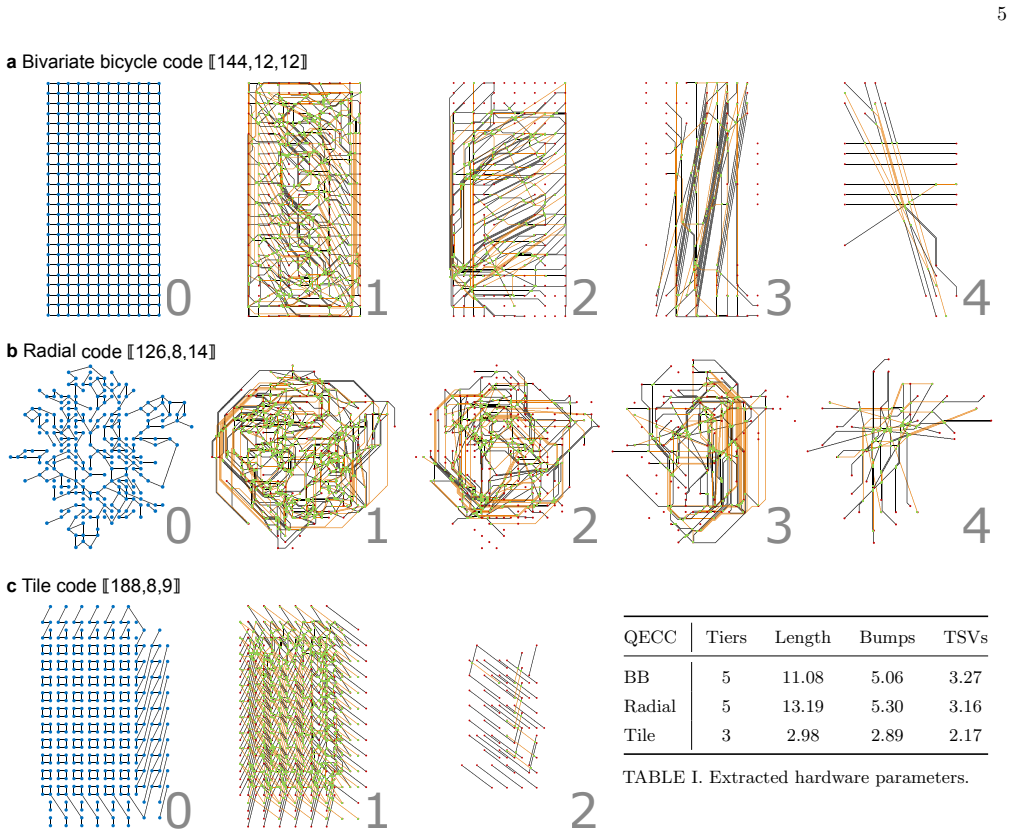
Quantum error-correcting codes with asymptotically lower overheads than the surface code require nonlocal connectivity. Leveraging multilayer routing and long-range coupling capabilities in superconducting qubit hardware, we develop Hardware-Aware Layout, HAL: a robust, runtime-efficient heuristic algorithm that automates and optimizes the placement and routing of arbitrary codes. Using HAL, we generate around 150 explicit layouts of quantum low-density parity-check (qLDPC) codes with topological structure -- such as the bivariate bicycle codes and the open-boundary tile codes -- and find that removing the periodic boundaries significantly lowers the hardware complexity with only a moderate reduction of logical efficiency. We also lay out highly nonlocal qLDPC code families -- quantum radial and Tanner codes -- that achieve competitive tradeoffs between hardware complexity and logical efficiency. Based on our findings, we anticipate many novel qLDPC codes to be realizable on near-term superconducting qubit hardware and inform future directions for the co-design of quantum devices and fault-tolerant architectures.
Editorial analysis
A structured set of objections, weighed in public.
Referee Report
Summary. The manuscript introduces HAL, a runtime-efficient heuristic algorithm for automated placement and routing of arbitrary quantum LDPC codes on multilayer superconducting hardware that supports long-range couplings. Using HAL, the authors generate around 150 explicit layouts for topologically structured qLDPC codes (including bivariate bicycle codes and open-boundary tile codes) and report that open-boundary versions achieve significantly lower hardware complexity at the cost of only a moderate reduction in logical efficiency. The work also presents layouts for highly nonlocal families such as quantum radial and Tanner codes and concludes that many such codes should be realizable on near-term hardware.
Significance. If the hardware model is realistic, the concrete layouts and the periodic-versus-open-boundary comparison could usefully inform co-design of superconducting devices and fault-tolerant architectures. The heuristic's ability to handle arbitrary codes and produce explicit, multilayer routings is a practical contribution. However, the significance is limited by the absence of quantitative error bars, formal optimality guarantees, or measured hardware performance, and by the heuristic nature of the results.
major comments (2)
- [Hardware assumptions and HAL cost function] Hardware assumptions and HAL cost function (abstract and introduction): the logical-efficiency metric used to compare periodic-boundary and open-boundary layouts counts layers, wire lengths, and coupler ranges but does not propagate any additional error rates or yield penalties from long-range couplers or multilayer vias. If realistic superconducting hardware assigns even modest extra noise to these elements, the reported 'moderate reduction' in logical efficiency could become large enough to erase the claimed advantage of open-boundary layouts.
- [Results on layout generation] Results section on layout generation: the claim that removing periodic boundaries 'significantly lowers the hardware complexity with only a moderate reduction of logical efficiency' is supported only by heuristic outputs without quantitative error bars, sensitivity analysis to the cost-function weights, or comparison against an independent baseline optimizer.
minor comments (2)
- The manuscript should clarify whether the reported efficiency numbers are averaged over the 150 layouts or selected from best-case runs, and should include at least a brief discussion of runtime scaling with code size.
- Figure captions and text should explicitly state the precise definition of 'logical efficiency' and 'hardware complexity' used in the comparisons.
Simulated Author's Rebuttal
We thank the referee for the detailed and constructive feedback on our manuscript. We appreciate the opportunity to clarify the hardware assumptions underlying our logical-efficiency metric and to strengthen the presentation of our heuristic results. Below we address each major comment point by point.
read point-by-point responses
-
Referee: Hardware assumptions and HAL cost function (abstract and introduction): the logical-efficiency metric used to compare periodic-boundary and open-boundary layouts counts layers, wire lengths, and coupler ranges but does not propagate any additional error rates or yield penalties from long-range couplers or multilayer vias. If realistic superconducting hardware assigns even modest extra noise to these elements, the reported 'moderate reduction' in logical efficiency could become large enough to erase the claimed advantage of open-boundary layouts.
Authors: We agree that incorporating explicit error rates or yield penalties from long-range couplers and multilayer vias would provide a more comprehensive assessment. Our logical-efficiency metric is designed as a hardware-complexity proxy based on the number of layers, total wire length, and maximum coupler range, which directly impact the feasibility of implementation on current and near-term superconducting platforms. The 'moderate reduction' refers to this complexity measure. To address this, we will revise the manuscript to include a dedicated discussion on how additional noise from these elements might affect the comparison, and note that detailed error modeling would require device-specific parameters not available in the current hardware-agnostic model. This addition will clarify the scope of our claims. revision: yes
-
Referee: Results section on layout generation: the claim that removing periodic boundaries 'significantly lowers the hardware complexity with only a moderate reduction of logical efficiency' is supported only by heuristic outputs without quantitative error bars, sensitivity analysis to the cost-function weights, or comparison against an independent baseline optimizer.
Authors: The results are indeed generated using the HAL heuristic, which is the core contribution for producing explicit layouts. We acknowledge the absence of error bars from multiple runs and sensitivity analysis in the current version. In the revision, we will add error bars by reporting statistics over multiple independent runs of HAL for representative codes, and include a sensitivity analysis varying the weights in the cost function to show robustness of the periodic vs. open-boundary comparison. Regarding comparison to an independent baseline optimizer, we note that the primary goal is to demonstrate that HAL can generate high-quality layouts for a variety of codes, rather than to prove optimality; however, we will add a brief comparison to a simple greedy placement baseline to provide additional context. revision: yes
Circularity Check
No circularity: results are direct algorithmic outputs under explicit assumptions
full rationale
The paper defines the HAL heuristic algorithm for placement and routing, then executes it to produce ~150 explicit layouts for qLDPC codes (bivariate bicycle, open-boundary tile, radial, Tanner). The reported comparisons of hardware complexity and logical efficiency between periodic and open-boundary versions are computational results from this execution inside a stated hardware model that counts layers, wire lengths, and coupler ranges. No equations or definitions reduce a claimed quantity to itself by construction, no parameters are fitted to a subset and then relabeled as predictions, and no load-bearing step relies on a self-citation whose content is unverified or imported as a uniqueness theorem. The central claims remain independent of the authors' prior work and rest on the algorithm's outputs plus the enumerated hardware assumptions.
Axiom & Free-Parameter Ledger
axioms (1)
- domain assumption Multilayer superconducting hardware supports long-range coupling with acceptable noise levels
Lean theorems connected to this paper
-
IndisputableMonolith/Foundation/AlexanderDuality.leanalexander_duality_circle_linking unclear?
unclearRelation between the paper passage and the cited Recognition theorem.
We develop Hardware-Aware Layout, HAL: a robust, runtime-efficient heuristic algorithm that automates and optimizes the placement and routing of arbitrary codes... extract a heuristically maximal planar subgraph... Kamada–Kawai spring layout... modified A* pathfinding algorithm
-
IndisputableMonolith/Cost/FunctionalEquation.leanwashburn_uniqueness_aczel unclear?
unclearRelation between the paper passage and the cited Recognition theorem.
logical efficiency η_L = k · d² / n... hardware complexity Chw = 1 + Σ w_i c_i / Σ w_i
What do these tags mean?
- matches
- The paper's claim is directly supported by a theorem in the formal canon.
- supports
- The theorem supports part of the paper's argument, but the paper may add assumptions or extra steps.
- extends
- The paper goes beyond the formal theorem; the theorem is a base layer rather than the whole result.
- uses
- The paper appears to rely on the theorem as machinery.
- contradicts
- The paper's claim conflicts with a theorem or certificate in the canon.
- unclear
- Pith found a possible connection, but the passage is too broad, indirect, or ambiguous to say the theorem truly supports the claim.
Forward citations
Cited by 5 Pith papers
-
Mitigating Classical Resource Costs in Quantum Error Correction via Generalized qLDPC Predecoding
An automated predecoder generator for arbitrary qLDPC codes cuts decoder utilization by up to 3963x and supports hardware scaling to tens or hundreds of thousands of logical qubits within power limits.
-
Breaking the scalability barrier via a vertical tunable coupler in 3D integrated transmon system
A 3D integrated transmon system achieves 99.87% single-qubit and 97.5% CZ gate fidelities with interchip entanglement, showing vertical tunable couplers enable scalable superconducting quantum processors.
-
Distributed Quantum Error Correction with Bivariate Bicycle Codes in a Modular Architecture
The [[144,12,12]] bivariate bicycle code is distributed across 4 to 12 processors in a star network, with simulations showing logical error rates under varying nonlocal noise scaling.
-
Efficient Routing of Quantum LDPC Codes on Programmable 2D Toric Architectures
A programmable 2D toric oscillator network enables efficient routing for bivariate bicycle LDPC codes, reducing long-range couplers to O(sqrt(n)) and achieving 3.06% logical error rate per cycle in simulations for the...
-
Geometry-induced correlated noise in qLDPC syndrome extraction
Geometry choices in bivariate-bicycle qLDPC syndrome extraction determine leading correlated error structure via weighted exposure, which correlates strongly with logical error rates and is reduced by biplanar layouts.
Reference graph
Works this paper leans on
-
[1]
Placement phase In the placement phase, we embed the code connec- tivity graph G = ( V, E), where V is the set of nodes and E is the set of edges, on a regular lattice such that (i) all nodes occupy distinct grid points and (ii) a heuris- tically maximal subset of edges can later be routed in the plane without crossings. The procedure comprises three cons...
-
[2]
Routing phase The routing phase assigns an explicit geometric path to every edge in the connectivity graph. It proceeds tier by tier, starting with the qubit tier and creating further tiers on demand up to the user-specified maximum number of tiers. Although the heuristic maximal-planar-subgraph (MPS) step guarantees that all edges placed on the qubit tie...
-
[3]
• Edge margin: The safety margin (in grid cells) around every routed trace
User-configurable settings HAL exposes several user-configurable parameters to tailor the placement and routing process to specific hard- ware constraints: • Custom positions: an explicit map p0 : V → Z2 that overrides the automatic placement for vertices. • Edge margin: The safety margin (in grid cells) around every routed trace. We use a default value o...
work page 2000
-
[4]
This construction already provides the connectivity graph—we assume one check qubit for each tile
for more details. This construction already provides the connectivity graph—we assume one check qubit for each tile. How- ever, to enforce the regularity possible with tile codes, we need to fix the position of the check qubits and pro- vide all qubit positions as a geometric ansatz to HAL. We allow for check qubits of one basis to be placed on faces of t...
- [5]
- [6]
- [7]
-
[8]
V. Steffan, S. H. Choe, N. P. Breuckmann, F. R. F. Pereira, and J. N. Eberhardt, Tile codes: High-efficiency quantum codes on a lattice with boundary, arXiv preprint arXiv:2504.09171 (2025)
-
[9]
arXiv preprint arXiv:2504.08887 (2025)
Z. Liang, J. N. Eberhardt, and Y.-A. Chen, Planar quan- tum low-density parity-check codes with open bound- aries, arXiv preprint arXiv:2504.08887 (2025)
-
[10]
T. R. Scruby, T. Hillmann, and J. Roffe, High-threshold, low-overhead and single-shot decodable fault-tolerant quantum memory, arXiv preprint arXiv:2406.14445 (2024)
work page internal anchor Pith review Pith/arXiv arXiv 2024
- [11]
- [12]
-
[13]
M. H. Freedman and D. A. Meyer, Projective plane and planar quantum codes, Foundations of Computational Mathematics 1, 325 (2001)
work page 2001
-
[14]
A. G. Fowler, M. Mariantoni, J. M. Martinis, and A. N. Cleland, Surface codes: Towards practical large-scale quantum computation, Physical Review A 86, 032324 (2012)
work page 2012
-
[15]
C. K. Andersen, A. Remm, S. Lazar, S. Krinner, N. Lacroix, G. J. Norris, M. Gabureac, C. Eichler, and A. Wallraff, Repeated quantum error detection in a sur- face code, Nature Physics 16, 875 (2020)
work page 2020
-
[16]
S. Krinner, N. Lacroix, A. Remm, A. Di Paolo, E. Genois, C. Leroux, C. Hellings, S. Lazar, F. Swiadek, J. Her- rmann, et al. , Realizing repeated quantum error correc- tion in a distance-three surface code, Nature 605, 669 (2022)
work page 2022
-
[17]
Google Quantum AI, Suppressing quantum errors by scaling a surface code logical qubit, Nature 614, 676 (2023)
work page 2023
-
[18]
R. Acharya, D. A. Abanin, L. Aghababaie-Beni, I. Aleiner, T. I. Andersen, M. Ansmann, F. Arute, K. Arya, A. Asfaw, N. Astrakhantsev, et al. , Quantum error correction below the surface code threshold, Nature 638, 920 (2025)
work page 2025
-
[19]
N. P. Breuckmann and J. N. Eberhardt, Quantum low- density parity-check codes, PRX Quantum 2, 040101 (2021)
work page 2021
-
[20]
D. Rosenberg, D. Kim, R. Das, D. Yost, S. Gustavsson, D. Hover, P. Krantz, A. Melville, L. Racz, G. Samach, et al. , 3D integrated superconducting qubits, npj Quan- tum Information 3, 42 (2017)
work page 2017
- [21]
-
[22]
S. Kosen, H.-X. Li, M. Rommel, R. Rehammar, M. Ca- puto, L. Gr¨ onberg, J. Fern´ andez-Pend´ as, A. F. Kockum, J. Bizn´ arov´ a, L. Chen, et al. , Signal crosstalk in a flip-chip quantum processor, PRX Quantum 5, 030350 (2024)
work page 2024
-
[23]
A. H. Karamlou, I. T. Rosen, S. E. Muschinske, C. N. Barrett, A. Di Paolo, L. Ding, P. M. Harrington, M. Hays, R. Das, D. K. Kim,et al., Probing entanglement in a 2D hard-core bose–hubbard lattice, Nature 629, 561 (2024)
work page 2024
-
[24]
G. J. Norris, L. Michaud, D. Pahl, M. Kerschbaum, C. Eichler, J.-C. Besse, and A. Wallraff, Improved pa- rameter targeting in 3D-integrated superconducting cir- cuits through a polymer spacer process, EPJ Quantum Technology 11, 5 (2024)
work page 2024
- [25]
-
[26]
D.-R. W. Yost, M. E. Schwartz, J. Mallek, D. Rosenberg, C. Stull, J. L. Yoder, G. Calusine, M. Cook, R. Das, A. L. Day, et al. , Solid-state qubits integrated with supercon- ducting through-silicon vias, npj Quantum Information 6, 59 (2020)
work page 2020
- [27]
-
[28]
T. M. Hazard, W. Woods, D. Rosenberg, R. Das, C. F. Hirjibehedin, D. K. Kim, J. Knecht, J. Mallek, A. Melville, B. M. Niedzielski, et al. , Characterization of superconducting through-silicon vias as capacitive ele- ments in quantum circuits, Applied Physics Letters 123 (2023)
work page 2023
- [29]
- [30]
- [31]
-
[32]
J. Niu, L. Zhang, Y. Liu, J. Qiu, W. Huang, J. Huang, H. Jia, J. Liu, Z. Tao, W. Wei, et al. , Low-loss intercon- nects for modular superconducting quantum processors, Nature Electronics 6, 235 (2023)
work page 2023
- [33]
- [34]
- [35]
- [36]
-
[37]
N. Delfosse, M. E. Beverland, and M. A. Tremblay, Bounds on stabilizer measurement circuits and obstruc- tions to local implementations of quantum ldpc codes, arXiv preprint arXiv:2109.14599 (2021)
-
[38]
N. Berthusen, D. Devulapalli, E. Schoute, A. M. Childs, M. J. Gullans, A. V. Gorshkov, and D. Gottesman, To- ward a 2d local implementation of quantum ldpc codes, arXiv preprint arXiv:2404.17676 (2024)
-
[39]
C. A. Pattison, A. Krishna, and J. Preskill, Hierarchi- cal memories: Simulating quantum ldpc codes with local gates, Quantum 9, 1728 (2025)
work page 2025
- [40]
-
[41]
M. A. Tremblay, N. Delfosse, and M. E. Beverland, Constant-overhead quantum error correction with thin planar connectivity, Physical Review Letters129, 050504 (2022)
work page 2022
-
[42]
J. Pach and R. Wenger, Embedding planar graphs at fixed vertex locations, in Graph Drawing (GD 1998) , Lec- ture Notes in Computer Science, Vol. 1547, edited by S. H. Whitesides (Springer, Berlin, Heidelberg, 1998) pp. 263–274
work page 1998
-
[43]
M. Schaefer, A new algorithm for embedding plane graphs at fixed vertex locations, The Electronic Journal of Combinatorics , P4 (2021)
work page 2021
-
[44]
A. B. Kahng, J. Lienig, I. L. Markov, and J. Hu, VLSI physical design: from graph partitioning to timing clo- sure, Vol. 312 (Springer, 2011)
work page 2011
- [45]
-
[46]
K. Bu, S. Huai, Z. Zhang, D. Li, Y. Li, J. Hu, X. Yang, M. Dai, T. Cai, Y.-C. Zheng, et al. , Tantalum airbridges for scalable superconducting quantum processors, npj Quantum Information 11, 17 (2025)
work page 2025
-
[47]
A. Leverrier, J.-P. Tillich, and G. Z´ emor, Quantum ex- pander codes, in 2015 IEEE 56th Annual Symposium on Foundations of Computer Science (IEEE, 2015) pp. 810– 824
work page 2015
-
[48]
V. D. Blondel, J.-L. Guillaume, R. Lambiotte, and E. Lefebvre, Fast unfolding of communities in large net- works, Journal of Statistical Mechanics: Theory and Ex- periment 2008, P10008 (2008)
work page 2008
- [49]
-
[50]
P. E. Hart, N. J. Nilsson, and B. Raphael, A formal basis for the heuristic determination of minimum cost paths, IEEE Transactions on Systems Science and Cybernetics 4, 100 (1968)
work page 1968
-
[51]
D. J. MacKay, G. Mitchison, and P. L. McFadden, Sparse-graph codes for quantum error correction, IEEE Transactions on Information Theory 50, 2315 (2004)
work page 2004
-
[52]
A. A. Kovalev and L. P. Pryadko, Quantum kronecker sum-product low-density parity-check codes with finite rate, Physical Review A 88, 012311 (2013)
work page 2013
-
[53]
T. J. Yoder, E. Schoute, P. Rall, E. Pritchett, J. M. Gam- betta, A. W. Cross, M. Carroll, and M. E. Beverland, Tour de gross: A modular quantum computer based on bivariate bicycle codes, arXiv preprint arXiv:2506.03094 (2025)
work page internal anchor Pith review Pith/arXiv arXiv 2025
-
[54]
A. Leverrier and G. Z´ emor, Quantum tanner codes, in 2022 IEEE 63rd Annual Symposium on Foundations of Computer Science (FOCS) (IEEE, 2022) pp. 872–883
work page 2022
-
[55]
M. P. Fossorier, Quasicyclic low-density parity-check codes from circulant permutation matrices, IEEE trans- actions on information theory 50, 1788 (2004)
work page 2004
-
[56]
S. Bravyi and B. Terhal, A no-go theorem for a two- dimensional self-correcting quantum memory based on stabilizer codes, New Journal of Physics 11, 043029 (2009)
work page 2009
-
[57]
EQuS Group, HAL database (2025), accessed: 2025-07- 29
work page 2025
- [58]
-
[59]
M. H. Shaw and B. M. Terhal, Lowering connectivity requirements for bivariate bicycle codes using morphing circuits, Physical Review Letters 134, 090602 (2025)
work page 2025
- [60]
- [61]
-
[62]
P. V. Klimov, A. Bengtsson, C. Quintana, A. Bourassa, S. Hong, A. Dunsworth, K. J. Satzinger, W. P. Liv- ingston, V. Sivak, M. Y. Niu, et al., Optimizing quantum gates towards the scale of logical qubits, Nature Commu- nications 15, 2442 (2024)
work page 2024
- [63]
-
[64]
L. Ding, M. Hays, Y. Sung, B. Kannan, J. An, A. Di Paolo, A. H. Karamlou, T. M. Hazard, K. Azar, D. K. Kim, et al. , High-fidelity, frequency-flexible two- qubit fluxonium gates with a transmon coupler, Physical Review X 13, 031035 (2023)
work page 2023
-
[65]
V. Guemard and G. Z´ emor, Moderate-length lifted quantum tanner codes, arXiv preprint arXiv:2502.20297 (2025)
-
[66]
S. Gu, E. Tang, L. Caha, S. H. Choe, Z. He, and A. Kubica, Single-shot decoding of good quantum ldpc codes, Communications in Mathematical Physics 405, 85 (2024)
work page 2024
-
[67]
HAL: Hardware-Aware Layout for Quantum Error Cor- rection, GitHub repository (2025), commit: 6fa604d. 23
work page 2025
-
[68]
D. Aharonov and L. Eldar, On the complexity of com- muting local hamiltonians, and tight conditions for topo- logical order in such systems, in 2011 IEEE 52nd Annual Symposium on Foundations of Computer Science (IEEE,
work page 2011
-
[69]
Commutative version of the k-local Hamiltonian problem and common eigenspace problem
S. Bravyi and M. Vyalyi, Commutative version of the k- local hamiltonian problem and common eigenspace prob- lem, arXiv preprint arXiv:quant-ph/0308021 (2003)
work page internal anchor Pith review Pith/arXiv arXiv 2003
-
[70]
A. Y. Kitaev, Fault-tolerant quantum computation by anyons, Annals of Physics 303, 2 (2003)
work page 2003
-
[71]
M. Chimani, K. Klein, and T. Wiedera, A note on the practicality of maximal planar subgraph algorithms, in Graph Drawing and Network Visualization: 24th Inter- national Symposium, GD 2016, Athens, Greece, Septem- ber 19-21, 2016, Revised Selected Papers 24 (Springer,
work page 2016
-
[72]
J. Hopcroft and R. Tarjan, Efficient planarity testing, Journal of the ACM 21, 549 (1974)
work page 1974
- [73]
-
[74]
N. Baspin and A. Krishna, Quantifying nonlocality: How outperforming local quantum codes is expensive, Physical Review Letters 129, 050505 (2022)
work page 2022
-
[75]
A. Almanakly, B. Yankelevich, M. Hays, B. Kannan, R. Assouly, A. Greene, M. Gingras, B. M. Niedzielski, H. Stickler, M. E. Schwartz, et al. , Deterministic remote entanglement using a chiral quantum interconnect, Na- ture Physics 21, 825 (2025)
work page 2025
-
[76]
K. D. Rao, Low density parity check codes, in Chan- nel Coding Techniques for Wireless Communications (Springer, 2019) pp. 273–329
work page 2019
-
[77]
S. Kosen, H.-X. Li, M. Rommel, D. Shiri, C. Warren, L. Gr¨ onberg, J. Salonen, T. Abad, J. Bizn´ arov´ a, M. Ca- puto, et al. , Building blocks of a flip-chip integrated su- perconducting quantum processor, Quantum Science and Technology 7, 035018 (2022)
work page 2022
-
[78]
D. Nigg, M. Mueller, E. A. Martinez, P. Schindler, M. Hennrich, T. Monz, M. A. Martin-Delgado, and R. Blatt, Quantum computations on a topologically en- coded qubit, Science 345, 302 (2014)
work page 2014
-
[79]
QEC developers or project team, Qec: Python tools for quantum error correction, PyPI package qec (2025), 0.3.3
work page 2025
-
[80]
P. Ngatchou, A. Zarei, and A. El-Sharkawi, Pareto multi objective optimization, in Proceedings of the 13th inter- national conference on, intelligent systems application to power systems (IEEE, 2005) pp. 84–91
work page 2005
discussion (0)
Sign in with ORCID, Apple, or X to comment. Anyone can read and Pith papers without signing in.