Complete reflection of nonlinear electromagnetic waves in underdense pair plasmas enabled by dynamically formed Bragg-like structures
Pith reviewed 2026-05-18 17:40 UTC · model grok-4.3
The pith
Nonlinear electromagnetic waves render underdense pair plasmas fully reflective by forming dynamic Bragg-like structures.
A machine-rendered reading of the paper's core claim, the machinery that carries it, and where it could break.
Core claim
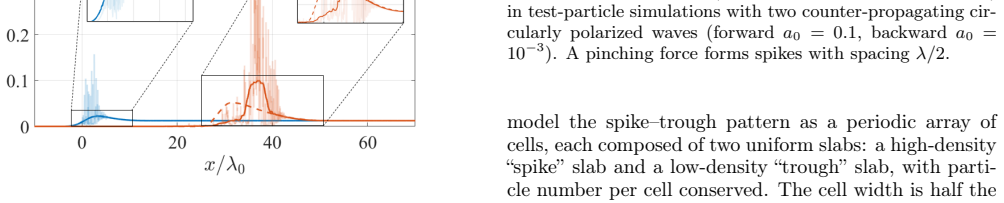
In underdense pair plasmas the mass symmetry between electrons and positrons prevents charge-separation fields during compression by a nonlinear electromagnetic wave. Weak initial reflections therefore seed density spikes that self-organize into a moving Bragg-like grating. The grating amplifies reflection, producing a transition to a regime in which the plasma-vacuum interface sustains complete reflection of the incident wave.
What carries the argument
Dynamically formed moving Bragg-like grating produced by plasma density spikes, made possible by mass symmetry that removes charge-separation electric fields.
If this is right
- An initially transparent underdense pair plasma becomes fully reflective to the nonlinear wave.
- Complete reflection is maintained at the moving plasma-vacuum interface once the grating has formed.
- The process occurs without any externally imposed periodic structure.
- The outcome is specific to equal-mass pair plasmas and does not occur in electron-ion plasmas.
Where Pith is reading between the lines
- The same compression-to-grating sequence could operate in astrophysical pair plasmas such as those near pulsars or in gamma-ray burst environments.
- Laboratory generation of dense pair plasmas might allow controlled tests of tunable reflection via this internal grating.
- Varying wave intensity or plasma density gradients could reveal thresholds separating partial and complete reflection regimes.
Load-bearing premise
The kinetic simulations accurately capture the nonlinear compression and the transition to full reflection without numerical artifacts or strong dependence on the precise initial wave amplitude and density profile.
What would settle it
A higher-resolution simulation or laboratory experiment that shows either the absence of the predicted density spikes or a time-averaged reflection coefficient that remains well below unity would falsify the proposed mechanism.
Figures



read the original abstract
In contrast to relativistically induced transparency in electron--ion plasmas, where nonlinear electromagnetic waves render initially opaque plasmas transparent, we show using kinetic simulations that such waves can instead make initially transparent pair plasmas fully reflective. The difference is mass symmetry, which eliminates charge-separation electric fields. As the wave compresses the pair plasma, weak reflection seeds density spikes that form a moving Bragg-like grating. Enhanced reflection enables a transition to a regime where the plasma--vacuum interface sustains complete reflection.
Editorial analysis
A structured set of objections, weighed in public.
Referee Report
Summary. The manuscript uses kinetic simulations to show that nonlinear electromagnetic waves propagating into an initially underdense pair plasma can induce a transition to complete reflection at the plasma-vacuum interface. Mass symmetry eliminates charge-separation fields, allowing the wave to compress the plasma and amplify weak initial reflections into a moving Bragg-like density grating that sustains total reflection, in contrast to the relativistically induced transparency seen in electron-ion plasmas.
Significance. If validated, the result identifies a distinct nonlinear regime for pair plasmas in which transparency is reversed rather than induced, with potential relevance to astrophysical pair plasmas and laboratory experiments. The mechanism emerges directly from the time-dependent dynamics without adjustable parameters, and the simulations illustrate how the Bragg grating forms and stabilizes the reflection front.
major comments (2)
- [§3.2 and §4] §3.2 and §4: The central claim rests on the observed transition to complete reflection in the kinetic simulations, yet the manuscript provides no convergence tests with respect to spatial resolution, particles per cell, or time step. Without these, it remains possible that the density-spike formation and subsequent grating amplification are influenced by numerical noise or under-resolved instabilities.
- [§5.1] §5.1: Robustness to initial conditions is not demonstrated. The transition is shown for a single wave amplitude and density profile; a parameter scan would be required to establish that the Bragg-grating mechanism operates generally rather than for the specific setup chosen.
minor comments (2)
- [Figure 2] Figure 2 caption: the time at which the reflection coefficient reaches unity should be marked explicitly on the plot to facilitate comparison with the density evolution shown in Figure 3.
- [Eq. (7)] The notation for the local plasma frequency in the text following Eq. (7) is introduced without a clear definition of the averaging window used to compute it from the particle data.
Simulated Author's Rebuttal
We thank the referee for the constructive comments and positive assessment of the significance of our results. We address each major comment below in detail. Where the manuscript requires strengthening, we commit to revisions in the next version.
read point-by-point responses
-
Referee: [§3.2 and §4] The central claim rests on the observed transition to complete reflection in the kinetic simulations, yet the manuscript provides no convergence tests with respect to spatial resolution, particles per cell, or time step. Without these, it remains possible that the density-spike formation and subsequent grating amplification are influenced by numerical noise or under-resolved instabilities.
Authors: We agree that explicit convergence tests are necessary to support the central claim. We have now performed additional simulations doubling the spatial resolution, increasing particles per cell from 200 to 1000, and halving the time step. The density-spike formation, Bragg-grating amplification, and transition to complete reflection (reflection coefficient >0.99) remain quantitatively consistent across these runs, with variations below 5%. We will add a new paragraph to §3.2 and a convergence figure to the revised manuscript. revision: yes
-
Referee: [§5.1] Robustness to initial conditions is not demonstrated. The transition is shown for a single wave amplitude and density profile; a parameter scan would be required to establish that the Bragg-grating mechanism operates generally rather than for the specific setup chosen.
Authors: We acknowledge the value of demonstrating robustness. While the manuscript focuses on a representative case to elucidate the mechanism, we have carried out supplementary runs at nearby amplitudes (a0=0.8 and 1.5) and with smoother density ramps. The mass-symmetry-enabled Bragg-grating formation and complete reflection persist in these cases. We will expand §5.1 with a brief summary of these checks and note that the underlying physics (elimination of charge-separation fields) is general for pair plasmas. A full parameter scan lies beyond the scope of this work but is planned for follow-up. revision: partial
Circularity Check
No circularity: reflection transition emerges from simulation dynamics
full rationale
The paper derives its central claim—that nonlinear EM waves induce complete reflection in underdense pair plasmas through dynamically formed Bragg-like structures—directly from the time evolution of kinetic simulations. The mass symmetry eliminating charge-separation fields is a standard property of pair plasmas, not derived from or fitted to the target reflection outcome. No equations, parameters, or self-citations are shown that reduce the observed transition to a pre-defined input or constructed equivalence; the result is an emergent feature of the plasma-wave interaction under the stated initial conditions.
Axiom & Free-Parameter Ledger
axioms (1)
- domain assumption Mass symmetry between electrons and positrons eliminates charge-separation electric fields.
Forward citations
Cited by 2 Pith papers
-
Interaction of Strong Electromagnetic Waves with Unmagnetized Pair Plasmas
Strong EM waves in pair plasmas are governed by nonlinearity parameter ε_p, producing attenuation over ε_p^{-2/3} wavelengths when small and shock formation when large.
-
Powerful parametric instability of Alfven waves in astrophysical pair plasma
Nonlinear Alfven waves with k near k0 in highly magnetized pair plasmas experience strong modulational instability that drives density fluctuations and generates high-frequency modes.
Reference graph
Works this paper leans on
-
[1]
D. R. Lorimer, M. Bailes, M. A. McLaughlin, D. J. Narkevic, and F. Crawford, Science318, 777 (2007)
work page 2007
-
[2]
E. Petroff, J. Hessels, and D. Lorimer, The Astronomy and Astrophysics Review30, 2 (2022)
work page 2022
-
[3]
D. R. Lorimer, M. A. McLaughlin, and M. Bailes, As- trophysics and Space Science369, 59 (2024)
work page 2024
-
[4]
Y. Qu, P. Kumar, and B. Zhang, Monthly Notices of the Royal Astronomical Society515, 2020 (2022)
work page 2020
-
[5]
G. Brambilla, C. Kalapotharakos, A. N. Timokhin, A. K. Harding, and D. Kazanas, The Astrophysical Journal 858, 81 (2018)
work page 2018
-
[6]
A. M. Beloborodov, The Astrophysical Journal Letters 922, L7 (2021)
work page 2021
-
[7]
Lyutikov, Monthly Notices of the Royal Astronomical Society529, 2180 (2024)
M. Lyutikov, Monthly Notices of the Royal Astronomical Society529, 2180 (2024)
work page 2024
- [8]
-
[9]
C. N. Danson, C. Haefner, J. Bromage, T. Butcher, J.- C. F. Chanteloup, E. A. Chowdhury, A. Galvanauskas, L. A. Gizzi, J. Hein, D. I. Hillier, and et al., High Power Laser Science and Engineering7, e54 (2019)
work page 2019
-
[10]
G. Chériaux, F. Giambruno, A. Fréneaux, F. Leconte, L. Ramirez, P. Georges, F. Druon, D. Papadopou- los, A. Pellegrina, C. Le Blanc, I. Doyen, L. Legat, J. Boudenne, G. Mennerat, P. Audebert, G. Mourou, F. Mathieu, and J. Chambaret, AIP Conference Pro- ceedings1462, 78 (2012)
work page 2012
-
[11]
J. W. Yoon, Y. G. Kim, I. W. Choi, J. H. Sung, H. W. Lee, S. K. Lee, and C. H. Nam, Optica8, 630 (2021)
work page 2021
- [12]
- [13]
- [14]
- [15]
-
[16]
A. E. Raymond, C. F. Dong, A. McKelvey, C. Zulick, N. Alexander, A. Bhattacharjee, P. T. Campbell, H. Chen, V. Chvykov, E. Del Rio, P. Fitzsimmons, W. Fox, B. Hou, A. Maksimchuk, C. Mileham, J. Nees, P. M. Nilson, C. Stoeckl, A. G. R. Thomas, M. S. Wei, V. Yanovsky, K. Krushelnick, and L. Willingale, Phys. Rev. E98, 043207 (2018)
work page 2018
- [17]
-
[18]
A. Gonoskov, T. G. Blackburn, M. Marklund, and S. S. Bulanov, Rev. Mod. Phys.94, 045001 (2022)
work page 2022
-
[19]
Gibbon,Short pulse laser interactions with matter: an introduction(World Scientific, 2005)
P. Gibbon,Short pulse laser interactions with matter: an introduction(World Scientific, 2005)
work page 2005
-
[20]
A. I. Akhiezer, I. A. Akhiezer, R. V. Polovin, A. G. Sitenko, and K. N. Stepanov, Oxford Pergamon Press International Series on Natural Philosophy1(1975)
work page 1975
-
[21]
S. Palaniyappan, B. M. Hegelich, H.-C. Wu, D. Jung, D. C. Gautier, L. Yin, B. J. Albright, R. P. Johnson, T. Shimada, S. Letzring,et al., Nature Physics8, 763 (2012)
work page 2012
-
[22]
J. C. Fernández, D. Cort Gautier, C. Huang, S. Palaniyappan, B. J. Albright, W. Bang, G. Dyer, A. Favalli, J. F. Hunter, J. Mendez, M. Roth, M. Swin- hoe, P. A. Bradley, O. Deppert, M. Espy, K. Falk, N. Guler, C. Hamilton, B. M. Hegelich, D. Henzlova, K. D. Ianakiev, M. Iliev, R. P. Johnson, A. Kleinschmidt, A.S.Losko, E.McCary, M.Mocko, R.O.Nelson, R.Roy...
work page 2017
-
[23]
F. Cattani, A. Kim, D. Anderson, and M. Lisak, Phys. Rev. E62, 1234 (2000)
work page 2000
- [24]
-
[25]
E. Siminos, M. Grech, B. S. Wettervik, and T. Fülöp, New Journal of Physics19, 123042 (2017)
work page 2017
-
[26]
K. Sugimoto, Y. He, N. Iwata, I.-L. Yeh, K. Tang- tartharakul, A. Arefiev, and Y. Sentoku, Phys. Rev. Lett.131, 065102 (2023)
work page 2023
-
[27]
I.-L. Yeh, K. Tangtartharakul, H. Tang, L. Willingale, and A. Arefiev, Physics of Plasmas31, 113108 (2024)
work page 2024
-
[28]
A. P. L. Robinson, A. V. Arefiev, and V. N. Khudik, Physics of Plasmas22, 083114 (2015)
work page 2015
-
[29]
J. P. Palastro, D. Kaganovich, D. Gordon, B. Hafizi, M. Helle, J. Penano, and A. Ting, New Journal of Physics17, 023072 (2015)
work page 2015
-
[30]
Lyutikov, The Astrophysical Journal922, 166 (2021)
M. Lyutikov, The Astrophysical Journal922, 166 (2021)
work page 2021
-
[31]
A. Arefiev, D. J. Stark, T. Toncian, and M. Murakami, Physics of Plasmas27, 063106 (2020)
work page 2020
-
[32]
A. P. L. Robinson, P. Gibbon, M. Zepf, S. Kar, R. G. Evans, and C. Bellei, Plasma Physics and Controlled Fusion51, 024004 (2009)
work page 2009
-
[33]
T. D. Arber, K. Bennett, C. S. Brady, A. Lawrence- Douglas, M. G. Ramsay, N. J. Sircombe, P. Gillies, R. G. Evans, H. Schmitz, A. R.Bell, andC. P. Ridgers, Plasma Physics and Controlled Fusion57, 113001 (2015). 6 Appendix A: Parameters used in PIC simulations Table I provides the parameters used in our 1D-3V PIC simulations. All simulations were performed...
work page 2015
-
[34]
Using this relation after expanding the expression for ki while treating|δn i|as a small parameter, we obtain thatk 1l1 +k 2l2 ≈π. We use this in Eq. (C7) to find that|TrM cell|>2fork 1 ̸=k 2, which corresponds to a complexκand thus an evanescent wave. Therefore, even relatively small spikes cause wave reflection. 8 Appendix D: Relativistic pair-plasma re...
discussion (0)
Sign in with ORCID, Apple, or X to comment. Anyone can read and Pith papers without signing in.