Quantum sensing with a spin ensemble in a two-dimensional material
Pith reviewed 2026-05-18 17:10 UTC · model grok-4.3
The pith
A central spin ensemble in hexagonal boron nitride reaches 80 microseconds coherence time under dynamical decoupling for sub-microtesla AC magnetic sensing at 10 nanometer distance.
A machine-rendered reading of the paper's core claim, the machinery that carries it, and where it could break.
Core claim
Using a central spin system in an hBN crystal, the authors map its hyperfine interactions with proximal nuclear spins, demonstrate switchable magnetic and electric noise sensing, and introduce a method to reconstruct the environmental noise spectrum while explicitly accounting for quantum control imperfections. They achieve a coherence time of 80 microseconds under dynamical decoupling, which enables sub-microtesla AC magnetic sensitivity at a 10 nanometer target distance.
What carries the argument
The central spin system in hBN together with dynamical decoupling sequences that extend coherence while the noise-spectrum reconstruction method corrects for control-pulse imperfections.
If this is right
- The 2D host allows sensor-target separations that are difficult to achieve with bulk diamond platforms without surface-induced decoherence.
- Switchable magnetic and electric sensing opens routes to selective detection of different signal types in the same device.
- The noise-reconstruction technique that accounts for control imperfections improves the accuracy of sensitivity estimates in other spin-based sensors.
- Defect engineering in atomically thin materials can now be guided by the same Hamiltonian-mapping and noise-analysis tools demonstrated here.
Where Pith is reading between the lines
- Because the sensor is confined to a single atomic layer, it could be placed directly on or within van der Waals heterostructures for in-situ sensing of currents or spins in adjacent layers.
- The demonstrated coherence extension may allow the same platform to serve as a quantum memory or interface in hybrid 2D quantum devices.
- If the hyperfine mapping generalizes to other defects in hBN or similar 2D hosts, the approach could scale to sensor arrays with engineered spectral responses.
Load-bearing premise
The spin system in hBN behaves as an isolated ensemble whose hyperfine interactions with nuclear spins can be fully mapped and whose noise environment can be reconstructed after correcting for control imperfections.
What would settle it
An experiment that measures coherence times substantially below 80 microseconds under the same dynamical decoupling conditions, or that finds magnetic sensitivity worse than sub-microtesla at 10 nanometer separation after identical noise reconstruction.
Figures



read the original abstract
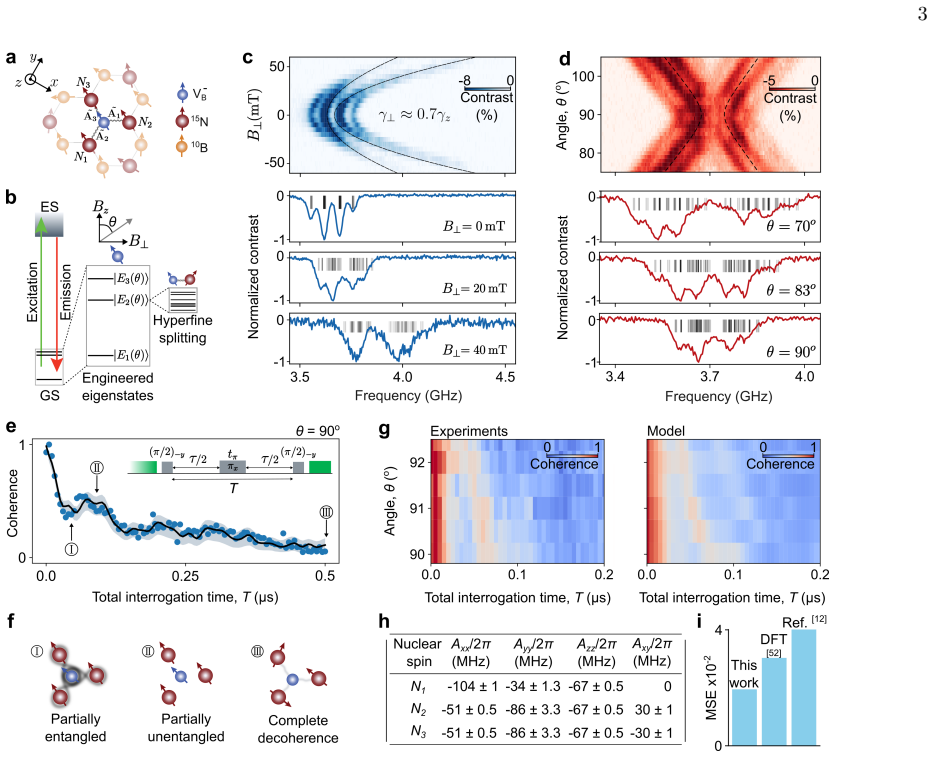
Quantum sensing with solid-state spin defects has transformed nanoscale metrology, offering sub-wavelength spatial resolution with exceptional sensitivity to multiple signal types. Maximizing these advantages requires minimizing both the sensor-target separation and the detectable signal threshold. However, leading platforms such as nitrogen-vacancy (NV) centers in diamond suffer from performance degradation near surfaces or in nanoscale volumes, motivating the search for optically addressable spin sensors in atomically thin, two-dimensional (2D) van der Waals materials. Here, we present a comprehensive experimental framework to probe a 2D spin ensemble, including its Hamiltonian, coherent sensing dynamics, and noise environment. Using a central spin system in a hexagonal boron nitride (hBN) crystal, we fully map the hyperfine interactions with proximal nuclear spins, demonstrate switchable magnetic and electric noise sensing, and introduce a method to accurately reconstruct the environmental noise spectrum while explicitly accounting for quantum control imperfections. We achieve a record coherence time of $80~\mu\mathrm{s}$ under dynamical decoupling, enabling sub-microtesla AC magnetic sensitivity at a $10~\mathrm{nm}$ target distance. Leveraging the broad opportunities for defect engineering in atomically thin hosts, these results lay the foundation for next-generation quantum sensors with ultrahigh sensitivity, tunable noise selectivity, and versatile functionalities.
Editorial analysis
A structured set of objections, weighed in public.
Referee Report
Summary. The manuscript reports an experimental framework for quantum sensing with a central spin ensemble in hexagonal boron nitride (hBN). It maps hyperfine interactions with proximal nuclear spins, demonstrates switchable magnetic and electric noise sensing, introduces a method to reconstruct the environmental noise spectrum while explicitly correcting for quantum control imperfections, and achieves a coherence time of 80 μs under dynamical decoupling. This is claimed to enable sub-microtesla AC magnetic sensitivity at a 10 nm target distance, positioning hBN defects as a platform for nanoscale metrology in 2D materials.
Significance. If the central claims hold, the work would advance quantum sensing by establishing a viable 2D van der Waals platform that mitigates surface degradation issues common to NV centers in diamond. The measured coherence time, noise reconstruction approach, and projected sensitivity represent concrete experimental progress in defect engineering, with potential for tunable selectivity and integration into atomically thin devices. The experimental nature of the coherence and sensitivity values (rather than derived circularly) strengthens the contribution if the supporting methods are robust.
major comments (1)
- [Noise spectrum reconstruction / environmental noise characterization section] The noise spectrum reconstruction method (described in the section on environmental noise characterization and the abstract's paragraph on this topic) is load-bearing for the 80 μs coherence time and sub-μT sensitivity claims. The explicit correction for quantum control imperfections (finite pulse duration, amplitude fluctuations, higher-order Magnus terms) lacks an independent benchmark, such as application to simulated data with known injected errors or cross-check against a different dynamical decoupling sequence. Without this, residual biases could overstate the isolation of the spin ensemble and the accuracy of the reconstructed spectrum, directly affecting the central performance metrics.
minor comments (2)
- [Abstract] The abstract states concrete numbers (80 μs, sub-μT at 10 nm) without accompanying error bars or details on data exclusion criteria; these should be added for clarity in the main text or supplementary information.
- [Throughout (e.g., Hamiltonian and sensing dynamics sections)] Notation for the hyperfine interaction mapping and the switchable sensing protocols could be standardized across figures and text to improve readability.
Simulated Author's Rebuttal
We thank the referee for their detailed and constructive report. We address the single major comment below and agree that an independent benchmark will strengthen the presentation of the noise reconstruction method.
read point-by-point responses
-
Referee: The noise spectrum reconstruction method (described in the section on environmental noise characterization and the abstract's paragraph on this topic) is load-bearing for the 80 μs coherence time and sub-μT sensitivity claims. The explicit correction for quantum control imperfections (finite pulse duration, amplitude fluctuations, higher-order Magnus terms) lacks an independent benchmark, such as application to simulated data with known injected errors or cross-check against a different dynamical decoupling sequence. Without this, residual biases could overstate the isolation of the spin ensemble and the accuracy of the reconstructed spectrum, directly affecting the central performance metrics.
Authors: We thank the referee for this important observation. The reconstruction corrects for control imperfections via an analytic Magnus-expansion treatment that includes finite pulse width, amplitude noise, and higher-order commutators; internal consistency checks against measured T2 values under different pulse spacings were used during development. To supply the requested independent validation, we will add a new subsection (and associated supplementary figures) that (i) applies the full pipeline to simulated ensemble dynamics with known injected noise spectra plus realistic control errors and recovers the input spectrum to within statistical uncertainty, and (ii) performs an experimental cross-check by reconstructing the spectrum from both CPMG and XY8 data sets on the same sample, confirming agreement within the reported error bars. These additions will be included in the revised manuscript. revision: yes
Circularity Check
Experimental measurements of coherence time and sensitivity are direct observations with no derivation reducing to fitted inputs or self-citation chains
full rationale
The paper is primarily experimental, reporting measured coherence times (80 μs under dynamical decoupling) and projected sensitivities as observed quantities from the hBN spin ensemble. The abstract and described framework focus on mapping hyperfine interactions, demonstrating noise sensing, and introducing a reconstruction method that explicitly corrects for control imperfections; these steps are methodological contributions rather than closed-loop derivations where a prediction equals its own input by construction. No equations are shown that define a result in terms of itself or rename a fit as a first-principles prediction. Self-citations, if present, are not load-bearing for the central experimental claims, which remain independently verifiable through the reported data acquisition and analysis protocols.
Axiom & Free-Parameter Ledger
axioms (1)
- domain assumption The defect spin in hBN can be optically initialized and read out while remaining addressable as an isolated central spin.
Lean theorems connected to this paper
-
IndisputableMonolith/Cost/FunctionalEquation.leanwashburn_uniqueness_aczel unclear?
unclearRelation between the paper passage and the cited Recognition theorem.
We achieve a record coherence time of 80 µs under dynamical decoupling... introduce a method to accurately reconstruct the environmental noise spectrum while explicitly accounting for quantum control imperfections.
What do these tags mean?
- matches
- The paper's claim is directly supported by a theorem in the formal canon.
- supports
- The theorem supports part of the paper's argument, but the paper may add assumptions or extra steps.
- extends
- The paper goes beyond the formal theorem; the theorem is a base layer rather than the whole result.
- uses
- The paper appears to rely on the theorem as machinery.
- contradicts
- The paper's claim conflicts with a theorem or certificate in the canon.
- unclear
- Pith found a possible connection, but the passage is too broad, indirect, or ambiguous to say the theorem truly supports the claim.
Forward citations
Cited by 2 Pith papers
-
An extended ab initio theory of the V$_{\text{B}}^-$ center in hBN: excited states, Jahn-Teller distortion, and pressure dependence
CASSCF-NEVPT2 calculations map the excited-state fine structure, pseudo-Jahn-Teller distortion, singlet-triplet crossings, and pressure dependence of the V_B^- center in hBN.
-
Dynamical decoupling and quantum error correction with SU(d) symmetries
Finite subgroups of SU(d) can serve as both dynamical decoupling groups and generators of quantum error-correcting codes in qudit systems.
Reference graph
Works this paper leans on
-
[1]
We also acknowledge support from the Stanford Research Computing Center for providing computational resources, as some of the computations for this project were performed on the Sherlock cluster. G.S. acknowl- edges support from the Stanford Bloch Postdoctoral Fel- lowship. E.I.R. acknowledges support from an appoint- ment to the Intelligence Community Po...
work page 2082
-
[2]
By measuring the spec- tral spacing between the hyperfine peaks at differentB z values, we extract both the axial hyperfine component, Azz /2π=−67±0.5 MHz, and thez-axis gyromagnetic ratio,γ z/2π= 28±0.2 GHz/T (Supplementary Informa- tion). Importantly, fluctuations in the transition frequency, δf, are governed by magnetic field noise projected along thez...
-
[3]
C. L. Degen, F. Reinhard, and P. Cappellaro, Quantum sensing, Reviews of modern physics89, 035002 (2017)
work page 2017
- [4]
-
[5]
J. Du, F. Shi, X. Kong, F. Jelezko, and J. Wrachtrup, Single-molecule scale magnetic resonance spectroscopy using quantum diamond sensors, Reviews of Modern Physics96, 025001 (2024)
work page 2024
- [6]
-
[7]
M. Kim, H. Mamin, M. Sherwood, K. Ohno, D. D. Awschalom, and D. Rugar, Decoherence of near-surface nitrogen-vacancy centers due to electric field noise, Phys- ical review letters115, 087602 (2015)
work page 2015
-
[8]
S. Sangtawesin, B. L. Dwyer, S. Srinivasan, J. J. Allred, L. V. Rodgers, K. De Greve, A. Stacey, N. Dontschuk, K. M. O’Donnell, D. Hu,et al., Origins of diamond sur- face noise probed by correlating single-spin measurements with surface spectroscopy, Physical Review X9, 031052 (2019)
work page 2019
-
[9]
L. P. McGuinness, Y. Yan, A. Stacey, D. A. Simp- son, L. T. Hall, D. Maclaurin, S. Prawer, P. Mulvaney, J. Wrachtrup, F. Caruso,et al., Quantum measurement and orientation tracking of fluorescent nanodiamonds in- side living cells, Nature nanotechnology6, 358 (2011)
work page 2011
-
[10]
J. Holzgrafe, Q. Gu, J. Beitner, D. M. Kara, H. S. Knowles, and M. Atat¨ ure, Nanoscale nmr spectroscopy using nanodiamond quantum sensors, Physical Review Applied13, 044004 (2020)
work page 2020
-
[11]
B. S. Miller, L. Bezinge, H. D. Gliddon, D. Huang, G. Dold, E. R. Gray, J. Heaney, P. J. Dobson, E. Nas- touli, J. J. Morton,et al., Spin-enhanced nanodiamond biosensing for ultrasensitive diagnostics, Nature587, 588 (2020)
work page 2020
-
[12]
Y. Lee, Y. Hu, X. Lang, D. Kim, K. Li, Y. Ping, K.-M. C. Fu, and K. Cho, Spin-defect qubits in two-dimensional transition metal dichalcogenides operating at telecom wavelengths, Nature Communications13, 7501 (2022)
work page 2022
-
[13]
T. Clua-Provost, A. Durand, Z. Mu, T. Rastoin, J. Frauni´ e, E. Janzen, H. Schutte, J. H. Edgar, G. Seine, A. Claverie,et al., Isotopic control of the boron-vacancy spin defect in hexagonal boron nitride, Physical Review Letters131, 126901 (2023)
work page 2023
-
[14]
R. Gong, X. Du, E. Janzen, V. Liu, Z. Liu, G. He, B. Ye, T. Li, N. Y. Yao, J. H. Edgar,et al., Isotope engineer- ing for spin defects in van der waals materials, Nature communications15, 104 (2024)
work page 2024
-
[15]
H. L. Stern, Q. Gu, J. Jarman, S. Eizagirre Barker, N. Mendelson, D. Chugh, S. Schott, H. H. Tan, H. Sir- ringhaus, I. Aharonovich,et al., Room-temperature op- tically detected magnetic resonance of single defects in hexagonal boron nitride, Nature communications13, 618 (2022)
work page 2022
-
[16]
H. L. Stern, C. M. Gilardoni, Q. Gu, S. Eizagirre Barker, O. F. Powell, X. Deng, S. A. Fraser, L. Follet, C. Li, A. J. Ramsay,et al., A quantum coherent spin in hexagonal boron nitride at ambient conditions, Nature Materials23, 1379 (2024)
work page 2024
-
[17]
X. Gao, S. Vaidya, K. Li, Z. Ge, S. Dikshit, S. Zhang, P. Ju, K. Shen, Y. Jin, Y. Ping,et al., Single nuclear spin detection and control in a van der waals material, Nature 643, 943 (2025)
work page 2025
-
[18]
A. Gottscholl, M. Diez, V. Soltamov, C. Kasper, D. Krauße, A. Sperlich, M. Kianinia, C. Bradac, I. Aharonovich, and V. Dyakonov, Spin defects in hbn as promising temperature, pressure and magnetic field quan- 15 tum sensors, Nature communications12, 4480 (2021)
work page 2021
-
[19]
A. Gottscholl, M. Diez, V. Soltamov, C. Kasper, A. Sper- lich, M. Kianinia, C. Bradac, I. Aharonovich, and V. Dyakonov, Room temperature coherent control of spin defects in hexagonal boron nitride, Science Advances7, eabf3630 (2021)
work page 2021
- [20]
-
[21]
R. Rizzato, M. Schalk, S. Mohr, J. C. Hermann, J. P. Leibold, F. Bruckmaier, G. Salvitti, C. Qian, P. Ji, G. V. Astakhov,et al., Extending the coherence of spin defects in hbn enables advanced qubit control and quantum sens- ing, Nature communications14, 5089 (2023)
work page 2023
-
[22]
M. Ye, H. Seo, and G. Galli, Spin coherence in two- dimensional materials, npj Computational Materials5, 44 (2019)
work page 2019
- [23]
-
[24]
H.-H. Fang, X.-J. Wang, X. Marie, and H.-B. Sun, Quan- tum sensing with optically accessible spin defects in van der waals layered materials, Light: Science & Applica- tions13, 303 (2024)
work page 2024
- [25]
-
[26]
D. R. Glenn, D. B. Bucher, J. Lee, M. D. Lukin, H. Park, and R. L. Walsworth, High-resolution magnetic resonance spectroscopy using a solid-state spin sensor, Nature555, 351 (2018)
work page 2018
-
[27]
F. Shi, Q. Zhang, P. Wang, H. Sun, J. Wang, X. Rong, M. Chen, C. Ju, F. Reinhard, H. Chen,et al., Single- protein spin resonance spectroscopy under ambient con- ditions, Science347, 1135 (2015)
work page 2015
-
[28]
I. Lovchinsky, A. Sushkov, E. Urbach, N. P. de Leon, S. Choi, K. De Greve, R. Evans, R. Gertner, E. Bersin, C. M¨ uller,et al., Nuclear magnetic resonance detection and spectroscopy of single proteins using quantum logic, Science351, 836 (2016)
work page 2016
-
[29]
T. I. Andersen, B. L. Dwyer, J. D. Sanchez-Yamagishi, J. F. Rodriguez-Nieva, K. Agarwal, K. Watanabe, T. Taniguchi, E. A. Demler, P. Kim, H. Park,et al., Electron-phonon instability in graphene revealed by global and local noise probes, Science364, 154 (2019)
work page 2019
-
[30]
T. Esat, D. Borodin, J. Oh, A. J. Heinrich, F. S. Tautz, Y. Bae, and R. Temirov, A quantum sensor for atomic- scale electric and magnetic fields, Nature nanotechnology 19, 1466 (2024)
work page 2024
- [31]
-
[32]
J. Choi, H. Zhou, R. Landig, H.-Y. Wu, X. Yu, S. E. Von Stetina, G. Kucsko, S. E. Mango, D. J. Needleman, A. D. Samuel,et al., Probing and manipulating embryo- genesis via nanoscale thermometry and temperature con- trol, Proceedings of the National Academy of Sciences 117, 14636 (2020)
work page 2020
-
[33]
R. R. Fu, B. P. Weiss, E. A. Lima, R. J. Harrison, X.- N. Bai, S. J. Desch, D. S. Ebel, C. Suavet, H. Wang, D. Glenn,et al., Solar nebula magnetic fields recorded in the semarkona meteorite, Science346, 1089 (2014)
work page 2014
-
[34]
D. R. Glenn, R. R. Fu, P. Kehayias, D. Le Sage, E. A. Lima, B. P. Weiss, and R. L. Walsworth, Micrometer- scale magnetic imaging of geological samples using a quantum diamond microscope, Geochemistry, Geo- physics, Geosystems18, 3254 (2017)
work page 2017
-
[35]
A. K. Geim and I. V. Grigorieva, Van der waals het- erostructures, Nature499, 419 (2013)
work page 2013
-
[36]
A. Castellanos-Gomez, X. Duan, Z. Fei, H. R. Gutierrez, Y. Huang, X. Huang, J. Quereda, Q. Qian, E. Sutter, and P. Sutter, Van der waals heterostructures, Nature Reviews Methods Primers2, 58 (2022)
work page 2022
-
[37]
M. Onizhuk and G. Galli, Colloquium: Decoherence of solid-state spin qubits: A computational perspective, Re- views of Modern Physics97, 021001 (2025)
work page 2025
-
[38]
K. R. K. Rao and D. Suter, Characterization of hyper- fine interaction between an nv electron spin and a first- shell c 13 nuclear spin in diamond, Physical Review B94, 060101 (2016)
work page 2016
-
[39]
M. Abobeih, J. Randall, C. Bradley, H. Bartling, M. Bakker, M. Degen, M. Markham, D. Twitchen, and T. Taminiau, Atomic-scale imaging of a 27-nuclear-spin cluster using a quantum sensor, Nature576, 411 (2019)
work page 2019
- [40]
-
[41]
D. F. Wise, J. J. Morton, and S. Dhomkar, Using deep learning to understand and mitigate the qubit noise en- vironment, PRX Quantum2, 010316 (2021)
work page 2021
- [42]
-
[43]
T. Rosskopf, A. Dussaux, K. Ohashi, M. Loretz, R. Schirhagl, H. Watanabe, S. Shikata, K. M. Itoh, and C. Degen, Investigation of surface magnetic noise by shal- low spins in diamond, Physical review letters112, 147602 (2014)
work page 2014
-
[44]
B. A. Myers, A. Das, M. Dartiailh, K. Ohno, D. D. Awschalom, and A. Bleszynski Jayich, Probing surface noise with depth-calibrated spins in diamond, Physical Review Letters113, 027602 (2014)
work page 2014
-
[45]
S. Hong, M. S. Grinolds, L. M. Pham, D. Le Sage, L. Luan, R. L. Walsworth, and A. Yacoby, Nanoscale magnetometry with nv centers in diamond, MRS bulletin 38, 155 (2013)
work page 2013
-
[46]
J. R. Maze, P. L. Stanwix, J. S. Hodges, S. Hong, J. M. Taylor, P. Cappellaro, L. Jiang, M. G. Dutt, E. Togan, A. Zibrov,et al., Nanoscale magnetic sensing with an individual electronic spin in diamond, Nature455, 644 (2008)
work page 2008
-
[47]
M. L. Palm, W. Huxter, P. Welter, S. Ernst, P. Schei- degger, S. Diesch, K. Chang, P. Rickhaus, T. Taniguchi, K. Watanabe,et al., Imaging of submicroampere currents in bilayer graphene using a scanning diamond magne- tometer, Physical Review Applied17, 054008 (2022)
work page 2022
-
[48]
Y. Chen, Q. Lin, H. Cheng, H. Huang, J. Shao, Y. Ye, G.-S. Liu, L. Chen, Y. Luo, and Z. Chen, Nanodiamond- based optical-fiber quantum probe for magnetic field and biological sensing, ACS sensors7, 3660 (2022)
work page 2022
-
[49]
J. H. Shim, S.-J. Lee, S. Ghimire, J. I. Hwang, K.-G. Lee, K. Kim, M. J. Turner, C. A. Hart, R. L. Walsworth, and S. Oh, Multiplexed sensing of magnetic field and temper- ature in real time using a nitrogen-vacancy ensemble in diamond, Physical Review Applied17, 014009 (2022)
work page 2022
-
[50]
J. F. Barry, M. J. Turner, J. M. Schloss, D. R. Glenn, Y. Song, M. D. Lukin, H. Park, and R. L. Walsworth, Optical magnetic detection of single-neuron action po- tentials using quantum defects in diamond, Proceedings of the National Academy of Sciences113, 14133 (2016)
work page 2016
-
[51]
N. Arunkumar, K. S. Olsson, J. T. Oon, C. A. Hart, D. B. 16 Bucher, D. R. Glenn, M. D. Lukin, H. Park, D. Ham, and R. L. Walsworth, Quantum logic enhanced sensing in solid-state spin ensembles, Physical Review Letters131, 100801 (2023)
work page 2023
-
[52]
T. Wolf, P. Neumann, K. Nakamura, H. Sumiya, T. Ohshima, J. Isoya, and J. Wrachtrup, Subpicotesla diamond magnetometry, Physical Review X5, 041001 (2015)
work page 2015
-
[53]
W. Lee, V. S. Liu, Z. Zhang, S. Kim, R. Gong, X. Du, K. Pham, T. Poirier, Z. Hao, J. H. Edgar,et al., Intrin- sic high-fidelity spin polarization of charged vacancies in hexagonal boron nitride, Physical Review Letters134, 096202 (2025)
work page 2025
-
[54]
V. Iv´ ady, G. Barcza, G. Thiering, S. Li, H. Hamdi, J.- P. Chou, ¨O. Legeza, and A. Gali, Ab initio theory of the negatively charged boron vacancy qubit in hexagonal boron nitride, npj Computational Materials6, 41 (2020)
work page 2020
-
[55]
Z. Liu, R. Gong, B. Huang, Y. Jin, X. Du, G. He, E. Janzen, L. Yang, E. A. Henriksen, J. H. Edgar,et al., Temperature-dependent spin-phonon coupling of boron- vacancy centers in hexagonal boron nitride, Physical Re- view B111, 024108 (2025)
work page 2025
-
[56]
X. Gao, S. Vaidya, K. Li, P. Ju, B. Jiang, Z. Xu, A. E. L. Allcca, K. Shen, T. Taniguchi, K. Watanabe,et al., Nu- clear spin polarization and control in hexagonal boron nitride, Nature Materials21, 1024 (2022)
work page 2022
-
[57]
L. Childress, M. Gurudev Dutt, J. Taylor, A. Zibrov, F. Jelezko, J. Wrachtrup, P. Hemmer, and M. Lukin, Coherent dynamics of coupled electron and nuclear spin qubits in diamond, Science314, 281 (2006)
work page 2006
-
[58]
Z. Qiu, U. Vool, A. Hamo, and A. Yacoby, Nuclear spin assisted magnetic field angle sensing, npj Quantum Infor- mation7, 39 (2021)
work page 2021
-
[59]
J. C. Marcks, B. Pingault, J. Zhang, C. Zeledon, F. J. Heremans, and D. D. Awschalom, Nuclear spin engineer- ing for quantum information science: Jc marcks et al., Journal of Materials Research , 1 (2025)
work page 2025
-
[60]
S. Meiboom and D. Gill, Modified spin-echo method for measuring nuclear relaxation times, Review of Scientific Instruments29, 688 (1958)
work page 1958
-
[61]
H. Y. Carr and E. M. Purcell, Effects of diffusion on free precession in nuclear magnetic resonance experiments, Physical review94, 630 (1954)
work page 1954
- [62]
-
[63]
W. S. Huxter, M. F. Sarott, M. Trassin, and C. L. Degen, Imaging ferroelectric domains with a single-spin scanning quantum sensor, Nature Physics19, 644 (2023)
work page 2023
-
[64]
H. Zhou, J. Choi, S. Choi, R. Landig, A. M. Douglas, J. Isoya, F. Jelezko, S. Onoda, H. Sumiya, P. Cappellaro, et al., Quantum metrology with strongly interacting spin systems, Physical review X10, 031003 (2020)
work page 2020
-
[65]
R. Gong, G. He, X. Gao, P. Ju, Z. Liu, B. Ye, E. A. Hen- riksen, T. Li, and C. Zu, Coherent dynamics of strongly interacting electronic spin defects in hexagonal boron ni- tride, Nature Communications14, 3299 (2023)
work page 2023
-
[66]
T. Gullion, D. B. Baker, and M. S. Conradi, New, compensated carr-purcell sequences, Journal of Magnetic Resonance (1969)89, 479 (1990)
work page 1969
-
[67]
T. Ishikawa, A. Yoshizawa, Y. Mawatari, H. Watanabe, and S. Kashiwaya, Influence of dynamical decoupling se- quences with finite-width pulses on quantum sensing for ac magnetometry, Physical Review Applied10, 054059 (2018)
work page 2018
-
[68]
E. Paladino, Y. Galperin, G. Falci, and B. Altshuler, 1/f noise: Implications for solid-state quantum information, Reviews of Modern Physics86, 361 (2014)
work page 2014
-
[69]
S. Kolkowitz, A. Safira, A. High, R. Devlin, S. Choi, Q. Unterreithmeier, D. Patterson, A. Zibrov, V. Manucharyan, H. Park,et al., Probing johnson noise and ballistic transport in normal metals with a single-spin qubit, Science347, 1129 (2015)
work page 2015
-
[70]
J. F. Barry, J. M. Schloss, E. Bauch, M. J. Turner, C. A. Hart, L. M. Pham, and R. L. Walsworth, Sensitivity opti- mization for nv-diamond magnetometry, Reviews of Mod- ern Physics92, 015004 (2020)
work page 2020
- [71]
-
[72]
W. Wang, N. Clark, M. Hamer, A. Carl, E. Tovari, S. Sullivan-Allsop, E. Tillotson, Y. Gao, H. de Latour, F. Selles,et al., Clean assembly of van der waals het- erostructures using silicon nitride membranes, Nature Electronics6, 981 (2023)
work page 2023
-
[73]
D. G. Purdie, N. Pugno, T. Taniguchi, K. Watanabe, A. Ferrari, and A. Lombardo, Cleaning interfaces in lay- ered materials heterostructures, Nature communications 9, 5387 (2018)
work page 2018
- [74]
-
[75]
C. Li, J. E. Froch, M. Nonahal, T. N. Tran, M. Toth, S. Kim, and I. Aharonovich, Integration of hbn quantum emitters in monolithically fabricated waveguides, ACS photonics8, 2966 (2021)
work page 2021
-
[76]
R. J. Gelly, A. D. White, G. Scuri, X. Liao, G. H. Ahn, B. Deng, K. Watanabe, T. Taniguchi, J. Vuckovic, and H. Park, An inverse-designed nanophotonic interface for excitons in atomically thin materials, Nano Letters23, 8779 (2023)
work page 2023
-
[77]
A. Reiserer, Colloquium: cavity-enhanced quantum net- work nodes, Reviews of Modern Physics94, 041003 (2022)
work page 2022
-
[78]
E. I. Rosenthal, C. P. Anderson, H. C. Kleidermacher, A. J. Stein, H. Lee, J. Grzesik, G. Scuri, A. E. Rugar, D. Riedel, S. Aghaeimeibodi, G. H. Ahn, K. Van Gasse, and J. Vuˇ ckovi´ c, Microwave spin control of a tin-vacancy qubit in diamond, Phys. Rev. X13, 031022 (2023)
work page 2023
-
[79]
Quantum sensing with a spin ensemble in a two-dimensional material
E. I. Rosenthal, S. Biswas, G. Scuri, H. Lee, A. J. Stein, H. C. Kleidermacher, J. Grzesik, A. E. Rugar, S. Aghaeimeibodi, D. Riedel,et al., Single-shot readout and weak measurement of a tin-vacancy qubit in dia- mond, Physical Review X14, 041008 (2024). 17 Extended Data Fig. 1. Experimental setup and device. a,Schematic of the experimental setup used to ...
work page 2024
discussion (0)
Sign in with ORCID, Apple, or X to comment. Anyone can read and Pith papers without signing in.