XRISM/Resolve observations of Hercules X-1: vertical structure and kinematics of the disk wind
Pith reviewed 2026-05-18 08:28 UTC · model grok-4.3
The pith
In Hercules X-1 the disk wind accelerates from 250 km/s to 600 km/s as it rises higher after orbital correction.
A machine-rendered reading of the paper's core claim, the machinery that carries it, and where it could break.
Core claim
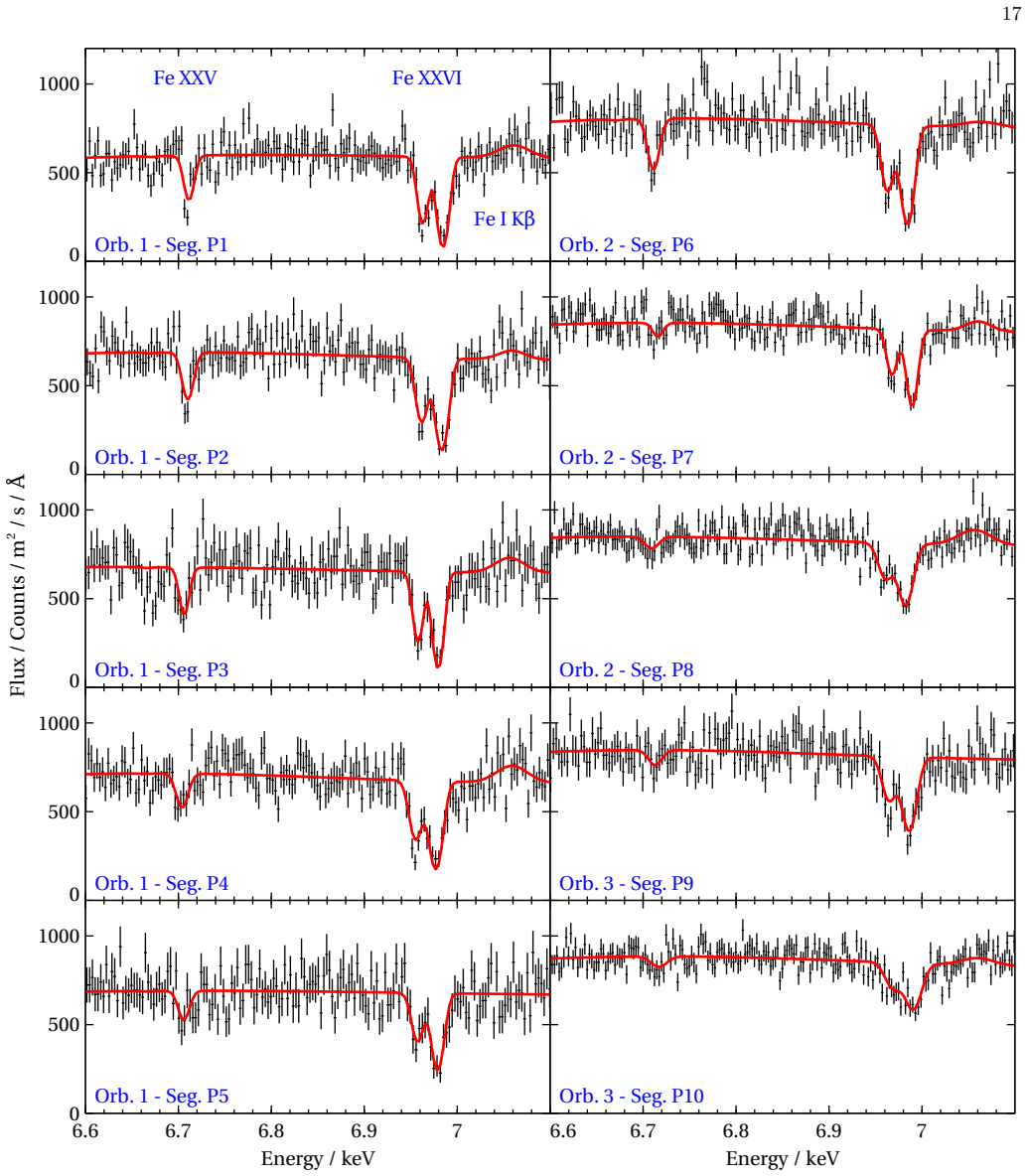
The observations reveal that, once the binary orbital motion is subtracted, the disk wind velocity rises steadily from 250 km/s to 600 km/s with increasing height above the disk. Column density decreases with height in the expected manner, yet the ionization parameter evolves only weakly. A new orbital-phase dependence also appears, indicating a second wind component visible briefly after eclipse by the companion star.
What carries the argument
The warped, precessing accretion disk that supplies a continuous range of sightlines through the vertical structure of the disk wind.
If this is right
- Mass outflow rates can be integrated over the measured velocity and density profile instead of relying on a single sightline.
- Disk winds remove a substantial fraction of transferred mass, altering the long-term accretion history and binary evolution.
- The nearly constant ionization with height implies the wind remains in a similar ionization state while expanding.
Where Pith is reading between the lines
- The same vertical acceleration may operate in other X-ray binaries but remains hidden without a precessing disk that provides multiple sightlines.
- High-resolution spectroscopy of additional precessing systems could test whether velocity gradients of this magnitude are generic.
- Incorporating height-dependent kinematics into wind models would refine estimates of angular-momentum loss and disk truncation radii.
Load-bearing premise
Changes in observed wind velocity, column density and ionization with orbital phase arise from sampling different heights in a stable wind rather than from intrinsic time variability or changing geometry unrelated to height.
What would settle it
Detailed modeling or observations in a non-precessing system that show no systematic velocity increase or column-density decrease with phase would indicate the trends are not height-dependent.
Figures


read the original abstract
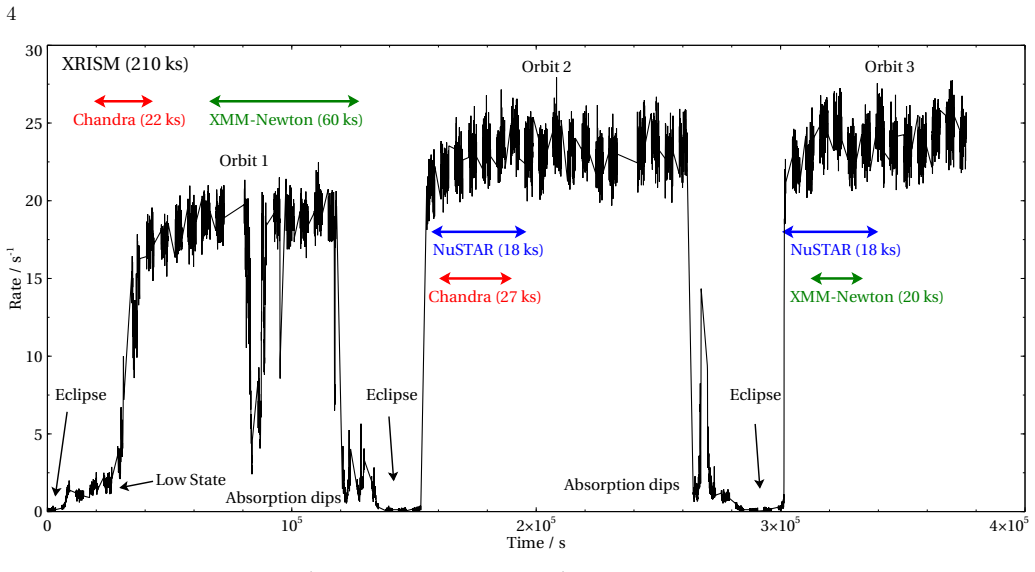
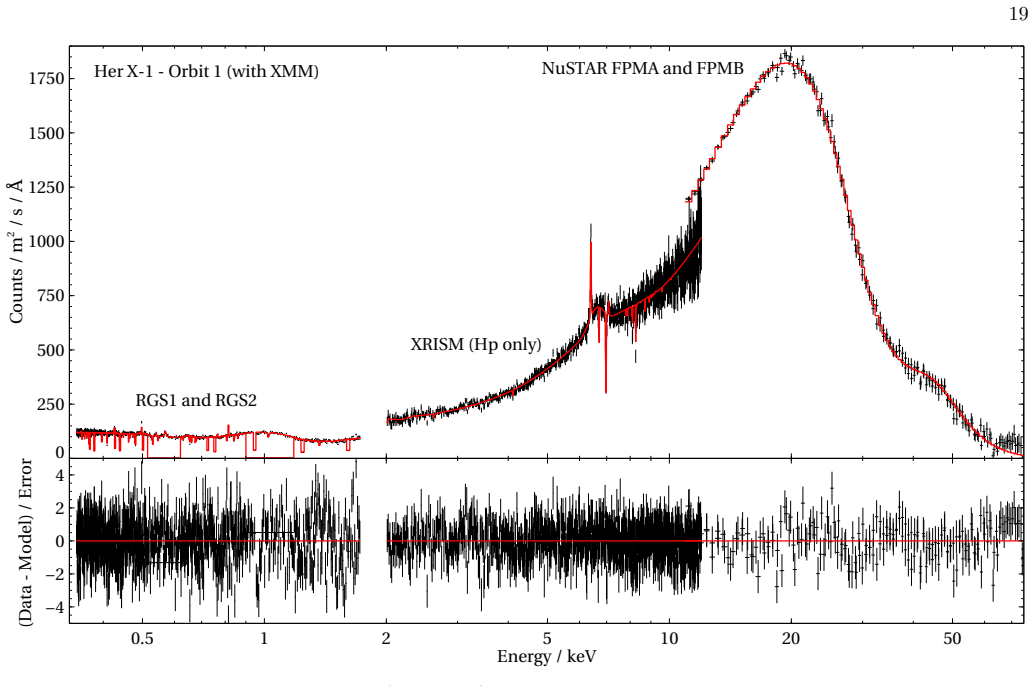
X-ray binary accretion disk winds can carry away a significant fraction of the matter transferred from the companion and hence strongly affect the accretion flow and the long-term evolution of the binary. However, accurate mass outflow rate measurements are challenging due to uncertainties in our understanding of the 3D wind structure. Most studies employ absorption line spectroscopy that only gives us a single sightline through the wind streamlines. Hercules X-1 is a peculiar X-ray binary which allows us to avoid this issue, as its warped, precessing accretion disk naturally presents a range of sightlines through the vertical structure of its disk wind. Here we present the first results from a large, coordinated campaign on Her X-1 led by the new XRISM observatory (with an exposure of 210 ks) and supported by XMM-Newton, NuSTAR and Chandra. We perform a time-resolved analysis and constrain the wind properties. With XRISM/Resolve, we directly detect the Her X-1 orbital motion with an amplitude of 170 km/s in the evolution of the wind velocity. After correcting for this effect, we observe an increase in wind velocity from 250 km/s to 600 km/s as the wind rises to greater heights above the disk. The wind column density decreases with increasing height, as expected, but its ionization parameter log($\xi$/erg cm s$^{-1}$) evolves only weakly from 3.65 to 3.9 as the wind expands away. Additionally, we detect a new orbital dependence of the wind properties, revealing a likely second component that appears only briefly after the eclipse by the secondary star.
Editorial analysis
A structured set of objections, weighed in public.
Referee Report
Summary. The paper reports XRISM/Resolve observations of the accretion disk wind in Hercules X-1, using the system's warped, precessing disk to sample different sightlines through the wind's vertical structure. Time-resolved absorption-line spectroscopy yields a direct detection of orbital motion with amplitude 170 km/s; after correction, wind velocity rises from 250 km/s to 600 km/s with increasing height, column density declines, and log ξ evolves only weakly from 3.65 to 3.9. A new orbital-phase dependence is also reported, interpreted as evidence for a transient second wind component visible shortly after eclipse.
Significance. If the geometric interpretation holds, the work supplies rare empirical constraints on the vertical kinematics and ionization structure of a disk wind in an X-ray binary, directly addressing uncertainties in mass-outflow-rate estimates that affect accretion flow and binary evolution models. The high-resolution, time-resolved XRISM data and explicit orbital-motion correction constitute a clear methodological advance over single-sightline studies.
major comments (2)
- [Abstract and time-resolved analysis section] The central claim that velocity, column, and ionization trends trace vertical structure via changing sightlines through a steady, azimuthally symmetric wind is load-bearing and rests on the assumption (stated in the abstract) that precession monotonically varies line-of-sight height while radial launch radius and temporal effects remain fixed. No explicit tests, Monte-Carlo simulations, or alternative models (e.g., time-variable launch or azimuthal asymmetry on the 35-day timescale) are presented to quantify the risk that the observed 250–600 km/s trend arises from radial or temporal confounding instead.
- [§4] §4 (spectral fitting and results): the manuscript provides insufficient detail on the absorption-line modeling (specific line lists, continuum choices, error-bar derivation, data-exclusion criteria, and any post-hoc velocity corrections). Without these, it is not possible to verify whether the reported velocity increase and weak log ξ evolution are robust against modeling choices or alternative interpretations.
minor comments (2)
- [Abstract] The ionization parameter is written as log(ξ/erg cm s⁻¹); standard notation in the field is log ξ (with units stated once in the text or table caption) to avoid visual clutter.
- [Figure captions] Figure captions should explicitly state the orbital-phase bins used for each spectrum and the corresponding estimated height range above the disk to make the geometric mapping transparent.
Simulated Author's Rebuttal
We thank the referee for their careful reading and constructive comments, which have helped us identify areas where the manuscript can be clarified and strengthened. We respond to each major comment below and indicate the revisions we will implement.
read point-by-point responses
-
Referee: [Abstract and time-resolved analysis section] The central claim that velocity, column, and ionization trends trace vertical structure via changing sightlines through a steady, azimuthally symmetric wind is load-bearing and rests on the assumption (stated in the abstract) that precession monotonically varies line-of-sight height while radial launch radius and temporal effects remain fixed. No explicit tests, Monte-Carlo simulations, or alternative models (e.g., time-variable launch or azimuthal asymmetry on the 35-day timescale) are presented to quantify the risk that the observed 250–600 km/s trend arises from radial or temporal confounding instead.
Authors: We acknowledge that the geometric interpretation of the velocity, column-density, and ionization trends as sampling different heights through a steady, azimuthally symmetric wind is central to the paper and rests on the assumption that precession primarily changes the line-of-sight height. The direct detection of the 170 km s^{-1} orbital-motion signature in the time-resolved velocity evolution provides independent kinematic support for separating orbital effects from the intrinsic wind velocity. While the submitted manuscript did not contain explicit Monte-Carlo simulations or quantitative alternative models, the observed monotonic increase in velocity with precession phase, the decline in column density, and the very weak change in log ξ are difficult to reconcile with strong radial or 35-day temporal variations. In the revised manuscript we will add a dedicated paragraph in the discussion that explicitly considers alternative scenarios (time-variable launch radius, azimuthal asymmetry) and explains why they are disfavored by the data; we will also include a simple sensitivity test that perturbs the assumed launch radius and re-derives the velocity-height relation to quantify robustness. revision: partial
-
Referee: [§4] §4 (spectral fitting and results): the manuscript provides insufficient detail on the absorption-line modeling (specific line lists, continuum choices, error-bar derivation, data-exclusion criteria, and any post-hoc velocity corrections). Without these, it is not possible to verify whether the reported velocity increase and weak log ξ evolution are robust against modeling choices or alternative interpretations.
Authors: We agree that the current level of detail in §4 is insufficient for full reproducibility and independent verification. In the revised manuscript we will expand this section to specify: the atomic line lists and databases used to model the absorption features; the functional form and free parameters of the continuum model; the statistical method employed to derive parameter uncertainties (including any use of MCMC sampling or Δχ² contours); the precise criteria for excluding data segments (e.g., eclipse intervals, low-count bins, or instrumental artifacts); and a step-by-step account of the post-hoc orbital-velocity correction that was applied before reporting the wind velocities. These additions will allow readers to assess the robustness of the reported trends against modeling choices. revision: yes
Circularity Check
No significant circularity; results follow directly from time-resolved spectroscopy and known system geometry
full rationale
The paper reports direct measurements of absorption-line velocities and column densities from XRISM/Resolve spectra across precession phases. Orbital motion is detected in the data (amplitude 170 km/s) and subtracted to isolate the residual trend, which is then interpreted using the independently established 35-day precession and warp geometry of Her X-1. No step equates a derived quantity to its own fitted inputs by construction, no load-bearing claim rests on an unverified self-citation, and the central trends (velocity rising from 250 to 600 km/s, weak ionization change) are extracted quantities rather than tautological redefinitions. The derivation chain remains self-contained against the observational dataset.
Axiom & Free-Parameter Ledger
axioms (1)
- domain assumption The warped, precessing accretion disk naturally presents a range of sightlines through the vertical structure of its disk wind
Lean theorems connected to this paper
-
IndisputableMonolith/Cost/FunctionalEquation.leanwashburn_uniqueness_aczel unclear?
unclearRelation between the paper passage and the cited Recognition theorem.
We perform a time-resolved analysis and constrain the wind properties... After correcting for this effect, we observe an increase in wind velocity from 250 km/s to 600 km/s... column density decreases... log(ξ) evolves only weakly from 3.65 to 3.9
What do these tags mean?
- matches
- The paper's claim is directly supported by a theorem in the formal canon.
- supports
- The theorem supports part of the paper's argument, but the paper may add assumptions or extra steps.
- extends
- The paper goes beyond the formal theorem; the theorem is a base layer rather than the whole result.
- uses
- The paper appears to rely on the theorem as machinery.
- contradicts
- The paper's claim conflicts with a theorem or certificate in the canon.
- unclear
- Pith found a possible connection, but the passage is too broad, indirect, or ambiguous to say the theorem truly supports the claim.
Forward citations
Cited by 1 Pith paper
-
XRISM/Resolve observations of Hercules X-1: a pulsating, highly broadened Fe K emission line from the neutron star accretion column
New XRISM observations confirm a highly broadened, pulsating Fe K line from the accretion column of Hercules X-1 that varies with pulse phase and evolves with the 35-day precession cycle.
Reference graph
Works this paper leans on
-
[1]
Arnaud, K. A. 1996, in Astronomical Society of the Pacific Conference Series, Vol. 101, Astronomical Data Analysis Software and Systems V, ed. G. H. Jacoby & J. Barnes, 17
work page 1996
-
[2]
Begelman, M. C., McKee, C. F., & Shields, G. A. 1983, ApJ, 271, 70, doi: 10.1086/161178
-
[3]
Boroson, B., Kallman, T., & Vrtilek, S. D. 2001, ApJ, 562, 925, doi: 10.1086/323850
-
[4]
1979, , 228, 939, 10.1086/156922
Cash, W. 1979, ApJ, 228, 939, doi: 10.1086/156922 Castro Segura, N., Knigge, C., Long, K. S., et al. 2022, Nature, 603, 52, doi: 10.1038/s41586-021-04324-2 de Plaa, J., Kaastra, J. S., Tamura, T., et al. 2004, A&A, 423, 49, doi: 10.1051/0004-6361:20047170
-
[5]
Deeter, J. E., Boynton, P. E., & Pravdo, S. H. 1981, ApJ, 247, 1003, doi: 10.1086/159110 den Herder, J. W., Brinkman, A. C., Kahn, S. M., et al. 2001, A&A, 365, L7, doi: 10.1051/0004-6361:20000058 21 D´ ıaz Trigo, M., Sidoli, L., Boirin, L., & Parmar, A. N. 2012, A&A, 543, A50, doi: 10.1051/0004-6361/201219049
-
[6]
2024, ApJ, 973, 168, doi: 10.3847/1538-4357/ad6769
Gallegos-Garcia, M., Jacquemin-Ide, J., & Kalogera, V. 2024, ApJ, 973, 168, doi: 10.3847/1538-4357/ad6769
-
[7]
Gerend, D., & Boynton, P. E. 1976, ApJ, 209, 562, doi: 10.1086/154751
-
[8]
Harrison, F. A., Craig, W. W., Christensen, F. E., et al. 2013, ApJ, 770, 103, doi: 10.1088/0004-637X/770/2/103 HI4PI Collaboration, Ben Bekhti, N., Fl¨ oer, L., et al. 2016, A&A, 594, A116, doi: 10.1051/0004-6361/201629178 H¨ olzer, G., Fritsch, M., Deutsch, M., H¨ artwig, J., & F¨ orster, E. 1997, PhRvA, 56, 4554, doi: 10.1103/PhysRevA.56.4554
-
[9]
Ishisaki, Y., Kelley, R. L., Awaki, H., et al. 2022, in Society of Photo-Optical Instrumentation Engineers (SPIE) Conference Series, Vol. 12181, Space Telescopes and Instrumentation 2022: Ultraviolet to Gamma Ray, ed. J.-W. A. den Herder, S. Nikzad, & K. Nakazawa, 121811S, doi: 10.1117/12.2630654
-
[10]
2001, Astronomy & Astrophysics, 365, L1, doi: 10.1051/0004-6361:20000036
Jansen, F., Lumb, D., Altieri, B., et al. 2001, A&A, 365, L1, doi: 10.1051/0004-6361:20000036
-
[11]
2002, ApJ, 578, 391, doi: 10.1086/342348
Zane, S., & Ramsay, G. 2002, ApJ, 578, 391, doi: 10.1086/342348
-
[12]
Hailey, C. J. 2005, ApJ, 625, 931, doi: 10.1086/426702
-
[13]
Kaastra, J. S., & Bleeker, J. A. M. 2016, A&A, 587, A151, doi: 10.1051/0004-6361/201527395
-
[14]
S., Mewe, R., & Nieuwenhuijzen, H
Kaastra, J. S., Mewe, R., & Nieuwenhuijzen, H. 1996, in UV and X-ray Spectroscopy of Astrophysical and Laboratory Plasmas, 411–414
work page 1996
-
[15]
Kaastra, J. S., Steenbrugge, K. C., Raassen, A. J. J., et al. 2002, A&A, 386, 427, doi: 10.1051/0004-6361:20020235
-
[16]
Katz, J. I. 1973, Nature Physical Science, 246, 87, doi: 10.1038/physci246087a0
-
[17]
Keshet, N., Behar, E., & Miller, J. M. 2025, arXiv e-prints, arXiv:2506.19440, doi: 10.48550/arXiv.2506.19440
-
[18]
Kosec, P., Fabian, A. C., Pinto, C., et al. 2020, MNRAS, 491, 3730, doi: 10.1093/mnras/stz3200
-
[19]
Kosec, P., Kara, E., Fabian, A. C., et al. 2023a, ApJ, 959, 51, doi: 10.3847/1538-4357/acfc3e
-
[20]
Kosec, P., Pinto, C., Walton, D. J., et al. 2018, MNRAS, 479, 3978, doi: 10.1093/mnras/sty1626
-
[21]
Kosec, P., Kara, E., Fabian, A. C., et al. 2022, ApJ, 936, 185, doi: 10.3847/1538-4357/ac897e
-
[22]
2023b, Nature Astronomy, 7, 715, doi: 10.1038/s41550-023-01929-7
Kosec, P., Kara, E., Fabian, A., et al. 2023b, Nature Astronomy, 7, 715, doi: 10.1038/s41550-023-01929-7
-
[23]
2024, ApJ, 972, 32, doi: 10.3847/1538-4357/ad5b5a
Kosec, P., Rogantini, D., Kara, E., et al. 2024, ApJ, 972, 32, doi: 10.3847/1538-4357/ad5b5a
-
[24]
2000, ApJ, 539, 413, doi: 10.1086/309200
Kotani, T., Ebisawa, K., Dotani, T., et al. 2000, ApJ, 539, 413, doi: 10.1086/309200
-
[25]
Leahy, D. A., & Abdallah, M. H. 2014, ApJ, 793, 79, doi: 10.1088/0004-637X/793/2/79
-
[26]
Lee, J. C., Reynolds, C. S., Remillard, R., et al. 2002, ApJ, 567, 1102, doi: 10.1086/338588
-
[27]
Mehdipour, M., Kaastra, J. S., & Kallman, T. 2016, A&A, 596, A65, doi: 10.1051/0004-6361/201628721
-
[28]
2025, PASJ, 77, psaf057, doi: 10.1093/pasj/psaf057
Miura, D., Yamaguchi, H., Ballhausen, R., et al. 2025, PASJ, 77, psaf057, doi: 10.1093/pasj/psaf057
-
[29]
Mochizuki, Y., Tsujimoto, M., Kelley, R. L., et al. 2024, ApJL, 977, L21, doi: 10.3847/2041-8213/ad946d Mu˜ noz-Darias, T., Jim´ enez-Ibarra, F., Panizo-Espinar, G., et al. 2019, ApJL, 879, L4, doi: 10.3847/2041-8213/ab2768
-
[30]
2023, arXiv e-prints, arXiv:2304.05412, doi: 10.48550/arXiv.2304.05412
Neilsen, J., & Degenaar, N. 2023, arXiv e-prints, arXiv:2304.05412, doi: 10.48550/arXiv.2304.05412
-
[31]
Parra, M., Petrucci, P. O., Bianchi, S., et al. 2024, A&A, 681, A49, doi: 10.1051/0004-6361/202346920
- [32]
-
[33]
Ponti, G., Fender, R. P., Begelman, M. C., et al. 2012, MNRAS, 422, L11, doi: 10.1111/j.1745-3933.2012.01224.x
-
[34]
Reynolds, A. P., Quaintrell, H., Still, M. D., et al. 1997, MNRAS, 288, 43, doi: 10.1093/mnras/288.1.43 S´ anchez-Sierras, J., & Mu˜ noz-Darias, T. 2020, A&A, 640, L3, doi: 10.1051/0004-6361/202038406
-
[35]
Scott, D. M., Leahy, D. A., & Wilson, R. B. 2000, ApJ, 539, 392, doi: 10.1086/309203
-
[36]
Harrison, F. A. 2016, A&A, 590, A91, doi: 10.1051/0004-6361/201527955 Str¨ uder, L., Briel, U., Dennerl, K., et al. 2001, A&A, 365, L18, doi: 10.1051/0004-6361:20000066
-
[37]
Tananbaum, H., Gursky, H., Kellogg, E. M., et al. 1972, ApJL, 174, L143, doi: 10.1086/180968
-
[38]
Tashiro, M. S. 2022, International Journal of Modern Physics D, 31, 2230001, doi: 10.1142/S0218271822300014
-
[39]
Tetarenko, B. E., Lasota, J. P., Heinke, C. O., Dubus, G., & Sivakoff, G. R. 2018, Nature, 554, 69, doi: 10.1038/nature25159
- [40]
-
[41]
1978, ApJL, 219, L105, doi: 10.1086/182617
Truemper, J., Pietsch, W., Reppin, C., et al. 1978, ApJL, 219, L105, doi: 10.1086/182617
-
[42]
1998, ApJ, 492, 782, doi: 10.1086/305063
Ueda, Y., Inoue, H., Tanaka, Y., et al. 1998, ApJ, 492, 782, doi: 10.1086/305063
- [43]
-
[44]
Weisskopf, M. C., Tananbaum, H. D., Van Speybroeck, L. P., & O’Dell, S. L. 2000, in Society of Photo-Optical Instrumentation Engineers (SPIE) Conference Series, Vol. 4012, X-Ray Optics, Instruments, and Missions III, ed. J. E. Truemper & B. Aschenbach, 2–16, doi: 10.1117/12.391545 XRISM Collaboration, Audard, M., Awaki, H., et al. 2024, ApJL, 977, L34, do...
discussion (0)
Sign in with ORCID, Apple, or X to comment. Anyone can read and Pith papers without signing in.