A first look at quasar-galaxy clustering at zsimeq7.3
Pith reviewed 2026-05-18 08:23 UTC · model grok-4.3
The pith
Observations of two z~7.3 quasars yield a quasar-galaxy correlation length of 7.6 h^{-1} cMpc, implying minimum host halo masses of 10^{11.6} solar masses.
A machine-rendered reading of the paper's core claim, the machinery that carries it, and where it could break.
Core claim
Combining galaxies found within 1500 km/s of the two quasars produces a measured correlation length r_0^{QG} of 7.6_{-1.6}^{+1.7} h^{-1} cMpc for a fixed slope gamma=2.0; converting this length through the halo model gives a minimum dark-matter halo mass log10(M_halo,min/Msun)=11.6_{-0.7}^{+0.6} at z~7.3.
What carries the argument
The quasar-galaxy cross-correlation function measured from spectroscopically confirmed galaxies and modeled as a power law whose amplitude is translated into halo mass using the standard halo-occupation framework.
If this is right
- The inferred minimum halo mass lies below the values found at lower redshifts, supporting the possibility of non-monotonic redshift evolution in quasar clustering.
- The derived quasar duty cycle of 0.05 percent matches independent estimates from proximity-zone and damping-wing analyses.
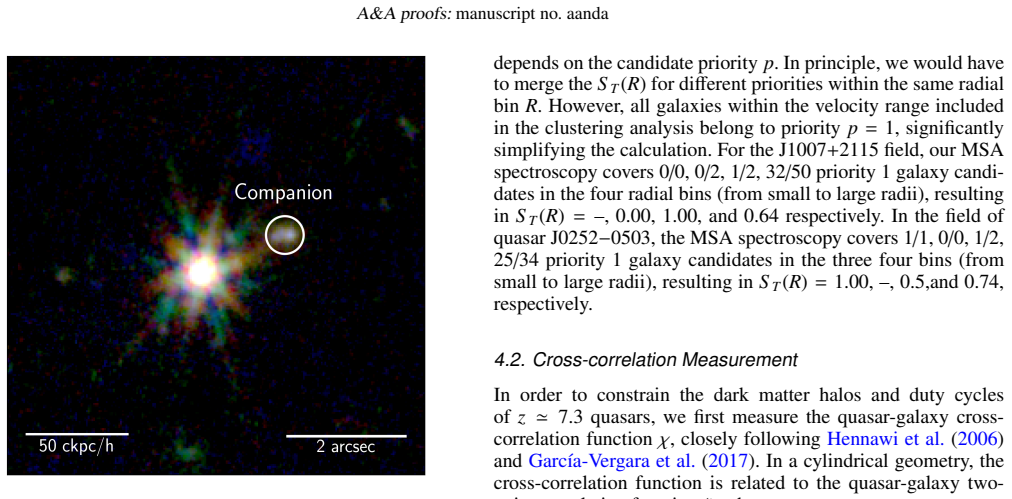
- One galaxy lies only 7 pkpc and 360 km/s from its quasar, providing a candidate for an early quasar-galaxy merger.
Where Pith is reading between the lines
- If the lower halo mass persists in larger samples, models of early black-hole growth would need to accommodate supermassive black holes forming inside comparatively modest dark-matter structures.
- The close projected companion offers a direct laboratory for studying gas dynamics and star formation in the immediate vicinity of a z>7 quasar.
- Repeating the measurement across many more quasar sight-lines at z>7 would test whether the apparent decline in clustering strength continues or reverses at still higher redshift.
Load-bearing premise
Quasars and galaxies are assumed to trace the same underlying dark-matter density field so that the observed clustering amplitude can be mapped directly to halo mass.
What would settle it
A larger sample of z~7.3 quasars whose measured correlation length falls outside the reported 1-sigma range of 6 to 9.3 h^{-1} cMpc would falsify the current halo-mass inference.
Figures




read the original abstract
We present JWST observations of the environments surrounding two high-redshift quasars, J0252$-$0503 at $z = 7.0$ and J1007$+$2115 at $z = 7.5$, which enable the first constraints on quasar-galaxy clustering at $z \sim 7.3$. Galaxies in the vicinity of the quasars are selected through ground-based and JWST/NIRCam imaging and then spectroscopically confirmed with JWST/NIRSpec using the multi-shutter assembly (MSA). Over both fields, we identified 51 $z>5$ galaxies, of which eight are found within a $\Delta v_{\textrm{LOS}}=\pm1500 \rm{km} \rm{s}^{-1}$ line-of-sight velocity window from the quasars and another eight in the background. The galaxy J0252\_8713, located just $7\,\rm{pkpc}$ and $\Delta v_{\textrm{LOS}} \approx 360\,\rm{km}\,\rm{s}^{-1}$ from quasar J0252$-$0503, emerges as a compelling candidate for one of the most distant quasar-galaxy mergers. Combining the galaxy discoveries over the two fields, we measure the quasar-galaxy cross-correlation and obtain a correlation length of $r_0^{\rm{QG}}\approx7.6_{-1.6}^{+1.7}\,h^{-1}\,\rm{cMpc}$, based on a power-law model with a fixed slope of $\gamma_{\rm{QG}} = 2.0$. Under the assumption that quasars and galaxies trace the same underlying dark matter density fluctuations, we infer a minimum dark matter halo mass for $z\simeq7.3$ quasars of $\log_{10}(M_{\textrm{halo, min}}/\textrm{M}_{\odot})= 11.6_{-0.7}^{+0.6}$ in a halo model framework. Compared to measurements from EIGER at $\langle z \rangle = 6.25$ and ASPIRE at $\langle z \rangle = 6.7$ (where $\log_{10}(M_{\textrm{halo, min}}/\textrm{M}_{\odot}) \gtrsim 12.3$), our clustering results provide tentative evidence for a non-monotonic redshift evolution of quasar clustering properties. We further estimate a quasar duty cycle of $f_{\rm{duty}}\approx0.05\%$, consistent with constraints from quasar proximity zones and IGM damping wings. (abridged)
Editorial analysis
A structured set of objections, weighed in public.
Referee Report
Summary. The manuscript presents JWST/NIRCam imaging and NIRSpec spectroscopy of the environments around two quasars (J0252−0503 at z=7.0 and J1007+2115 at z=7.5). It identifies 51 z>5 galaxies across the two fields, of which eight lie within a Δv_LOS=±1500 km s^{-1} window of the quasars. Combining these, the authors measure the quasar-galaxy cross-correlation function, obtaining r_0^QG≈7.6_{-1.6}^{+1.7} h^{-1} cMpc under a fixed power-law slope γ_QG=2.0. Under the assumption that quasars and galaxies trace the same dark matter density fluctuations, they infer a minimum halo mass log_{10}(M_halo,min/M_⊙)=11.6_{-0.7}^{+0.6} via a halo model, compare to EIGER and ASPIRE results at lower redshift, and estimate a quasar duty cycle f_duty≈0.05%.
Significance. If the central measurement and inference hold, the work supplies the first direct quasar-galaxy clustering constraint at z≃7.3, extending the redshift baseline of EIGER and ASPIRE studies. The new JWST spectroscopic confirmations in these fields constitute a valuable addition to high-redshift environment data, and the reported duty cycle is noted as consistent with independent proximity-zone and IGM damping-wing constraints.
major comments (3)
- [Abstract] Abstract: The minimum-halo-mass result log_{10}(M_halo,min/M_⊙)=11.6 is obtained only after imposing the assumption that quasars and galaxies share identical linear bias (b_Q=b_G) when mapping the measured r_0^QG through the halo model. The data themselves do not constrain this equality; if b_Q>b_G (as expected for rarer quasar peaks), the inferred mass is biased low. This step is load-bearing for the non-monotonic evolution claim relative to EIGER (⟨z⟩=6.25) and ASPIRE (⟨z⟩=6.7).
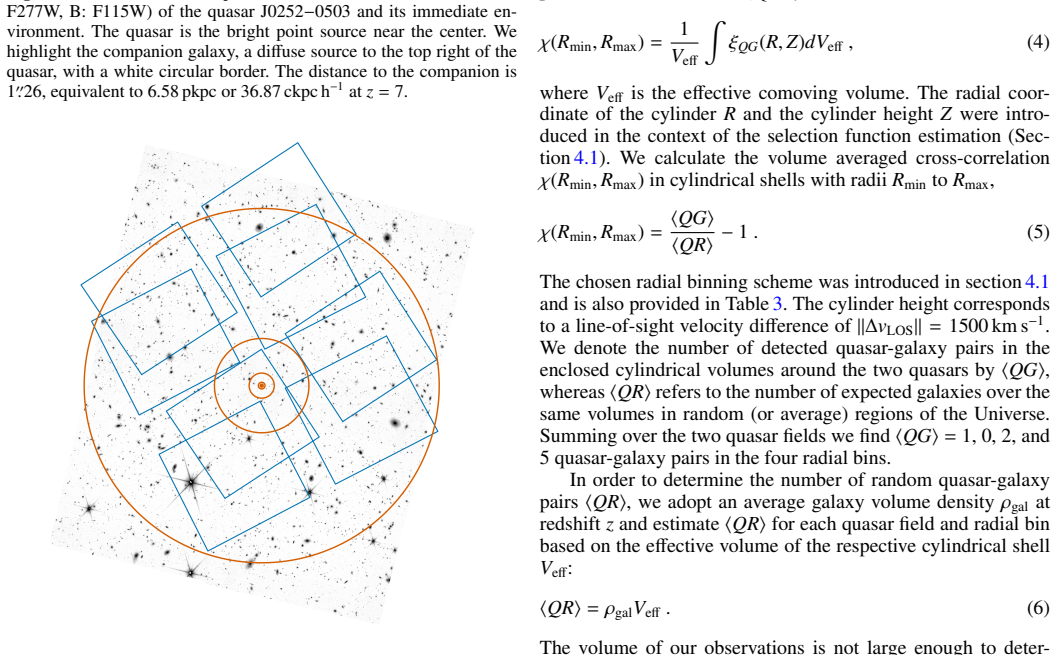
- [Clustering measurement] Clustering analysis: The cross-correlation length is derived from only eight associated galaxies (across two fields) inside the ±1500 km s^{-1} velocity window. The power-law index is fixed at γ_QG=2.0 without any variation or free fit shown; given the Poisson-limited sample, the quoted uncertainties do not yet incorporate the systematic effect of this choice on the central value or on the subsequent halo-mass conversion.
- [Halo model framework] Halo-model section: The conversion from r_0^QG to M_halo,min applies a standard external halo model at z≈7.3 without presenting robustness checks against the bias-equality assumption or against plausible variations in the model parameters (e.g., concentration-mass relation or scatter). This model dependence is not quantified within the presented data.
minor comments (2)
- [Abstract] Abstract ends with '(abridged)'; the full concluding sentence should be restored or the parenthetical removed.
- [Observations and galaxy selection] The selection and completeness of the 51 z>5 galaxies (ground-based plus NIRCam, then NIRSpec MSA confirmation) should be described with explicit criteria and any applied weights or corrections before the clustering measurement.
Simulated Author's Rebuttal
We thank the referee for their careful and constructive review of our manuscript. We address each of the major comments below and describe the changes we will implement. The revisions will clarify assumptions, quantify limitations, and strengthen the presentation of the results.
read point-by-point responses
-
Referee: [Abstract] Abstract: The minimum-halo-mass result log_{10}(M_halo,min/M_⊙)=11.6 is obtained only after imposing the assumption that quasars and galaxies share identical linear bias (b_Q=b_G) when mapping the measured r_0^QG through the halo model. The data themselves do not constrain this equality; if b_Q>b_G (as expected for rarer quasar peaks), the inferred mass is biased low. This step is load-bearing for the non-monotonic evolution claim relative to EIGER (⟨z⟩=6.25) and ASPIRE (⟨z⟩=6.7).
Authors: We agree that the halo-mass inference relies on the assumption b_Q = b_G, which is explicitly stated in the manuscript as 'under the assumption that quasars and galaxies trace the same underlying dark matter density fluctuations.' If quasars occupy rarer, higher-bias peaks, the inferred minimum halo mass would indeed be biased low. The non-monotonic evolution relative to EIGER and ASPIRE is already described as 'tentative evidence' in the text. In the revised manuscript we will (i) move this assumption into the abstract itself, (ii) add a short paragraph in the discussion quantifying how a higher b_Q would shift the mass and weaken the apparent non-monotonic trend, and (iii) retain the comparison to lower-redshift works while emphasizing the shared modeling assumptions across studies. revision: yes
-
Referee: [Clustering measurement] Clustering analysis: The cross-correlation length is derived from only eight associated galaxies (across two fields) inside the ±1500 km s^{-1} velocity window. The power-law index is fixed at γ_QG=2.0 without any variation or free fit shown; given the Poisson-limited sample, the quoted uncertainties do not yet incorporate the systematic effect of this choice on the central value or on the subsequent halo-mass conversion.
Authors: The sample of eight galaxies within the velocity window is indeed small and Poisson-limited; this is an inherent limitation of the current JWST data. Fixing γ_QG = 2.0 follows the convention used in EIGER and ASPIRE to avoid strong degeneracies with r_0 when the number of pairs is low. We acknowledge that the reported uncertainties are purely statistical and do not yet fold in the systematic uncertainty arising from this choice. In the revision we will (i) explicitly state the rationale for fixing the slope, (ii) add a sensitivity test showing r_0 and M_halo,min for γ_QG = 1.8 and 2.2, and (iii) include the resulting range as an additional systematic uncertainty in the final quoted values. revision: partial
-
Referee: [Halo model framework] Halo-model section: The conversion from r_0^QG to M_halo,min applies a standard external halo model at z≈7.3 without presenting robustness checks against the bias-equality assumption or against plausible variations in the model parameters (e.g., concentration-mass relation or scatter). This model dependence is not quantified within the presented data.
Authors: We adopted the same halo-model framework used by EIGER and ASPIRE to permit a direct comparison at different redshifts. We agree that additional robustness checks would be valuable. In the revised manuscript we will add a dedicated paragraph (or short subsection) that (i) tests the effect of relaxing b_Q = b_G by adopting a range of b_Q/b_G ratios motivated by lower-redshift quasar bias measurements, (ii) varies the concentration-mass relation within published uncertainties at z ≈ 7, and (iii) reports the resulting spread in log M_halo,min. While a full MCMC marginalization over all parameters is not feasible with only eight galaxies, these targeted checks will quantify the model dependence. revision: yes
Circularity Check
No significant circularity; derivation uses direct measurement plus external halo model
full rationale
The correlation length r_0^QG is measured directly from the spatial and velocity distribution of the eight associated galaxies identified in the two fields. The minimum halo mass is then obtained by applying a standard external halo model under the explicitly stated assumption that quasars and galaxies share the same linear bias. This step does not reduce to the paper's own inputs by construction, nor does it rely on self-citation chains, fitted parameters renamed as predictions, or ansatzes smuggled via prior work. The central results remain independently falsifiable with additional data or alternative bias assumptions.
Axiom & Free-Parameter Ledger
free parameters (1)
- fixed power-law slope γ_QG =
2.0
axioms (1)
- domain assumption quasars and galaxies trace the same underlying dark matter density fluctuations
Lean theorems connected to this paper
-
IndisputableMonolith/Foundation/RealityFromDistinction.leanreality_from_one_distinction unclear?
unclearRelation between the paper passage and the cited Recognition theorem.
Under the assumption that quasars and galaxies trace the same underlying dark matter density fluctuations, we infer a minimum dark matter halo mass for z≃7.3 quasars of log10(Mhalo,min/M⊙)=11.6
What do these tags mean?
- matches
- The paper's claim is directly supported by a theorem in the formal canon.
- supports
- The theorem supports part of the paper's argument, but the paper may add assumptions or extra steps.
- extends
- The paper goes beyond the formal theorem; the theorem is a base layer rather than the whole result.
- uses
- The paper appears to rely on the theorem as machinery.
- contradicts
- The paper's claim conflicts with a theorem or certificate in the canon.
- unclear
- Pith found a possible connection, but the passage is too broad, indirect, or ambiguous to say the theorem truly supports the claim.
Forward citations
Cited by 2 Pith papers
-
The Impact of Cosmic Variance and Satellites on JWST Clustering Measurements at Redshift around 6
Using 1000 mock realizations matched to the ASPIRE survey, the authors find cosmic variance increases clustering errors by ~3x over Poisson estimates and widens minimum halo mass uncertainties by 1.5-3x for z~6 quasar...
-
Probing Dark Matter Halos of High-redshift Quasars via Wide-Field Clustering
High-redshift quasars at 5<z<6.2 reside in dark matter halos of log(M_h/M_sun) ~12.1-12.5 with duty cycles of 0.0002-0.002 indicating obscured black hole growth.
Reference graph
Works this paper leans on
-
[1]
Ajiki, M., Taniguchi, Y ., Murayama, T., et al. 2006, PASJ, 58, 499
work page 2006
-
[2]
T., Jahnke, K., Onoue, M., et al
Andika, I. T., Jahnke, K., Onoue, M., et al. 2020, ApJ, 903, 34
work page 2020
-
[3]
Arita, J., Kashikawa, N., Matsuoka, Y ., et al. 2023, ApJ, 954, 210
work page 2023
-
[4]
2025, MNRAS, 536, 3677 Bañados, E., Momjian, E., Connor, T., et al
Arita, J., Kashikawa, N., Onoue, M., et al. 2025, MNRAS, 536, 3677 Bañados, E., Momjian, E., Connor, T., et al. 2025, Nature Astronomy, 9, 293 Bañados, E., Venemans, B., Walter, F., et al. 2013, ApJ, 773, 178 Bañados, E., Venemans, B. P., Mazzucchelli, C., et al. 2018, Nature, 553, 473
work page 2025
-
[5]
Barai, P., Gallerani, S., Pallottini, A., et al. 2018, MNRAS, 473, 4003
work page 2018
-
[6]
Begelman, M. C. 1979, MNRAS, 187, 237
work page 1979
-
[7]
S., Sijacki, D., Costa, T., Laporte, N., & Witten, C
Bennett, J. S., Sijacki, D., Costa, T., Laporte, N., & Witten, C. 2024, MNRAS, 527, 1033
work page 2024
-
[8]
2006, in Astronomical Society of the Pacific Conference Series, V ol
Bertin, E. 2006, in Astronomical Society of the Pacific Conference Series, V ol. 351, Astronomical Data Analysis Software and Systems XV , ed. C. Gabriel, C. Arviset, D. Ponz, & S. Enrique, 112
work page 2006
- [9]
-
[10]
2002, in Astronomical Society of the Pacific Conference Series, V ol
Bertin, E., Mellier, Y ., Radovich, M., et al. 2002, in Astronomical Society of the Pacific Conference Series, V ol. 281, Astronomical Data Analysis Software and Systems XI, ed. D. A. Bohlender, D. Durand, & T. H. Handley, 228
work page 2002
-
[11]
Bonaventura, N., Jakobsen, P., Ferruit, P., Arribas, S., & Giardino, G. 2023, A&A, 672, A40
work page 2023
-
[12]
Bouwens, R. J., Illingworth, G., Ellis, R. S., Oesch, P., & Stefanon, M. 2022, ApJ, 940, 55
work page 2022
- [13]
- [14]
-
[15]
Carnall, A. C., McLure, R. J., Dunlop, J. S., & Davé, R. 2018, MNRAS, 480, 4379
work page 2018
-
[16]
Chambers, K. C., Magnier, E. A., Metcalfe, N., et al. 2016, arXiv e-prints, arXiv:1612.05560
work page internal anchor Pith review Pith/arXiv arXiv 2016
-
[17]
Champagne, J. B., Decarli, R., Casey, C. M., et al. 2018, ApJ, 867, 153
work page 2018
-
[18]
Chen, H., Eilers, A.-C., Bosman, S. E. I., et al. 2022, ApJ, 931, 29
work page 2022
-
[19]
Circosta, C., Vignali, C., Gilli, R., et al. 2019, A&A, 623, A172
work page 2019
- [20]
-
[21]
Costa, T., Sijacki, D., Trenti, M., & Haehnelt, M. G. 2014, MNRAS, 439, 2146
work page 2014
- [22]
- [23]
-
[24]
2024b, MNRAS, 528, 898 D’Amato, Q., Gilli, R., Vignali, C., et al
Dalmasso, N., Trenti, M., & Leethochawalit, N. 2024b, MNRAS, 528, 898 D’Amato, Q., Gilli, R., Vignali, C., et al. 2020, A&A, 636, A37
work page 2020
- [25]
-
[26]
Devecchi, B. & V olonteri, M. 2009, ApJ, 694, 302 Di Matteo, T., Khandai, N., DeGraf, C., et al. 2012, ApJ, 745, L29 Di Matteo, T., Springel, V ., & Hernquist, L. 2005, Nature, 433, 604
work page 2009
-
[27]
Eftekharzadeh, S., Myers, A. D., White, M., et al. 2015, MNRAS, 453, 2779
work page 2015
-
[28]
Eilers, A.-C., Davies, F. B., Hennawi, J. F., et al. 2017, ApJ, 840, 24
work page 2017
-
[29]
Eilers, A.-C., Mackenzie, R., Pizzati, E., et al. 2024, ApJ, 974, 275
work page 2024
-
[30]
2025, arXiv e-prints, arXiv:2509.05417
Eilers, A.-C., Yue, M., Matthee, J., et al. 2025, arXiv e-prints, arXiv:2509.05417
-
[31]
Endsley, R., Stark, D. P., Lyu, J., et al. 2023, MNRAS, 520, 4609 Euclid Collaboration, Barnett, R., Warren, S. J., et al. 2019, A&A, 631, A85 Euclid Collaboration, Scaramella, R., Amiaux, J., et al. 2022, A&A, 662, A112
work page 2023
-
[32]
Fan, X., Bañados, E., & Simcoe, R. A. 2023, ARA&A, 61, 373
work page 2023
- [33]
-
[34]
Gardner, J. P., Mather, J. C., Abbott, R., et al. 2023, PASP, 135, 068001
work page 2023
- [35]
-
[36]
Giallongo, E., Ragazzoni, R., Grazian, A., et al. 2008, A&A, 482, 349
work page 2008
- [37]
- [38]
-
[39]
Goto, T., Utsumi, Y ., Kikuta, S., et al. 2017, MNRAS, 470, L117
work page 2017
-
[40]
Greene, J. E., Labbe, I., Goulding, A. D., et al. 2024, ApJ, 964, 39
work page 2024
-
[41]
Greene, J. E., Setton, D. J., Furtak, L. J., et al. 2025, arXiv e-prints, arXiv:2509.05434
- [42]
- [43]
-
[44]
Harikane, Y ., Zhang, Y ., Nakajima, K., et al. 2023, ApJ, 959, 39
work page 2023
- [45]
- [46]
- [47]
- [48]
- [49]
- [50]
-
[51]
Kashino, D., Lilly, S. J., Matthee, J., et al. 2023, ApJ, 950, 66
work page 2023
-
[52]
Khandai, N., Di Matteo, T., Croft, R., et al. 2015, MNRAS, 450, 1349
work page 2015
- [53]
-
[54]
Kocevski, D. D., Finkelstein, S. L., Barro, G., et al. 2025, ApJ, 986, 126
work page 2025
-
[55]
D., Onoue, M., Inayoshi, K., et al
Kocevski, D. D., Onoue, M., Inayoshi, K., et al. 2023, ApJ, 954, L4
work page 2023
- [56]
-
[57]
Kron, R. G. 1980, ApJS, 43, 305
work page 1980
- [58]
-
[59]
Laurent, P., Eftekharzadeh, S., Le Goff, J.-M., et al. 2017, J. Cosmology As- tropart. Phys., 2017, 017
work page 2017
-
[60]
2025b, arXiv e-prints, arXiv:2505.02896, doi: 10.48550/arXiv.2505.02896
Lin, X., Fan, X., Sun, F., et al. 2025, arXiv e-prints, arXiv:2505.02896
-
[61]
Lupi, A., V olonteri, M., Decarli, R., Bovino, S., & Silk, J. 2022, MNRAS, 510, 5760
work page 2022
- [62]
-
[63]
Maiolino, R., Scholtz, J., Curtis-Lake, E., et al. 2024, A&A, 691, A145
work page 2024
-
[64]
2004, in Coevolution of Black Holes and Galaxies, ed
Martini, P. 2004, in Coevolution of Black Holes and Galaxies, ed. L. C. Ho, 169
work page 2004
- [65]
-
[66]
Matsuoka, Y ., Iwasawa, K., Onoue, M., et al. 2022, ApJS, 259, 18
work page 2022
-
[67]
2025a, arXiv e-prints, arXiv:2508.21229
Matsuoka, Y ., Iwasawa, K., Onoue, M., et al. 2025a, arXiv e-prints, arXiv:2508.21229
-
[68]
2025b, arXiv e-prints, arXiv:2505.04825
Matsuoka, Y ., Onoue, M., Iwasawa, K., et al. 2025b, arXiv e-prints, arXiv:2505.04825
-
[69]
Matsuoka, Y ., Onoue, M., Iwasawa, K., et al. 2023, ApJ, 949, L42
work page 2023
-
[70]
Matsuoka, Y ., Onoue, M., Kashikawa, N., et al. 2016, ApJ, 828, 26
work page 2016
-
[71]
Matsuoka, Y ., Strauss, M. A., Kashikawa, N., et al. 2018, ApJ, 869, 150
work page 2018
- [72]
-
[73]
Matthee, J., Naidu, R. P., Brammer, G., et al. 2024, ApJ, 963, 129
work page 2024
-
[74]
Mazzucchelli, C., Bañados, E., Decarli, R., et al. 2017, ApJ, 834, 83
work page 2017
-
[75]
McCarthy, J. K., Cohen, J. G., Butcher, B., et al. 1998, in Society of Photo- Optical Instrumentation Engineers (SPIE) Conference Series, V ol. 3355, Op- tical Astronomical Instrumentation, ed. S. D’Odorico, 81–92
work page 1998
-
[76]
A., Decarli, R., Walter, F., et al
Meyer, R. A., Decarli, R., Walter, F., et al. 2022, ApJ, 927, 141
work page 2022
- [77]
-
[78]
Miller, T. B., Chapman, S. C., Hayward, C. C., et al. 2020, ApJ, 889, 98
work page 2020
-
[79]
Morey, K. A., Eilers, A.-C., Davies, F. B., Hennawi, J. F., & Simcoe, R. A. 2021, ApJ, 921, 88
work page 2021
- [80]
discussion (0)
Sign in with ORCID, Apple, or X to comment. Anyone can read and Pith papers without signing in.