Recognition: 2 theorem links
· Lean TheoremProbing The Dark Matter Halo of High-redshift Quasar from Wide-Field Clustering Analysis
Pith reviewed 2026-05-16 07:49 UTC · model grok-4.3
The pith
High-redshift quasars at z>5 reside in dark matter halos of roughly 10^12 solar masses, with duty cycles low enough to imply most black hole growth is obscured.
A machine-rendered reading of the paper's core claim, the machinery that carries it, and where it could break.
Core claim
The dark matter halo mass of quasars estimated from the projected auto correlation function is log(M_h/M_⊙)=12.13 ± 0.07 (12.45 ± 0.14), with the bias parameter b of 14.80 ± 0.84 (24.18 ± 3.11) for the redshift interval of 5.0 ≤ z <5.6 (5.6 ≤ z <6.2). Moreover, the duty cycle of those quasars is 0.0002 ± 0.0001 (0.0021^{+0.0049}_{-0.0014}) for the same intervals, well aligning with the f_duty - M_halo scaling relation. These comparably small duty cycle estimates might indicate that a significant fraction of supermassive black hole growth occurs in an obscured phase.
What carries the argument
The probability-weighted projected auto-correlation function of the quasar sample, which converts the measured clustering amplitude into a linear bias parameter and then into dark matter halo mass through standard cosmological models.
If this is right
- Quasars in the 5.0-5.6 redshift bin occupy halos of typical mass 10^12.13 solar masses with bias 14.80.
- Quasars in the 5.6-6.2 redshift bin occupy halos of typical mass 10^12.45 solar masses with bias 24.18.
- Duty cycles fall to 0.0002 and 0.0021 in the two redshift bins and follow the known f_duty-M_halo relation.
- A substantial fraction of supermassive black hole growth at these redshifts must occur in an obscured phase.
Where Pith is reading between the lines
- The measured clustering amplitude could be used to forecast the surface density of still-hidden quasars at the same redshifts.
- Such large halo masses at z>5 would require early structure-formation models to assemble 10^12 solar mass halos efficiently.
- X-ray or infrared surveys sensitive to obscured sources could directly test whether the inferred hidden growth phase is real.
Load-bearing premise
The machine-learning-selected photometric candidates are sufficiently pure that contamination does not distort the clustering signal, and the halo bias model calibrated at lower redshifts applies unchanged at z>5.
What would settle it
A clustering measurement performed on only the spectroscopically confirmed quasars, or an independent halo-mass estimate from weak lensing, that returns a mass differing by more than the quoted uncertainties.
Figures


read the original abstract
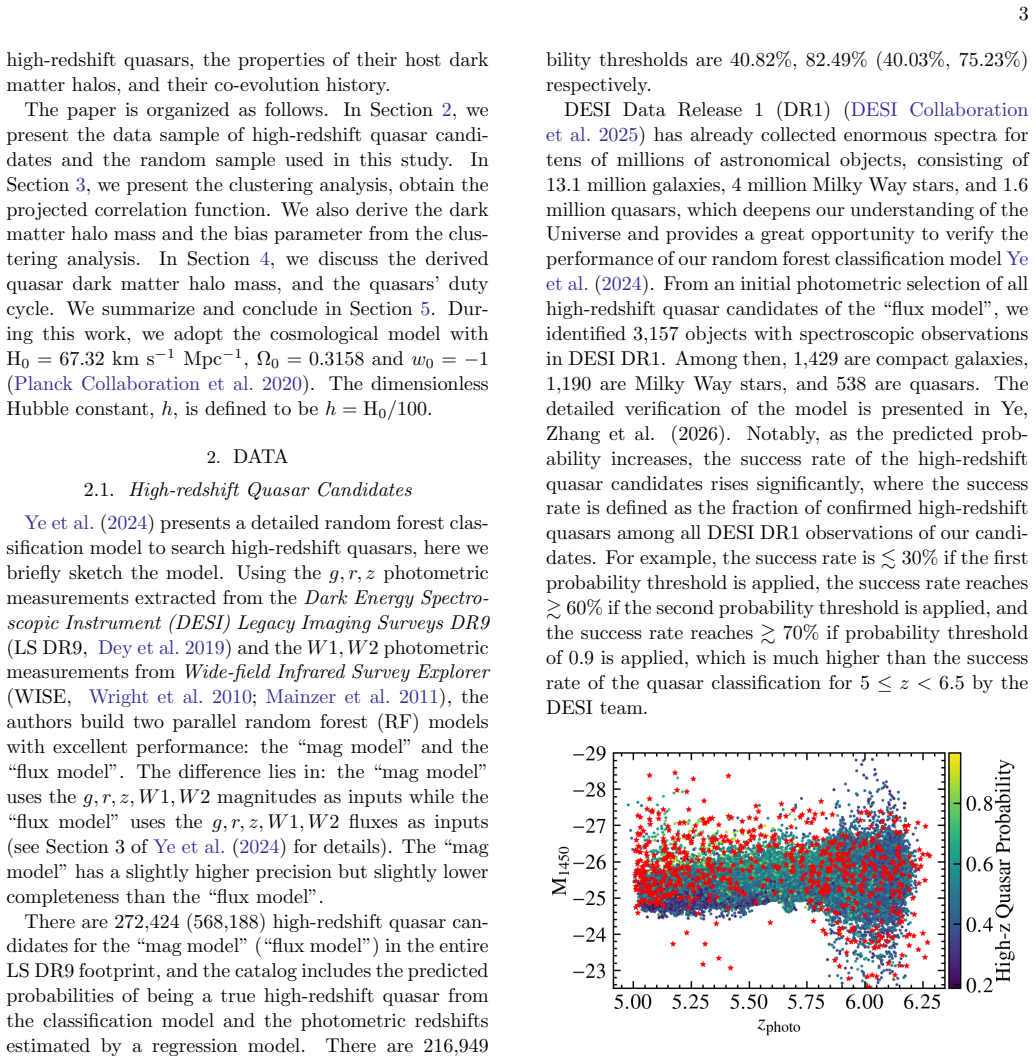
High-redshift quasars have been an excellent tracer to study the astrophysics and cosmology at early Universe. Using 577 spectroscopically confirmed high-redshift quasars and 1,796 highly reliable photometric quasar candidates (all with $5.0 \leq z < 6.2$, median $M_{1450} \sim -25.9$) selected via machine learning, we perform wide-field clustering analyses to investigate the large-scale environment of these objects. We construct the projected auto correlation function of those high-redshift quasars that is weighted by its predicted probability of being a true high-redshift quasar, from which we derive the bias parameter and the typical dark matter halo mass of those quasars. The dark matter halo mass of quasars estimated from the projected auto correlation function is $\log(M_h/M_{\odot})=12.13 \pm 0.07$ ($12.45 \pm 0.14$), with the bias parameter $b$ of $14.80 \pm 0.84 $ ($24.18 \pm 3.11$) for the redshift interval of $5.0 \leq z <5.6$ ($5.6 \leq z <6.2$). Moreover, we estimate the duty cycle of those quasars, which is $0.0002 \pm 0.0001$ ($0.0021^{+0.0049}_{-0.0014}$) for the redshift interval of $5.0 \leq z <5.6$ ($5.6 \leq z <6.2$), well aligning with the $f_{\rm duty} - M_{\rm halo}$ scaling relation. These comparably small duty cycle estimates might indicate that a significant fraction of supermassive black hole growth occurs in an obscured phase.
Editorial analysis