Structural modulation, physical properties, and electronic band structure of the kagome metal UCr₆Ge₆
Pith reviewed 2026-05-17 23:54 UTC · model grok-4.3
The pith
UCr6Ge6 shows isotropic magnetic behavior from its uranium 5f electrons unlike the localized moments seen in other uranium 166 compounds.
A machine-rendered reading of the paper's core claim, the machinery that carries it, and where it could break.
Core claim
UCr6Ge6 crystallizes in a monoclinically distorted structure with a unique real-space modulation and hosts kagome flatbands near the Fermi level. Its small isotropic magnetization and featureless resistivity indicate that the uranium 5f electrons are itinerant and produce Pauli paramagnetism. ARPES spectra show 5f spectral weight at the Fermi level along with a flatband from the chromium kagome lattice. These properties stand in contrast to the localized 5f behavior observed in other uranium 166 compounds.
What carries the argument
The intercalation of uranium into the chromium-germanium kagome lattice, realized through a monoclinic distortion approximated by a 3×1×2 supercell, which positions flatbands near the Fermi level and enables itinerant 5f character.
If this is right
- The magnetic ground state across the RM6X6 family becomes highly tunable by substituting different f-block elements.
- Kagome flatbands can be positioned at the Fermi level in 5f members to promote emergent phenomena from f-d electron interactions.
- Moderately enhanced electronic heat capacity arises from the kagome flatbands as captured by the Sommerfeld coefficient of 86.5 mJ mol^{-1} K^{-2}.
- Single-crystal studies of additional 5f 166 compounds can map the crossover between itinerant and localized regimes.
Where Pith is reading between the lines
- The unique structural modulation may split or shift the kagome flatbands in ways not present in undistorted 166 members.
- Transport and magnetic measurements under pressure or doping could drive transitions between itinerant and localized 5f states.
- Comparison with isostructural 4f analogs would isolate the role of 5f hybridization in setting the observed isotropy.
Load-bearing premise
The small isotropic magnetization, featureless resistivity, and ARPES signals reflect purely itinerant 5f electrons without significant localized moments, impurities, or surface effects.
What would settle it
Observation of anisotropic magnetic susceptibility or clear signatures of localized moments in bulk thermodynamic or spectroscopic measurements on UCr6Ge6.
Figures




read the original abstract
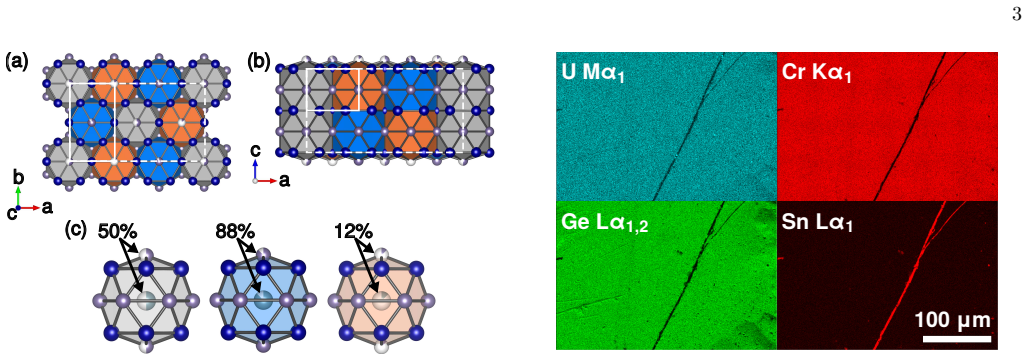
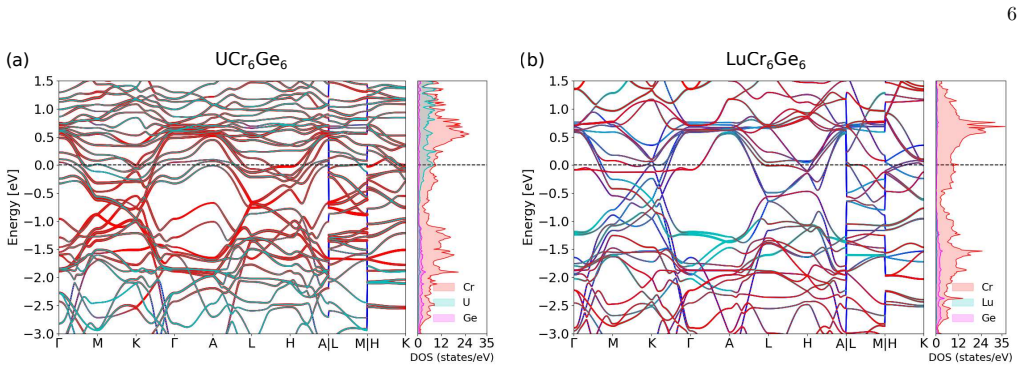
The chemical flexibility of the $RM_6X_6$ stoichiometry, where an $f$-block element is intercalated in the CoSn structure type, allows for the tuning of flatbands associated with kagome lattices to the Fermi level and for emergent phenomena due to interactions between the $f$- and $d$-electron lattices. Yet, 5$f$ members of the ``166" compounds are underrepresented compared with 4$f$ members. Here, we report single-crystal growth of UCr$_6$Ge$_6$, which crystallizes in a monoclinically distorted Y$_{0.5}$Co$_3$Ge$_3$-type structure. The real-space character of the modulation, which is unique within the $RM_6X_6$ family, is approximated by a 3$\times$1$\times$2 supercell of the average monoclinic cell. The compound has kagome-lattice flatbands near the Fermi level and a moderately enhanced electronic heat capacity, as evidenced by its low-temperature Sommerfeld coefficient ($\gamma=86.5$~mJ~mol$^{-1}$~K$^{-2}$) paired with band structure calculations. The small, isotropic magnetization and featureless resistivity of UCr$_6$Ge$_6$ suggest itinerant uranium 5$f$ electrons and Pauli paramagnetism. Angle-resolved photoemission spectroscopy results provide evidence for uranium 5$f$ weight at the Fermi level and for a flatband near the Fermi level associated with the chromium $3d$ kagome lattice. The isotropic magnetic behavior of the uranium 5$f$ electrons starkly contrasts with localized behavior in other uranium 166 compounds, highlighting the high tunability of the magnetic ground state across the material family.
Editorial analysis
A structured set of objections, weighed in public.
Referee Report
Summary. The manuscript reports single-crystal growth of UCr₆Ge₆, which adopts a monoclinically distorted Y₀.₅Co₃Ge₃-type structure approximated by a 3×1×2 supercell. It presents kagome-lattice flatbands near the Fermi level, a Sommerfeld coefficient γ = 86.5 mJ mol⁻¹ K⁻² from specific-heat measurements paired with band-structure calculations, small isotropic magnetization and featureless resistivity interpreted as evidence for itinerant uranium 5f electrons and Pauli paramagnetism, and ARPES data showing 5f spectral weight at E_F together with a Cr 3d flatband. The central claim is that this itinerant 5f behavior starkly contrasts with localized moments in other U-166 compounds, demonstrating high tunability of the magnetic ground state across the RM₆X₆ family.
Significance. If the itinerant interpretation of the 5f electrons is substantiated, the work is significant for expanding the limited set of 5f members in the kagome 166 family and for illustrating chemical tunability between itinerant and localized regimes. The multi-probe approach (structural refinement, thermodynamics, transport, and ARPES) with independent grounding in experimental observables is a strength; the reported γ value and flatband observation provide concrete, falsifiable anchors for the electronic-structure claims.
major comments (1)
- [Physical properties / magnetization and resistivity data] The central claim of stark contrast and resulting tunability rests on the interpretation that small isotropic magnetization and featureless resistivity demonstrate purely itinerant 5f electrons with Pauli paramagnetism (abstract and physical-properties section). This is undermined if the susceptibility data contain even a modest low-T upturn, Curie-Weiss tail, or unquantified impurity contribution, as these would allow weak localized moments and weaken the exclusion of localized behavior seen in other U-166 compounds. Explicit demonstration that χ(T) is strictly temperature-independent down to base temperature, with error bars and impurity analysis, is required.
minor comments (2)
- [Structural characterization] The real-space description of the structural modulation and its approximation by the 3×1×2 supercell would benefit from a clearer statement of the relationship between the average monoclinic cell and the supercell lattice parameters.
- [ARPES measurements] ARPES figures would be improved by stating the photon energy, polarization, and sample temperature used for the reported spectra.
Simulated Author's Rebuttal
We thank the referee for their careful reading of the manuscript and for the constructive comment on the magnetic data interpretation. We address the point below and have revised the manuscript to incorporate additional analysis as requested.
read point-by-point responses
-
Referee: [Physical properties / magnetization and resistivity data] The central claim of stark contrast and resulting tunability rests on the interpretation that small isotropic magnetization and featureless resistivity demonstrate purely itinerant 5f electrons with Pauli paramagnetism (abstract and physical-properties section). This is undermined if the susceptibility data contain even a modest low-T upturn, Curie-Weiss tail, or unquantified impurity contribution, as these would allow weak localized moments and weaken the exclusion of localized behavior seen in other U-166 compounds. Explicit demonstration that χ(T) is strictly temperature-independent down to base temperature, with error bars and impurity analysis, is required.
Authors: We thank the referee for highlighting the need for a more quantitative presentation of the susceptibility data. Our measurements show a small, isotropic magnetization with no discernible low-temperature upturn or Curie-Weiss tail down to the base temperature, consistent with Pauli paramagnetism from itinerant 5f electrons. In the revised manuscript we have added error bars to the χ(T) plot and included an explicit impurity analysis: a fit of the low-T susceptibility to a temperature-independent Pauli term plus a possible Curie-Weiss impurity contribution yields an impurity moment fraction below the experimental detection limit (<<0.1 % of a localized U moment). This additional quantification supports the original interpretation while making the exclusion of significant localized behavior more rigorous. The text in the abstract and physical-properties section has been updated to reference this analysis. revision: yes
Circularity Check
No significant circularity detected; claims grounded in independent experimental and computational observables
full rationale
The paper's central claims derive from direct measurements (single-crystal magnetization showing small isotropic response, featureless resistivity, Sommerfeld coefficient from heat capacity, ARPES spectra) and DFT band-structure calculations. These inputs are not redefined in terms of the conclusions, nor are any parameters fitted to a subset and then relabeled as predictions. The contrast with other U-166 compounds is drawn from external literature rather than self-citation chains or uniqueness theorems. No ansatz is smuggled via prior work, and no renaming of known results occurs. The derivation chain from raw data to the interpretation of itinerant 5f electrons and tunability remains self-contained against external benchmarks.
Axiom & Free-Parameter Ledger
axioms (2)
- standard math Standard assumptions of single-crystal X-ray diffraction for determining average structure and modulation
- domain assumption Validity of DFT band-structure calculations for identifying flatbands and orbital character
Lean theorems connected to this paper
-
IndisputableMonolith/Cost/FunctionalEquation.leanwashburn_uniqueness_aczel unclear?
unclearRelation between the paper passage and the cited Recognition theorem.
The small, isotropic magnetization and featureless resistivity of UCr₆Ge₆ suggest itinerant uranium 5f electrons and Pauli paramagnetism.
-
IndisputableMonolith/Foundation/RealityFromDistinction.leanreality_from_one_distinction unclear?
unclearRelation between the paper passage and the cited Recognition theorem.
electronic band structure calculations... flatbands near the Fermi level
What do these tags mean?
- matches
- The paper's claim is directly supported by a theorem in the formal canon.
- supports
- The theorem supports part of the paper's argument, but the paper may add assumptions or extra steps.
- extends
- The paper goes beyond the formal theorem; the theorem is a base layer rather than the whole result.
- uses
- The paper appears to rely on the theorem as machinery.
- contradicts
- The paper's claim conflicts with a theorem or certificate in the canon.
- unclear
- Pith found a possible connection, but the passage is too broad, indirect, or ambiguous to say the theorem truly supports the claim.
Forward citations
Cited by 1 Pith paper
-
Anomalous magnetotransport in a non-collinear correlated kagome ferromagnet MgMn6Sn6
MgMn6Sn6 is a room-temperature non-collinear kagome ferromagnet with substantial intrinsic anomalous Hall conductivity and enhanced electron correlations indicated by a large Sommerfeld coefficient.
Reference graph
Works this paper leans on
-
[1]
5(1) mJ mol − 1 K− 2 and β = 0
7≤ T 2≤ 60 K yields γ = 86 . 5(1) mJ mol − 1 K− 2 and β = 0 . 289(8) mJ mol − 1 K− 4. The large Sommer- feld coefficient of UCr 6Ge6 is comparable to that re- ported for LuFe 6Ge6, YbFe6Ge6, and Lu 1− xFe6Sn6 (γ = 87 − 90 mJ mol − 1 K− 2 [19–21]), though smaller than that of YbV 6Sn6 (γ ∼ 400 mJ mol − 1 K− 2 [23]) and YbMn6Sn6 (γ ∼ 144 mJ mol − 1 K− 2 [24])...
-
[2]
3(3) mJ mol − 1 K− 2 and θD = 458(9) K for LuCr 6Ge6. The Sommerfeld coefficient of LuCr 6Ge6 is similar to that of YCr 6Ge6 (66 mJ mol − 1 K− 2), which has electronic bands near EF associated with the chromium kagome 5 0 50 100 150 200 250 T (K) 0.00 0.25 0.50 0.75 1.00 1.25 1.50 1.75 2.00Cp/T (J mol 1 f. u. K 2) 0 30 60 T2 (K2) 0.08 0.09 0.10 0.11Cp/T Cp/...
-
[3]
Quantum fluctuations in narrow band systems
and for several CoSn-structure compounds [67]. Fig- ure 7(b) shows the magnetoresistance (MR) up to 9 T for both current directions with a perpendicular applied magnetic field. The magnetoresistance was calculated using M R = ρ(H) − ρ(H = 0) ρ(H = 0) × 100%. As with the zero-field, temperature-dependent resistiv- ity, no transitions appear. The changes are ...
-
[4]
H. W. S. Arachchige, W. R. Meier, M. Marshall, T. Mat- suoka, R. Xue, M. A. McGuire, R. P. Hermann, H. Cao, and D. Mandrus, Charge density wave in kagome lat- 7 tice intermetallic ScV 6Sn6, Physical Review Letters 129, 216402 (2022)
work page 2022
- [5]
-
[6]
G. Pokharel, B. R. Ortiz, L. Kautzsch, S. J. Gomez Al- varado, K. Mallayya, G. Wu, E.-A. Kim, J. P. C. Ruff, S. Sarker, and S. D. Wilson, Frustrated charge order and cooperative distortions in ScV 6Sn6, Physical Review Ma- terials 7, 104201 (2023)
work page 2023
-
[7]
D. W. Kim, S. Liu, C. Wang, H. W. Nam, G. Pokharel, S. D. Wilson, J.-H. Cho, and S. J. Moon, Infrared probe of the charge density wave gap in ScV 6Sn6, Physical Re- view B 108, 205118 (2023)
work page 2023
-
[8]
W. R. Meier, R. P. Madhogaria, S. Mozaffari, M. Mar- shall, D. E. Graf, M. A. McGuire, H. W. S. Arachchige, C. L. Allen, J. Driver, H. Cao, et al. , Tiny Sc allows the chains to rattle: Impact of Lu and Y doping on the charge-density wave in ScV6Sn6, Journal of the American Chemical Society 145, 20943 (2023)
work page 2023
-
[9]
Y. Hu, J. Ma, Y. Li, Y. Jiang, D. J. Gawryluk, T. Hu, J. Teyssier, V. Multian, Z. Yin, S. Xu, et al., Phonon pro- moted charge density wave in topological kagome metal ScV6Sn6, Nature Communications 15, 1658 (2024)
work page 2024
-
[10]
C. Yi, X. Feng, N. Kumar, C. Felser, and C. Shekhar, Tuning charge density wave of kagome metal ScV 6Sn6, New Journal of Physics 26, 052001 (2024)
work page 2024
-
[11]
B. R. Ortiz, W. R. Meier, G. Pokharel, J. Chamorro, F. Yang, S. Mozaffari, A. Thaler, S. J. Gomez Alvarado, H. Zhang, D. S. Parker, et al. , Stability frontiers in the AM6X6 kagome metals: The LnNb 6Sn6 (Ln:Ce-Lu,Y) family and density-wave transition in LuNb 6Sn6, Journal of the American Chemical Society (2024)
work page 2024
-
[12]
W. R. Meier, D. E. Graf, B. R. Ortiz, S. Mozaffari, and D. Mandrus, Pressure suppresses the density wave order in kagome metal LuNb 6Sn6, Physical Review Materials 9, L082001 (2025)
work page 2025
-
[13]
D. M. Clatterbuck and K. A. Gschneidner Jr, Magnetic properties of RMn 6Sn6 (R=Tb, Ho, Er, Tm, Lu) single crystals, Journal of Magnetism and Magnetic Materials 207, 78 (1999)
work page 1999
- [14]
-
[15]
S. X. M. Riberolles, T. Han, T. J. Slade, J. M. Wilde, A. Sapkota, W. Tian, Q. Zhang, D. L. Abernathy, L. D. Sanjeewa, S. L. Bud’ko, P. C. Canfield, R. J. McQueeney, and B. G. Ueland, New insight into tuning magnetic phases of RMn6Sn6 kagome metals, npj Quantum Ma- terials 9, 42 (2024)
work page 2024
-
[16]
N. J. Ghimire, R. L. Dally, L. Poudel, D. C. Jones, D. Michel, N. T. Magar, M. Bleuel, M. A. McGuire, J. S. Jiang, J. F. Mitchell, J. W. Lynn, and I. I. Mazin, Competing magnetic phases and fluctuation-driven scalar spin chirality in the kagome metal YMn 6Sn6, Science Ad- vances 6, eabe2680 (2020)
work page 2020
-
[17]
N. L, T. V. Trevisan, and R. J. McQueeney, High-field magnetic phase diagrams of the RMn6Sn6 (R= Gd–Tm) kagome metals, Physical Review B 111, 054410 (2025)
work page 2025
- [18]
-
[19]
Z. W. Riedel, W. Simeth, C. S. Kengle, S. M. Thomas, J. D. Thompson, A. O. Scheie, F. Ronning, C. Lane, J.- X. Zhu, P. F. S. Rosa, and E. D. Bauer, Magnetic order and physical properties of the kagome metal UNb 6Sn6, Physical Review Materials 9, 084401 (2025)
work page 2025
-
[20]
G. Pokharel, S. M. L. Teicher, B. R. Ortiz, P. M. Sarte, G. Wu, S. Peng, J. He, R. Seshadri, and S. D. Wilson, Electronic properties of the topological kagome metals YV6Sn6 and GdV 6Sn6, Physical Review B 104, 235139 (2021)
work page 2021
- [21]
-
[22]
M. A. Avila, T. Takabatake, Y. Takahashi, S. L. Bud’ko, and P. C. Canfield, Direct observation of Fe spin reorien- tation in single-crystalline YbFe 6Ge6, Journal of Physics: Condensed Matter 17, 6969 (2005)
work page 2005
-
[23]
M. Lyu, Y. Liu, S. Zhang, J. Liu, J. Yang, Y. Wang, Y. Feng, X. Dong, B. Wang, H. Wei, and E. Liu, Anoma- lous Hall effect and electronic correlation in a spin- reoriented kagome antiferromagnet LuFe 6Sn6, Chinese Physics B 33, 107507 (2024)
work page 2024
-
[24]
C. Shi, Z. Lin, Q. Liu, J. Lyu, X. Xu, B. Kang, J.-H. Yang, Y. Liu, J. Zhang, S. Cao, and J.-K. Bao, Weak low-temperature ferromagnetism and linear magnetore- sistance in Lu 0.75Fe6Sn6 with a disordered HfFe 6Ge6- type structure, Journal of Magnetism and Magnetic Ma- terials 615, 172793 (2025)
work page 2025
-
[25]
G. Pokharel, B. Ortiz, J. Chamorro, P. Sarte, L. Kautzsch, G. Wu, J. Ruff, and S. D. Wilson, Highly anisotropic magnetism in the vanadium-based kagome metal TbV 6Sn6, Physical Review Materials 6, 104202 (2022)
work page 2022
-
[26]
K. Guo, J. Ye, S. Guan, and S. Jia, Triangular Kondo lattice in YbV 6Sn6 and its quantum critical behavior in a magnetic field, Physical Review B 107, 205151 (2023)
work page 2023
-
[27]
R. Lou, M. Mende, R. Vocaturo, H. Zhang, Q. Dong, M. Li, P. Ding, E. Cheng, Z. Liao, Y. Zhang, J. Lin, R. Firouzmandi, V. Kocsis, L. T. Corredor, Y. Prots, O. Suvorov, A. Jana, J. Fujii, I. Vobornik, O. Janson, W. Zhu, J. van den Brink, C. Krellner, M. Pan, B. Wang, T. Xia, J. Cheng, S. Wang, C. Felser, B. B¨ uchner, S. Borisenko, R. Yu, D. V. Vyalikh, an...
work page 2025
-
[28]
W. Buchholz and H.-U. Schuster, Intermetallische phasen mit B35- ¨Uberstruktur und verwandtschaftsbeziehung zu LiFe6Ge6, Zeitschrift f¨ ur anorganische und allgemeine Chemie 482, 40 (1981)
work page 1981
-
[29]
A. P. Gon¸ calves, J. C. Waerenborgh, G. Bonfait, A. Amaro, M. M. Godinho, M. Almeida, and J. C. Spir- let, UFe6Ge6: A new ternary magnetic compound, Jour- nal of Alloys and Compounds 204, 59 (1994)
work page 1994
-
[30]
J. C. Waerenborgh, L. C. J. Pereira, A. P. Gon¸ calves, and H. No¨ el, Crystal structure, 57Fe M¨ ossbauer spec- 8 troscopy and magnetization of U xFe6Sn6 (0 ≤ x≤ 0.6), In- termetallics 13, 490 (2005)
work page 2005
-
[31]
S. M. Thomas, C. S. Kengle, W. Simeth, C.-y. Lim, Z. W. Riedel, K. Allen, A. Schmidt, M. Ruf, S. Gim, J. D. Thompson, F. Ronning, A. O. Scheie, C. Lane, J. D. Denlinger, S. Blanco-Canosa, J.-X. Zhu, E. D. Bauer, and P. F. S. Rosa, Unusual 5 f magnetism in new kagome material UV 6Sn6, npj quantum materials 10, 66 (2025)
work page 2025
-
[32]
M. Amano Patino, S. Raymond, G. Knebel, P. Le Berre, S. Savvin, E. Pachoud, E. Ressouche, J. C. Fettinger, O. Leynaud, J. Pecaut, P. Klavins, K. Hasselbach, J.- P. Brison, G. Lapertot, and V. Taufour, Incommensu- rate and commensurate antiferromagnetic orders in the kagome compound UV 6Sn6, Physical Review B 111, 174432 (2025)
work page 2025
-
[33]
Y. Xiao, Y. Chen, H. Ni, Y. Li, Z. Wen, Y. Cui, Y. Zhang, S. Liu, C. Wang, R. Zhong, et al. , Preparation, crystal structure, and properties of the kagome metal ThV 6Sn6, Inorganic Chemistry 63, 23288 (2024)
work page 2024
-
[34]
F. M. Mulder, R. C. Thiel, J. H. V. J. Brabers, F. R. de Boer, and K. H. J. Buschow, 155Gd M¨ ossbauer effect and magnetic properties of GdMn 6− xCrxGe6, Journal of Alloys and Compounds 198, L1 (1993)
work page 1993
-
[35]
P. Schobinger-Papamantellos, J. Rodr ´ ıguez-Carvajal, and K. H. J. Buschow, Atomic disorder and canted ferri- magnetism in the TbCr 6Ge6 compound. a neutron study, Journal of Alloys and Compounds 255, 67 (1997)
work page 1997
-
[36]
P. Schobinger-Papamantellos, J. Rodr ´ ıguez-Carvajal, and K. H. J. Buschow, Ferrimagnetism and disorder in the RCr 6Ge6 compounds (R=Dy, Ho, Er, Y): A neutron study, Journal of Alloys and Compounds 256, 92 (1997)
work page 1997
- [37]
-
[38]
X. Yang, Q. Zeng, M. He, X. Xu, H. Du, and Z. Qu, Crys- tal growth, magnetic and electrical transport properties of the kagome magnet RCr6Ge6 (R= Gd–Tm), Chinese Physics B 33, 077501 (2024)
work page 2024
-
[39]
V. V. Romaka, L. Romaka, M. Konyk, L. T. Corre- dor, K. Srowik, B. Kuzhel, Y. Stadnyk, and Y. Yatskiv, Structure, bonding, and properties of RCr6Ge6 inter- metallics ( R=Gd–Lu), Journal of Solid State Chemistry 338, 124874 (2024)
work page 2024
-
[40]
H. Lee, C. Lyi, T. Lee, H. Na, J. Kim, S. Lee, Y. Kim, A. Rajapitamahuni, A. K. Kundu, E. Vescovo, B.-G. Park, C. Kim, C. H. Ahn, F. J. Walker, J. Oh, B. Jang, Y. Kim, B. Sohn, and T. Park, Coexisting kagome and heavy fermion flat bands in YbCr 6Ge6 (2025), arXiv:2509.04902 [cond-mat.str-el]
-
[41]
Bruker AXS SE, SAINT V8.42 (2025)
work page 2025
- [42]
-
[43]
G. M. Sheldrick, SHELXT–integrated space-group and crystal-structure determination, Acta Crystallographica Section A 71, 3 (2015)
work page 2015
-
[44]
G. M. Sheldrick, Crystal structure refinement with SHELXL, Acta Crystallographica Section C 71, 3 (2015)
work page 2015
-
[45]
C. R. Groom, I. J. Bruno, M. P. Lightfoot, and S. C. Ward, The Cambridge structural database, Structural Science 72, 171 (2016)
work page 2016
- [46]
-
[47]
G. Kresse and D. Joubert, From ultrasoft pseudopoten- tials to the projector augmented-wave method, Physical Review B 59, 1758 (1999)
work page 1999
-
[48]
G. Kresse and J. Hafner, abinitio molecular dynamics for open-shell transition metals, Physical Review B 48, 13115 (1993)
work page 1993
-
[49]
G. Kresse and J. Furthm¨ uller, Efficient iterative schemes for abinitio total-energy calculations using a plane-wave basis set, Physical Review B 54, 11169 (1996)
work page 1996
-
[50]
J. P. Perdew, K. Burke, and M. Ernzerhof, Generalized gradient approximation made simple, Physical Review Letters 77, 3865 (1996)
work page 1996
-
[51]
S. L. Dudarev, G. A. Botton, S. Y. Savrasov, C. J. Humphreys, and A. P. Sutton, Electron-energy-loss spec- tra and the structural stability of nickel oxide: An LSDA+U study, Physical Review B 57, 1505 (1998)
work page 1998
-
[52]
D. C. Fredrickson, S. Lidin, G. Venturini, B. Malaman, and J. Christensen, Origins of superstructure ordering and incommensurability in stuffed CoSn-type phases, Journal of the American Chemical Society 130, 8195 (2008)
work page 2008
-
[53]
G. Venturini, Crystallographic and magnetic properties of TbFe 6Ge6− xGax compounds (0.5 ≤ x≤ 3.5), Journal of alloys and compounds 329, 8 (2001)
work page 2001
-
[54]
G. Venturini, Filling the CoSn host-cell: the HfFe 6Ge6- type and the related structures, Zeitschrift f¨ ur Kristallographie-Crystalline Materials 221, 511 (2006)
work page 2006
-
[55]
S. Ivantchev, E. Kroumova, G. Madariaga, J. M. P´ erez- Mato, and M. I. Aroyo, SUBGROUPGRAPH: a com- puter program for analysis of group–subgroup relations between space groups, Applied Crystallography 33, 1190 (2000)
work page 2000
-
[56]
B. Malaman, G. Venturini, B. C. El Idrissi, and E. Ressouche, Magnetic properties of NdMn 6Sn6 and SmMn6Sn6 compounds from susceptibility measurements and neutron diffraction study, Journal of Alloys and Compounds 252, 41 (1997)
work page 1997
-
[57]
J. H. V. J. Brabers, K. H. J. Buschow, and F. R. De Boer, Magnetic properties of RCr 6Ge6 compounds, Journal of Alloys and Compounds 205, 77 (1994)
work page 1994
-
[58]
V. L. Zagryazhskii, P. V. Gel’d, and A. K. Shtol’ts, Magnetic susceptibility and electrical conductivity of the highest chromium germanide, Soviet Physics Journal 11, 23 (1968)
work page 1968
-
[59]
M. Kolenda, J. Stoch, and A. Szytu/suppress la, Esca and magnetic studies of the Cr-Ge system, Journal of Magnetism and Magnetic Materials 20, 99 (1980)
work page 1980
-
[60]
T. Sato and M. Sakata, Magnetic and electrical proper- ties of CrGe and Cr 11Ge8, Journal of the Physical Society of Japan 52, 1807 (1983)
work page 1983
-
[61]
T. Sato, A. Jono, E. Ohta, and M. Sakata, Electrical resistivity and magnetic susceptibility in the amorphous CrxGe1− x alloy system, Physical Review B 38, 11741 (1988)
work page 1988
- [62]
- [63]
-
[64]
N. J. Ghimire, M. A. McGuire, D. S. Parker, B. C. Sales, J.-Q. Yan, V. Keppens, M. Koehler, R. M. Lat- ture, and D. Mandrus, Complex itinerant ferromagnetism in noncentrosymmetric Cr 11Ge19, Physical Review B 85, 224405 (2012)
work page 2012
-
[65]
X. Ji, X. Zhou, S. Zhu, F. Ma, G. Li, and W. Wu, Small Seebeck in A15-type Cr 3Ge single crystals, Europhysics Letters (2025)
work page 2025
-
[66]
M. Venkatraman, J. P. Neumann, and D. E. Peterson, The Cr–U (Chromium–Uranium) system, Bulletin of Al- loy Phase Diagrams 6, 425 (1985)
work page 1985
-
[67]
C. Moussa, N. Brisset, G. Chajewski, M. Samsel-Czeka/suppress la, P. Boulet, H. No¨ el, M. Pasturel, A. Pikul, and O. Tougait, Overview of the U 3T Ge5 family with T = Ti, V, Cr, Mn, Zr, Nb, Mo, Hf, Ta and W: Nine new members, phase for- mation, stability, structural and physical properties and electronic structures, Journal of Solid State Chemistry 277, ...
work page 2019
-
[68]
T. Mazet and B. Malaman, Macroscopic magnetic prop- erties of the HfFe 6Ge6-type RFe6X6 (X= Ge or Sn) com- pounds involving a non-magnetic R metal, Journal of Al- loys and Compounds 325, 67 (2001)
work page 2001
-
[69]
Y. Hu, X. Wu, Y. Yang, S. Gao, N. C. Plumb, A. P. Schnyder, W. Xie, J. Ma, and M. Shi, Tunable topological Dirac surface states and van Hove singularities in kagome metal GdV 6Sn6, Science Advances 8, eadd2024 (2022)
work page 2022
-
[70]
W. R. Meier, M.-H. Du, S. Okamoto, N. Mohanta, A. F. May, M. A. McGuire, C. A. Bridges, G. D. Samolyuk, and B. C. Sales, Flat bands in the CoSn-type compounds, Physical Review B 102, 075148 (2020). Supplemental Material Z. W. Riedel, 1 C. S. Kengle, 1 A. Schmidt, 2 K. Allen, 1, 3 C. Lane, 1 Ying Wai Li, 1 Jian-Xin Zhu,1 J. D. Thompson, 1 F. Ronning, 1 S. ...
work page 2020
-
[71]
B. Malaman, G. Venturini, B. C. El Idrissi, and E. Ressouche , Magnetic properties of NdMn 6Sn6 and SmMn6Sn6 compounds from susceptibility measurements and neutron diffraction study, Journal of Alloys and Compounds 252, 41 (1997)
work page 1997
-
[72]
S. Ivantchev, E. Kroumova, G. Madariaga, J. M. P´ erez-Mato, and M. I. Aroyo, SUBGROUPGRAPH: a computer program for analysis of group–subgroup relations between space groups, A pplied Crystallography 33, 1190 (2000)
work page 2000
discussion (0)
Sign in with ORCID, Apple, or X to comment. Anyone can read and Pith papers without signing in.