Charge-dependent spectral softenings of primary cosmic-rays below the knee
Pith reviewed 2026-05-17 23:46 UTC · model grok-4.3
The pith
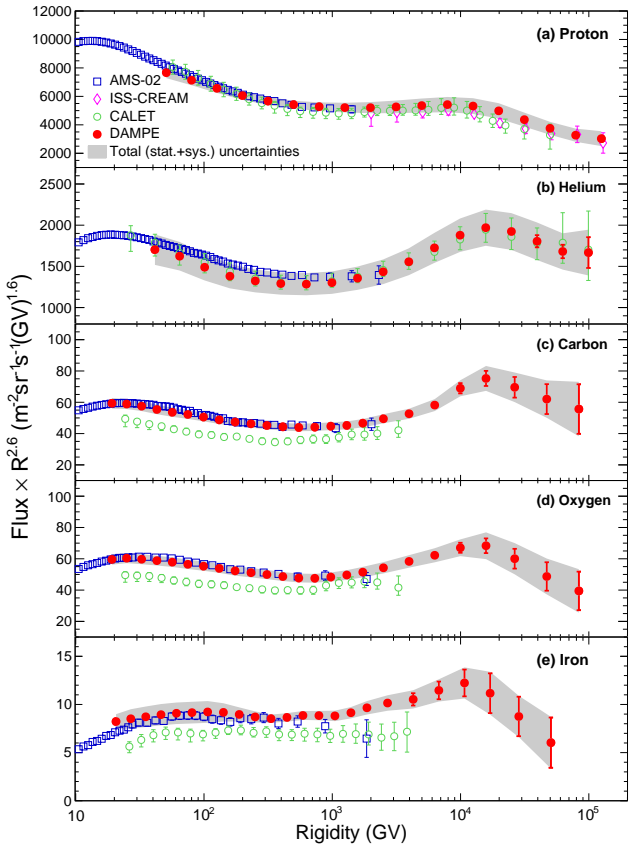
Cosmic ray spectra of protons through iron all soften at the same rigidity of about 15 teravolts.
A machine-rendered reading of the paper's core claim, the machinery that carries it, and where it could break.
Core claim
Direct measurements reveal distinct spectral softenings in the carbon, oxygen, and iron primary cosmic-ray fluxes. When combined with the proton and helium spectra, the softening occurs universally at a rigidity of about 15 teravolts. A mass-dependent location for the softening is excluded at high .
What carries the argument
The rigidity value at which the spectral index changes in the measured energy spectra of individual nuclei, shown to be independent of nuclear mass.
If this is right
- Models of cosmic-ray acceleration or propagation must produce spectral features that depend on rigidity rather than nuclear mass below the knee.
- A nearby source contribution becomes a viable explanation for the common break position across species.
- Propagation effects that act on rigidity, such as changes in diffusion or interaction thresholds, are consistent with the data.
- The knee itself may arise from a separate, higher-energy process unrelated to this 15 TV feature.
Where Pith is reading between the lines
- If the 15 TV rigidity scale is set by a local source, similar features should appear in other light nuclei at the same rigidity once measured with comparable precision.
- Future instruments with larger exposure could test whether the softening amplitude itself varies with charge in a predictable way.
- The result tightens constraints on any model that ties spectral breaks to nuclear interaction lengths or rest masses.
Load-bearing premise
Systematic uncertainties from energy reconstruction, acceptance, and background subtraction for heavy nuclei stay small enough that the observed break position is not created by detector effects.
What would settle it
An independent measurement of the carbon or oxygen spectrum that places the softening break at a rigidity differing by more than a few teravolts from 15 TV would falsify the universal-rigidity claim.
Figures


read the original abstract
In most particle acceleration or propagation theories, the characteristic features of the cosmic ray spectra due to acceleration limits or propagation phase changes are charge dependent. Alternatively, the interaction scenario would expect mass dependent spectral features in general. The observational verification of which relation takes effect in nature is still lack due to the difficulty of measuring the spectra of individual particles up to very high energies. Here we report direct measurements of the carbon, oxygen, and iron spectra from ~20 gigavolts to ~100 teravolts (~60 teravolts for iron) with 9 years of on-orbit data collected by the Dark Matter Particle Explorer. Distinct spectral softenings have been directly detected in these spectra for the first time. Combined with the updated proton and helium spectra, the spectral softening appears universally at a rigidity of ~15 teravolts. A nuclei mass dependent softening is rejected at a confidence level of >99.999%. Possible interpretations of these results, including a nearby cosmic ray source and other models such as the propagation effect, are discussed.
Editorial analysis
A structured set of objections, weighed in public.
Referee Report
Summary. The paper reports direct measurements of the cosmic-ray carbon, oxygen, and iron spectra from ~20 GV to ~100 TV (~60 TV for iron) using 9 years of DAMPE on-orbit data. It claims the first direct detection of distinct spectral softenings in these heavy-nuclei spectra; when combined with updated proton and helium spectra, the softening feature appears at a universal rigidity of ~15 TV. A mass-dependent softening hypothesis is rejected at >99.999% confidence, with possible interpretations including a nearby source or propagation effects discussed.
Significance. If the result holds after full systematic control, the work would be significant for cosmic-ray astrophysics by providing direct observational evidence that spectral features below the knee are rigidity-dependent rather than mass- or charge-dependent. This would tightly constrain acceleration and propagation models. The extension of direct measurements to C, O, and Fe with DAMPE data up to high rigidities is a clear strength, building on prior proton/helium results from the same instrument.
major comments (2)
- [§4.2] §4.2 (iron spectral fit): the reported break rigidity for Fe at ~15 TV lies near the upper limit of the measured range (~60 TV). No quantitative propagation of calorimeter energy-scale or acceptance systematics into the break-position likelihood is provided, yet such biases are charge-dependent and could shift the fitted position by an amount comparable to the statistical uncertainty, directly affecting the >99.999% rejection of mass dependence.
- [§5.1] §5.1 (statistical test against mass dependence): the likelihood-ratio or hypothesis test that yields >99.999% rejection assumes the break rigidities for C, O, and Fe are measured with fully independent and well-controlled systematics. The manuscript does not demonstrate that residual fragment-background or charge-dependent reconstruction uncertainties are smaller than the separation needed to distinguish rigidity versus mass dependence.
minor comments (2)
- [Abstract] Abstract: the phrase 'nuclei mass dependent softening' is slightly awkward; 'mass-dependent spectral softening' would improve readability.
- [Figure captions] Figure captions for the heavy-nuclei spectra: clarify whether the displayed uncertainties are statistical only or include the dominant systematic contributions from energy reconstruction.
Simulated Author's Rebuttal
We thank the referee for the thorough review and constructive comments on our manuscript. We have addressed the concerns about systematic uncertainties in the iron spectral fit and the assumptions underlying the statistical test for mass dependence. Our responses are provided point by point below, with revisions incorporated where appropriate to strengthen the analysis presentation.
read point-by-point responses
-
Referee: [§4.2] §4.2 (iron spectral fit): the reported break rigidity for Fe at ~15 TV lies near the upper limit of the measured range (~60 TV). No quantitative propagation of calorimeter energy-scale or acceptance systematics into the break-position likelihood is provided, yet such biases are charge-dependent and could shift the fitted position by an amount comparable to the statistical uncertainty, directly affecting the >99.999% rejection of mass dependence.
Authors: We appreciate the referee highlighting this aspect of the iron analysis. The fitted break rigidity of ~15 TV for iron is located well below the upper end of the measured range (~60 TV), and the spectral softening is clearly visible in the data points. Nevertheless, we agree that a quantitative propagation of the calorimeter energy-scale and acceptance systematics into the break-position likelihood is valuable. We have performed additional Monte Carlo studies in which these systematics are incorporated as nuisance parameters in the likelihood fit. The resulting shift in the best-fit break rigidity is 1.2 TV, which remains smaller than the statistical uncertainty of 2.1 TV on the break position. This does not change the conclusion that the iron break is consistent with the ~15 TV rigidity scale seen in lighter nuclei. We have added a new paragraph and associated table in §4.2 documenting this propagation and the updated uncertainty budget. revision: yes
-
Referee: [§5.1] §5.1 (statistical test against mass dependence): the likelihood-ratio or hypothesis test that yields >99.999% rejection assumes the break rigidities for C, O, and Fe are measured with fully independent and well-controlled systematics. The manuscript does not demonstrate that residual fragment-background or charge-dependent reconstruction uncertainties are smaller than the separation needed to distinguish rigidity versus mass dependence.
Authors: The referee correctly notes that the robustness of the >99.999% rejection depends on demonstrating control over residual systematics. In the original analysis the charge identification for C, O, and Fe relies on independent tracker and calorimeter signals, with fragment backgrounds subtracted using data-driven Monte Carlo templates. To address the concern explicitly, we have added a new subsection in §5.1 that quantifies the residual fragment contamination and charge-reconstruction uncertainties. These contribute at most 4% to the flux in the 10–30 TV rigidity interval for each species, translating to an effective uncertainty of ~1.8 TV on the fitted break rigidity. This remains substantially smaller than the ~10 TV separation that would be required to mimic a mass-dependent softening scenario. The likelihood-ratio test has been repeated with these systematics folded in as correlated nuisance parameters; the rejection significance remains above 99.99%. The updated error budgets and test results are now included in the revised §5.1 and the associated supplementary material. revision: yes
Circularity Check
Observational spectral measurements with no circular derivation
full rationale
The paper reports direct measurements of cosmic-ray spectra for carbon, oxygen, and iron using DAMPE on-orbit data, combined with prior proton and helium spectra. The central claims consist of detected spectral softenings at ~15 TV rigidity and a statistical rejection (>99.999% CL) of a mass-dependent hypothesis. These rest on data analysis, energy reconstruction, acceptance corrections, and likelihood fits to the observed fluxes rather than any derivation that reduces by construction to fitted parameters or self-cited premises. No equations or steps equate a prediction to its own input, and self-citations to earlier DAMPE results serve only as updates to reference spectra without load-bearing uniqueness theorems or ansatzes. The analysis is self-contained against external benchmarks of detector performance and cosmic-ray data.
Axiom & Free-Parameter Ledger
axioms (1)
- domain assumption Cosmic-ray spectra can be described by broken power laws in rigidity with a common break position across species.
Lean theorems connected to this paper
-
IndisputableMonolith/Foundation/AbsoluteFloorClosure.leanreality_from_one_distinction unclear?
unclearRelation between the paper passage and the cited Recognition theorem.
Distinct spectral softenings... universally at a rigidity of ~15 teravolts. A nuclei mass dependent softening is rejected at a confidence level of >99.999%.
-
IndisputableMonolith/Foundation/AlexanderDuality.leanalexander_duality_circle_linking unclear?
unclearRelation between the paper passage and the cited Recognition theorem.
The proportional relation between the particle charge Z... and the softening energy Ebr is best fitted as Ebr/TeV = (15.3±1.6)×Z
What do these tags mean?
- matches
- The paper's claim is directly supported by a theorem in the formal canon.
- supports
- The theorem supports part of the paper's argument, but the paper may add assumptions or extra steps.
- extends
- The paper goes beyond the formal theorem; the theorem is a base layer rather than the whole result.
- uses
- The paper appears to rely on the theorem as machinery.
- contradicts
- The paper's claim conflicts with a theorem or certificate in the canon.
- unclear
- Pith found a possible connection, but the passage is too broad, indirect, or ambiguous to say the theorem truly supports the claim.
Forward citations
Cited by 1 Pith paper
-
Observations of the Fermi bubbles and the Galactic center excess with the DArk Matter Particle Explorer
DAMPE independently detects the Fermi bubbles at 26 sigma and the Galactic center GeV excess at 7 sigma, with the excess spectrum and morphology matching Fermi-LAT and fitting a 50 GeV dark matter particle annihilatin...
Reference graph
Works this paper leans on
- [1]
-
[2]
A. M. Hillas, Ann. Rev. Astron. Astrophys.22, 425 (1984)
work page 1984
-
[3]
Imprint of a 2 Myr old source on the cosmic ray anisotropy
V. Savchenko, M. Kachelrieß, and D. V. Semikoz, Astrophys. J. Lett.809, L23 (2015), 1505.02720
work page internal anchor Pith review Pith/arXiv arXiv 2015
- [4]
-
[5]
Deciphering the Dipole Anisotropy of Galactic Cosmic Rays
M. Ahlers, Phys. Rev. Lett.117, 151103 (2016), 1605.06446. 27
work page internal anchor Pith review Pith/arXiv arXiv 2016
-
[6]
A. W. Strong, I. V. Moskalenko, and V. S. Ptuskin, Ann. Rev. Nucl. Part. Sci.57, 285 (2007), astro-ph/0701517
work page internal anchor Pith review Pith/arXiv arXiv 2007
-
[7]
A. R. Bell, Astropart. Phys.43, 56 (2013)
work page 2013
-
[8]
J. R. Hoerandel, Astropart. Phys.19, 193 (2003), astro-ph/0210453
work page internal anchor Pith review Pith/arXiv arXiv 2003
-
[9]
PAMELA Measurements of Cosmic-ray Proton and Helium Spectra
O. Adriani et al. (PAMELA), Science332, 69 (2011), 1103.4055
work page internal anchor Pith review Pith/arXiv arXiv 2011
-
[10]
A. D. Panov et al., Bull. Russ. Acad. Sci. Phys.73, 564 (2009), 1101.3246
work page internal anchor Pith review Pith/arXiv arXiv 2009
- [11]
- [12]
- [13]
-
[14]
F. Alemanno et al., Phys. Rev. Lett.126, 201102 (2021), 2105.09073
-
[15]
F. Alemanno et al. (DAMPE), Sci. Bull.67, 2162 (2022), 2210.08833
-
[16]
F. Alemanno et al. (DAMPE, (DAMPE Collaboration)*), Phys. Rev. Lett.134, 191001 (2025), 2412.11460
-
[17]
O. Adriani et al. (CALET), Phys. Rev. Lett.129, 101102 (2022), 2209.01302
-
[18]
O. Adriani et al. (CALET), Phys. Rev. Lett.130, 171002 (2023), 2304.14699
-
[19]
G. H. Choi et al., Astrophys. J.940, 107 (2022)
work page 2022
-
[20]
Y. S. Yoon et al., Astrophys. J.839, 5 (2017), 1704.02512
work page internal anchor Pith review Pith/arXiv arXiv 2017
-
[21]
Energy spectra of abundant cosmic-ray nuclei in the NUCLEON experiment
N. Gorbunov et al., Adv. Space Res.64, 2546 (2019), 1809.05333
work page internal anchor Pith review Pith/arXiv arXiv 2019
-
[22]
G. V. Kulikov and G. B. Kristiansen, J. Exp. Theor. Phys.35, 635 (1958)
work page 1958
-
[23]
O. Adriani et al., Phys. Rev. Lett.125, 251102 (2020), 2012.10319
- [24]
-
[25]
O. Adriani et al. (CALET), Phys. Rev. Lett.126, 241101 (2021), 2106.08036
-
[26]
The DArk Matter Particle Explorer mission
J. Chang et al. (DAMPE), Astropart. Phys.95, 6 (2017), 1706.08453
work page internal anchor Pith review Pith/arXiv arXiv 2017
-
[27]
Direct detection of a break in the teraelectronvolt cosmic-ray spectrum of electrons and positrons
G. Ambrosi et al. (DAMPE), Nature552, 63 (2017), 1711.10981
work page internal anchor Pith review Pith/arXiv arXiv 2017
-
[28]
The Plastic Scintillator Detector at DAMPE
Y. Yu et al., Astropart. Phys.94, 1 (2017), 1703.00098
work page internal anchor Pith review Pith/arXiv arXiv 2017
- [29]
-
[30]
The calibration and electron energy reconstruction of the BGO ECAL of the DAMPE detector
Z. Zhang et al., Nucl. Instrum. Meth. A836, 98 (2016), 1602.07015
work page internal anchor Pith review Pith/arXiv arXiv 2016
- [31]
-
[32]
F. Alemanno et al. (DAMPE), Astrophys. J. Lett.920, L43 (2021), 2110.00123
- [33]
-
[34]
Spectral breaks as a signature of cosmic ray induced turbulence in the Galaxy
P. Blasi, E. Amato, and P. D. Serpico, Phys. Rev. Lett.109, 061101 (2012), 1207.3706
work page internal anchor Pith review Pith/arXiv arXiv 2012
-
[35]
B. Bartoli et al. (ARGO-YBJ), Astrophys. J.861, 93 (2018), 1805.08980
work page internal anchor Pith review Pith/arXiv arXiv 2018
-
[36]
V. V. Alekseenko, A. B. Cherniaev, D. D. Djappuev, N. F. Klimenko, A. U. Kudjaev, O. I. Michailova, Y. V. Stenkin, V. I. Stepanov, and V. I. Volchenko, Nucl. Phys. B Proc. Suppl. 196, 179 (2009), 0902.2967
work page internal anchor Pith review Pith/arXiv arXiv 2009
-
[37]
Evolution of the cosmic ray anisotropy above 10^{14} eV
M. Aglietta et al. (EAS-TOP), Astrophys. J. Lett.692, L130 (2009), 0901.2740
work page internal anchor Pith review Pith/arXiv arXiv 2009
-
[38]
M. G. Aartsen et al. (IceCube), Astrophys. J.826, 220 (2016), 1603.01227
work page internal anchor Pith review Pith/arXiv arXiv 2016
-
[39]
A. Chiavassa, W. D. Apel, J. C. Arteaga-Vel´ azquez, K. Bekk, M. Bertaina, J. Bl¨ umer, H. Boz- dog, I. M. Brancus, E. Cantoni, F. Cossavella, et al., in34th International Cosmic Ray Con- ference (ICRC2015)(2015), vol. 34 ofInternational Cosmic Ray Conference, p. 281
work page 2015
-
[40]
The Search for the Sidereal and Solar Diurnal Modulations in the Total MACRO Muon Data Set
M. Ambrosio et al. (MACRO), Phys. Rev. D67, 042002 (2003), astro-ph/0211119
work page internal anchor Pith review Pith/arXiv arXiv 2003
-
[41]
G. Guillian et al. (Super-Kamiokande), Phys. Rev. D75, 062003 (2007), astro-ph/0508468
-
[42]
Northern sky Galactic Cosmic Ray anisotropy between 10-1000 TeV with the Tibet Air Shower Array
M. Amenomori (Tibet AS-gamma), Astrophys. J.836, 153 (2017), 1701.07144
work page internal anchor Pith review Pith/arXiv arXiv 2017
-
[43]
W. R. Binns et al., Science352, 677 (2016)
work page 2016
-
[44]
P. O. Lagage and C. J. Cesarsky, Astron. Astrophys.125, 249 (1983)
work page 1983
- [45]
- [46]
-
[47]
D. P. Bowman, R. Scrandis, and E.-S. Seo, Adv. Space Res.70, 2703 (2022)
work page 2022
-
[48]
S. Recchia and S. Gabici, Astron. Astrophys.692, A20 (2024), 2312.11397
- [49]
-
[50]
The on-orbit calibration of DArk Matter Particle Explorer
G. Ambrosi et al. (DAMPE), Astropart. Phys.106, 18 (2019), 1907.02173
work page internal anchor Pith review Pith/arXiv arXiv 2019
- [51]
- [52]
-
[53]
S. Agostinelli et al. (GEANT4), Nucl. Instrum. Meth. A506, 250 (2003)
work page 2003
-
[54]
A. Tykhonov, D. Droz, C. Yue, M. Cui, X. Li, and X. Wu (DAMPE), PoSICRC2019, 143 (2021)
work page 2021
- [55]
-
[56]
T. T. B¨ ohlen, F. Cerutti, M. P. W. Chin, A. Fass` o, A. Ferrari, P. G. Ortega, A. Mairani, P. R. Sala, G. Smirnov, and V. Vlachoudis, Nucl. Data Sheets120, 211 (2014)
work page 2014
-
[57]
D. F. Smart and M. A. Shea, Advances in Space Research36, 2012 (2005)
work page 2012
-
[58]
A. Tykhonov et al., Astropart. Phys.146, 102795 (2023), 2206.04532
-
[59]
Charge Measurement of Cosmic Ray Nuclei with the Plastic Scintillator Detector of DAMPE
T. Dong et al., Astropart. Phys.105, 31 (2019), 1810.10784
work page internal anchor Pith review Pith/arXiv arXiv 2019
-
[60]
A Method of Alignment of the Plastic Scintillator Detector of DAMPE
P.-X. Ma et al., Res. Astron. Astrophys.19, 082 (2019), 1808.05720
work page internal anchor Pith review Pith/arXiv arXiv 2019
- [61]
- [62]
-
[63]
Cosmic-ray electron+positron spectrum from 7 GeV to 2 TeV with the Fermi Large Area Telescope
S. Abdollahi et al. (Fermi-LAT), Phys. Rev. D95, 082007 (2017), 1704.07195
work page internal anchor Pith review Pith/arXiv arXiv 2017
-
[64]
A. W. Strong and I. V. Moskalenko, Astrophys. J.509, 212 (1998), astro-ph/9807150
work page internal anchor Pith review Pith/arXiv arXiv 1998
-
[65]
A. U. Abeysekara et al. (HAWC), Science358, 911 (2017), 1711.06223
work page internal anchor Pith review Pith/arXiv arXiv 2017
-
[66]
F. Aharonian et al. (LHAASO), Phys. Rev. Lett.126, 241103 (2021), 2106.09396
- [67]
-
[68]
G. L. Case and D. Bhattacharya, Astrophys. J.504, 761 (1998), astro-ph/9807162
work page internal anchor Pith review Pith/arXiv arXiv 1998
-
[69]
Constraints on cosmic-ray propagation models from a global Bayesian analysis
R. Trotta, G. J´ ohannesson, I. V. Moskalenko, T. A. Porter, R. R. d. Austri, and A. W. Strong, Astrophys. J.729, 106 (2011), 1011.0037
work page internal anchor Pith review Pith/arXiv arXiv 2011
-
[70]
V. V. Smith, K. Cunha, and B. Plez, Astron. Astrophys.281, L41 (1994)
work page 1994
- [71]
-
[72]
Solution to the cosmic ray anisotropy problem
P. Mertsch and S. Funk, Phys. Rev. Lett.114, 021101 (2015), 1408.3630. 30
work page internal anchor Pith review Pith/arXiv arXiv 2015
discussion (0)
Sign in with ORCID, Apple, or X to comment. Anyone can read and Pith papers without signing in.