Changing-Look Active Galactic Nuclei in SDSS-V: Host-Galaxy Properties and Black-Hole Scaling Relations
Pith reviewed 2026-05-17 23:18 UTC · model grok-4.3
The pith
CL-AGNs live in typical AGN host galaxies and follow standard black-hole scaling relations.
A machine-rendered reading of the paper's core claim, the machinery that carries it, and where it could break.
Core claim
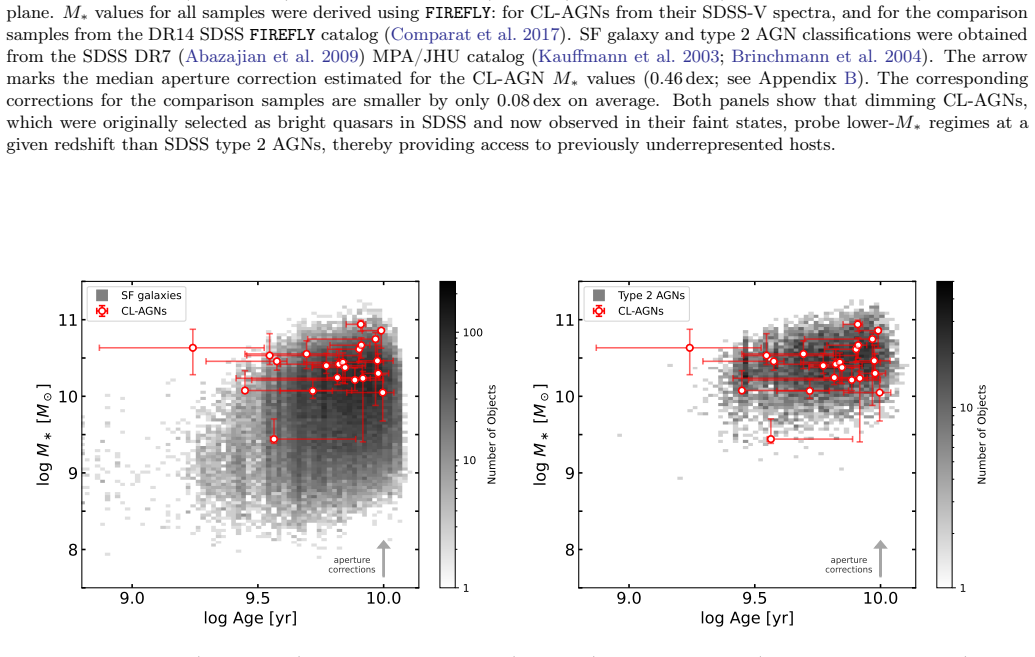
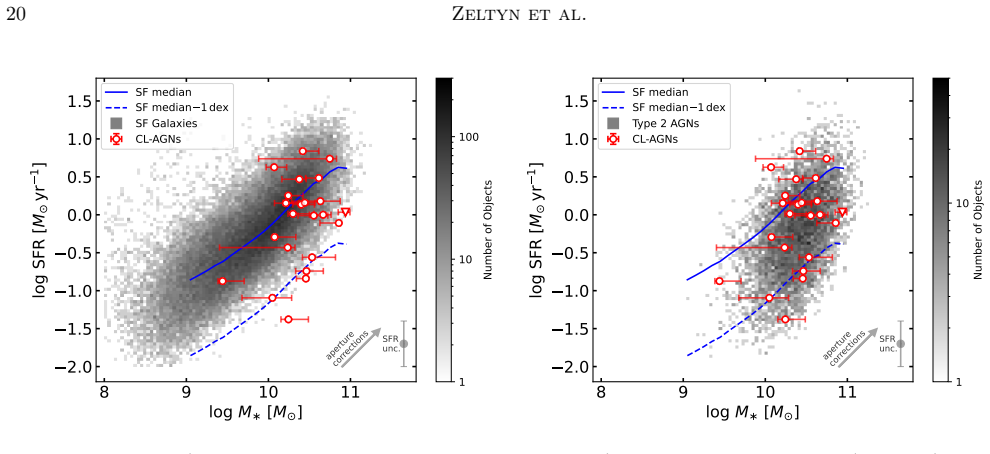
The CL-AGNs roughly follow the M_BH-sigma_* and M_BH-M_* relations of inactive galaxies, with a median black hole-to-stellar mass ratio of 0.38%. Stellar population properties including mass, age, young stellar fraction, and star-formation rate show no difference from those of type 2 AGNs in SDSS. MgII emission-line analysis rules out variable obscuration for the majority of the sample. These results indicate that CL-AGNs reside in typical AGN host galaxies and that their variability is unrelated to host environment, so they represent a phase of normal AGN activity rather than a distinct population.
What carries the argument
Direct comparison of stellar population parameters and black-hole scaling relations against a matched SDSS type 2 AGN control sample, supported by MgII line diagnostics to exclude variable obscuration.
If this is right
- CL-AGNs can serve as useful probes of the AGN-host connection because the same systems supply both AGN-dominated and host-dominated spectra.
- The extreme variability of CL-AGNs is likely unrelated to host-galaxy environment.
- CL-AGNs represent a phase of normal AGN activity rather than a distinct population.
Where Pith is reading between the lines
- If the hosts are ordinary, the variability is more likely driven by changes in accretion rate or disk structure than by external triggers.
- CL-AGNs could be used to test whether black-hole growth tracks stellar mass assembly on the same timescales in active and changing phases.
- Larger samples might reveal whether transition timescales correlate with black-hole mass in the same way as in steady-state AGNs.
Load-bearing premise
The control sample of type 2 AGNs from SDSS is assumed to be well-matched in selection and measurement methods to the CL-AGN targets.
What would settle it
A statistically significant difference in average stellar age or star-formation rate between a larger set of CL-AGNs and a re-matched type 2 control sample would falsify the claim that the hosts are typical.
Figures







read the original abstract
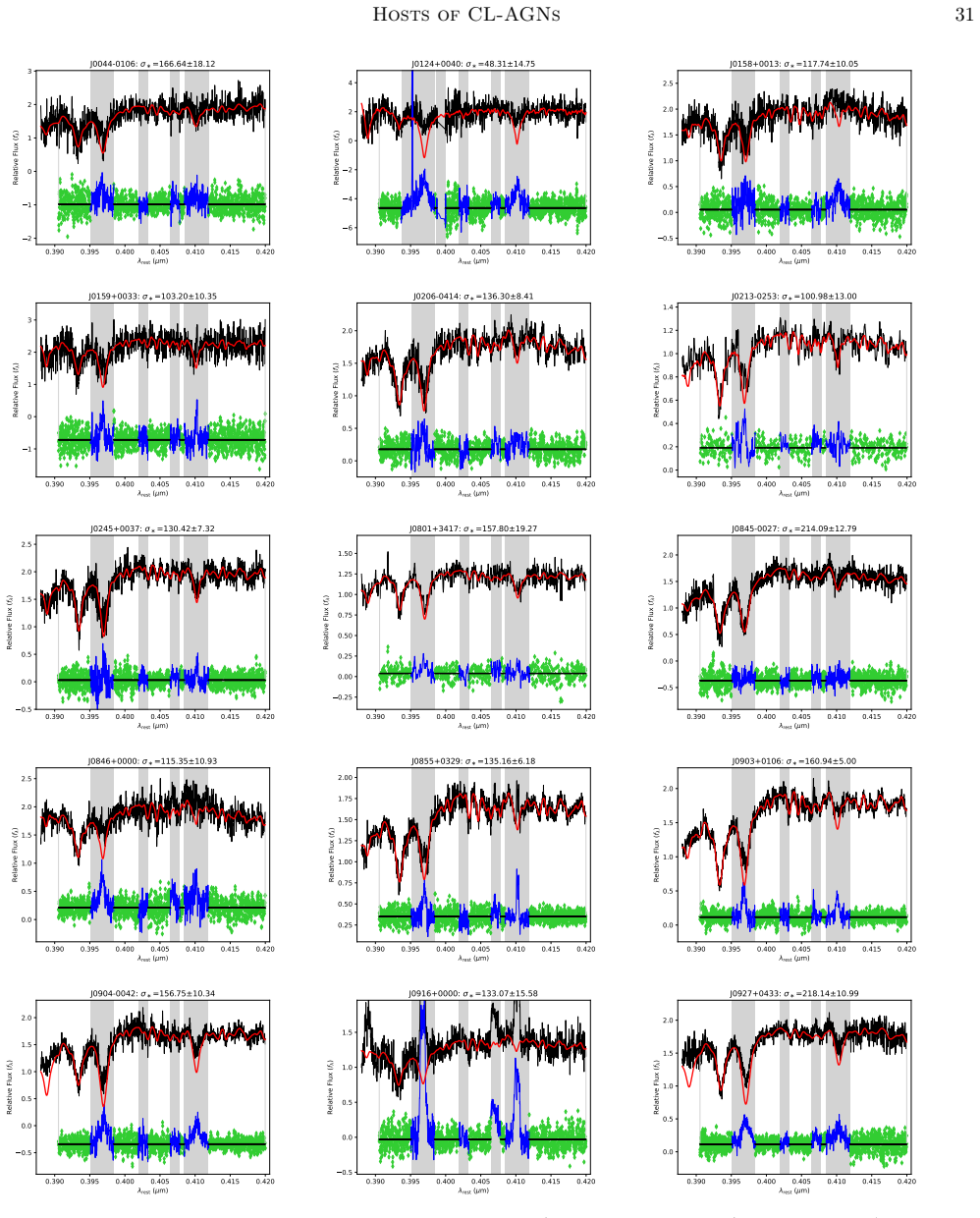
Changing-look active galactic nuclei (CL-AGNs) exhibit dramatic spectral variability on unexpectedly short timescales, challenging standard accretion flow models. Despite growing samples, the physical drivers of this extreme variability, and the potential link to host-galaxy properties, remain unknown. Regardless of the underlying mechanism, the transition between AGN-dominated and host-dominated spectra offers a unique opportunity to study relations between AGNs and their hosts within the same objects. We present intermediate-resolution spectroscopy of 23 CL-AGNs identified by the Sloan Digital Sky Survey V (SDSS-V), obtained with the Very Large Telescope/X-shooter and Gemini-N/GMOS. An analysis of the Mgii emission line observed in the spectra demonstrates that the majority of these sources cannot be driven by variable obscuration. Our CL-AGNs roughly follow the M_BH-sigma_* and M_BH-M_* relations of inactive galaxies, with a median black hole-to-stellar mass ratio of 0.38%. We find no evidence that the stellar population properties of our CL-AGNs, including stellar mass, age, young stellar fraction, and star-formation rate, differ from those of type 2 AGNs in SDSS. These results suggest that CL-AGNs reside in typical AGN host galaxies and that their extreme variability is likely unrelated to host-galaxy environment, supporting the idea that CL-AGNs are not a distinct population, but rather represent a phase of normal AGN activity. This result, in turn, implies that CL-AGNs can serve as useful probes of the AGN-host connection, providing access to both AGN-dominated and host-dominated spectra of the same systems.
Editorial analysis
A structured set of objections, weighed in public.
Referee Report
Summary. The manuscript presents intermediate-resolution spectroscopy of 23 CL-AGNs identified in SDSS-V, obtained with VLT/X-shooter and Gemini-N/GMOS. Mg II line analysis is used to argue that variable obscuration cannot explain the variability for the majority of the sample. The CL-AGNs are shown to follow the M_BH-σ_* and M_BH-M_* relations of inactive galaxies (median black-hole-to-stellar-mass ratio 0.38%). Stellar population properties (stellar mass, age, young stellar fraction, SFR) show no significant differences from a control sample of SDSS type 2 AGNs, leading to the conclusion that CL-AGNs reside in typical AGN host galaxies, that their variability is unrelated to host environment, and that they represent a normal phase of AGN activity rather than a distinct population.
Significance. If the central results hold after addressing sample matching, the work adds new spectroscopic data on a growing class of variable AGNs and supports the interpretation that CL-AGNs are useful probes of the AGN-host connection because the same objects can be observed in both AGN-dominated and host-dominated states. The quantitative comparison to standard scaling relations and the null result versus type 2 hosts are potentially valuable for accretion-disk models.
major comments (2)
- [§4] §4 (host-galaxy properties comparison): The claim of no differences in stellar mass, age, young fraction, and SFR relative to the SDSS type 2 AGN control sample is load-bearing for the conclusion that CL-AGNs are not a distinct population. However, the manuscript provides no explicit matching criteria or distributions for redshift, AGN luminosity (e.g., [O III] or bolometric), or host mass range. Without these, selection or measurement systematics could produce an artifactual null result, as raised by the control-sample concern.
- [§3.1] §3.1 (Mg II analysis): The statement that Mg II emission demonstrates variable obscuration is ruled out for the majority lacks reported details on line-fitting procedures, velocity-width measurements, error bars, and quantitative thresholds used to reach this conclusion. This step is central to excluding an extrinsic driver and therefore to the intrinsic-variability interpretation.
minor comments (2)
- [Figures 5-7] Ensure that all scaling-relation figures include the full sample size, individual error bars, and the exact functional form of the reference relations from the literature.
- [§3.2] Clarify the exact definition and measurement method for the young stellar fraction and SFR in the stellar-population fitting section.
Simulated Author's Rebuttal
We thank the referee for their constructive and detailed report. We address each major comment below and have revised the manuscript to incorporate additional details and clarifications as suggested.
read point-by-point responses
-
Referee: [§4] §4 (host-galaxy properties comparison): The claim of no differences in stellar mass, age, young fraction, and SFR relative to the SDSS type 2 AGN control sample is load-bearing for the conclusion that CL-AGNs are not a distinct population. However, the manuscript provides no explicit matching criteria or distributions for redshift, AGN luminosity (e.g., [O III] or bolometric), or host mass range. Without these, selection or measurement systematics could produce an artifactual null result, as raised by the control-sample concern.
Authors: We agree that explicit documentation of the control-sample matching is necessary to support the null result robustly. In the revised manuscript we will add a dedicated paragraph in §4 describing the matching criteria applied to redshift, [O III] luminosity (as an AGN-power proxy), and stellar-mass range. We will also include a new figure (or table) showing the distributions of these quantities for the CL-AGN sample and the control sample, allowing readers to assess the quality of the match and any residual systematics. revision: yes
-
Referee: [§3.1] §3.1 (Mg II analysis): The statement that Mg II emission demonstrates variable obscuration is ruled out for the majority lacks reported details on line-fitting procedures, velocity-width measurements, error bars, and quantitative thresholds used to reach this conclusion. This step is central to excluding an extrinsic driver and therefore to the intrinsic-variability interpretation.
Authors: We acknowledge the need for greater methodological transparency. In the revised §3.1 we will expand the description of the Mg II fitting procedure to include the functional form and number of Gaussian components employed, the precise definition and measurement of velocity width (FWHM), the method used to derive uncertainties (e.g., Monte-Carlo resampling or covariance-matrix errors), and the quantitative thresholds (detection significance, minimum line width, or flux-ratio criteria) applied to conclude that variable obscuration is ruled out for the majority of the sample. These additions will make the intrinsic-variability argument fully reproducible. revision: yes
Circularity Check
No significant circularity; claims rest on new observations vs external catalogs
full rationale
The paper reports new intermediate-resolution spectroscopy for 23 SDSS-V CL-AGNs, uses Mg II line analysis to argue against variable obscuration as the driver, and directly compares measured stellar mass, age, young fraction, SFR, and black-hole scaling relations against SDSS type 2 AGN catalogs and standard inactive-galaxy relations. These comparisons use external benchmarks and standard relations rather than quantities defined or fitted by the authors themselves. No load-bearing step reduces by construction to a self-citation, self-defined parameter, or fitted input renamed as a prediction. The central claim that CL-AGNs represent a normal AGN phase follows from the observed lack of differences, which is independent of the paper's own prior fits.
Axiom & Free-Parameter Ledger
axioms (2)
- domain assumption Black hole mass can be estimated from the width and luminosity of the MgII emission line using established virial calibrations
- domain assumption Stellar velocity dispersion and stellar mass measurements from spectra are comparable across CL-AGN and type 2 AGN samples
Lean theorems connected to this paper
-
IndisputableMonolith/Foundation/AbsoluteFloorClosure.leanreality_from_one_distinction unclear?
unclearRelation between the paper passage and the cited Recognition theorem.
We find no evidence that the stellar population properties of our CL-AGNs, including stellar mass, age, young stellar fraction, and star-formation rate, differ from those of type 2 AGNs in SDSS.
-
IndisputableMonolith/Cost/FunctionalEquation.leanwashburn_uniqueness_aczel unclear?
unclearRelation between the paper passage and the cited Recognition theorem.
Our CL-AGNs roughly follow the M_BH–σ_* and M_BH–M_* relations of inactive galaxies
What do these tags mean?
- matches
- The paper's claim is directly supported by a theorem in the formal canon.
- supports
- The theorem supports part of the paper's argument, but the paper may add assumptions or extra steps.
- extends
- The paper goes beyond the formal theorem; the theorem is a base layer rather than the whole result.
- uses
- The paper appears to rely on the theorem as machinery.
- contradicts
- The paper's claim conflicts with a theorem or certificate in the canon.
- unclear
- Pith found a possible connection, but the passage is too broad, indirect, or ambiguous to say the theorem truly supports the claim.
Forward citations
Cited by 1 Pith paper
-
Identifying Changing-Look AGN Transitions in Light Curve Data with the Zwicky Transient Facility
A criterion of |Δg| > 0.4 mag and |Δ(g-r)| > 0.2 mag detects photometric CL-AGN transitions in 9.6% of known hosts with 1.6% false positive rate from simulations.
Reference graph
Works this paper leans on
-
[1]
, " * write output.state after.block = add.period write newline
ENTRY address archivePrefix author booktitle chapter doi edition editor eprint howpublished institution journal key month number organization pages publisher school series title misctitle type volume year version url label extra.label sort.label short.list INTEGERS output.state before.all mid.sentence after.sentence after.block FUNCTION init.state.consts ...
-
[2]
" write newline "" before.all 'output.state := FUNCTION format.url url empty "" new.block "" url * "" * if FUNCTION format.eprint eprint empty "" archivePrefix empty "" archivePrefix "arXiv" = new.block " " eprint * " " * new.block " " eprint * " " * if if if FUNCTION format.doi doi empty "" " " doi * " " * if FUNCTION format.pid doi empty eprint empty ur...
-
[3]
- [1] #1 = = ^ ^ ^ .\!\!^ d .\!\!^ h .\!\!^ m .\!\!^ s .\!\!^ @mss
thebibliography [1] 20pt to REFERENCES 6pt =0pt 10pt plus 3pt =0pt =0pt =1pt plus 1pt =0pt =0pt -12pt =13pt plus 1pt =20pt =13pt plus 1pt \@M =10000 =-1.0em =0pt =0pt 0pt =0pt =1.0em @enumiv\@empty 10000 10000 `\.\@m \@noitemerr \@latex@warning Empty `thebibliography' environment \@ifnextchar \@reference \@latexerr Missing key on reference command Each re...
discussion (0)
Sign in with ORCID, Apple, or X to comment. Anyone can read and Pith papers without signing in.