High Dynamic Range 3D Gaussian Splatting via Luminance-Chromaticity Decomposition
Pith reviewed 2026-05-17 22:24 UTC · model grok-4.3
The pith
Decoupling luminance from chromaticity lets 3D Gaussian Splatting learn HDR scenes directly with a simpler model.
A machine-rendered reading of the paper's core claim, the machinery that carries it, and where it could break.
Core claim
LCD-GS decouples luminance and chromaticity into independent parameters per Gaussian, enhancing the ability to capture extreme radiance variations across views while adding minimal overhead and preserving the standard training and inference pipeline of 3D Gaussian Splatting.
What carries the argument
Luminance-Chromaticity Decomposition, which replaces the single color parameter with a separate luminance scalar and chromaticity vector for each 3D Gaussian to independently model brightness and color information.
If this is right
- The model maintains the exact original 3DGS training and inference pipeline, requiring only a change in how color is stored and computed.
- Primitive-level local and global luminance editing becomes possible directly at inference time without retraining.
- Reconstruction fidelity and dynamic-range preservation improve over existing dual-branch HDR methods despite using a simpler architecture.
- The decomposition adds only one extra scalar per primitive, keeping parameter count and efficiency close to vanilla 3DGS.
Where Pith is reading between the lines
- The same luminance-chromaticity split could be tested on other view-dependent appearance models that currently rely on spherical harmonics or similar bases.
- Luminance editing at the primitive level may support new workflows for exposure control in virtual production without full scene re-optimization.
- Because the change is local to color representation, it could be combined with existing compression or acceleration techniques for 3DGS.
Load-bearing premise
That the main reason standard 3D Gaussian Splatting underperforms on HDR data is the limited capacity of spherical harmonics to handle large radiance changes between different viewpoints.
What would settle it
Training the same HDR scenes with higher-degree spherical harmonics alone and checking whether reconstruction error and dynamic range metrics match those of the luminance-chromaticity decomposition without increased overfitting.
Figures


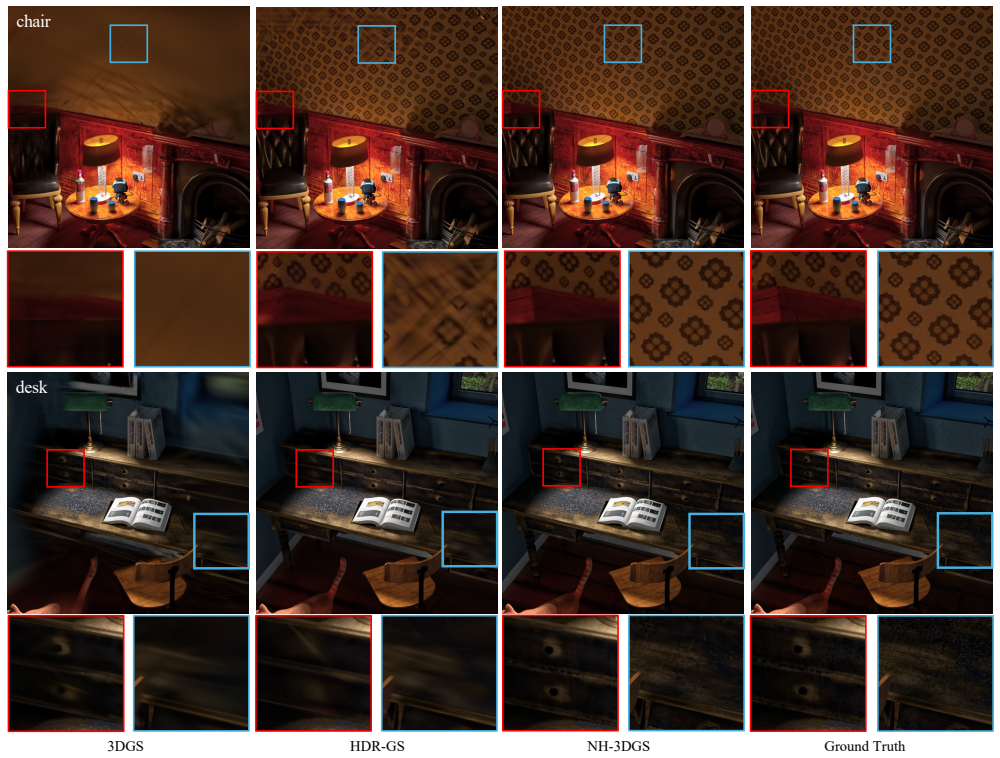
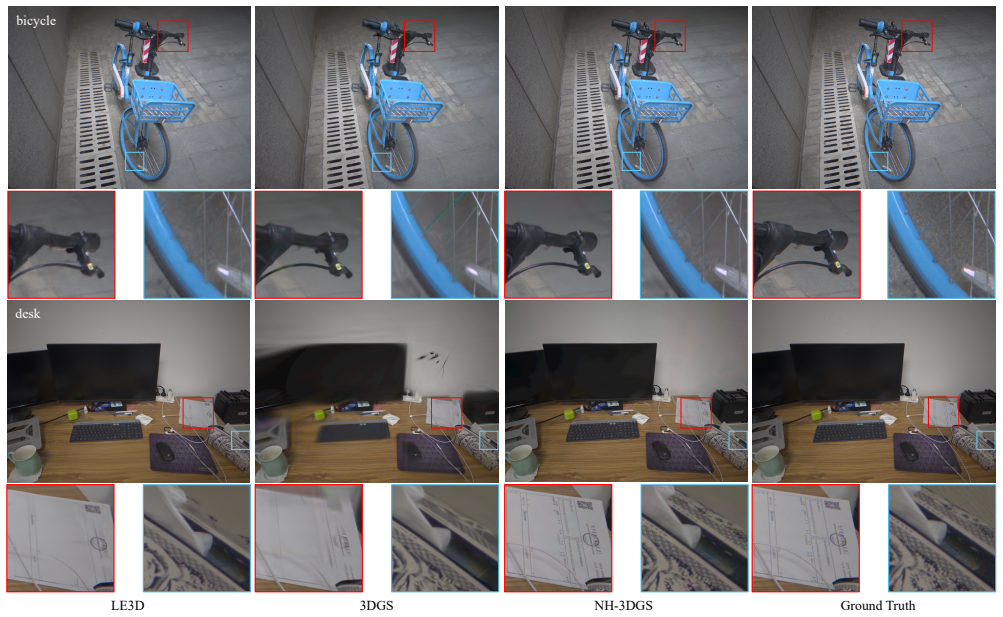
read the original abstract
High Dynamic Range (HDR) 3D reconstruction is pivotal for professional content creation in filmmaking and virtual production. Existing methods typically rely on multi-exposure Low Dynamic Range (LDR) supervision to constrain the learning process within vast brightness spaces, resulting in complex, dual-branch architectures. This work explores the feasibility of learning HDR 3D models exclusively in the HDR data space to simplify model design. By analyzing 3D Gaussian Splatting (3DGS) for HDR imagery, we reveal that its failure stems from the limited capacity of Spherical Harmonics (SHs) to capture extreme radiance variations across views, often biasing towards high-radiance observations and underfitting. While increasing the maximum SH degree improves training fitting, it leads to severe overfitting and excessive parameter overhead. To address this, we propose \textit{Luminance--Chromaticity Decomposition Gaussian Splatting} (LCD-GS). By decoupling luminance and chromaticity into independent parameters, LCD-GS significantly enhances learning flexibility with minimal parameter increase (\textit{e.g.}, one extra scalar per primitive). Notably, LCD-GS maintains the original training and inference pipeline, requiring only a change in color representation. This explicit decomposition naturally enables primitive-level local and global luminance editing during inference. Extensive experiments on synthetic and real datasets demonstrate that LCD-GS consistently outperforms state-of-the-art methods in reconstruction fidelity and dynamic-range preservation even with a simpler, more efficient architecture, providing an elegant paradigm for professional-grade HDR 3D modeling. Code and datasets will be released.
Editorial analysis
A structured set of objections, weighed in public.
Referee Report
Summary. The paper proposes Luminance-Chromaticity Decomposition Gaussian Splatting (LCD-GS) for high dynamic range 3D reconstruction. It identifies that standard 3D Gaussian Splatting fails on HDR data due to Spherical Harmonics' limited capacity to capture extreme radiance variations across views, leading to bias toward high-radiance observations. The method decouples luminance and chromaticity into independent parameters (adding one extra scalar per primitive), enabling direct training in HDR space without multi-exposure LDR supervision or complex dual-branch architectures. It claims this yields superior reconstruction fidelity and dynamic-range preservation on synthetic and real datasets compared to state-of-the-art methods, while preserving the original training/inference pipeline and enabling primitive-level luminance editing.
Significance. If the performance gains hold under equivalent supervision conditions, the approach offers a simpler, more efficient alternative to existing HDR 3DGS methods. The minimal parameter overhead and built-in editing capability could streamline professional workflows in filmmaking and virtual production. The explicit decomposition provides a clean way to handle luminance variations without architectural complexity.
major comments (2)
- [Experiments] The central outperformance claim in the abstract and Experiments section rests on comparisons whose fairness is unclear. The manuscript must explicitly state whether SOTA baselines were retrained on the same direct HDR inputs used for LCD-GS or evaluated under their original multi-exposure LDR supervision; without this, gains cannot be isolated to the luminance-chromaticity decomposition rather than richer ground-truth data.
- [Section 3.1] Section 3.1: The analysis that Spherical Harmonics bias toward high-radiance observations and underfit low-radiance views requires quantitative support (e.g., per-view radiance error histograms or view-specific PSNR breakdowns) to establish this as the primary failure mode rather than other factors such as optimization dynamics.
minor comments (2)
- [Abstract] The abstract would be strengthened by including at least one concrete quantitative result (e.g., average PSNR or HDR-VDP-2 improvement) to support the 'consistently outperforms' statement.
- [Section 3.2] Notation for the luminance and chromaticity parameters should be introduced with explicit equations in Section 3.2 to clarify how the decomposition integrates with the existing 3DGS color representation.
Simulated Author's Rebuttal
We thank the referee for the constructive and detailed feedback on our manuscript. We address the major comments point by point below, clarifying our experimental setup and strengthening the supporting analysis as requested.
read point-by-point responses
-
Referee: [Experiments] The central outperformance claim in the abstract and Experiments section rests on comparisons whose fairness is unclear. The manuscript must explicitly state whether SOTA baselines were retrained on the same direct HDR inputs used for LCD-GS or evaluated under their original multi-exposure LDR supervision; without this, gains cannot be isolated to the luminance-chromaticity decomposition rather than richer ground-truth data.
Authors: We thank the referee for highlighting this critical aspect of fair comparison. In our experiments, the state-of-the-art baselines were evaluated using their original published implementations and the multi-exposure LDR supervision protocols described in their papers. LCD-GS was trained directly on the available HDR inputs without requiring multi-exposure LDR data. To address the concern, we will revise the Experiments section (and add a dedicated paragraph in the main text) to explicitly document the supervision conditions for each method. We will also include a short discussion clarifying that the observed gains stem from the ability to train end-to-end in HDR space via the luminance-chromaticity decomposition, rather than from access to richer ground truth. This revision will make the comparison transparent and isolate the contribution of our approach. revision: yes
-
Referee: [Section 3.1] Section 3.1: The analysis that Spherical Harmonics bias toward high-radiance observations and underfit low-radiance views requires quantitative support (e.g., per-view radiance error histograms or view-specific PSNR breakdowns) to establish this as the primary failure mode rather than other factors such as optimization dynamics.
Authors: We agree that quantitative evidence would make the analysis in Section 3.1 more rigorous. We will augment Section 3.1 with per-view radiance error histograms and view-specific PSNR breakdowns computed on the HDR training views for standard 3DGS. These additions will visually and numerically demonstrate the systematic bias toward high-radiance observations and the underfitting of low-radiance views. We will also briefly note why this pattern is more consistent with limited SH representational capacity than with generic optimization dynamics. The new figures and accompanying text will be included in the revised manuscript. revision: yes
Circularity Check
No circularity: direct architectural proposal with independent empirical validation
full rationale
The paper's chain consists of an empirical observation about SH limitations on HDR radiance variation, followed by an explicit change to the color representation via luminance-chromaticity decoupling. This modification is presented as a minimal parameter adjustment that preserves the original 3DGS training and inference pipeline, with performance claims resting on comparative experiments rather than any derivation that reduces to fitted inputs or prior self-citations by construction. No self-definitional steps, fitted predictions renamed as results, or load-bearing uniqueness theorems appear in the provided text. The contribution is therefore self-contained against external benchmarks.
Axiom & Free-Parameter Ledger
free parameters (1)
- extra scalar per primitive
axioms (1)
- domain assumption Spherical Harmonics have limited capacity to capture extreme radiance variations across views in HDR imagery
Lean theorems connected to this paper
-
IndisputableMonolith/Cost/FunctionalEquation.leanwashburn_uniqueness_aczel unclear?
unclearRelation between the paper passage and the cited Recognition theorem.
we replace the conventional entangled SH representation with two complementary components: (1) an explicit, per-Gaussian luminance co-efficiency ... and (2) view-dependent chromatic coefficients represented by low-order SHs
-
IndisputableMonolith/Foundation/AbsoluteFloorClosure.leanreality_from_one_distinction unclear?
unclearRelation between the paper passage and the cited Recognition theorem.
luminance–chromaticity decomposition strategy of the color representation
What do these tags mean?
- matches
- The paper's claim is directly supported by a theorem in the formal canon.
- supports
- The theorem supports part of the paper's argument, but the paper may add assumptions or extra steps.
- extends
- The paper goes beyond the formal theorem; the theorem is a base layer rather than the whole result.
- uses
- The paper appears to rely on the theorem as machinery.
- contradicts
- The paper's claim conflicts with a theorem or certificate in the canon.
- unclear
- Pith found a possible connection, but the passage is too broad, indirect, or ambiguous to say the theorem truly supports the claim.
Reference graph
Works this paper leans on
-
[1]
Barron, Ben Mildenhall, Matthew Tancik, Peter Hedman, Ricardo Martin-Brualla, and Pratul P
Jonathan T. Barron, Ben Mildenhall, Matthew Tancik, Peter Hedman, Ricardo Martin-Brualla, and Pratul P. Srinivasan. Mip-nerf: A multiscale representation for anti-aliasing neu- ral radiance fields, 2021. 7
work page 2021
- [2]
-
[3]
Nerf-based multi-view synthesis techniques: A survey
Jintong Cai and Huimin Lu. Nerf-based multi-view synthesis techniques: A survey. In2024 International Wireless Com- munications and Mobile Computing (IWCMC), pages 208–
-
[4]
Yuanhao Cai, Zihao Xiao, Yixun Liang, Minghan Qin, Yu- lun Zhang, Xiaokang Yang, Yaoyao Liu, and Alan L Yuille. Hdr-gs: Efficient high dynamic range novel view synthesis at 1000x speed via gaussian splatting.Advances in Neural Information Processing Systems, 37:68453–68471, 2024. 1, 2, 3, 4, 6, 7, 8
work page 2024
-
[5]
Perceptual as- sessment and optimization of hdr image rendering
Peibei Cao, Rafal K Mantiuk, and Kede Ma. Perceptual as- sessment and optimization of hdr image rendering. InPro- ceedings of the IEEE/CVF Conference on Computer Vision and Pattern Recognition, pages 22433–22443, 2024. 8
work page 2024
-
[6]
Gaussianpro: 3d gaussian splatting with progressive propagation
Kai Cheng, Xiaoxiao Long, Kaizhi Yang, Yao Yao, Wei Yin, Yuexin Ma, Wenping Wang, and Xuejin Chen. Gaussianpro: 3d gaussian splatting with progressive propagation. InForty- first International Conference on Machine Learning, 2024. 2
work page 2024
-
[7]
Anurag Dalal, Daniel Hagen, Kjell G Robbersmyr, and Kris- tian Muri Knausg ˚ard. Gaussian splatting: 3d reconstruc- tion and novel view synthesis: A review.IEEE Access, 12: 96797–96820, 2024. 1
work page 2024
-
[8]
Shengjie Feng, Xiaoqun Wu, and Jian Cao. A survey of multi-view stereo 3d reconstruction algorithms based on deep learning.Digital Signal Processing, page 105291,
-
[9]
Yang Fu, Sifei Liu, Amey Kulkarni, Jan Kautz, Alexei A. Efros, and Xiaolong Wang. Colmap-free 3d gaussian splat- ting. InProceedings of the IEEE/CVF Conference on Com- puter Vision and Pattern Recognition (CVPR), pages 20796– 20805, 2024. 2
work page 2024
-
[10]
Mip-nerf+: Multi-scale 3d scene synthesis
Xuan Gao, Wei Li, and Baojie Fan. Mip-nerf+: Multi-scale 3d scene synthesis. InInternational Conference on Intel- ligent Robotics and Applications, pages 174–188. Springer,
- [11]
-
[12]
Hongbo Huang, Xiaoxu Yan, Yaolin Zheng, Jiayu He, Longfei Xu, and Dechun Qin. Multi-view stereo algorithms based on deep learning: a survey.Multimedia Tools and Ap- plications, 84(6):2877–2908, 2025. 2
work page 2025
-
[13]
Hdr-nerf: High dynamic range neu- ral radiance fields
Xin Huang, Qi Zhang, Ying Feng, Hongdong Li, Xuan Wang, and Qing Wang. Hdr-nerf: High dynamic range neu- ral radiance fields. InProceedings of the IEEE/CVF Con- ference on Computer Vision and Pattern Recognition, pages 18398–18408, 2022. 1, 2, 4, 5, 6, 7, 8
work page 2022
-
[14]
Lighting every darkness with 3dgs: Fast training and real-time rendering for hdr view synthesis
Xin Jin, Pengyi Jiao, Zheng-Peng Duan, Xingchao Yang, Chong-Yi Li, Chun-Le Guo, and Bo Ren. Lighting every darkness with 3dgs: Fast training and real-time rendering for hdr view synthesis. InNIPS, 2024. 2, 5, 7, 8
work page 2024
-
[15]
Bernhard Kerbl, Georgios Kopanas, Thomas Leimk ¨uhler, and George Drettakis. 3d gaussian splatting for real-time radiance field rendering.ACM Transactions on Graphics, 42 (4), 2023. 1, 2, 3, 4, 5, 6, 7, 8
work page 2023
-
[16]
Wildgaussians: 3d gaussian splatting in the wild,
Jonas Kulhanek, Songyou Peng, Zuzana Kukelova, Marc Pollefeys, and Torsten Sattler. Wildgaussians: 3d gaussian splatting in the wild.arXiv preprint arXiv:2407.08447, 2024. 2
-
[17]
Zhihao Li, Yufei Wang, Alex Kot, and Bihan Wen. From chaos to clarity: 3dgs in the dark.Advances in Neural Infor- mation Processing Systems, 37:94971–94992, 2024. 2, 5
work page 2024
-
[18]
Gausshdr: High dynamic range gaussian splatting via learning uni- fied 3d and 2d local tone mapping
Jinfeng Liu, Lingtong Kong, Bo Li, and Dan Xu. Gausshdr: High dynamic range gaussian splatting via learning uni- fied 3d and 2d local tone mapping. InProceedings of the Computer Vision and Pattern Recognition Conference, pages 5991–6000, 2025. 1, 2, 6
work page 2025
-
[19]
Novel view synthesis under large-deviation view- point for autonomous driving
Xin Ma, Jiguang Zhang, Peng Lu, Shibiao Xu, and Cheng- wei Pan. Novel view synthesis under large-deviation view- point for autonomous driving. InProceedings of the AAAI Conference on Artificial Intelligence, pages 6000–6008,
-
[20]
Srinivasan, Matthew Tancik, Jonathan T
Ben Mildenhall, Pratul P. Srinivasan, Matthew Tancik, Jonathan T. Barron, Ravi Ramamoorthi, and Ren Ng. Nerf: Representing scenes as neural radiance fields for view syn- thesis. InECCV, 2020. 2, 6, 7
work page 2020
-
[21]
Nerf in the dark: High dynamic range view synthesis from noisy raw images
Ben Mildenhall, Peter Hedman, Ricardo Martin-Brualla, Pratul P Srinivasan, and Jonathan T Barron. Nerf in the dark: High dynamic range view synthesis from noisy raw images. InProceedings of the IEEE/CVF conference on computer vi- sion and pattern recognition, pages 16190–16199, 2022. 2, 7, 8
work page 2022
-
[22]
Instant neural graphics primitives with a multires- olution hash encoding.ACM Trans
Thomas M ¨uller, Alex Evans, Christoph Schied, and Alexan- der Keller. Instant neural graphics primitives with a multires- olution hash encoding.ACM Trans. Graph., 41(4):102:1– 102:15, 2022. 2
work page 2022
-
[23]
Yuandong Niu, Limin Liu, Fuyu Huang, Siyuan Huang, and Shuangyou Chen. Overview of image-based 3d reconstruc- tion technology.Journal of the European Optical Society- Rapid Publications, 20(1):18, 2024. 1
work page 2024
-
[24]
Global structure-from-motion revisited
Linfei Pan, D ´aniel Bar´ath, Marc Pollefeys, and Johannes L Sch¨onberger. Global structure-from-motion revisited. In European Conference on Computer Vision, pages 58–77. Springer, 2024. 2 9
work page 2024
-
[25]
Game engine based multi-view video dataset synthesis for pedes- trian detection and tracking
Xiaonan Pan, Qilei Sun, Jia Wang, and Eng Gee Lim. Game engine based multi-view video dataset synthesis for pedes- trian detection and tracking. In2024 IEEE International Conference on Metaverse Computing, Networking, and Ap- plications (MetaCom), pages 259–264. IEEE, 2024. 1, 2
work page 2024
-
[26]
A survey of 3d gaussian splatting: Optimization techniques, applications, and ai-driven advancements
Santosh Reddy, H Abhiram, and KS Archish. A survey of 3d gaussian splatting: Optimization techniques, applications, and ai-driven advancements. In2025 International Confer- ence on Intelligent and Innovative Technologies in Comput- ing, Electrical and Electronics (IITCEE), pages 1–6. IEEE,
-
[27]
Shreyas Singh, Aryan Garg, and Kaushik Mitra. Hdrsplat: Gaussian splatting for high dynamic range 3d scene recon- struction from raw images.BMVC, 2024. 2, 5
work page 2024
-
[28]
Novel view synthesis in em- bedded virtual reality devices.Electronic Imaging, 34:1–6,
Laurie Van Bogaert, Daniele Bonatto, Sarah Fernades Pinto Fachada, and Gauthier Lafruit. Novel view synthesis in em- bedded virtual reality devices.Electronic Imaging, 34:1–6,
-
[29]
Real-time vehicle signal lights recognition with hdr camera
Jian-Gang Wang, Lubing Zhou, Zhiwei Song, and Miaolong Yuan. Real-time vehicle signal lights recognition with hdr camera. In2016 IEEE International Conference on Internet of Things (iThings) and IEEE Green Computing and Com- munications (GreenCom) and IEEE Cyber, Physical and So- cial Computing (CPSCom) and IEEE Smart Data (Smart- Data), pages 355–358. IE...
work page 2016
-
[30]
All-frequency re- lighting of glossy objects.ACM Transactions on Graphics (TOG), 25(2):293–318, 2006
Rui Wang, John Tran, and David Luebke. All-frequency re- lighting of glossy objects.ACM Transactions on Graphics (TOG), 25(2):293–318, 2006. 3
work page 2006
-
[31]
Dajun Xing, Ahmed Ouni, Stephanie Chen, Hinde Sahmoud, James Gordon, and Robert Shapley. Brightness–color in- teractions in human early visual cortex.Journal of Neuro- science, 35(5):2226–2232, 2015. 4
work page 2015
-
[32]
Xingting Yao, Qinghao Hu, Fei Zhou, Tielong Liu, Zitao Mo, Zeyu Zhu, Zhengyang Zhuge, and Jian Cheng. Spin- erf: Direct-trained spiking neural networks for efficient neu- ral radiance field rendering.Frontiers in Neuroscience, 19: 1593580, 2025. 2
work page 2025
-
[33]
Absgs: Recovering fine details in 3d gaussian splat- ting
Zongxin Ye, Wenyu Li, Sidun Liu, Peng Qiao, and Yong Dou. Absgs: Recovering fine details in 3d gaussian splat- ting. InProceedings of the 32nd ACM International Confer- ence on Multimedia, pages 1053–1061, 2024. 2
work page 2024
-
[34]
PlenOctrees for real-time rendering of neural radiance fields
Alex Yu, Ruilong Li, Matthew Tancik, Hao Li, Ren Ng, and Angjoo Kanazawa. PlenOctrees for real-time rendering of neural radiance fields. InICCV, 2021. 2
work page 2021
-
[35]
Mip-splatting: Alias-free 3d gaussian splat- ting
Zehao Yu, Anpei Chen, Binbin Huang, Torsten Sattler, and Andreas Geiger. Mip-splatting: Alias-free 3d gaussian splat- ting. InProceedings of the IEEE/CVF Conference on Com- puter Vision and Pattern Recognition (CVPR), pages 19447– 19456, 2024. 2
work page 2024
-
[36]
High dynamic range novel view synthe- sis with single exposure.arXiv preprint arXiv:2505.01212,
Kaixuan Zhang, Hu Wang, Minxian Li, Mingwu Ren, Mao Ye, and Xiatian Zhu. High dynamic range novel view synthe- sis with single exposure.arXiv preprint arXiv:2505.01212,
-
[37]
Spikenerf: Learning neural radi- ance fields from continuous spike stream
Lin Zhu, Kangmin Jia, Yifan Zhao, Yunshan Qi, Lizhi Wang, and Hua Huang. Spikenerf: Learning neural radi- ance fields from continuous spike stream. InProceedings of the IEEE/CVF Conference on Computer Vision and Pattern Recognition, pages 6285–6295, 2024. 2 don 10
work page 2024
discussion (0)
Sign in with ORCID, Apple, or X to comment. Anyone can read and Pith papers without signing in.