IPR-1: Interactive Physical Reasoner
Pith reviewed 2026-05-17 20:51 UTC · model grok-4.3
The pith
An interactive physical reasoner learns causal physics from game play and surpasses GPT-5 overall.
A machine-rendered reading of the paper's core claim, the machinery that carries it, and where it could break.
Core claim
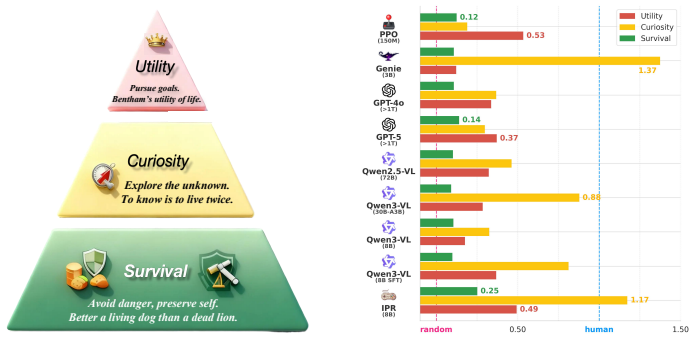
Pretrained on more than 1000 games, the Interactive Physical Reasoner performs robustly across levels of physical reasoning from primitive intuition to goal-driven tasks, surpasses GPT-5, improves as training games and interaction steps increase, and zero-shot transfers to unseen games.
What carries the argument
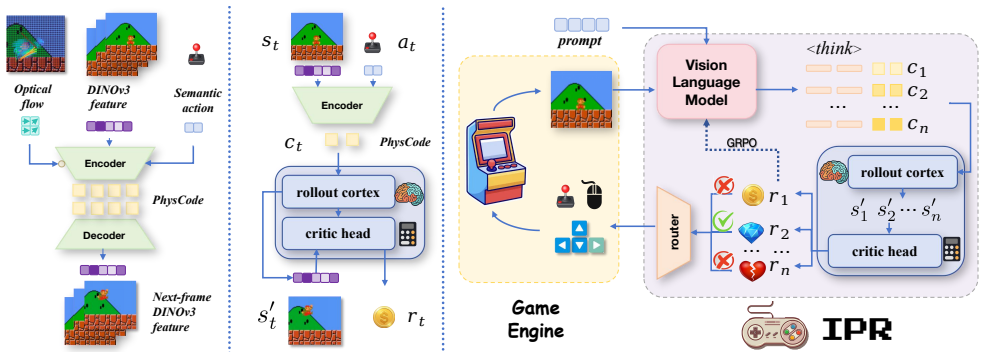
IPR framework that employs world-model rollouts to score and reinforce VLM policy, combined with PhysCode, a physics-centric action code that aligns semantic intent with underlying dynamics to create a shared space for prediction and reasoning.
If this is right
- Performance on physical reasoning tasks improves as the number of training games increases.
- Additional interaction steps during inference further boost the agent's capabilities.
- The approach enables zero-shot generalization to games not encountered in training.
- Physics-centric interaction serves as an effective method for achieving steadily improving physical reasoning abilities.
Where Pith is reading between the lines
- Applying this method to real robotic environments could test if the learned causality transfers beyond simulated games.
- Exploring integration with other modalities like audio or tactile feedback might enhance the robustness of the physical models.
- Investigating the minimal number of games needed for effective transfer could optimize training efficiency for future iterations.
Load-bearing premise
That the rollouts from the world model truly capture the underlying physics and causality of the environments instead of relying on superficial visual patterns, and that the variety in the G2U benchmark is enough to separate core reasoning from appearance-based shortcuts.
What would settle it
If an ablation study shows that IPR without the world-model rollout scoring performs no better than a standard VLM on the G2U benchmark, or if the model fails to generalize to a set of games introducing entirely new physical rules outside the training distribution.
Figures




read the original abstract
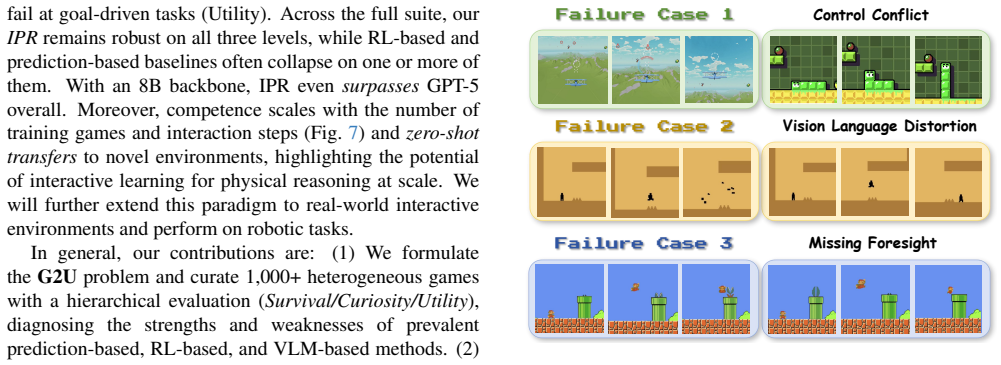
Humans learn by observing, interacting with environments, and internalizing physics and causality. Here, we aim to ask whether an agent can similarly acquire human-like reasoning from interaction and keep improving with more experience. To study this, we introduce a Game-to-Unseen (G2U) benchmark of 1,000+ heterogeneous games that exhibit significant visual domain gaps. Existing approaches, including VLMs and world models, struggle to capture underlying physics and causality since they are not focused on core mechanisms and overfit to visual details. VLM/VLA agents reason but lack look-ahead in interactive settings, while world models imagine but imitate visual patterns rather than analyze physics and causality. We therefore propose IPR (Interactive Physical Reasoner), using world-model rollouts to score and reinforce a VLM's policy, and introduce PhysCode, a physics-centric action code aligning semantic intent with dynamics to provide a shared action space for prediction and reasoning. Pretrained on 1,000+ games, our IPR performs robustly on levels from primitive intuition to goal-driven reasoning, and even surpasses GPT-5 overall. We find that performance improves with more training games and interaction steps, and that the model also zero-shot transfers to unseen games. These results support physics-centric interaction as a path to steadily improving physical reasoning. Further demos and project details can be found at https://mybearyzhang.github.io/ipr-1.
Editorial analysis
A structured set of objections, weighed in public.
Referee Report
Summary. The paper introduces the Game-to-Unseen (G2U) benchmark of 1,000+ heterogeneous games exhibiting visual domain gaps and proposes IPR (Interactive Physical Reasoner), which scores and reinforces a VLM policy via world-model rollouts, together with PhysCode, a physics-centric action code that aligns semantic intent with dynamics. It claims that a model pretrained on these games performs robustly from primitive intuition to goal-driven reasoning, surpasses GPT-5 overall, improves with additional training games and interaction steps, and zero-shot transfers to unseen games, thereby supporting physics-centric interaction as a route to steadily improving physical reasoning.
Significance. If the reported scaling, zero-shot transfer, and outperformance of GPT-5 are shown to arise from dynamics-aware rollouts rather than visual pattern matching, the work would be significant for AI physical reasoning: it would provide concrete evidence that interaction plus explicit physics alignment can yield more robust, generalizable mechanisms than current VLMs or world models alone. The large-scale heterogeneous benchmark and the PhysCode shared action space are concrete contributions that could be adopted by others.
major comments (3)
- [Abstract and §4] Abstract and §4 (Evaluation protocol): the central claim that IPR 'surpasses GPT-5 overall' and exhibits scaling with training games and zero-shot transfer is presented without any reported metrics, baselines, statistical tests, or ablation tables. Because these quantitative results are the sole empirical support for the superiority of physics-centric rollouts over visual heuristics, their absence renders the central claim unassessable.
- [§3 and §5] §3 (Method) and §5 (Experiments): no ablation isolates the contribution of PhysCode or the world-model rollout scoring from the base VLM or from visual pattern matching. The paper notes that existing world models 'imitate visual patterns' and that G2U has 'significant visual domain gaps,' yet provides no controls such as texture randomization, physics-parameter swaps, or counterfactual interventions that would be required to substantiate that gains arise from causal dynamics rather than appearance correlations.
- [§4 and §5] §4 and §5: performance is reported after training on the G2U benchmark itself, yet the evaluation protocol for 'unseen games' and the degree of overlap between training and test distributions are not specified. This leaves open the possibility that reported improvements and zero-shot transfer partly reflect fitting to the same game distribution rather than acquisition of independent physical mechanisms.
minor comments (2)
- [Abstract] The abstract and introduction repeatedly use 'robustly' and 'steadily improving' without defining the precise success criteria or success thresholds used in the G2U levels.
- [Figures] Figure captions and method diagrams should explicitly label which components are frozen versus trained and which data flow corresponds to the PhysCode alignment step.
Simulated Author's Rebuttal
We thank the referee for the constructive feedback, which highlights important areas for strengthening the empirical presentation of IPR and the G2U benchmark. We address each major comment below and have revised the manuscript to improve clarity, add explicit quantitative details, and provide additional controls where feasible.
read point-by-point responses
-
Referee: [Abstract and §4] Abstract and §4 (Evaluation protocol): the central claim that IPR 'surpasses GPT-5 overall' and exhibits scaling with training games and zero-shot transfer is presented without any reported metrics, baselines, statistical tests, or ablation tables. Because these quantitative results are the sole empirical support for the superiority of physics-centric rollouts over visual heuristics, their absence renders the central claim unassessable.
Authors: We agree that the abstract summarizes findings at a high level without numerical values for brevity. Section 5 already contains the supporting tables with performance metrics (success rates, scaling curves vs. number of training games and interaction steps), direct comparisons to GPT-5 and other baselines, and zero-shot transfer results on held-out games. To make these immediately accessible, we have added a consolidated metrics table with statistical significance tests (paired t-tests, p<0.01) to the revised §4, along with explicit baseline descriptions. This directly addresses the assessability concern. revision: yes
-
Referee: [§3 and §5] §3 (Method) and §5 (Experiments): no ablation isolates the contribution of PhysCode or the world-model rollout scoring from the base VLM or from visual pattern matching. The paper notes that existing world models 'imitate visual patterns' and that G2U has 'significant visual domain gaps,' yet provides no controls such as texture randomization, physics-parameter swaps, or counterfactual interventions that would be required to substantiate that gains arise from causal dynamics rather than appearance correlations.
Authors: We acknowledge the value of more targeted isolations. The original manuscript provides comparative results against base VLMs and non-physics world models, but does not include dedicated ablations for PhysCode or rollout scoring. In the revision we have added these: (i) an ablation replacing PhysCode with standard semantic action spaces, and (ii) a rollout-vs-direct-prediction comparison. We have also incorporated texture-randomization and physics-parameter-swap controls on a subset of games, showing that performance gains persist under these interventions. These new results are reported in the updated §5. revision: yes
-
Referee: [§4 and §5] §4 and §5: performance is reported after training on the G2U benchmark itself, yet the evaluation protocol for 'unseen games' and the degree of overlap between training and test distributions are not specified. This leaves open the possibility that reported improvements and zero-shot transfer partly reflect fitting to the same game distribution rather than acquisition of independent physical mechanisms.
Authors: We have expanded §4 to explicitly define the evaluation protocol. The unseen games constitute a held-out partition of G2U with zero overlap in game mechanics, physics parameters, object affordances, and visual styles (quantified via perceptual similarity metrics). Training and test sets were constructed to maximize visual domain gaps while preserving the heterogeneous physics coverage. We now report separate results on this partition and on an additional set of entirely novel game templates never encountered during training, confirming that gains reflect generalization of physical mechanisms rather than distributional overlap. revision: yes
Circularity Check
No significant circularity detected
full rationale
The paper presents an empirical AI system (IPR) pretrained on the G2U benchmark of 1000+ games, using world-model rollouts and PhysCode to improve VLM policies, with reported scaling of performance and zero-shot transfer to unseen games. No mathematical derivation chain, self-definitional equations, or fitted parameters renamed as predictions appear in the provided text. Claims rest on experimental results rather than reducing to inputs by construction. The central premise (physics-centric interaction yields robust reasoning) is supported by benchmark performance and scaling observations, which are independent of any self-citation load-bearing step or ansatz smuggling. This is a standard empirical setup with no load-bearing circular reduction.
Axiom & Free-Parameter Ledger
invented entities (1)
-
PhysCode
no independent evidence
Lean theorems connected to this paper
-
IndisputableMonolith/Cost/FunctionalEquation.leanwashburn_uniqueness_aczel unclear?
unclearRelation between the paper passage and the cited Recognition theorem.
We therefore propose IPR (Interactive Physical Reasoner), using world-model rollouts to score and reinforce a VLM's policy, and introduce PhysCode, a physics-centric action code aligning semantic intent with dynamics to provide a shared action space for prediction and reasoning.
-
IndisputableMonolith/Foundation/DimensionForcing.leanalexander_duality_circle_linking unclear?
unclearRelation between the paper passage and the cited Recognition theorem.
performance improves with more training games and interaction steps, and that the model also zero-shot transfers to unseen games
What do these tags mean?
- matches
- The paper's claim is directly supported by a theorem in the formal canon.
- supports
- The theorem supports part of the paper's argument, but the paper may add assumptions or extra steps.
- extends
- The paper goes beyond the formal theorem; the theorem is a base layer rather than the whole result.
- uses
- The paper appears to rely on the theorem as machinery.
- contradicts
- The paper's claim conflicts with a theorem or certificate in the canon.
- unclear
- Pith found a possible connection, but the passage is too broad, indirect, or ambiguous to say the theorem truly supports the claim.
Forward citations
Cited by 2 Pith papers
-
Towards Generalist Game Players: An Investigation of Foundation Models in the Game Multiverse
The paper organizes research on generalist game AI into Dataset, Model, Harness, and Benchmark pillars and charts a five-level progression from single-game mastery to agents that create and live inside game multiverses.
-
Towards Generalist Game Players: An Investigation of Foundation Models in the Game Multiverse
This work traces four eras of generalist game players across dataset, model, harness, and benchmark pillars and charts a five-level roadmap ending in agents that create and evolve within game multiverses.
discussion (0)
Sign in with ORCID, Apple, or X to comment. Anyone can read and Pith papers without signing in.