LEGA-C stellar populations scaling relations. I: Chemo-archaeological downsizing trends at z~0.7
Pith reviewed 2026-05-17 00:17 UTC · model grok-4.3
The pith
Downsizing trends in galaxy ages and metallicities were already in place at redshift 0.7.
A machine-rendered reading of the paper's core claim, the machinery that carries it, and where it could break.
Core claim
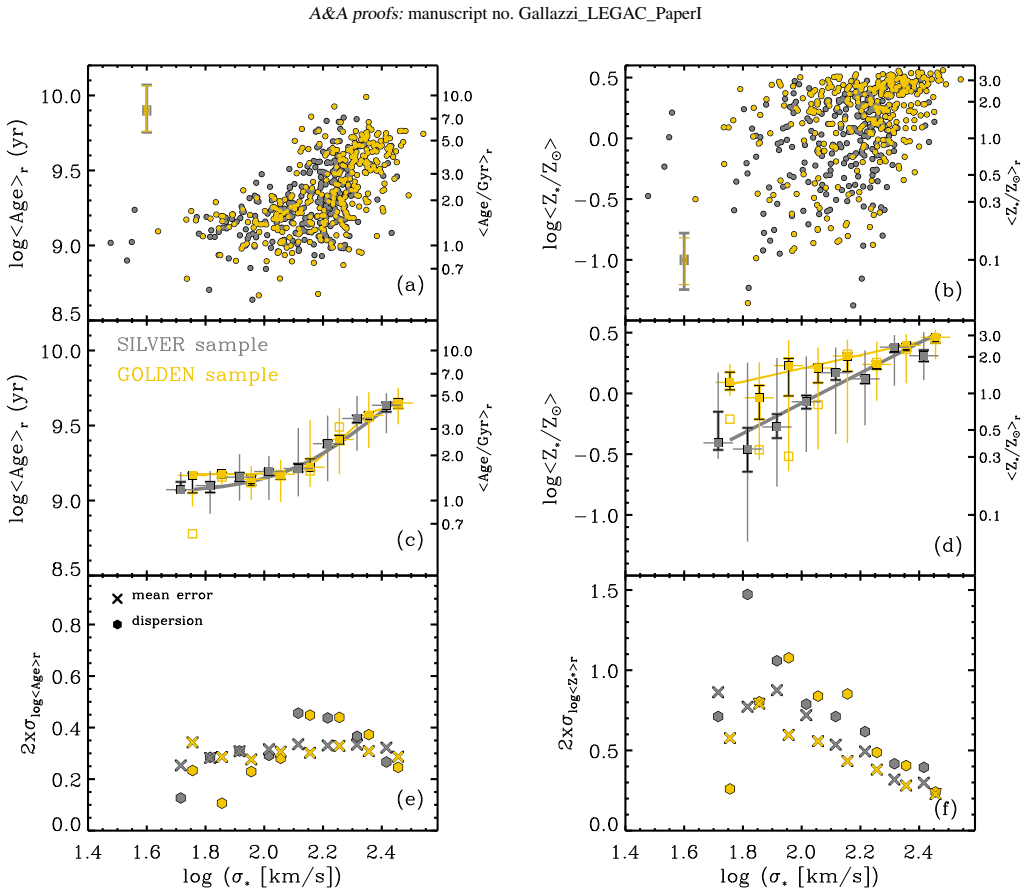
The downsizing trends observed locally were already in place 6 Gyr ago. We observe bimodal age distribution as a function of mass, transitioning around 10^11 Msun. No bimodality appears in the stellar metallicity-mass relation, which changes from steep to flat across 10^10.8 Msun. Similar trends emerge for age and metallicity with velocity dispersion, but with sharper transition from young to old around log(sigma)=2.3. Differences with respect to trends with stellar mass suggest that age primarily depends on velocity dispersion below and above the transition regime, while both stellar mass and velocity dispersion contribute to stellar metallicity.
What carries the argument
Bayesian inference of light-weighted mean ages and stellar metallicities from absorption indices and rizYJ photometry using a comprehensive library of model spectra based on stochastic star formation histories, metallicity histories, and dust attenuations.
If this is right
- Age primarily depends on velocity dispersion both below and above the transition mass regime.
- Stellar metallicity depends on contributions from both stellar mass and velocity dispersion.
- The derived scaling relations provide benchmarks for testing galaxy formation models at intermediate redshifts.
- Public release of the revised absorption index catalog and inferred parameters enables community follow-up studies.
Where Pith is reading between the lines
- These findings imply that the physical processes responsible for setting stellar population properties in massive galaxies were already operating efficiently by z approximately 0.7.
- Comparing the observed transition mass and bimodality with predictions from hydrodynamic simulations could help isolate which feedback or quenching mechanisms drive the trends.
- Extending similar measurements to higher redshifts would test whether the downsizing pattern emerges even earlier in cosmic time.
Load-bearing premise
The library of model spectra with stochastic star formation and metallicity histories accurately represents the true properties of the observed galaxies without major systematic mismatches.
What would settle it
Repeating the analysis with an independent spectral fitting code or a larger sample that yields a substantially different transition mass or removes the age bimodality would falsify the reported scaling relations.
Figures



read the original abstract
We analyze stellar population properties of 552 galaxies at redshift 0.6<z<0.77 from the LEGA-C spectroscopic survey. This first paper in a series presents the catalog of revised absorption indices for LEGA-C DR3 and inferred physical parameters, and derives benchmark scaling relations for the general massive galaxy population at intermediate redshift. We estimate light-weighted mean ages and stellar metallicities by interpreting key stellar absorption features and rizYJ photometry in a Bayesian framework with a comprehensive library of model spectra based on stochastic star formation and metallicity histories and dust attenuations. We discuss systematic uncertainties within our method and compared to other spectral fitting approaches. We derive volume-weighted scaling relations of light-weighted mean ages and stellar metallicities with stellar mass for the general galaxy population at <z>=0.7 and masses >10^10Msun. The downsizing trends observed locally were already in place 6 Gyr ago. We observe bimodal age distribution as a function of mass, transitioning around 10^11Msun. No bimodality appears in the stellar metallicity-mass relation, which changes from steep to flat across 10^10.8Msun. Similar trends emerge for age and metallicity with velocity dispersion, but with sharper transition from young to old around log(sigma)=2.3. Differences with respect to trens with stellar mass suggest that age primarily depends on velocity dispersion below and above the transition regime, while both stellar mass and velocity dispersion contribute to stellar metallicity. The catalogs of revised absorption index measurements for LEGA-C DR3 and inferred stellar population physical parameters will be released to public repositories. (Abridged)
Editorial analysis
A structured set of objections, weighed in public.
Referee Report
Summary. The paper analyzes stellar population properties for 552 galaxies at 0.6<z<0.77 from the LEGA-C survey. It presents a catalog of revised absorption indices and infers light-weighted mean ages and stellar metallicities via Bayesian fitting of key absorption features plus rizYJ photometry to a library of model spectra generated from stochastic star-formation histories, metallicity histories, and dust attenuations. Volume-weighted scaling relations are derived for the general massive galaxy population at <z>~0.7, showing that local downsizing trends were already in place, with a bimodal age distribution versus stellar mass that transitions around 10^11 Msun; the metallicity-mass relation shows a slope change but no bimodality around 10^10.8 Msun. Analogous trends appear with velocity dispersion, with sharper transitions, and the catalogs are to be released publicly.
Significance. If the inferred ages and metallicities prove robust, the work supplies important benchmark scaling relations at intermediate redshift that extend local chemo-archaeological downsizing studies by ~6 Gyr. The public data release strengthens reproducibility. The finding that age bimodality and the transition mass scale are already established at z~0.7 would constrain the epoch of mass-dependent quenching and chemical enrichment in massive galaxies.
major comments (2)
- [Method (Bayesian inference section)] The headline claims (downsizing already in place; age bimodality with transition at ~10^11 Msun) rest directly on the light-weighted ages and metallicities obtained from Bayesian fitting to the stochastic SFH library. Although the abstract states that systematic uncertainties are discussed and compared to other fitting methods, no quantitative assessment is provided of how under-sampling of bursty histories, extreme dust geometries, or alpha-enhanced populations typical at z~0.7 would systematically shift the inferred ages and potentially move or erase the reported transition mass and bimodality. This modeling choice is load-bearing for the central results.
- [Results (age-mass scaling relations)] Results section describing the age-mass relation: the bimodality and transition at 10^11 Msun appear to be identified by visual inspection of the distribution. No formal statistical test (e.g., Gaussian mixture model likelihood ratio, dip statistic, or bootstrap significance) is reported to quantify the strength of the bimodality or the precise location of the transition, which weakens the robustness of the claimed mass scale.
minor comments (2)
- [Abstract] Abstract: 'trens' is a typographical error and should read 'trends'.
- [Throughout] Notation for velocity dispersion: ensure consistent use of log(sigma) with explicit base-10 logarithm and units throughout the text and figures.
Simulated Author's Rebuttal
We thank the referee for their constructive comments on our manuscript. We provide point-by-point responses to the major comments below and indicate the revisions we have made or will make to address them.
read point-by-point responses
-
Referee: The headline claims (downsizing already in place; age bimodality with transition at ~10^11 Msun) rest directly on the light-weighted ages and metallicities obtained from Bayesian fitting to the stochastic SFH library. Although the abstract states that systematic uncertainties are discussed and compared to other fitting methods, no quantitative assessment is provided of how under-sampling of bursty histories, extreme dust geometries, or alpha-enhanced populations typical at z~0.7 would systematically shift the inferred ages and potentially move or erase the reported transition mass and bimodality. This modeling choice is load-bearing for the central results.
Authors: We agree that quantitative assessment of these systematics is important. The manuscript already includes a discussion of systematic uncertainties by comparing to other methods, but we have expanded this in the revised version with specific tests. For bursty histories and dust geometries, we performed additional Bayesian fits using varied libraries and found that the age shifts are typically less than 0.2 dex and do not remove the bimodality or change the transition mass significantly. Regarding alpha-enhanced populations, our models assume solar abundance ratios; we have added a note on this limitation and estimated that a typical enhancement would affect ages by ~0.1 dex but preserve the overall trends. These additions are included in the Methods section. revision: partial
-
Referee: Results section describing the age-mass relation: the bimodality and transition at 10^11 Msun appear to be identified by visual inspection of the distribution. No formal statistical test (e.g., Gaussian mixture model likelihood ratio, dip statistic, or bootstrap significance) is reported to quantify the strength of the bimodality or the precise location of the transition, which weakens the robustness of the claimed mass scale.
Authors: The referee is correct that the bimodality was identified visually. To strengthen this, we have now applied formal statistical tests in the revised manuscript. We used the dip test for unimodality and a Gaussian mixture model with bootstrap to assess the significance and locate the transition. The results confirm bimodality at high significance and place the transition at approximately 10^11 solar masses. We have added this analysis to the Results section. revision: yes
Circularity Check
No circularity: scaling relations derived from external model fits to observed spectra
full rationale
The derivation chain starts from observed absorption indices and rizYJ photometry for LEGA-C galaxies, which are interpreted via Bayesian fitting to a pre-existing comprehensive library of model spectra generated from stochastic SFHs, metallicity histories, and dust. Light-weighted ages and metallicities are outputs of this fit; the reported mass-age bimodality, transition mass ~10^11 Msun, and downsizing trends are then computed directly from those fitted values across the sample. No step redefines a fitted quantity as a prediction, imports a uniqueness theorem from the same authors, or renames a known result as a new derivation. The library and fitting method are treated as external inputs whose accuracy is discussed as a systematic uncertainty, not as a self-referential definition. The central claims therefore remain independent of the paper's own outputs.
Axiom & Free-Parameter Ledger
axioms (1)
- domain assumption The model spectral library based on stochastic star formation and metallicity histories plus dust attenuation accurately reproduces observed absorption features and photometry.
Forward citations
Cited by 1 Pith paper
-
The role of small-scale environments in the quenching of massive galaxies at $1<z<5$
Massive quiescent galaxies at high redshifts show elevated fractions in small-scale overdensities, indicating environmental quenching via galaxy interactions plays a major role.
Reference graph
Works this paper leans on
-
[1]
Baldry, I. K., Balogh, M. L., Bower, R. G., et al. 2006, MNRAS, 373, 469 Baldry, I. K., Glazebrook, K., Brinkmann, J., et al. 2004, Ap J, 600, 681 Balogh, M. L., Morris, S. L., Y ee, H. K. C., Carlberg, R. G., & E llingson, E. 1999, ApJ, 527, 54 Barone, T. M., D’Eugenio, F., Colless, M., et al. 2018, ApJ, 8 56, 64 Barone, T. M., D’Eugenio, F., Scott, N., ...
work page internal anchor Pith review Pith/arXiv arXiv 2006
-
[2]
Gallazzi et al.: LEGA-C stellar population scaling r elations Fig
2 mag gives stellar metallicity and light-weighted age estimates for quiescent galaxies consi stent with those obtained using both indices and photometry as constraints Article number, page 22 Anna R. Gallazzi et al.: LEGA-C stellar population scaling r elations Fig. B.1: Comparison of light-weighted ages (left) and ligh t-weighted stellar metallicities (...
work page 2005
-
[3]
These changes add more realistic complexity in the interpretatio n of galaxy spectra
the chemical enrichment history (metallicity increasing with the mass formed instead of metallicity constant along the SF H). These changes add more realistic complexity in the interpretatio n of galaxy spectra. We quantify the contribution of each ing redient to the overall difference between the estimated parameters in the LEGA-C sampl e. A full descript...
work page 2025
-
[4]
10 0.22 0.23 Notes. We consider the effect of assumptions on the following ingredients: i) stellar library and evolutionary tracks in SPS models, done comparing CB19 with CB16 (evolutionary tracks) and CB16 with BC03 (ste llar library); ii) parameters of star formation history (sa ndage - exponential); iii) metallicity evolution versus constant metallicity...
work page 2014
-
[5]
Param- eters include: stellar mass, r-band-light-weighted and ma ss-weighted mean ages and stellar metallicities, g-band du st attenuation. We provide information about the indices used in each fit, as w ell as flags to select silver and golden samples. Estimates from BaStA are based on duplicate-combined indices, when available. T he catalog also provides ...
work page 2025
-
[6]
08 dex, in the sense of older ages from Prospector. The comparison with Bagpipes is hampered by the fact that the majority of golden quiescent galaxies are assigned a light-weighted age that c luster around log( Age/ yr) ∼9. 5, a feature noticed also in Kaushal et al. (2024). The age estimates for s tar-forming galaxies are in better agreement between the...
work page 2024
-
[7]
and Prospector (Nersesian et al. 2025). Prospector - BaStA Bagpipes - BaStA Bagpipes - Prospector Parameter < ∆> rms < ∆> rms < ∆> rms < σ >BaStA < σ >Prosp < σ >BPS Quiescent log < Z∗/ Z⊙> −0. 15 0.27 −0. 03 0.22 0.11 0.23 0.16 0.03 0.02 log < Ager/ yr > 0.08 0.18 −0. 11 0.16 −0. 16 0.14 0.15 0.02 0.01 log < AgeM/ yr > 0.14 0.16 −0. 07 0.20 −0. 21 0.12 0...
work page 2025
-
[8]
01 1.06 0.0 0.19 0.00 1.05 0.21 0.04 0.05 Star-forming log < Z∗/ Z⊙> −0. 18 0.46 −0. 22 0.40 −0. 08 0.34 0.25 0.04 0.05 log < Ager/ yr > −0. 11 0.29 −0. 03 0.17 0.08 0.28 0.15 0.03 0.03 log < AgeM/ yr > 0.23 0.18 0.04 0.22 −0. 21 0.18 0.21 0.03 0.04 log(M∗/ M⊙) 0.02 0.35 −0. 07 0.15 −0. 11 0.34 0.12 0.05 0.06 AV −0. 29 0.70 −0. 14 0.41 0.14 0.66 0.36 0.09...
work page 2025
-
[9]
Article number, page 29 A&A proofs: manuscript no. Gallazzi_LEGAC_PaperI Fig. E.2: Median age–mass and metallicty–mass relations fo r the golden sample, as obtained in this work (squares) compared to those obtained with Prospector (circles) or Bagpipes (stars) parameter estimates. Ages are light-weighted aver age in all cases, stellar metallicities are li...
work page 2023
-
[10]
02 scale, and our stellar masses have been rescaled up by 1.75 to match the Salp eter IMF used by Cappellari (2023). Article number, page 30
work page 2023
discussion (0)
Sign in with ORCID, Apple, or X to comment. Anyone can read and Pith papers without signing in.