Recognition: unknown
The role of small-scale environments in the quenching of massive galaxies at 1<z<5
Pith reviewed 2026-05-10 16:06 UTC · model grok-4.3
The pith
Massive galaxies that stop forming stars are more common in small-scale overdensities at redshifts above 2, showing that mergers and interactions drive early quenching.
A machine-rendered reading of the paper's core claim, the machinery that carries it, and where it could break.
Core claim
Using star-formation-rate criteria to identify quiescent galaxies, the fraction of such objects is elevated in group- or cluster-like environments across 1<z<5, and the excess is particularly pronounced within small-scale overdensities of less than 100-300 pkpc at z>2, indicating that environmental quenching driven primarily by galaxy mergers and interactions plays a major role in the formation of massive quiescent galaxies at high redshifts.
What carries the argument
SFR-based classification of quiescent versus star-forming galaxies combined with counts of neighboring galaxies on small physical scales to quantify local overdensities.
Load-bearing premise
The star-formation-rate selection cleanly identifies galaxies that have truly stopped forming stars without significant misclassification, and the observed small-scale overdensities correspond to real physical associations rather than chance line-of-sight alignments.
What would settle it
Deep spectroscopic follow-up that either finds no increase in the quiescent fraction within small overdensities or reveals substantial contamination of the quiescent sample by still-star-forming galaxies would undermine the environmental-quenching interpretation.
Figures



read the original abstract
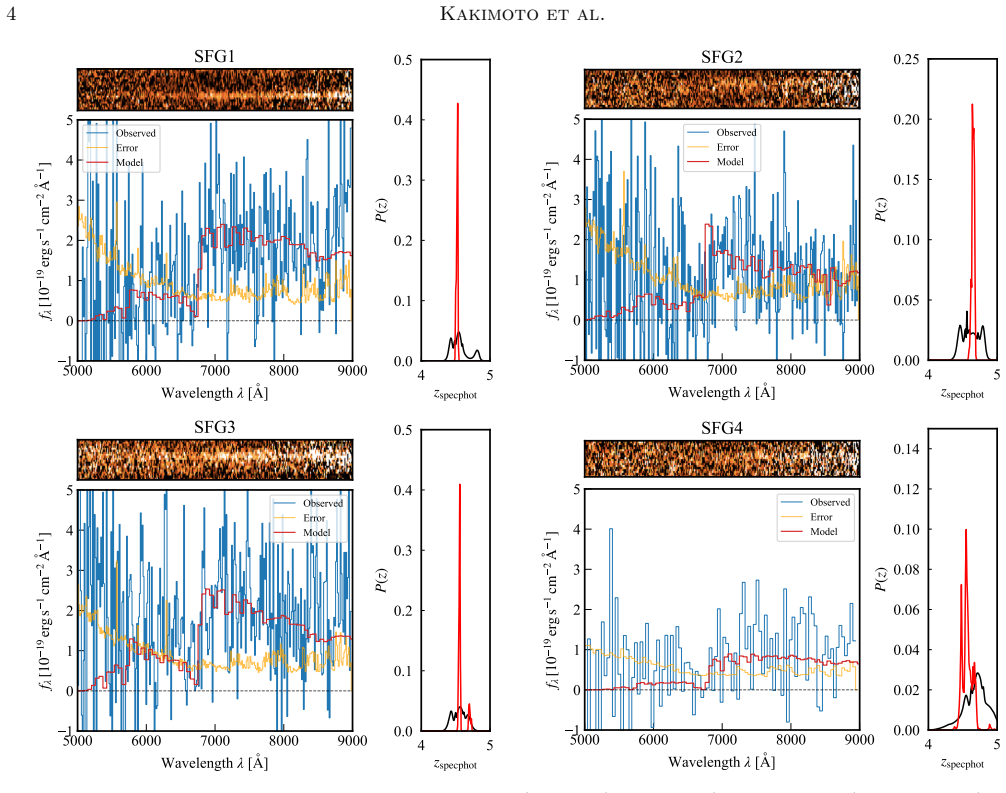
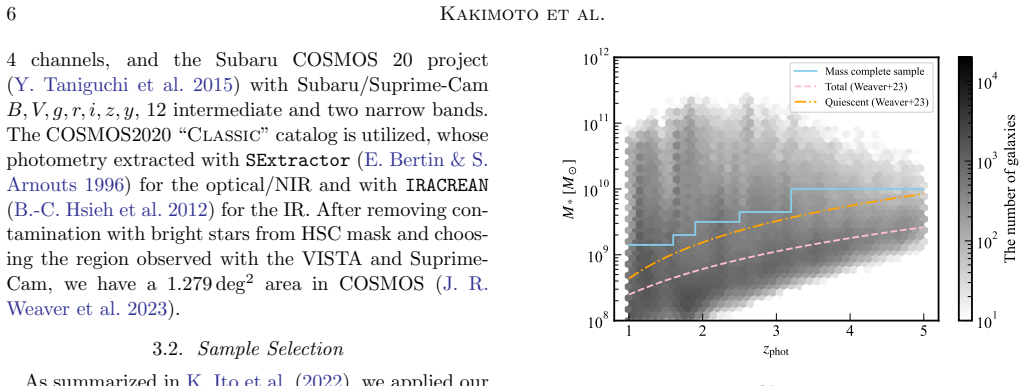
Massive quiescent galaxies (QGs) at high redshifts are likely progenitors of massive elliptical galaxies in the local Universe. Recent observations, such as the discovery of QGs in overdensity (galaxy groups and proto-clusters) at high redshifts, have highlighted the importance of the relationship between star formation activity in galaxies and the surrounding environment. We spectroscopically confirm a galaxy group associated with a massive QG at $z_\mathrm{spec}=4.53$ from the Lyman break feature using Subaru/FOCAS. This group consists of at least three star-forming galaxies within 150 pkpc of the QG, which suggests the importance of physical association with other galaxies for galaxy quenching. In order to understand the role of the surrounding environment, we also perform a statistical analysis to characterize the typical environment of QGs at high redshifts. By selecting QGs using the SFR-based selection in the COSMOS field, we find that the fraction of QGs is higher in group or cluster-like environment at $1<z_\mathrm{phot}<5$. This means some of the processes that regulate galaxy quenching occurs more frequently in the overdensity regions. In particular, the elevated fraction of QGs within small-scale overdensities ($<100\mathrm{-}300$ pkpc) at $z>2$ demonstrates that environmental quenching (primarily driven by galaxy mergers and interactions) plays a major role in the formation and evolution of massive QGs at high redshifts.
Editorial analysis
A structured set of objections, weighed in public.
Referee Report
Summary. The manuscript spectroscopically confirms a galaxy group at z_spec=4.53 around a massive quiescent galaxy using Subaru/FOCAS, with at least three star-forming galaxies within 150 pkpc, and performs a statistical analysis of quiescent galaxy (QG) environments in the COSMOS field. Using SFR-based selection and photometric redshifts for 1<z_phot<5, it reports higher QG fractions in group/cluster-like overdensities, with an elevated signal at small scales (<100-300 pkpc) for z>2, concluding that environmental quenching (primarily mergers and interactions) plays a major role in massive QG formation and evolution at high redshift.
Significance. The single spectroscopically confirmed group provides direct evidence of physical association at z>4. If the statistical small-scale overdensity signal survives rigorous checks for projection effects and selection biases, the result would add useful observational support for environmental contributions to quenching at 1<z<5, an area where current consensus is still developing. The paper's reliance on direct counts and fractions (rather than parameter-fitted models) is a methodological strength.
major comments (3)
- [COSMOS statistical analysis and abstract] The central claim that elevated QG fractions within <100-300 pkpc overdensities at z>2 demonstrate environmental quenching via mergers rests on interpreting these as physical associations. However, the statistical analysis (described in the abstract and the COSMOS results section) uses photometric redshifts without quantifying line-of-sight projection contamination. At z≈3, photo-z scatter σ_z/(1+z)≈0.02 corresponds to ~20 Mpc comoving uncertainty (using c/H(z)≈980 Mpc per unit redshift), while 100-300 pkpc physical is only 0.4-1.2 Mpc comoving; this scale mismatch means apparent small-scale overdensities are likely dominated by chance alignments rather than true environments.
- [Methods and results sections on statistical analysis] The manuscript lacks essential details on sample completeness, error bars or uncertainties on the reported QG fractions, definition of control samples for field versus overdense regions, and any robustness tests (e.g., varying photo-z cuts or mock catalogs) for the environmental trends. These omissions make it impossible to evaluate whether the reported elevation in overdense regions is statistically significant or driven by selection effects.
- [Sample selection and abstract] The SFR-based selection of QGs is assumed to cleanly separate quiescent from star-forming galaxies without significant contamination or bias from dust-obscured star formation or other effects, but no validation (e.g., via UVJ colors, specific SFR thresholds with uncertainties, or cross-checks with the spectroscopic subsample) is provided. This assumption is load-bearing for both the single-group interpretation and the population statistics.
minor comments (2)
- [Abstract] The abstract and text should more explicitly separate the single spectroscopically confirmed group (a strength) from the photometric statistical results to avoid conflating their reliability.
- [Throughout] Notation for physical versus comoving scales and redshift ranges should be used consistently (e.g., always specifying pkpc vs. ckpc and z_spec vs. z_phot).
Simulated Author's Rebuttal
We thank the referee for their constructive and detailed comments, which have identified important areas for clarification and strengthening of our analysis. We address each major point below and will incorporate the suggested improvements into the revised manuscript.
read point-by-point responses
-
Referee: [COSMOS statistical analysis and abstract] The central claim that elevated QG fractions within <100-300 pkpc overdensities at z>2 demonstrate environmental quenching via mergers rests on interpreting these as physical associations. However, the statistical analysis (described in the abstract and the COSMOS results section) uses photometric redshifts without quantifying line-of-sight projection contamination. At z≈3, photo-z scatter σ_z/(1+z)≈0.02 corresponds to ~20 Mpc comoving uncertainty (using c/H(z)≈980 Mpc per unit redshift), while 100-300 pkpc physical is only 0.4-1.2 Mpc comoving; this scale mismatch means apparent small-scale overdensities are likely dominated by chance alignments rather than true environments.
Authors: We thank the referee for this important observation on projection effects. The scale mismatch between photo-z uncertainties and the physical scales probed is a valid concern that could affect the interpretation of small-scale signals. While our analysis uses a redshift window matched to the expected environment size, we did not provide an explicit quantification of contamination. In the revised manuscript, we will add a dedicated subsection estimating the line-of-sight contamination fraction using the reported photo-z error distribution and will include a robustness test by cross-matching with available spectroscopic redshifts in the COSMOS field to assess the purity of the overdensity signal at <300 pkpc. revision: yes
-
Referee: [Methods and results sections on statistical analysis] The manuscript lacks essential details on sample completeness, error bars or uncertainties on the reported QG fractions, definition of control samples for field versus overdense regions, and any robustness tests (e.g., varying photo-z cuts or mock catalogs) for the environmental trends. These omissions make it impossible to evaluate whether the reported elevation in overdense regions is statistically significant or driven by selection effects.
Authors: We agree that these methodological details are essential for assessing the reliability of the results. The original submission emphasized the primary findings but did not fully document these aspects. In the revised version, we will expand the Methods section to include: (i) completeness estimates derived from the COSMOS catalog as a function of mass and redshift, (ii) binomial uncertainties on all reported QG fractions, (iii) an explicit definition of the control (field) sample using a density threshold below the median, and (iv) robustness tests including variations in photo-z quality cuts and a simple mock-catalog assessment of selection biases. These additions will be accompanied by updated figures and tables. revision: yes
-
Referee: [Sample selection and abstract] The SFR-based selection of QGs is assumed to cleanly separate quiescent from star-forming galaxies without significant contamination or bias from dust-obscured star formation or other effects, but no validation (e.g., via UVJ colors, specific SFR thresholds with uncertainties, or cross-checks with the spectroscopic subsample) is provided. This assumption is load-bearing for both the single-group interpretation and the population statistics.
Authors: The SFR-based selection follows established criteria from the COSMOS literature. We acknowledge that dust-obscured star formation could introduce contamination and that explicit validation strengthens the claim. For the statistical sample, we will add a direct comparison between SFR-selected and UVJ-selected quiescent samples in the revised manuscript to demonstrate consistency. For the spectroscopically confirmed z=4.53 group, the central galaxy's quiescent nature is supported by its Lyman-break spectrum and absence of emission lines; we will include the specific sSFR threshold with associated uncertainties and note the limited size of the spectroscopic subsample for cross-checks. revision: partial
Circularity Check
No circularity: observational counts and fractions
full rationale
The paper reports a single spectroscopic confirmation plus direct statistical fractions of SFR-selected QGs in projected overdensities from COSMOS photometry. No equations, fitted parameters, or predictions are defined in terms of the target result; the central claim follows from counting galaxies in bins of local density and redshift. This is self-contained observational analysis with no load-bearing self-citation chains or ansatz smuggling.
Axiom & Free-Parameter Ledger
axioms (1)
- standard math Flat Lambda-CDM cosmology with standard parameters for converting redshifts to physical distances in pkpc
Reference graph
Works this paper leans on
-
[1]
Aihara, H., AlSayyad, Y., Ando, M., et al. 2019, PASJ, 71, 114, doi: 10.1093/pasj/psz103
-
[2]
Aihara, H., AlSayyad, Y., Ando, M., et al. 2022, PASJ, 74, 247, doi: 10.1093/pasj/psab122 14Kakimoto et al
-
[3]
Alberts, S., & Noble, A. 2022, Universe, 8, 554, doi: 10.3390/universe8110554
-
[4]
2006, ApJL, 645, L9, doi: 10.1086/505652 Astropy Collaboration, Robitaille, T
Ando, M., Ohta, K., Iwata, I., et al. 2006, ApJL, 645, L9, doi: 10.1086/505652 Astropy Collaboration, Robitaille, T. P., Tollerud, E. J., et al. 2013, A&A, 558, A33, doi: 10.1051/0004-6361/201322068 Astropy Collaboration, Price-Whelan, A. M., Sip˝ ocz, B. M., et al. 2018, AJ, 156, 123, doi: 10.3847/1538-3881/aabc4f
-
[5]
Monthly Notices of the Royal Astronomical Society 373, 1195–1202
Baldry, I. K., Balogh, M. L., Bower, R. G., et al. 2006, MNRAS, 373, 469, doi: 10.1111/j.1365-2966.2006.11081.x
-
[6]
, year = 2000, month = sep, volume =
Balogh, M. L., Navarro, J. F., & Morris, S. L. 2000, ApJ, 540, 113, doi: 10.1086/309323
-
[7]
S., Marchesini, D., Wechsler, R
Behroozi, P. S., Marchesini, D., Wechsler, R. H., et al. 2013, ApJL, 777, L10, doi: 10.1088/2041-8205/777/1/L10
-
[8]
Bellstedt, S., Robotham, A. S. G., Driver, S. P., et al. 2020, MNRAS, 498, 5581, doi: 10.1093/mnras/staa2620
-
[9]
Bertin, E., & Arnouts, S. 1996, A&AS, 117, 393, doi: 10.1051/aas:1996164
-
[10]
Bickley, R. W., Ellison, S. L., Patton, D. R., et al. 2022, MNRAS, 514, 3294, doi: 10.1093/mnras/stac1500
-
[11]
Bickley, R. W., Ellison, S. L., Patton, D. R., & Wilkinson, S. 2023, MNRAS, 519, 6149, doi: 10.1093/mnras/stad088
-
[12]
Blanton, M. R., & Berlind, A. A. 2007, ApJ, 664, 791, doi: 10.1086/512478
-
[13]
, archivePrefix = "arXiv", eprint =
Bohlin, R. C., Gordon, K. D., & Tremblay, P. E. 2014, PASP, 126, 711, doi: 10.1086/677655
-
[14]
2016, A&A, 596, A11, doi: 10.1051/0004-6361/201629221
Boselli, A., Roehlly, Y., Fossati, M., et al. 2016, A&A, 596, A11, doi: 10.1051/0004-6361/201629221
-
[15]
Bower, R. G., Lucey, J. R., & Ellis, R. S. 1992, MNRAS, 254, 601, doi: 10.1093/mnras/254.4.601
-
[16]
Brodwin, M., Stanford, S. A., Gonzalez, A. H., et al. 2013, ApJ, 779, 138, doi: 10.1088/0004-637X/779/2/138
-
[17]
Bruzual, G., & Charlot, S. 2003, MNRAS, 344, 1000, doi: 10.1046/j.1365-8711.2003.06897.x
-
[18]
1984, ApJ, 285, 426, doi: 10.1086/162519
Butcher, H., & Oemler, A., J. 1984, ApJ, 285, 426, doi: 10.1086/162519
-
[19]
Calzetti, D., Armus, L., Bohlin, R. C., et al. 2000, ApJ, 533, 682, doi: 10.1086/308692
work page internal anchor Pith review doi:10.1086/308692 2000
-
[20]
2011, PASA, 28, 128, doi: 10.1071/AS10046
Cameron, E. 2011, PASA, 28, 128, doi: 10.1071/AS10046
-
[21]
Carnall, A. C., McLure, R. J., Dunlop, J. S., et al. 2023a, Nature, 619, 716, doi: 10.1038/s41586-023-06158-6
-
[22]
Carnall, A. C., McLeod, D. J., McLure, R. J., et al. 2023b, MNRAS, 520, 3974, doi: 10.1093/mnras/stad369
-
[23]
Carnall, A. C., Cullen, F., McLure, R. J., et al. 2024, MNRAS, 534, 325, doi: 10.1093/mnras/stae2092
-
[24]
Casey, C. M., Kartaltepe, J. S., Drakos, N. E., et al. 2023, ApJ, 954, 31, doi: 10.3847/1538-4357/acc2bc
-
[25]
Chabrier, G. 2003, PASP, 115, 763, doi: 10.1086/376392
work page internal anchor Pith review doi:10.1086/376392 2003
-
[26]
2020, ApJ, 890, 7, doi: 10.3847/1538-4357/ab61fd
Chartab, N., Mobasher, B., Darvish, B., et al. 2020, ApJ, 890, 7, doi: 10.3847/1538-4357/ab61fd
-
[27]
2013, ApJ, 779, 127, doi: 10.1088/0004-637X/779/2/127
Chiang, Y.-K., Overzier, R., & Gebhardt, K. 2013, ApJ, 779, 127, doi: 10.1088/0004-637X/779/2/127
-
[28]
A., Gebhardt, K., & Henriques, B
Chiang, Y.-K., Overzier, R. A., Gebhardt, K., & Henriques, B. 2017, ApJL, 844, L23, doi: 10.3847/2041-8213/aa7e7b
-
[29]
2016, ApJ, 823, 102, doi: 10.3847/0004-637X/823/2/102
Choi, J., Dotter, A., Conroy, C., et al. 2016, ApJ, 823, 102, doi: 10.3847/0004-637X/823/2/102
work page internal anchor Pith review doi:10.3847/0004-637x/823/2/102 2016
-
[30]
Conroy, C., & Gunn, J. E. 2010, ApJ, 712, 833, doi: 10.1088/0004-637X/712/2/833
-
[31]
Conroy, C., Gunn, J. E., & White, M. 2009, ApJ, 699, 486, doi: 10.1088/0004-637X/699/1/486
work page internal anchor Pith review doi:10.1088/0004-637x/699/1/486 2009
-
[32]
Coogan, R. T., Daddi, E., Sargent, M. T., et al. 2018, MNRAS, 479, 703, doi: 10.1093/mnras/sty1446
-
[33]
2016, ApJ, 825, 113, doi: 10.3847/0004-637X/825/2/113 de Graaff, A., Setton, D
Darvish, B., Mobasher, B., Sobral, D., et al. 2016, ApJ, 825, 113, doi: 10.3847/0004-637X/825/2/113 de Graaff, A., Setton, D. J., Brammer, G., et al. 2025, Nature Astronomy, 9, 280, doi: 10.1038/s41550-024-02424-3 De Lucia, G., Fontanot, F., Hirschmann, M., & Xie, L. 2025a, arXiv e-prints, arXiv:2502.01724, doi: 10.48550/arXiv.2502.01724 De Lucia, G., Fon...
-
[34]
2021, MNRAS, 506, 4760, doi: 10.1093/mnras/stab1950
Donnari, M., Pillepich, A., Nelson, D., et al. 2021, MNRAS, 506, 4760, doi: 10.1093/mnras/stab1950
-
[35]
2016, ApJS, 222, 8, doi: 10.3847/0067-0049/222/1/8
Dotter, A. 2016, ApJS, 222, 8, doi: 10.3847/0067-0049/222/1/8
-
[36]
Dressler, A. 1980, ApJ, 236, 351, doi: 10.1086/157753
-
[37]
Dubois, Y., Peirani, S., Pichon, C., et al. 2016, MNRAS, 463, 3948, doi: 10.1093/mnras/stw2265
-
[38]
Edward, A. H., Balogh, M. L., Bah´ e, Y. M., et al. 2024, MNRAS, 527, 8598, doi: 10.1093/mnras/stad3751
-
[39]
2024, The Open Journal of Astrophysics, 7, 121, doi: 10.33232/001c.127779
Ellison, S., Ferreira, L., Wild, V., et al. 2024, The Open Journal of Astrophysics, 7, 121, doi: 10.33232/001c.127779
-
[40]
2025, The Open Journal of Astrophysics, 8, 12, doi: 10.33232/001c.129235
Ellison, S., Ferreira, L., Bickley, R., et al. 2025, The Open Journal of Astrophysics, 8, 12, doi: 10.33232/001c.129235
-
[41]
Ellison, S. L., Wilkinson, S., Woo, J., et al. 2022, MNRAS, 517, L92, doi: 10.1093/mnrasl/slac109 Euclid Collaboration, Moneti, A., McCracken, H. J., et al. 2022, A&A, 658, A126, doi: 10.1051/0004-6361/202142361 Falc´ on-Barroso, J., S´ anchez-Bl´ azquez, P., Vazdekis, A., et al. 2011, A&A, 532, A95, doi: 10.1051/0004-6361/201116842 Environments of quiesc...
-
[42]
Foreman-Mackey, D., Hogg, D. W., Lang, D., & Goodman, J. 2013, PASP, 125, 306, doi: 10.1086/670067
-
[43]
Forrest, B., Lemaux, B. C., Shah, E. A., et al. 2024, ApJ, 971, 169, doi: 10.3847/1538-4357/ad5e78
-
[44]
Gallazzi, A., Charlot, S., Brinchmann, J., White, S. D. M., & Tremonti, C. A. 2005, MNRAS, 362, 41, doi: 10.1111/j.1365-2966.2005.09321.x
-
[45]
LEGA-C stellar populations scaling relations. I: Chemo-archaeological downsizing trends at z~0.7
Gallazzi, A. R., Zibetti, S., van der Wel, A., et al. 2025, arXiv e-prints, arXiv:2512.07952, doi: 10.48550/arXiv.2512.07952
work page internal anchor Pith review Pith/arXiv arXiv doi:10.48550/arxiv.2512.07952 2025
-
[46]
2017, Nature, 544, 71, doi: 10.1038/nature21680 G´ omez-Guijarro, C., Toft, S., Karim, A., et al
Glazebrook, K., Schreiber, C., Labb´ e, I., et al. 2017, Nature, 544, 71, doi: 10.1038/nature21680 G´ omez-Guijarro, C., Toft, S., Karim, A., et al. 2018, ApJ, 856, 121, doi: 10.3847/1538-4357/aab206
-
[47]
Gould, K. M. L., Brammer, G., Valentino, F., et al. 2023, AJ, 165, 248, doi: 10.3847/1538-3881/accadc
-
[48]
, year = 1972, month = aug, volume =
Gunn, J. E., & Gott, J. Richard, I. 1972, ApJ, 176, 1, doi: 10.1086/151605
-
[49]
Harris, C. R., Millman, K. J., van der Walt, S. J., et al. 2020, Nature, 585, 357, doi: 10.1038/s41586-020-2649-2
-
[50]
2023, ApJL, 955, L2, doi: 10.3847/2041-8213/acf57c
Hashimoto, T., ´Alvarez-M´ arquez, J., Fudamoto, Y., et al. 2023, ApJL, 955, L2, doi: 10.3847/2041-8213/acf57c
-
[51]
Herard-Demanche, T., Bouwens, R. J., Oesch, P. A., et al. 2025, MNRAS, 537, 788, doi: 10.1093/mnras/staf030
-
[52]
Hewitt, G., Sarron, F., Balogh, M. L., et al. 2025, MNRAS, 541, 409, doi: 10.1093/mnras/staf932
-
[53]
Hine, N. K., Geach, J. E., Alexander, D. M., et al. 2016, MNRAS, 455, 2363, doi: 10.1093/mnras/stv2448
-
[54]
Hopkins, P. F., Hernquist, L., Cox, T. J., et al. 2006, ApJS, 163, 1, doi: 10.1086/499298
-
[55]
Hopkins, P. F., Hernquist, L., Cox, T. J., & Kereˇ s, D. 2008, ApJS, 175, 356, doi: 10.1086/524362
work page internal anchor Pith review doi:10.1086/524362 2008
- [56]
-
[57]
2012, ApJS, 203, 23, doi: 10.1088/0067-0049/203/2/23
Hsieh, B.-C., Wang, W.-H., Hsieh, C.-C., et al. 2012, ApJS, 203, 23, doi: 10.1088/0067-0049/203/2/23
-
[58]
2025, Nature Astronomy, 9, 1568, doi: 10.1038/s41550-025-02636-1
Hu, W., Papovich, C., Shen, L., et al. 2025, Nature Astronomy, 9, 1568, doi: 10.1038/s41550-025-02636-1
-
[59]
Hunter, J. D. 2007, Computing in Science and Engineering, 9, 90, doi: 10.1109/MCSE.2007.55
-
[60]
Ilbert, O., McCracken, H. J., Le F` evre, O., et al. 2013, A&A, 556, A55, doi: 10.1051/0004-6361/201321100
-
[61]
2022, ApJ, 929, 53, doi: 10.3847/1538-4357/ac5aaf
Ito, K., Tanaka, M., Miyaji, T., et al. 2022, ApJ, 929, 53, doi: 10.3847/1538-4357/ac5aaf
-
[62]
2023, ApJL, 945, L9, doi: 10.3847/2041-8213/acb49b
Ito, K., Tanaka, M., Valentino, F., et al. 2023, ApJL, 945, L9, doi: 10.3847/2041-8213/acb49b
-
[63]
Ito, K., Valentino, F., Farcy, M., et al. 2025, A&A, 697, A111, doi: 10.1051/0004-6361/202453211
-
[64]
Jespersen, C. K., Carnall, A. C., & Lovell, C. C. 2025, ApJL, 988, L19, doi: 10.3847/2041-8213/adeb7c
-
[65]
Jin, S., Sillassen, N. B., Magdis, G. E., et al. 2024, A&A, 683, L4, doi: 10.1051/0004-6361/202348540
-
[66]
D., Leja, J., Conroy, C., & Speagle, J
Johnson, B. D., Leja, J., Conroy, C., & Speagle, J. S. 2021, ApJS, 254, 22, doi: 10.3847/1538-4365/abef67
work page internal anchor Pith review doi:10.3847/1538-4365/abef67 2021
-
[67]
Kakimoto, T., Tanaka, M., Onodera, M., et al. 2024, ApJ, 963, 49, doi: 10.3847/1538-4357/ad1ff1
-
[68]
S., Daddi, E., D’Eugenio, C., et al
Kalita, B. S., Daddi, E., D’Eugenio, C., et al. 2021, ApJL, 917, L17, doi: 10.3847/2041-8213/ac16dc
-
[69]
2002, PASJ, 54, 819, doi: 10.1093/pasj/54.6.819
Kashikawa, N., Aoki, K., Asai, R., et al. 2002, PASJ, 54, 819, doi: 10.1093/pasj/54.6.819
-
[70]
Kauffmann, G., White, S. D. M., Heckman, T. M., et al. 2004, MNRAS, 353, 713, doi: 10.1111/j.1365-2966.2004.08117.x
-
[71]
Kawinwanichakij, L., Papovich, C., Quadri, R. F., et al. 2017, ApJ, 847, 134, doi: 10.3847/1538-4357/aa8b75
-
[72]
Khostovan, A. A., Kartaltepe, J. S., Salvato, M., et al. 2026, ApJS, 282, 6, doi: 10.3847/1538-4365/ae1cb9
-
[73]
2021, ApJ, 919, 6, doi: 10.3847/1538-4357/ac0cf8
Kubo, M., Umehata, H., Matsuda, Y., et al. 2021, ApJ, 919, 6, doi: 10.3847/1538-4357/ac0cf8
-
[74]
2024, MNRAS, 534, 3974, doi: 10.1093/mnras/stae2297
Valentino, F. 2024, MNRAS, 534, 3974, doi: 10.1093/mnras/stae2297
-
[75]
2026, A&A, 705, A214, doi: 10.1051/0004-6361/202555947
Lagache, G., Xiao, M., Beelen, A., et al. 2026, A&A, 705, A214, doi: 10.1051/0004-6361/202555947
-
[76]
Lagos, C. d. P., Bravo, M., Tobar, R., et al. 2024, MNRAS, 531, 3551, doi: 10.1093/mnras/stae1024
-
[77]
Lagos, C. d. P., Valentino, F., Wright, R. J., et al. 2025, MNRAS, 536, 2324, doi: 10.1093/mnras/stae2626
-
[78]
2008, ApJ, 674, 70, doi: 10.1086/524702
Lai, K., Huang, J.-S., Fazio, G., et al. 2008, ApJ, 674, 70, doi: 10.1086/524702
-
[79]
Larson, R. B., Tinsley, B. M., & Caldwell, C. N. 1980, ApJ, 237, 692, doi: 10.1086/157917
-
[80]
C., Cucciati, O., Le F` evre, O., et al
Lemaux, B. C., Cucciati, O., Le F` evre, O., et al. 2022, A&A, 662, A33, doi: 10.1051/0004-6361/202039346
discussion (0)
Sign in with ORCID, Apple, or X to comment. Anyone can read and Pith papers without signing in.