Capacitive Touchscreens at Risk: Recovering Handwritten Trajectory on Smartphone via Electromagnetic Emanations
Pith reviewed 2026-05-16 23:20 UTC · model grok-4.3
The pith
Electromagnetic emissions from smartphone capacitive touchscreens can be used to reconstruct continuous handwritten trajectories in real time.
A machine-rendered reading of the paper's core claim, the machinery that carries it, and where it could break.
Core claim
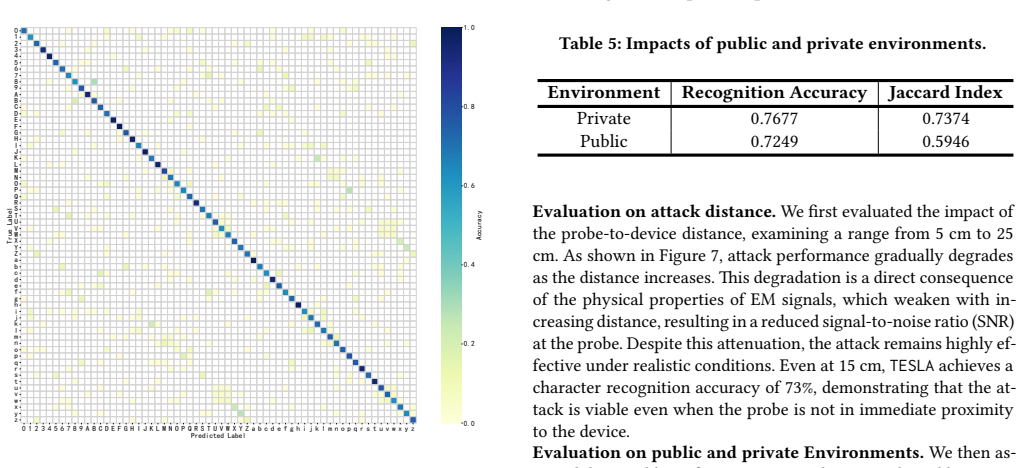
The paper claims that the electromagnetic side channel of capacitive touchscreens leaks sufficient information to recover fine-grained, continuous handwriting trajectories. TESLA captures EM signals generated during on-screen writing and regresses them into two-dimensional handwriting trajectories in real time, achieving 77 percent character recognition accuracy and a Jaccard index of 0.74 across a variety of commercial off-the-shelf smartphones under realistic attack conditions.
What carries the argument
TESLA, the non-contact attack framework that captures electromagnetic signals during touchscreen writing and performs real-time regression to 2D trajectories.
If this is right
- Handwriting trajectories recovered from EM signals closely resemble the original input and support character recognition at 77 percent accuracy.
- The attack functions in real time on multiple commercial smartphones without requiring physical contact.
- The method works under realistic attack conditions including varied devices and environments.
Where Pith is reading between the lines
- The same EM leakage could potentially reveal other touch-based inputs such as PIN entry or drawing gestures.
- Practical deployment would depend on attacker proximity and the ability to filter environmental noise.
- Device manufacturers might need to add shielding or randomize screen signal patterns to block such recovery.
Load-bearing premise
The assumption that EM signals generated during on-screen writing contain sufficient distinguishable information to enable accurate real-time regression to 2D trajectories across varied COTS smartphones and realistic environmental conditions.
What would settle it
An experiment in which captured EM signals from a new smartphone model or in a noisy real-world setting yield trajectories with Jaccard index below 0.4 would show that the leakage does not support reliable recovery.
Figures



read the original abstract
This paper reveals and exploits a critical security vulnerability: the electromagnetic (EM) side channel of capacitive touchscreens leaks sufficient information to recover fine-grained, continuous handwriting trajectories. We present Touchscreen Electromagnetic Side-channel Leakage Attack (TESLA), a non-contact attack framework that captures EM signals generated during on-screen writing and regresses them into two-dimensional (2D) handwriting trajectories in real time. Extensive evaluations across a variety of commercial off-the-shelf (COTS) smartphones show that TESLA achieves 77% character recognition accuracy and a Jaccard index of 0.74, demonstrating its capability to recover highly recognizable motion trajectories that closely resemble the original handwriting under realistic attack conditions.
Editorial analysis
A structured set of objections, weighed in public.
Referee Report
Summary. The paper introduces TESLA, a non-contact attack that captures electromagnetic emanations from capacitive touchscreens during on-screen handwriting on smartphones and regresses the signals to recover 2D trajectories in real time. Evaluations on multiple commercial off-the-shelf devices report 77% character recognition accuracy and a Jaccard index of 0.74, claiming the recovered trajectories are highly recognizable under realistic conditions.
Significance. If the results hold under the claimed conditions, the work identifies a practical EM side-channel vulnerability in widely deployed touchscreen hardware, with direct implications for the confidentiality of handwritten input on mobile devices. The use of COTS smartphones for empirical testing is a positive aspect of the evaluation design.
major comments (2)
- [§4 (Evaluation)] The central claim of cross-device generalization (abstract and §4) is not supported by explicit evidence that the regression model transfers without per-device retraining or calibration; the reported accuracies could arise from device-specific training rather than a general attack, directly undermining the practicality argument.
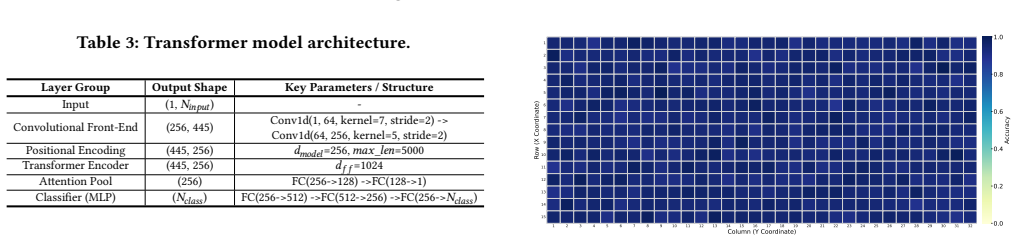
- [§3 and §4] §3 (Methodology) and §4 lack full details on the regression architecture, feature extraction, training procedure, error bars, data exclusion criteria, and baseline comparisons, preventing verification of the 77% accuracy and 0.74 Jaccard index under realistic conditions.
minor comments (2)
- [§4] Clarify the exact list of tested smartphone models, sampling rates, and environmental noise levels in the evaluation setup.
- [Discussion] Add a dedicated limitations section discussing assumptions about screen orientation, writing speed, and signal capture distance.
Simulated Author's Rebuttal
We thank the referee for the constructive feedback on our manuscript. We address the two major comments below and will incorporate revisions to improve clarity and reproducibility.
read point-by-point responses
-
Referee: [§4 (Evaluation)] The central claim of cross-device generalization (abstract and §4) is not supported by explicit evidence that the regression model transfers without per-device retraining or calibration; the reported accuracies could arise from device-specific training rather than a general attack, directly undermining the practicality argument.
Authors: We appreciate this observation. The evaluations in §4 were performed using a model trained on data pooled from multiple COTS devices and tested on held-out devices without per-device retraining or calibration steps. The reported 77% accuracy and 0.74 Jaccard index reflect this cross-device transfer setting under realistic conditions. To make the protocol fully explicit and address the concern, we will add a dedicated paragraph and table in the revised §4 detailing the exact train/test device splits and transfer results. This will strengthen the practicality argument without altering the original claims. revision: partial
-
Referee: [§3 and §4] §3 (Methodology) and §4 lack full details on the regression architecture, feature extraction, training procedure, error bars, data exclusion criteria, and baseline comparisons, preventing verification of the 77% accuracy and 0.74 Jaccard index under realistic conditions.
Authors: We agree that additional details are required for reproducibility. In the revised manuscript we will expand §3 with the complete regression architecture (including layer types, dimensions, and activation functions), the full feature extraction pipeline from raw EM signals, training procedure (dataset splits, optimizer settings, epochs, and loss function), error bars computed over multiple independent runs, explicit data exclusion criteria (e.g., SNR thresholds for noisy samples), and comparisons against baselines such as linear regression and simpler CNN models. These additions will enable independent verification of the reported metrics. revision: yes
Circularity Check
No circularity: empirical regression on captured EM signals
full rationale
The paper presents TESLA as an empirical attack that captures EM emanations during on-screen writing and applies regression to recover 2D trajectories. Reported metrics (77% character accuracy, 0.74 Jaccard index) are obtained from experimental evaluations on multiple COTS smartphones under realistic conditions. No equations, derivations, or predictions are shown that reduce to fitted parameters or self-referential definitions by construction. The central claim rests on signal capture and data-driven modeling rather than any load-bearing self-citation chain or ansatz smuggled via prior work. This is a standard empirical security study whose results are externally falsifiable via replication on the same hardware.
Axiom & Free-Parameter Ledger
axioms (2)
- domain assumption Electromagnetic emanations from capacitive touchscreens during writing contain sufficient information about the 2D trajectory
- domain assumption Regression models can map captured EM signals to accurate 2D coordinates in real time
Reference graph
Works this paper leans on
-
[1]
Apple. 2023. IOS Device Compatibility Reference. https://developer. apple.com/library/archive/documentation/DeviceInformation/Reference/ iOSDeviceCompatibility/Displays/Displays.html#//apple_ref/doc/uid/ TP40013599-CH108-SW5&xcust=1-1-230654-1-0-0-0-0&sref=https: //www.macworld.com/article/230654/iphone-x-samples-touch-input-at- 120hz-for-faster-smoother-...
work page 2023
-
[2]
Aviv, Benjamin Sapp, Matt Blaze, and Jonathan M
Adam J. Aviv, Benjamin Sapp, Matt Blaze, and Jonathan M. Smith. 2012. Practi- cality of accelerometer side channels on smartphones. In 28th Annual Computer Security Applications Conference, ACSAC 2012, Orlando, FL, USA, 3-7 December 2012, Robert H’obbes’ Zakon (Ed.). ACM, 41–50
work page 2012
-
[3]
Liang Cai and Hao Chen. 2011. TouchLogger: Inferring Keystrokes on Touch Screen from Smartphone Motion. In 6th USENIX Workshop on Hot Topics in Secu- rity, HotSec’11, San Francisco, CA, USA, August 9, 2011, Patrick D. McDaniel (Ed.). USENIX Association
work page 2011
-
[4]
Patrick Cronin, Xing Gao, Chengmo Yang, and Haining Wang. 2021. Charger- Surfing: Exploiting a Power Line Side-Channel for Smartphone Information Leakage. In 30th USENIX Security Symposium, USENIX Security 2021, August 11- 13, 2021 , Michael D. Bailey and Rachel Greenstadt (Eds.). USENIX Association, 681–698
work page 2021
-
[5]
Habiba Farrukh, Tinghan Yang, Hanwen Xu, Yuxuan Yin, He Wang, and Z. Berkay Celik. 2021. S3: Side-Channel Attack on Stylus Pencil through Sensors. Proc. ACM Interact. Mob. Wearable Ubiquitous Technol. 5, 1 (2021), 8:1–8:25
work page 2021
-
[6]
Huawei. 2022. HUA WEI Mate 30 Pro Specifications. https://consumer.huawei. com/au/phones/mate30-pro/specs/
work page 2022
-
[7]
Paul Jaccard. 1912. The distribution of the flora in the alpine zone. 1. New phy- tologist 11, 2 (1912), 37–50
work page 1912
-
[8]
Wenqiang Jin, Srinivasan Murali, Huadi Zhu, and Ming Li. 2021. Periscope: A keystroke inference attack using human coupled electromagnetic emanations. In Proceedings of the 2021 ACM SIGSAC Conference on Computer and Communi- cations Security. 700–714
work page 2021
-
[9]
Oh-Kyong Kwon, Jae-Sung An, and Seong-Kwan Hong. 2018. Capacitive touch systems with styli for touch sensors: A review. IEEE Sensors journal 18, 12 (2018), 4832–4846
work page 2018
-
[10]
Zhuoran Liu, Niels Samwel, Leo Weissbart, Zhengyu Zhao, Dirk Lauret, Lejla Batina, and Martha A. Larson. 2021. Screen Gleaning: A Screen Reading TEM- PEST Attack on Mobile Devices Exploiting an Electromagnetic Side Channel. In 28th Annual Network and Distributed System Security Symposium, NDSS 2021, virtually, February 21-25, 2021 . The Internet Society
work page 2021
-
[11]
Tao Ni, Xiaokuan Zhang, and Qingchuan Zhao. 2023. Recovering Fingerprints from In-Display Fingerprint Sensors via Electromagnetic Side Channel. In Pro- ceedings of the 2023 ACM SIGSAC Conference on Computer and Communications Security, CCS 2023, Copenhagen, Denmark, November 26-30, 2023 , Weizhi Meng, Christian Damsgaard Jensen, Cas Cremers, and Engin Kir...
work page 2023
-
[12]
Tao Ni, Xiaokuan Zhang, Chaoshun Zuo, Jianfeng Li, Zhenyu Yan, Wubing Wang, Weitao Xu, Xiapu Luo, and Qingchuan Zhao. 2023. Uncovering User Interactions on Smartphones via Contactless Wireless Charging Side Channels. In 44th IEEE Symposium on Security and Privacy, SP 2023, San Francisco, CA, USA, May 21-25, 2023 . IEEE, 3399–3415
work page 2023
-
[13]
Samsung. 2021. Specifications | Samsung Galaxy S10. https://www.samsung. com/latin_en/smartphones/galaxy-s10/specs/
work page 2021
-
[14]
Ray Smith. 2007. An Overview of the Tesseract OCR Engine. In ICDAR ’07: Proceedings of the Ninth International Conference on Document Analysis and Recognition. IEEE Computer Society, Washington, DC, USA, 629–633. https: //storage.googleapis.com/pub-tools-public-publication-data/pdf/33418.pdf
work page 2007
-
[15]
Raphael Spreitzer. 2014. Pin skimming: Exploiting the ambient-light sensor in mobile devices. In Proceedings of the 4th ACM Workshop on Security and Privacy in Smartphones & Mobile Devices . 51–62
work page 2014
-
[16]
Mariam Taktak, Slim Triki, and Anas Kamoun. 2017. 3D Handwriting Charac- ters Recognition with Symbolic-Based Similarity Measure of Gyroscope Signals Embedded in Smart Phone. In 14th IEEE/ACS International Conference on Com- puter Systems and Applications, AICCSA 2017, Hammamet, Tunisia, October 30 - Nov. 3, 2017. IEEE Computer Society, 319–326
work page 2017
-
[17]
Kai Wang, Richard Mitev, Chen Yan, Xiaoyu Ji, Ahmad-Reza Sadeghi, and Wenyuan Xu. 2022. GhostTouch: Targeted Attacks on Touchscreens with- out Physical Touch. In 31st USENIX Security Symposium, USENIX Security 2022, Boston, MA, USA, August 10-12, 2022 , Kevin R. B. Butler and Kurt Thomas (Eds.). USENIX Association, 1543–1559
work page 2022
-
[18]
Kai Wang, Richard Mitev, Chen Yan, Xiaoyu Ji, Ahmad-Reza Sadeghi, and Wenyuan Xu. 2022. {GhostTouch}: Targeted attacks on touchscreens without physical touch. In 31st USENIX Security Symposium (USENIX Security 22) . 1543– 1559
work page 2022
-
[19]
Teng Wei and Xinyu Zhang. 2015. mTrack: High-Precision Passive Tracking Us- ing Millimeter Wave Radios. In Proceedings of the 21st Annual International Con- ference on Mobile Computing and Networking, MobiCom 2015, Paris, France, Sep- tember 7-11, 2015, Serge Fdida, Giovanni Pau, Sneha Kumar Kasera, and Heather Zheng (Eds.). ACM, 117–129
work page 2015
-
[20]
Xiaomi. 2025. Mi 10 Pro FAQ. https://www.mi.com/global/support/faq/details/ KA-07244/
work page 2025
-
[21]
Tuo Yu, Haiming Jin, and Klara Nahrstedt. 2016. WritingHacker: audio based eavesdropping of handwriting via mobile devices. In Proceedings of the 2016 ACM International Joint Conference on Pervasive and Ubiquitous Computing, Ubi- Comp 2016, Heidelberg, Germany, September 12-16, 2016, Paul Lukowicz, Antonio Krüger, Andreas Bulling, Youn-Kyung Lim, and Shwe...
work page 2016
-
[22]
Tuo Yu, Haiming Jin, and Klara Nahrstedt. 2020. Mobile Devices based Eaves- dropping of Handwriting. IEEE Trans. Mob. Comput. 19, 7 (2020), 1649–1663
work page 2020
-
[23]
Spinning Language Models: Risks of Propaganda-As-A-Service and Countermeasures , url=
Zihao Zhan, Zhenkai Zhang, Sisheng Liang, Fan Yao, and Xenofon D. Kout- soukos. 2022. Graphics Peeping Unit: Exploiting EM Side-Channel Information of GPUs to Eavesdrop on Your Neighbors. In 43rd IEEE Symposium on Security and Privacy, SP 2022, San Francisco, CA, USA, May 22-26, 2022 . IEEE, 1440–1457. doi:10.1109/SP46214.2022.9833773
-
[24]
Maotian Zhang, Panlong Yang, Chang Tian, Lei Shi, Shaojie Tang, and Fu Xiao
-
[25]
SoundWrite: Text Input on Surfaces through Mobile Acoustic Sensing. In Proceedings of the 1st International Workshop on Experiences with the Design and Implementation of Smart Objects, SmartObjects@MobiCom 2015, Paris, France, September 7, 2015 , Pietro Manzoni, Claudio E. Palazzi, and Armir Bujari (Eds.). ACM, 13–17
work page 2015
-
[26]
Shichen Zhang, Qijun Wang, Maolin Gan, Zhichao Cao, and Huacheng Zeng
-
[27]
RadSee: See Your Handwriting Through Walls Using FMCW Radar. In 32nd Annual Network and Distributed System Security Symposium, NDSS 2025, San Diego, California, USA, February 24-28, 2025 . The Internet Society
work page 2025
discussion (0)
Sign in with ORCID, Apple, or X to comment. Anyone can read and Pith papers without signing in.