Recognition: 2 theorem links
· Lean TheoremDESI-DR1 3 times 2-pt analysis: consistent cosmology across weak lensing surveys
Pith reviewed 2026-05-16 21:13 UTC · model grok-4.3
The pith
Combining DESI galaxy clustering with three weak lensing surveys produces mutually consistent S8 values near 0.77.
A machine-rendered reading of the paper's core claim, the machinery that carries it, and where it could break.
Core claim
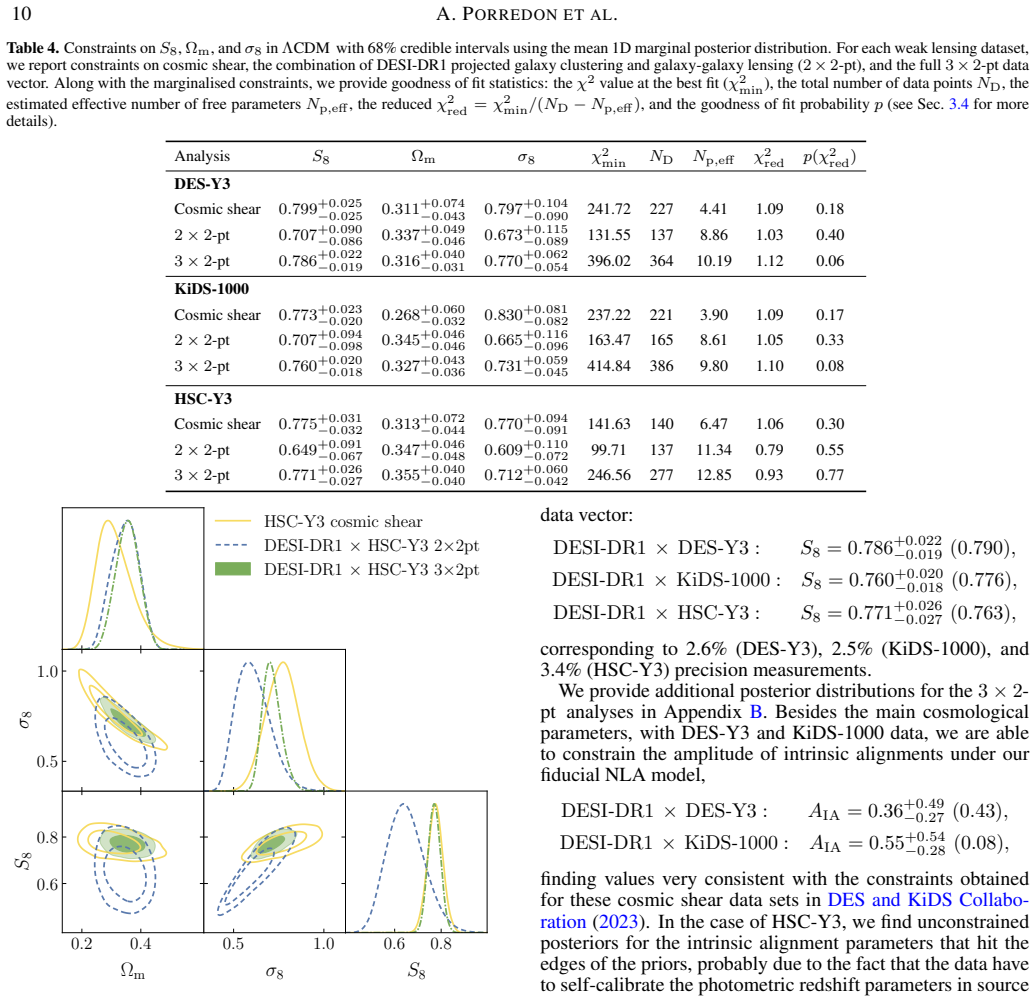
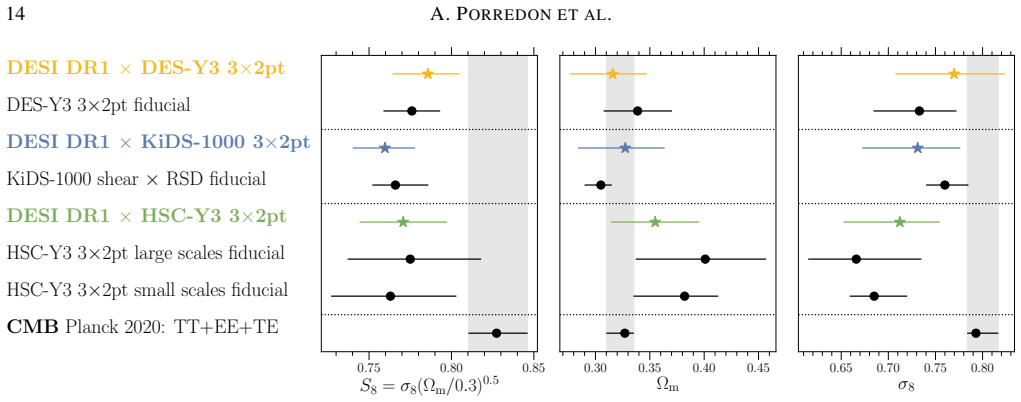
We obtain mutually-consistent constraints on the parameter S8 = σ8 √(Ωm/0.3) = 0.786+0.022−0.019 from the combination of DESI-DR1 and DES-Y3, S8 = 0.760+0.020−0.018 from KiDS-1000, and S8 = 0.771+0.026−0.027 from HSC-Y3. These determinations are consistent with fits to the Planck Cosmic Microwave Background dataset, albeit with 1.5-2σ lower values in the S8-Ωm plane. The analysis employs a unified pipeline that self-consistently determines cosmological and astrophysical parameters, an analytical covariance matrix that includes all cross-covariances, and a new blinding procedure.
What carries the argument
The 3 × 2-pt correlation functions formed by pairing DESI-DR1 galaxy clustering with cosmic shear from each lensing survey, processed through a unified pipeline that jointly fits all cosmological and nuisance parameters.
If this is right
- The S8 values remain consistent across the three independent lensing surveys, indicating that survey-specific effects are adequately controlled.
- The joint constraints lie 1.5-2 sigma below Planck in the S8-Omega_m plane while agreeing among themselves.
- The analytical covariance matrix incorporates all cross-covariances between the different probes.
- The blinding procedure leaves goodness-of-fit statistics unchanged while protecting against confirmation bias.
Where Pith is reading between the lines
- If the mild offset from Planck persists in future data, it may require extensions to the standard model such as new physics affecting structure growth.
- The same unified pipeline could be applied to upcoming surveys to test whether consistency holds at higher precision.
- Any unmodeled bias would have to be nearly identical across KiDS, DES, and HSC to preserve the observed agreement.
Load-bearing premise
The unified pipeline correctly models all survey-specific systematics and astrophysical nuisance parameters without residual biases that could shift the S8 posteriors.
What would settle it
A statistically significant inconsistency between the S8 values obtained from the three different lensing survey combinations with DESI would falsify the claim of mutual consistency.
Figures






read the original abstract
We present a joint cosmological analysis of projected galaxy clustering observations from the Dark Energy Spectroscopic Instrument Data Release 1 (DESI-DR1), and overlapping weak gravitational lensing observations from three datasets: the Kilo-Degree Survey (KiDS-1000), the Dark Energy Survey (DES-Y3), and the Hyper-Suprime-Cam Survey (HSC-Y3). This combination of large-scale structure probes allows us to measure a set of $3 \times 2$-pt correlation functions, breaking the degeneracies between parameters in cosmological fits to individual observables. We obtain mutually-consistent constraints on the parameter $S_8 = \sigma_8 \sqrt{\Omega_{\rm m}/0.3} = 0.786^{+0.022}_{-0.019}$ from the combination of DESI-DR1 and DES-Y3, $S_8 = 0.760^{+0.020}_{-0.018}$ from KiDS-1000, and $S_8 = 0.771^{+0.026}_{-0.027}$ from HSC-Y3. These parameter determinations are consistent with fits to the Planck Cosmic Microwave Background dataset, albeit with $1.5-2\sigma$ lower values in the $S_8-\Omega_{\rm m}$ plane. We perform our analysis with a unified pipeline tailored to the requirements of each cosmic shear survey, which self-consistently determines cosmological and astrophysical parameters. We generate an analytical covariance matrix for the correlation data including all cross-covariances between probes, and we design a new blinding procedure to safeguard our analysis against confirmation bias, whilst leaving goodness-of-fit statistics unchanged. Our study is part of a suite of papers that present joint cosmological analyses of DESI-DR1 and weak gravitational lensing datasets.
Editorial analysis
A structured set of objections, weighed in public.
Referee Report
Summary. The paper presents a joint 3x2-point cosmological analysis combining projected galaxy clustering from DESI-DR1 with weak lensing data from KiDS-1000, DES-Y3, and HSC-Y3. Using a unified pipeline, it derives mutually consistent S8 constraints (0.786+0.022-0.019 for DESI+DES-Y3, 0.760+0.020-0.018 for KiDS-1000, 0.771+0.026-0.027 for HSC-Y3) that lie 1.5-2σ below Planck in the S8-Ωm plane. The analysis employs an analytical covariance matrix including all cross-covariances and introduces a new blinding procedure.
Significance. If the central results hold, this provides a valuable cross-survey consistency test for S8 using a common clustering dataset, helping to assess whether the mild tension with CMB measurements is robust across independent lensing probes. The analytical covariance approach and blinding method represent methodological strengths that could be adopted more broadly if validated.
major comments (2)
- [Section 4 and Appendix B] Unified pipeline (Section 4 and Appendix B): the claim that a single pipeline self-consistently handles survey-specific systematics requires explicit verification that the functional forms, priors, and marginalization schemes for photo-z uncertainties, multiplicative shear bias, and intrinsic alignment amplitudes are applied identically across KiDS-1000, DES-Y3, and HSC-Y3 (adjusted only for survey windows and depth). Any unaccounted mismatch could produce coherent ~0.5σ shifts in the reported S8 posteriors, undermining the mutual-consistency conclusion.
- [Section 5.2, Eq. (12)-(15)] Analytical covariance construction (Section 5.2, Eq. (12)-(15)): the matrix must demonstrably include the full shared large-scale structure contributions between the three lensing fields and DESI-DR1. If the off-diagonal blocks underestimate these terms, the joint posteriors will tighten artificially, making the apparent agreement (and the 1.5-2σ offset from Planck) appear more significant than it is.
minor comments (2)
- [Section 3.3] Blinding procedure (Section 3.3): clarify how the new blinding scheme preserves goodness-of-fit statistics while preventing confirmation bias; provide a quantitative test showing that unblinded and blinded posteriors differ only by the expected statistical fluctuation.
- [Figure 7 and Table 2] Figure 7 and Table 2: the S8-Ωm contours for the three combinations should include a direct overlay of the Planck contour for visual assessment of the 1.5-2σ offset.
Simulated Author's Rebuttal
We thank the referee for their careful reading of the manuscript and for highlighting the importance of explicit verification in the unified pipeline and covariance construction. We address each major comment below and have revised the manuscript accordingly to strengthen the presentation of these methodological aspects.
read point-by-point responses
-
Referee: [Section 4 and Appendix B] Unified pipeline (Section 4 and Appendix B): the claim that a single pipeline self-consistently handles survey-specific systematics requires explicit verification that the functional forms, priors, and marginalization schemes for photo-z uncertainties, multiplicative shear bias, and intrinsic alignment amplitudes are applied identically across KiDS-1000, DES-Y3, and HSC-Y3 (adjusted only for survey windows and depth). Any unaccounted mismatch could produce coherent ~0.5σ shifts in the reported S8 posteriors, undermining the mutual-consistency conclusion.
Authors: We confirm that the unified pipeline applies identical functional forms and marginalization schemes for all systematics across the three lensing surveys, with adjustments limited strictly to survey-specific quantities such as window functions, redshift distributions, and depth-dependent noise. Specifically, photo-z uncertainties use the same shift-and-stretch parameterization with survey-specific Gaussian priors; multiplicative shear bias employs the same m-bias model with identical prior widths (adjusted only for each survey's calibration uncertainty); and intrinsic alignments are modeled with the same nonlinear alignment (NLA) amplitude and redshift dependence, sharing the same cosmological and IA parameters. To address the referee's request for explicit verification, we have added a dedicated paragraph in Section 4 and a comparative table in Appendix B that lists the exact functional forms, prior ranges, and marginalization procedures side-by-side for KiDS-1000, DES-Y3, and HSC-Y3. This addition demonstrates that no unaccounted mismatches are present that could induce coherent shifts in S8. revision: yes
-
Referee: [Section 5.2, Eq. (12)-(15)] Analytical covariance construction (Section 5.2, Eq. (12)-(15)): the matrix must demonstrably include the full shared large-scale structure contributions between the three lensing fields and DESI-DR1. If the off-diagonal blocks underestimate these terms, the joint posteriors will tighten artificially, making the apparent agreement (and the 1.5-2σ offset from Planck) appear more significant than it is.
Authors: The analytical covariance matrix is constructed to include the complete set of shared large-scale structure contributions. Equations (12)-(15) implement a halo-model-based approach in which the off-diagonal blocks between the different weak-lensing surveys and DESI-DR1 explicitly contain the cross-power spectra arising from the common matter density field, evaluated under the Limber approximation with consistent galaxy bias and matter power spectrum modeling. To make this inclusion demonstrable, we have added a new figure in Section 5.2 displaying the full correlation matrix (with off-diagonal blocks highlighted) and a brief validation subsection comparing the analytical covariance elements to those obtained from a set of mock catalogs for a representative subset of the data vector. These additions confirm that the shared LSS terms are fully accounted for and that the joint posteriors are not artificially tightened. revision: yes
Circularity Check
No significant circularity: S8 constraints derived from external data fits
full rationale
The paper derives S8 posteriors by fitting a unified pipeline to measured 3x2pt correlation functions from DESI-DR1 combined with each lensing survey's data. These are standard likelihood-based constraints on cosmological parameters, not equivalent to inputs by construction. The analytical covariance matrix and blinding procedure are methodological tools that do not force the reported consistency. No load-bearing self-citation, self-definitional step, or fitted-input-renamed-as-prediction is present in the derivation chain; the central claims remain grounded in the survey data and external benchmarks like Planck.
Axiom & Free-Parameter Ledger
free parameters (2)
- S8
- galaxy bias parameters
axioms (2)
- domain assumption Flat ΛCDM cosmology with standard neutrino mass and dark energy equation of state
- domain assumption Analytical covariance matrix accurately captures all cross-probe correlations
Lean theorems connected to this paper
-
IndisputableMonolith/Cost/FunctionalEquation.leanwashburn_uniqueness_aczel (J-cost uniqueness) unclear?
unclearRelation between the paper passage and the cited Recognition theorem.
We obtain mutually-consistent constraints on the parameter S8 = σ8 √(Ωm/0.3) = 0.786+0.022−0.019 ... using CAMB + HMCODE2020 ... NLA intrinsic alignment model ... linear galaxy bias ... analytical covariance
-
IndisputableMonolith/Foundation/RealityFromDistinction.leanreality_from_one_distinction unclear?
unclearRelation between the paper passage and the cited Recognition theorem.
We assume two main cosmological models: flat ΛCDM and flat wCDM ... priors on Ωm, As, ns, w, ... Σmν ... log10(TAGN/K) ... AIA, ηIA
What do these tags mean?
- matches
- The paper's claim is directly supported by a theorem in the formal canon.
- supports
- The theorem supports part of the paper's argument, but the paper may add assumptions or extra steps.
- extends
- The paper goes beyond the formal theorem; the theorem is a base layer rather than the whole result.
- uses
- The paper appears to rely on the theorem as machinery.
- contradicts
- The paper's claim conflicts with a theorem or certificate in the canon.
- unclear
- Pith found a possible connection, but the passage is too broad, indirect, or ambiguous to say the theorem truly supports the claim.
Forward citations
Cited by 2 Pith papers
-
GI BAO as a cosmological consistency check
GI BAO provides a robust consistency check for density BAO and shear data, with the first photometric measurement on DES Y3 showing agreement at α = 0.966 ± 0.252.
-
Cosmological constraints from the small scale clustering of Emission Line Galaxies
SHAMe-SF modeling of small-scale DESI ELG clustering delivers 6% precision on σ8 and Ωm h², matching full DR1 results with 1% volume.
Reference graph
Works this paper leans on
-
[1]
Aihara H., et al., 2022, PASJ, 74, 247 Amon A., et al., 2022, Phys. Rev. D, 105, 023514 Anbajagane D., et al., 2025a, arXiv e-prints, p. arXiv:2502.17674 Anbajagane D., et al., 2025b, arXiv e-prints, p. arXiv:2502.17677 Asgari M., et al., 2021, A&A, 645, A104 Astropy Collaboration et al., 2022, ApJ, 935, 167 Bianchi D., et al., 2025, J. Cosmology Astropar...
-
[2]
Magdalena Contreras. Ciudad de México C. P. 10720, México 48 Space Sciences Laboratory, University of California, Berkeley, 7 Gauss Way, Berkeley, CA 94720, USA 49 Instituto de Astrofísica de Andalucía (CSIC), Glorieta de la Astronomía, s/n, E-18008 Granada, Spain 50 Departament de Física, EEBE, Universitat Politècnica de Catalunya, c/Eduard Maristany 10,...
work page 2018
-
[3]
We follow the fiducial HSC- Y1 cosmic shear analyses (Hikage et al. 2019; Hamana et al
work page 2019
-
[4]
Regarding photometric- redshift uncertainties, HSC-Y1 also assumes a Gaussian prior on the∆z j of each source binj, centered at zero, and with σ(∆z j) = [ 0.0374,0.0124,0.0326,0.0343 ]. In this case, there are also two parameters that correct for PSF-related sys- tematics,α PSF andβ PSF. The corresponding Gaussian priors are (0.029,0.01) and (−1.42,1.11),...
work page 2020
-
[5]
are included in dashed black lines. −4 0 4 AIA 0.2 0.5 0.8 ∆4 z 0.0 0.1 0.2 ∆3 z −0.04 0.00 0.04 ∆2 z −0.05 0.00 ∆1 z −4 −2 0 ηIA −4 −2 0 ηIA −0.06 0.01 ∆1 z −0.03 0.03 ∆2 z 0.0 0.1 ∆3 z 0.1 0.5 ∆4 z Figure 14.Marginalised constraints on the IA and∆ z parameters, in ΛCDM, from the3×2-pt combination of DESI-DR1 projected galaxy clus- tering and HSC-Y3 weak...
work page 2024
discussion (0)
Sign in with ORCID, Apple, or X to comment. Anyone can read and Pith papers without signing in.