Recognition: 2 theorem links
· Lean TheoremGI BAO as a cosmological consistency check
Pith reviewed 2026-05-13 01:06 UTC · model grok-4.3
The pith
GI BAO measurement on DES Y3 data matches the density BAO constraint on the scale dilation parameter, validating both and the linear alignment model.
A machine-rendered reading of the paper's core claim, the machinery that carries it, and where it could break.
Core claim
The first GI BAO measurement on DES Y3 photometric data gives α = 0.966 ± 0.252 (1σ), in good agreement with the density BAO result α = 0.966 ± 0.037. This agreement validates the density BAO, the shear measurement, and the linear alignment model. Combining density BAO with GI BAO produces results that are more resilient to systematic effects.
What carries the argument
GI BAO, the imprint of the Baryon Acoustic Oscillations feature on the galaxy shear field induced by the large-scale tidal field through the linear alignment model, serving as an independent consistency test for density BAO.
If this is right
- Agreement between GI BAO and density BAO confirms the absence of major independent systematics in either probe.
- The linear alignment model receives empirical support from the data.
- Combining density BAO with GI BAO increases resilience to systematic effects.
- Stage IV surveys will allow GI BAO to function as a more prominent and powerful consistency check due to larger data volumes.
Where Pith is reading between the lines
- A significant future disagreement could isolate problems in the alignment model rather than in the underlying cosmology.
- The same GI BAO extraction could be applied to other photometric surveys to cross-check BAO scales without relying solely on density fields.
- This consistency approach might be extended to test additional cosmological parameters beyond the BAO scale.
Load-bearing premise
The linear alignment model accurately describes galaxy shape alignment with the tidal field, and systematics in density and shear measurements are sufficiently independent that agreement indicates validity rather than shared bias.
What would settle it
A future high-significance mismatch between the GI BAO and density BAO constraints on α in a larger survey dataset would indicate that one or more of the validated components contains unaccounted systematics.
Figures



read the original abstract
Tensions often arise between different datasets in cosmology, and consistency tests can serve as a powerful tool for diagnosing potential issues. The density-shear Baryon Acoustic Oscillations (GI BAO) are the imprint of the BAO feature on the shear field induced by the large-scale tidal field. We highlight that GI BAO can provide a robust consistency check for the density BAO, shear measurement, and alignment model. Failure of this check hints at systematics in any of these parts. As an illustration, we present the first GI BAO measurement on photometric data, using the DES Y3 dataset. We find the GI BAO constraint on the BAO scale dilation parameter $\alpha $ to be $ 0.966 \pm 0.252 $ (1$\sigma$), in good agreement with the density BAO constraint, $ 0.966 \pm 0.037 $, thereby validating the density BAO, shear measurement, and the linear alignment model. Furthermore, we argue that combining the density BAO with the GI BAO yields results that are more resilient to systematic effects. Thanks to the massive data volumes of stage IV surveys, the GI BAO will play an even more prominent role as a consistency check.
Editorial analysis
A structured set of objections, weighed in public.
Referee Report
Summary. The paper proposes GI BAO (the BAO feature in the density-shear cross-correlation) as a consistency check for density BAO measurements, shear catalogs, and the linear alignment model. Using DES Y3 photometric data as an illustration, the authors measure the BAO dilation parameter α from GI BAO as 0.966 ± 0.252 (1σ) and note its agreement with the density BAO value 0.966 ± 0.037. They conclude that this agreement validates the three components and that combining the two probes increases resilience to systematics, with greater utility expected from stage-IV surveys.
Significance. If the central claim holds, the work introduces a useful cross-check that exploits the independence of density and shear systematics. The first GI BAO measurement on photometric data is a concrete demonstration of the method. However, the current statistical power is limited, so the immediate impact on validating existing BAO or shear results is modest; the primary value lies in the conceptual framework and its potential for future data sets where the GI error bar shrinks.
major comments (2)
- [Abstract] Abstract: the reported GI BAO uncertainty (0.252) is approximately seven times larger than the density BAO uncertainty (0.037). Consequently the GI constraint is consistent (within 1σ) with any α in roughly [0.46, 1.47], so the numerical agreement does not rule out moderate biases in the density BAO, the shear measurement, or the linear alignment model. A quantitative power analysis (e.g., the probability of detecting an injected systematic at the level of the density-BAO error) or the covariance between the two α measurements is required to support the validation statement.
- [Results / Discussion (section containing the combination argument)] The claim that combining density BAO with GI BAO produces results “more resilient to systematic effects” is load-bearing for the paper’s broader argument. Without an explicit joint covariance matrix, a demonstration of how the combination suppresses shared or independent biases, or a test under simulated systematics, the resilience statement remains qualitative.
minor comments (2)
- [Abstract] The abstract and main text repeatedly describe the agreement as “good” or “validating” without qualifying the limited statistical power; a brief parenthetical on the relative precisions would improve clarity.
- [Measurement section] Notation for the dilation parameter α and its error bars is clear, but the manuscript should explicitly state whether the quoted uncertainties are statistical only or include systematic contributions from the alignment model.
Simulated Author's Rebuttal
We thank the referee for their insightful comments on our manuscript. We address the major comments point by point below, proposing revisions to strengthen the presentation of our results.
read point-by-point responses
-
Referee: Abstract: the reported GI BAO uncertainty (0.252) is approximately seven times larger than the density BAO uncertainty (0.037). Consequently the GI constraint is consistent (within 1σ) with any α in roughly [0.46, 1.47], so the numerical agreement does not rule out moderate biases in the density BAO, the shear measurement, or the linear alignment model. A quantitative power analysis (e.g., the probability of detecting an injected systematic at the level of the density-BAO error) or the covariance between the two α measurements is required to support the validation statement.
Authors: We agree that the large uncertainty on the GI BAO α measurement means that the current agreement provides only a modest consistency check and does not exclude moderate biases at the level of the density BAO precision. Our intent was to present this as an initial demonstration of the method using existing data, with the understanding that the statistical power will increase substantially with future surveys. To better support the validation statement, we will revise the abstract to clarify the limited precision of the current measurement and add a brief discussion on the expected sensitivity. We can also include a simple estimate of the covariance between the two measurements based on the shared large-scale structure, noting that they are partially correlated but the dominant systematics differ. A full power analysis with injected systematics would require dedicated simulations, which we plan to pursue in follow-up work. revision: partial
-
Referee: The claim that combining density BAO with GI BAO produces results “more resilient to systematic effects” is load-bearing for the paper’s broader argument. Without an explicit joint covariance matrix, a demonstration of how the combination suppresses shared or independent biases, or a test under simulated systematics, the resilience statement remains qualitative.
Authors: We concur that the resilience to systematics would be more convincingly demonstrated with quantitative support. The GI BAO and density BAO measurements have largely independent systematics because one involves the shear field and the other the density field, with the linear alignment model linking them. We will expand the discussion section to explicitly state this and provide a qualitative argument for how biases in one probe are mitigated in the combination. Additionally, we will note that the joint covariance can be approximated as diagonal for the purpose of this consistency check, as the cross-covariance is expected to be small compared to the individual variances. A full simulation test is beyond the current scope but represents a valuable direction for future studies. revision: partial
Circularity Check
No circularity: direct empirical measurement of GI BAO from DES Y3 data
full rationale
The paper reports a new measurement of the GI BAO signal extracted from photometric galaxy shapes and positions in the DES Y3 dataset, constraining the dilation parameter α directly from the data. This is not obtained by fitting a model to a subset of the same data and then re-predicting a related quantity, nor does it rely on self-citations or imported uniqueness theorems for its central result. The agreement with the separate density BAO measurement is presented as an external consistency test rather than an algebraic identity or forced equivalence. The linear alignment model is an input assumption whose validity is being checked, not a derived output that reduces to the measurement by construction. The analysis chain is therefore self-contained as an observational result.
Axiom & Free-Parameter Ledger
free parameters (1)
- BAO scale dilation parameter α
axioms (1)
- domain assumption Linear alignment model for galaxy intrinsic alignments
Lean theorems connected to this paper
-
IndisputableMonolith/Cost/FunctionalEquation.leanwashburn_uniqueness_aczel unclear?
unclearRelation between the paper passage and the cited Recognition theorem.
We find the GI BAO constraint on the BAO scale dilation parameter α to be 0.966 ± 0.252 (1σ), in good agreement with the density BAO constraint, 0.966 ± 0.037
-
IndisputableMonolith/Foundation/AlexanderDuality.leanalexander_duality_circle_linking unclear?
unclearRelation between the paper passage and the cited Recognition theorem.
the linear alignment model accurately describes galaxy shape alignment with the tidal field
What do these tags mean?
- matches
- The paper's claim is directly supported by a theorem in the formal canon.
- supports
- The theorem supports part of the paper's argument, but the paper may add assumptions or extra steps.
- extends
- The paper goes beyond the formal theorem; the theorem is a base layer rather than the whole result.
- uses
- The paper appears to rely on the theorem as machinery.
- contradicts
- The paper's claim conflicts with a theorem or certificate in the canon.
- unclear
- Pith found a possible connection, but the passage is too broad, indirect, or ambiguous to say the theorem truly supports the claim.
Reference graph
Works this paper leans on
-
[1]
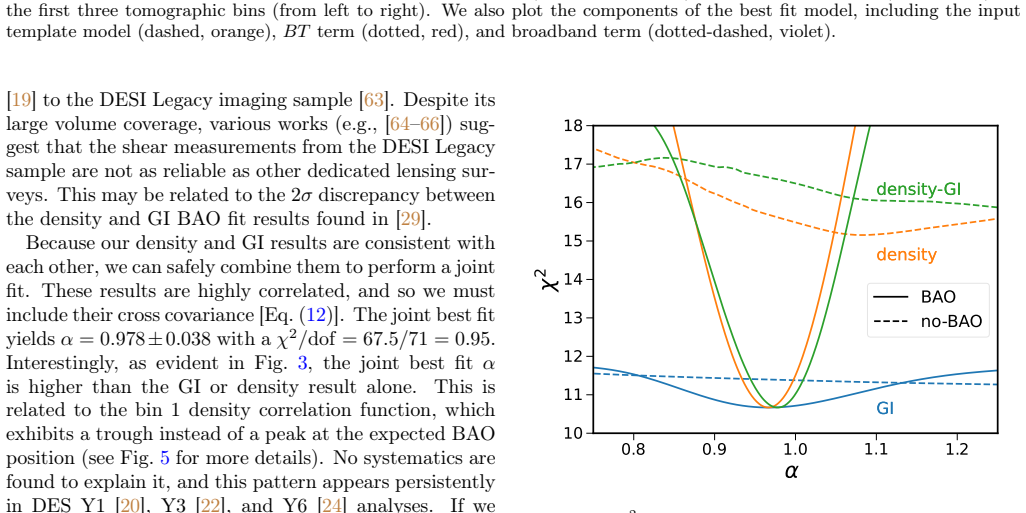
to the DESI Legacy imaging sample [63]. Despite its large volume coverage, various works (e.g., [64–66]) sug- gest that the shear measurements from the DESI Legacy sample are not as reliable as other dedicated lensing sur- veys. This may be related to the 2σdiscrepancy between the density and GI BAO fit results found in [29]. Because our density and GI re...
work page 2025
-
[2]
L. Perivolaropoulos and F. Skara, New Astron. Rev.95, 101659 (2022), arXiv:2105.05208 [astro-ph.CO]
-
[3]
E. Di Valentino, J. L. Said, A. Riess, A. Pollo, V. Poulin, et al., Physics of the Dark Universe49, 101965 (2025), arXiv:2504.01669 [astro-ph.CO]
work page internal anchor Pith review arXiv 2025
- [4]
-
[5]
Dark Energy Survey Year 3: Blue Shear
J. McCullough, A. Amon, E. Legnani, D. Gruen, A. Roodman,et al., arXiv e-prints , arXiv:2410.22272 (2024), arXiv:2410.22272 [astro-ph.CO]
work page internal anchor Pith review Pith/arXiv arXiv 2024
-
[6]
L. Bigwood, A. Amon, A. Schneider, J. Salcido, I. G. McCarthy,et al., MNRAS534, 655 (2024), arXiv:2404.06098 [astro-ph.CO]
-
[7]
G. Piccirilli, M. Zennaro, C. García-García, and D. Alonso, JCAP2025, 017 (2025), arXiv:2502.17339 [astro-ph.CO]
- [8]
-
[9]
DESI-DR1 $3 \times 2$-pt analysis: consistent cosmology across weak lensing surveys
A. Porredon, C. Blake, J. U. Lange, N. Emas, J. Aguilar,et al., arXiv e-prints , arXiv:2512.15960 (2025), arXiv:2512.15960 [astro-ph.CO]
work page internal anchor Pith review Pith/arXiv arXiv 2025
- [10]
-
[11]
R. A. Sunyaev and Y. B. Zeldovich, Astrophysics and Space Science7, 3 (1970)
work page 1970
-
[12]
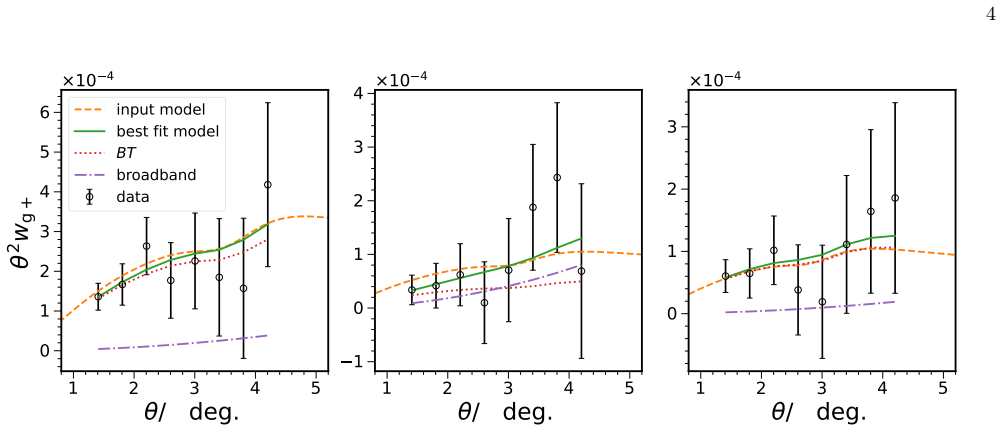
P. J. E. Peebles and J. T. Yu, ApJ162, 815 (1970). 7 2 4 0.005 0.000 0.005 0.010 0.015 0.020 2wg 2 4 0.010 0.005 0.000 0.005 0.010 2 4 0.010 0.005 0.000 0.005 0.010 2 4 / deg. 0 2 4 6 2wg + ×10 4 input model best fit model BT broadband data 2 4 / deg. 1 0 1 2 3 4 ×10 4 2 4 / deg. 0 1 2 3 ×10 4 FIG. 5. The density (upper panels) and GI (lower panels) corre...
work page 1970
-
[13]
D.H.Weinberg, M.J.Mortonson, D.J.Eisenstein, C.Hi- rata, A. G. Riess, and E. Rozo, Phys. Rep.530, 87 (2013), arXiv:1201.2434 [astro-ph.CO]
work page Pith review arXiv 2013
- [14]
- [15]
-
[16]
E. Gaztanaga, A. Cabre, and L. Hui, MNRAS399, 1663 (2009), arXiv:0807.3551 [astro-ph]
-
[17]
The 6dF Galaxy Survey: Baryon Acoustic Oscillations and the Local Hubble Constant
F. Beutler, C. Blake, M. Colless, D. H. Jones, L. Staveley-Smith,et al., MNRAS416, 3017 (2011), arXiv:1106.3366
work page Pith review arXiv 2011
-
[18]
Andersonet al., MNRAS427, 3435 (2012), arXiv:1203.6594 [astro-ph.CO]
L. Andersonet al., MNRAS427, 3435 (2012), arXiv:1203.6594 [astro-ph.CO]
- [19]
-
[20]
S. Alam, M. Ata, S. Bailey, F. Beutler, D. Bizyaev,et al., MNRAS470, 2617 (2017), arXiv:1607.03155
work page Pith review arXiv 2017
- [21]
- [22]
- [23]
- [24]
- [25]
-
[26]
A. G. Adame, J. Aguilar, S. Ahlen, S. Alam, D. M. Alexander,et al., JCAP2025, 021 (2025), arXiv:2404.03002 [astro-ph.CO]
work page internal anchor Pith review Pith/arXiv arXiv 2025
-
[27]
DESI DR2 Results II: Measurements of Baryon Acoustic Oscillations and Cosmological Constraints
M. Abdul Karim, J. Aguilar, S. Ahlen, S. Alam, L. Allen,et al., Phys. Rev. D112, 083515 (2025), arXiv:2503.14738 [astro-ph.CO]
work page internal anchor Pith review Pith/arXiv arXiv 2025
- [28]
-
[29]
T. Okumura and A. Taruya, MNRAS493, L124 (2020), arXiv:1912.04118 [astro-ph.CO]
- [30]
-
[31]
D. van Dompseler, C. Georgiou, and N. E. Chis- ari, The Open Journal of Astrophysics6, 19 (2023), arXiv:2301.04649 [astro-ph.CO]
-
[32]
Planck Collaboration, A&A641, A6 (2020), arXiv:1807.06209 [astro-ph.CO]
work page internal anchor Pith review Pith/arXiv arXiv 2020
- [33]
- [34]
- [35]
- [36]
- [37]
- [38]
-
[39]
M. A. Troxel and M. Ishak, Phys. Rep.558, 1 (2015), arXiv:1407.6990 [astro-ph.CO]
work page Pith review arXiv 2015
-
[40]
B. Joachimi, M. Cacciato, T. D. Kitching, A. Leonard, R. Mandelbaum,et al., Space Science Reviews193, 1 (2015), arXiv:1504.05456 [astro-ph.GA]
- [41]
- [42]
-
[43]
P. Catelan, M. Kamionkowski, and R. D. Blandford, MN- RAS320, L7 (2001), arXiv:astro-ph/0005470 [astro-ph]
-
[44]
C. M. Hirata and U. Seljak, Phys. Rev. D70, 063526 (2004), arXiv:astro-ph/0406275 [astro-ph]
work page Pith review arXiv 2004
-
[45]
R. de Putter and M. Takada, Phys. Rev. D82, 103522 (2010), arXiv:1007.4809 [astro-ph.CO]
- [46]
-
[47]
R. Mandelbaum, C. Blake, S. Bridle, F. B. Ab- dalla, S. Brough,et al., MNRAS410, 844 (2011), arXiv:0911.5347 [astro-ph.CO]
-
[48]
H. Johnston, C. Georgiou, B. Joachimi, H. Hoek- stra, N. E. Chisari,et al., A&A624, A30 (2019), arXiv:1811.09598 [astro-ph.CO]
-
[49]
S. Samuroff, R. Mandelbaum, J. Blazek, A. Cam- pos, N. MacCrann,et al., MNRAS524, 2195 (2023), arXiv:2212.11319 [astro-ph.CO]
-
[50]
F. Hervas Peters, M. Kilbinger, R. Paviot, L. Bau- mont, E. Russier,et al., A&A699, A201 (2025), arXiv:2412.01790 [astro-ph.CO]
-
[51]
doi:10.48550/arXiv.2505.15470 , urldate =
D. Navarro-Gironés, M. Crocce, E. Gaztañaga, A. Wit- tje, M. Siudek,et al., arXiv e-prints , arXiv:2505.15470 (2025), arXiv:2505.15470 [astro-ph.CO]
-
[52]
C. Georgiou, N. E. Chisari, M. Bilicki, F. La Bar- bera, N. R. Napolitano,et al., A&A699, A252 (2025), arXiv:2502.09452 [astro-ph.CO]
- [53]
-
[54]
Rosenfeld,et al., MNRAS508, 3125 (2021), arXiv:2012.08568 [astro-ph.CO]
O.Friedrich, F.Andrade-Oliveira, H.Camacho, O.Alves, R. Rosenfeld,et al., MNRAS508, 3125 (2021), arXiv:2012.08568 [astro-ph.CO]
-
[55]
Sevilla-Noarbe and DES, ApJS254, 24 (2021), arXiv:2011.03407 [astro-ph.CO]
I. Sevilla-Noarbe and DES, ApJS254, 24 (2021), arXiv:2011.03407 [astro-ph.CO]
-
[56]
Carnero Rosell and DES, MNRAS509, 778 (2022), arXiv:2107.05477 [astro-ph.CO]
A. Carnero Rosell and DES, MNRAS509, 778 (2022), arXiv:2107.05477 [astro-ph.CO]
-
[57]
DNF - Galaxy photometric redshift by Directional Neighbourhood Fitting
J. De Vicente, E. Sánchez, and I. Sevilla-Noarbe, MN- RAS459, 3078 (2016), arXiv:1511.07623
work page Pith review arXiv 2016
-
[58]
Guzzoet al., A&A566, A108 (2014), arXiv:1303.2623 [astro-ph.CO]
L. Guzzoet al., A&A566, A108 (2014), arXiv:1303.2623 [astro-ph.CO]
-
[59]
Metacalibration: Direct Self-Calibration of Biases in Shear Measurement
E. Huff and R. Mandelbaum, arXiv e-prints , arXiv:1702.02600 (2017), arXiv:1702.02600 [astro- ph.CO]
work page Pith review arXiv 2017
- [60]
- [61]
-
[62]
R. Mandelbaum, C. M. Hirata, M. Ishak, U. Seljak, and J. Brinkmann, MNRAS367, 611 (2006), arXiv:astro- ph/0509026 [astro-ph]
- [63]
-
[64]
A. Dey, D. J. Schlegel, D. Lang, R. Blum, K. Burleigh, et al., A.J.157, 168 (2019), arXiv:1804.08657 [astro- ph.IM]
work page Pith review arXiv 2019
-
[65]
A. Phriksee, E. Jullo, M. Limousin, H. Shan, A. Finoguenov,et al., MNRAS491, 1643 (2020), arXiv:1910.10983 [astro-ph.CO]
- [66]
- [67]
-
[68]
A. C. Carnall, R. J. McLure, J. S. Dunlop, and R. Davé, MNRAS480, 4379 (2018), arXiv:1712.04452 [astro- ph.GA]
work page internal anchor Pith review arXiv 2018
-
[69]
S. Everett, B. Yanny, N. Kuropatkin, E. M. Huff, Y. Zhang,et al., ApJS258, 15 (2022), arXiv:2012.12825 [astro-ph.CO]
- [70]
- [71]
-
[72]
S. Bridle and L. King, New Journal of Physics9, 444 (2007), arXiv:0705.0166 [astro-ph]
work page Pith review arXiv 2007
- [73]
- [74]
-
[75]
The MICE Grand Challenge Lightcone Simulation I: Dark matter clustering
P. Fosalba, M. Crocce, E. Gaztañaga, and F. J. Castand er, MNRAS448, 2987 (2015), arXiv:1312.1707 [astro- ph.CO]
work page Pith review arXiv 2015
-
[76]
I. Ferrero, M. Crocce, I. Tutusaus, A. Porredon, L. Blot, et al., A&A656, A106 (2021), arXiv:2107.04602 [astro- ph.CO]
-
[77]
Rodríguez-Monroyet al., MNRAS511, 2665 (2022), arXiv:2105.13540 [astro-ph.CO]
M. Rodríguez-Monroyet al., MNRAS511, 2665 (2022), arXiv:2105.13540 [astro-ph.CO]
discussion (0)
Sign in with ORCID, Apple, or X to comment. Anyone can read and Pith papers without signing in.