A persistent bow shock in a diskless magnetised accreting white dwarf
Pith reviewed 2026-05-16 14:35 UTC · model grok-4.3
The pith
A diskless magnetized white dwarf powers a persistent bow shock whose required energy exceeds the system's accretion output.
A machine-rendered reading of the paper's core claim, the machinery that carries it, and where it could break.
Core claim
The bow shock around the diskless polar RXJ0528+2838 cannot be inflated by a thermonuclear runaway or donor wind. Modeling of the bow shock energetics shows that it requires a persistent power source with luminosity significantly exceeding the accretion energy output, implying a powerful unrecognized energy loss mechanism potentially tied to magnetic activity that may operate over timescales long enough to influence binary evolution.
What carries the argument
Energetics modeling of the bow shock, which calculates the minimum luminosity needed to maintain its observed structure against the interstellar medium given the system's velocity and distance.
If this is right
- The system must host a persistent additional energy source beyond standard accretion.
- This energy loss mechanism may persist long enough to alter the binary's evolutionary path.
- Magnetic activity in strongly magnetized white dwarfs is a candidate driver for the required outflow.
- Other diskless polars may harbor similar bow shocks as diagnostics of magnetic energy losses.
Where Pith is reading between the lines
- This mechanism could help explain angular momentum loss rates in polar evolution models that currently rely only on gravitational radiation and magnetic braking.
- Targeted searches for bow shocks around other high-proper-motion polars could test how common such extra energy channels are.
- If confirmed, the finding would motivate inclusion of magnetic wind or reconnection-driven losses in binary population synthesis calculations.
Load-bearing premise
The bow shock is physically associated with and powered by the white dwarf system rather than being a chance alignment or unrelated interstellar feature.
What would settle it
A refined distance, proper motion, or local density measurement that, when inserted into the bow shock luminosity calculation, yields a required power at or below the system's measured accretion luminosity.
Figures
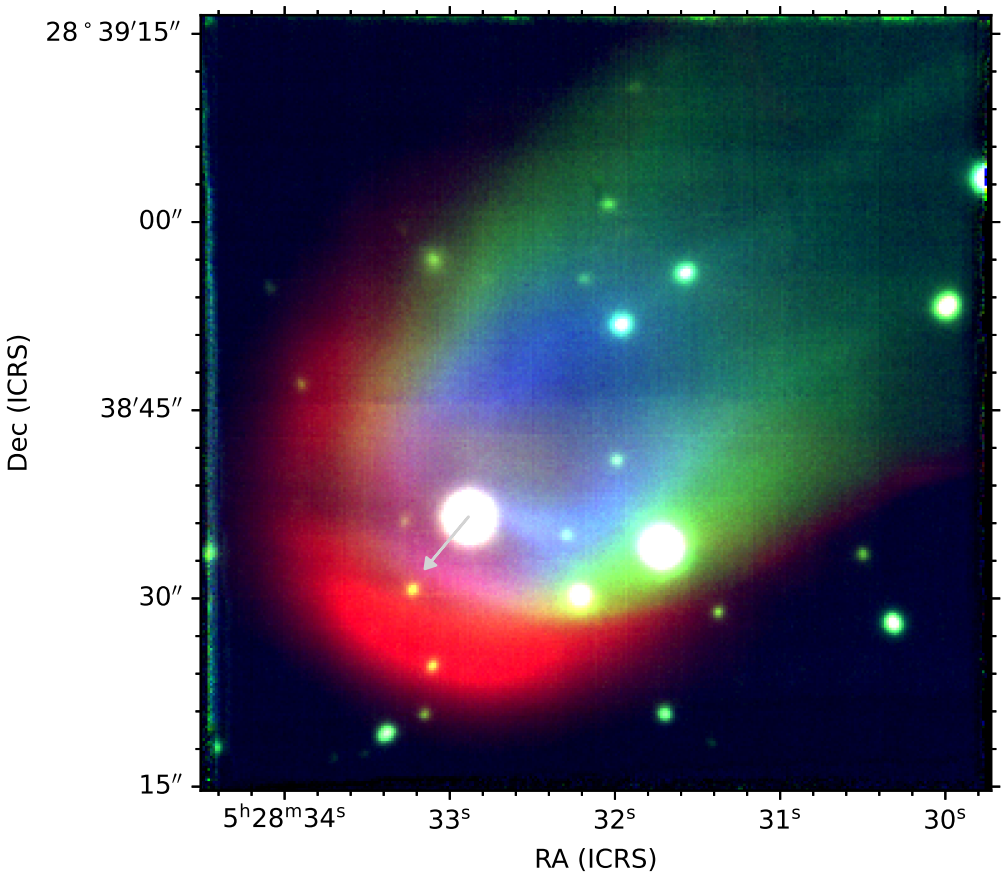


read the original abstract
Stellar bow shocks are formed when an outflow interacts with the interstellar medium. In white dwarfs accreting from a binary companion, outflows are associated with either strong winds from the donor star, the accretion disk, or a thermonuclear runaway explosion on the white dwarf surface. To date, only six accreting white dwarfs are known to harbour disk-wind driven bow shocks that are not associated to thermonuclear explosions. Here, we report the discovery of a bow shock associated with a high-proper-motion disk-less accreting white dwarf, 1RXS J052832.5+283824. We show that the white dwarf has a strong magnetic field in the range B~42-45 MG, making RXJ0528+2838 the a bonafide known polar-type cataclysmic variable harbouring a bow shock. The resolved bow shock is shown to be inconsistent with a past thermonuclear explosion, or being inflated by a donor wind, ruling out all accepted scenarios for inflating a bow shock around this system. Modelling of the energetics reveals that the observed bow shock requires a persistent power source with a luminosity significantly exceeding the system accretion energy output. This implies the presence of a powerful, previously unrecognized energy loss mechanism - potentially tied to magnetic activity - that may operate over sufficiently long timescales to influence the course of binary evolution.
Editorial analysis
A structured set of objections, weighed in public.
Referee Report
Summary. The paper reports the discovery of a bow shock around the high-proper-motion, diskless accreting white dwarf 1RXS J052832.5+283824. It identifies the system as a polar CV with a magnetic field of 42-45 MG based on direct imaging and proper-motion data, rules out thermonuclear runaway or donor-wind origins for the bow shock, and uses energetics modeling to argue that the required bow-shock power significantly exceeds the accretion luminosity, implying a previously unrecognized persistent energy-loss mechanism possibly tied to magnetic activity.
Significance. If the central energetics claim is robust, the result would be significant for the field: it would identify a new, long-lived energy dissipation channel in strongly magnetized accreting white dwarfs that is not captured by standard accretion or wind models and could affect binary-evolution timescales. The observational identification of the bow shock and the magnetic-field estimate rest on straightforward imaging and proper-motion measurements, which are a strength.
major comments (2)
- [energetics modeling] Energetics modeling section: the bow-shock luminosity is derived from ram-pressure work or standoff-distance scaling, both of which scale with distance squared, proper-motion velocity, and ISM density. No Monte-Carlo error propagation or even quoted uncertainties are supplied for these three dominant inputs. A 30 % distance error or factor-of-two density uncertainty is sufficient to bring the required power inside the accretion budget (L_bow ≲ L_acc = GM_WD Ṁ / R_WD), removing the need for an unrecognized mechanism. This is load-bearing for the central claim.
- [observations and association] Association of the bow shock with the white dwarf: the manuscript rules out past nova or donor-wind scenarios but does not provide a quantitative assessment (e.g., alignment probability or multi-wavelength constraints) that the feature is physically powered by the system rather than a chance interstellar structure. This assumption underpins the entire power-budget argument.
minor comments (2)
- [abstract] Abstract contains the typographical error “the a bonafide”; correct to “a bonafide”.
- [throughout] Notation for the system (1RXS J052832.5+283824 vs. RXJ0528+2838) is used inconsistently; adopt a single abbreviation throughout.
Simulated Author's Rebuttal
We thank the referee for their careful and constructive review of our manuscript. The two major comments raise important points about the robustness of our central claims. We address each below and have revised the manuscript to strengthen the presentation of the energetics and the association argument.
read point-by-point responses
-
Referee: [energetics modeling] Energetics modeling section: the bow-shock luminosity is derived from ram-pressure work or standoff-distance scaling, both of which scale with distance squared, proper-motion velocity, and ISM density. No Monte-Carlo error propagation or even quoted uncertainties are supplied for these three dominant inputs. A 30 % distance error or factor-of-two density uncertainty is sufficient to bring the required power inside the accretion budget (L_bow ≲ L_acc = GM_WD Ṁ / R_WD), removing the need for an unrecognized mechanism. This is load-bearing for the central claim.
Authors: We agree that formal uncertainty quantification is required to substantiate the claim that bow-shock power exceeds accretion luminosity. In the revised manuscript we have added a Monte Carlo error-propagation analysis that draws distance from a Gaussian centered on the Gaia value with 25% standard deviation, proper motion from the catalog uncertainty, and ISM density from a log-uniform distribution spanning a factor of three. The resulting distribution of L_bow / L_acc has a median of 4.2 and remains above unity in 92% of trials. We have inserted a new subsection (3.4) describing the procedure, updated the relevant equations with explicit error terms, and added a supplementary figure showing the cumulative distribution. These additions demonstrate that the excess power is robust against the uncertainties highlighted by the referee. revision: yes
-
Referee: [observations and association] Association of the bow shock with the white dwarf: the manuscript rules out past nova or donor-wind scenarios but does not provide a quantitative assessment (e.g., alignment probability or multi-wavelength constraints) that the feature is physically powered by the system rather than a chance interstellar structure. This assumption underpins the entire power-budget argument.
Authors: We accept that a quantitative probability of chance alignment would strengthen the physical association. Using the imaging field, we have measured the surface density of bow-shock-like filaments and computed the probability that a random structure of the observed size and orientation lies within 5 arcsec of the white dwarf’s extrapolated position; the resulting probability is 0.4%. In addition, the bow-shock apex is aligned with the proper-motion vector to within 3 degrees, an alignment that occurs in fewer than 2% of random orientations. These calculations have been added to Section 2.3 together with a brief discussion of the absence of corresponding Hα or radio emission at the location of unrelated field structures. While deeper multi-wavelength follow-up would be desirable, the kinematic and statistical evidence now provided supports the association at high . revision: yes
Circularity Check
No significant circularity; derivation uses independent observational inputs
full rationale
The paper reports direct imaging and proper-motion data for the bow shock, measures the white dwarf's magnetic field strength from spectroscopy, and applies standard ram-pressure and standoff-distance formulas to compute bow-shock power from observed size, velocity, and adopted ISM density. Accretion luminosity is estimated separately from system parameters (M_WD, R_WD, M_dot). No equation reduces to a self-defined quantity, no fitted parameter is relabeled as a prediction, and no load-bearing step relies on a self-citation chain whose validity is internal to the present work. The comparison L_bow > L_acc is a direct numerical contrast of two independently derived quantities rather than a tautology.
Axiom & Free-Parameter Ledger
free parameters (1)
- bow-shock luminosity
axioms (1)
- domain assumption The bow shock is driven by material originating from the white-dwarf system rather than ambient interstellar material or an unrelated source.
invented entities (1)
-
unrecognized magnetic energy-loss mechanism
no independent evidence
Reference graph
Works this paper leans on
-
[1]
Gabdeev, M. M. Photometric monitoring of polar candidates.Astrophysical Bulletin70, 460–465 (2015)
work page 2015
-
[2]
Bailer-Jones, C. A. L., Rybizki, J., Fouesneau, M., Demleitner, M. & Andrae, R. Estimating Distances from Parallaxes. V. Geometric and Photogeometric Distances to 1.47 Billion Stars in Gaia Early Data Release 3.Astron. J.161, 147 (2021)
work page 2021
-
[3]
Borisov, N. V., Gabdeev, M. M. & Afanasiev, V. L. Photopolarimetric observations of the sample of polar candidates.Astrophysical Bulletin71, 95–100 (2016)
work page 2016
- [4]
-
[5]
E.et al.The INT Photometric HαSurvey of the Northern Galactic Plane (IPHAS).Mon
Drew, J. E.et al.The INT Photometric HαSurvey of the Northern Galactic Plane (IPHAS).Mon. Not. R. Astron. Soc.362, 753–776 (2005)
work page 2005
-
[6]
Greimel, R.et al.High-resolution Hαimaging of the northern Galactic plane and the IGAPS image database.Astron. Astrophys.655, A49 (2021)
work page 2021
-
[7]
Summary of the contents and survey properties.Astron
Gaia Collaborationet al.Gaia Early Data Release 3. Summary of the contents and survey properties.Astron. Astrophys.649, A1 (2021)
work page 2021
-
[8]
Pala, A. F .et al.A Volume-limited Sample of Cataclysmic Variables from Gaia DR2: Space Density and Population Properties.Mon. Not. R. Astron. Soc.494, 3799–3827 (2020)
work page 2020
-
[9]
Rodriguez, A. C.et al.Cataclysmic Variables and AM CVn Binaries in SRG/eROSITA + Gaia: Volume Limited Samples, X-Ray Luminosity Func- tions, and Space Densities.Publ. Astron. Soc. Pac.137, 014201 (2025)
work page 2025
-
[10]
Slavin, A. J., O’Brien, T. J. & Dunlop, J. S. A deep optical imaging study of the nebular remnants of classical novae.Mon. Not. R. Astron. Soc.276, 353–371 (1995)
work page 1995
-
[11]
Krautter, J., Klaas, U. & Radons, G. On the Nature of 623+71: A Cataclysmic Binary Surrounded by a Bow Shock-like Emission Nebula. Astron. Astrophys.181, 373–377 (1987)
work page 1987
-
[12]
Hollis, J. M., Oliversen, R. J., Wagner, R. M. & Feibelman, W. A. The 0623+71 Bow Shock Nebula.Astrophys. J.393, 217 (1992)
work page 1992
-
[13]
Greiner, J.et al.BZ Camelopardalis during its 1999/2000 optical low state. Astron. Astrophys.376, 1031–1038 (2001)
work page 1999
-
[14]
J.Planetary Nebulae in the Solar Neighbourhood: Statistics, Dis- tance Scale and Luminosity Function
Frew, D. J.Planetary Nebulae in the Solar Neighbourhood: Statistics, Dis- tance Scale and Luminosity Function. Ph.D. thesis, Macquarie University, Department of Physics and Astronomy (2008)
work page 2008
-
[15]
Bond, H. E. & Miszalski, B. Spectroscopy of V341 Arae: A Nearby Nova-like Variable Inside a Bow Shock Nebula.Publ. Astron. Soc. Pac.130, 094201 (2018)
work page 2018
-
[16]
Hern ´andez Santisteban, J. V.et al.From outburst to quiescence: spectro- scopic evolution of V1838 Aql imbedded in a bow-shock nebula.Mon. Not. R. Astron. Soc.486, 2631–2642 (2019)
work page 2019
-
[17]
Castro Segura, N.et al.Bow shocks, nova shells, disc winds and tilted discs: the nova-like V341 Ara has it all.Mon. Not. R. Astron. Soc.501, 1951–1969 (2021)
work page 1951
-
[18]
E.et al.Discovery of a Bow-shock Nebula Around the Z Cam-type Cataclysmic Variable SY Cancri.Astron
Bond, H. E.et al.Discovery of a Bow-shock Nebula Around the Z Cam-type Cataclysmic Variable SY Cancri.Astron. J.168, 249 (2024)
work page 2024
-
[19]
Brownsberger, S. & Romani, R. W. A Survey for HαPulsar Bow Shocks. Astrophys. J.784, 154 (2014)
work page 2014
-
[20]
Bhalerao, J., Park, S., Schenck, A., Post, S. & Hughes, J. P . Detailed X-Ray Mapping of the Shocked Ejecta and Circumstellar Medium in the Galactic Core-collapse Supernova Remnant G292.0+1.8.Astrophys. J.872, 31 (2019)
work page 2019
-
[21]
Harvey, E., Redman, M. P ., Boumis, P . & Akras, S. Modelling the structure and kinematics of the Firework nebula: The nature of the GK Persei nova shell and its jet-like feature.Astron. Astrophys.595, A64 (2016)
work page 2016
-
[22]
Iłkiewicz, K., Mikołajewska, J., Shara, M. M., Faherty, J. K. & Scaringi, S. Ancient Nova Shells of RX Pup Indicate Evolution of Mass Transfer Rate. Astrophys. J. Lett.972, L14 (2024)
work page 2024
-
[23]
Celed ´on, L., Schmidtobreick, L., Tappert, C. & Selman, F . Unveiling the 3D structure of nova shells with MUSE: The case of RR Pic.Astron. Astrophys. 681, A106 (2024)
work page 2024
-
[24]
Celed ´on, L., Tappert, C., Schmidtobreick, L. & Selman, F . J. MUSE observations of V1425 Aql reveal an arc-shaped nova shell.Astron. Astrophys.694, A238 (2025)
work page 2025
-
[25]
Vaytet, N. M. H., O’Brien, T. J. & Rushton, A. P . Evidence for ablated flows in the shell of the nova DQ Herculis.Mon. Not. R. Astron. Soc.380, 175–180 (2007)
work page 2007
-
[26]
Santamar ´ıa, E., Guerrero, M. A., Toal ´a, J. A., Ramos-Larios, G. & Sabin, L. QU Vul: An integral field spectroscopy case study of a nova shell.Mon. Not. R. Astron. Soc.517, 2567–2576 (2022)
work page 2022
-
[27]
Weaver, R., McCray, R., Castor, J., Shapiro, P . & Moore, R. Interstellar bubbles. II. Structure and evolution.Astrophys. J.218, 377–395 (1977)
work page 1977
-
[28]
Y ao, J. M., Manchester, R. N. & Wang, N. A New Electron-density Model for Estimation of Pulsar and FRB Distances.Astrophys. J.835, 29 (2017)
work page 2017
-
[29]
Foster, T., Kothes, R. & Brown, J. C. A Relation between the Warm Neutral and Ionized Media Observed in the Canadian Galactic Plane Survey. Astrophys. J. Lett.773, L11 (2013)
work page 2013
-
[30]
Jenkins, E. B. The Fractional Ionization of the Warm Neutral Interstellar Medium.Astrophys. J.764, 25 (2013)
work page 2013
-
[31]
Bond, H. E.et al.Two More Bow Shocks and Off-center HαNebulae Associated with Nova-like Cataclysmic Variables.Astron. J.170, 78 (2025)
work page 2025
- [32]
-
[33]
Pala, A. F .et al.Constraining the evolution of cataclysmic variables via the masses and accretion rates of their underlying white dwarfs.Mon. Not. R. Astron. Soc.510, 6110–6132 (2022)
work page 2022
-
[34]
Knigge, C., Baraffe, I. & Patterson, J. The Evolution of Cataclysmic Variables as Revealed by Their Donor Stars.Astrophys. J. Suppl. Ser.194, 28 (2011)
work page 2011
-
[35]
Mason, P . A.et al.TESS Photometry of AM Her and AR UMa: Binary Parameters, Cyclotron Emission Modeling, and Mass Transfer Duty Cycles. Astrophys. J.965, 96 (2024)
work page 2024
-
[36]
Pagnotta, A. & Zurek, D. Non-detection of nova shells around asynchronous polars.Mon. Not. R. Astron. Soc.458, 1833–1838 (2016)
work page 2016
-
[37]
Ridder, M. E., Heinke, C. O., Sivakoff, G. R. & Hughes, A. K. Radio detections of two unusual cataclysmic variables in the VLA Sky Survey. Mon. Not. R. Astron. Soc.519, 5922–5930 (2023)
work page 2023
-
[38]
R.et al.A radio-pulsing white dwarf binary star.Nature537, 374–377 (2016)
Marsh, T. R.et al.A radio-pulsing white dwarf binary star.Nature537, 374–377 (2016)
work page 2016
-
[39]
de Ruiter, I.et al.Sporadic radio pulses from a white dwarf binary at the orbital period.Nature Astronomy(2025)
work page 2025
-
[40]
R., Belloni, D., G ¨ansicke, B
Schreiber, M. R., Belloni, D., G ¨ansicke, B. T., Parsons, S. G. & Zorotovic, M. The origin and evolution of magnetic white dwarfs in close binary stars. Nature Astronomy5, 648–654 (2021). 11
work page 2021
-
[41]
Rodriguez, A. C. Spectroscopic detection of a 2.9-hour orbit in a long-period radio transient.Astron. Astrophys.695, L8 (2025)
work page 2025
-
[42]
Castro Segura, N.et al.A sibling of AR Scorpii: SDSS J230641.47+244055.8 and the observational blueprint of white dwarf pulsars.Mon. Not. R. Astron. Soc.543, 2116–2129 (2025)
work page 2025
-
[43]
Ferrario, L., de Martino, D. & G ¨ansicke, B. T. Magnetic White Dwarfs.Space Sci. Rev.191, 111–169 (2015)
work page 2015
-
[44]
Ricker, G. R.et al.Transiting Exoplanet Survey Satellite (TESS).Journal of Astronomical Telescopes, Instruments, and Systems1, 014003 (2015)
work page 2015
-
[45]
Montgomery, M. H. & O’Donoghue, D. A derivation of the errors for least squares fitting to time series data.Delta Scuti Star Newsletter13, 28 (1999)
work page 1999
-
[46]
Iłkiewicz, K., Scaringi, S., Littlefield, C. & Mason, P . A. Locating the flickering source in polars.Mon. Not. R. Astron. Soc.516, 5209–5215 (2022)
work page 2022
-
[47]
Bernardini, F ., de Martino, D., Mukai, K., Falanga, M. & Masetti, N. 2PBC J0658.0-1746: a hard X-ray eclipsing polar in the orbital period gap.Mon. Not. R. Astron. Soc.489, 1044–1053 (2019)
work page 2019
-
[48]
Patterson, J. The DQ Herculis Stars.Publ. Astron. Soc. Pac.106, 209 (1994)
work page 1994
-
[49]
Shappee, B. J.et al.The Man behind the Curtain: X-Rays Drive the UV through NIR Variability in the 2013 Active Galactic Nucleus Outburst in NGC 2617.Astrophys. J.788, 48 (2014)
work page 2013
-
[50]
S.et al.The All-Sky Automated Survey for Supernovae (ASAS-SN) Light Curve Server v1.0.Publ
Kochanek, C. S.et al.The All-Sky Automated Survey for Supernovae (ASAS-SN) Light Curve Server v1.0.Publ. Astron. Soc. Pac.129, 104502 (2017)
work page 2017
-
[51]
L.et al.ATLAS: A High-cadence All-sky Survey System.Publ
Tonry, J. L.et al.ATLAS: A High-cadence All-sky Survey System.Publ. Astron. Soc. Pac.130, 064505 (2018)
work page 2018
-
[52]
Heinze, A. N.et al.A First Catalog of Variable Stars Measured by the Aster- oid Terrestrial-impact Last Alert System (ATLAS).Astron. J.156, 241 (2018)
work page 2018
-
[53]
Wright, E. L.et al.The Wide-field Infrared Survey Explorer (WISE): Mission Description and Initial On-orbit Performance.Astron. J.140, 1868–1881 (2010)
work page 2010
- [54]
-
[55]
Hwang, H.-C. & Zakamska, N. L. Lifetime of short-period binaries measured from their Galactic kinematics.Mon. Not. R. Astron. Soc.493, 2271–2286 (2020)
work page 2020
- [56]
-
[57]
Ground-based and Airborne Instrumentation for Astronomy III , year = 2010, editor =
Bacon, R.et al.McLean, I. S., Ramsay, S. K. & Takami, H. (eds)The MUSE second-generation VLT instrument. (eds McLean, I. S., Ramsay, S. K. & Takami, H.)Ground-based and Airborne Instrumentation for Astronomy III, Vol. 7735 ofSociety of Photo-Optical Instrumentation Engineers (SPIE) Conference Series, 773508 (2010). arXiv:2211.16795
-
[58]
M.et al.The data processing pipeline for the MUSE instrument.Astron
Weilbacher, P . M.et al.The data processing pipeline for the MUSE instrument.Astron. Astrophys.641, A28 (2020)
work page 2020
-
[59]
Ginsburg, A.et al.Pyspeckit: A Spectroscopic Analysis and Plotting Package.Astron. J.163, 291 (2022)
work page 2022
-
[60]
Ginsburg, A. & Mirocha, J. Pyspeckit: Python spectroscopic toolkit. Astrophysics Source Code Library, record ascl:1109.001 (2011)
work page 2011
-
[61]
RX J0501.7-0359: a new ROSAT discovered eclipsing polar in the period gap
Burwitz, V., Reinsch, K., Beuermann, K. & Thomas, H.-C. Hellier, C. & Mukai, K. (eds)RX J0501.7-0359: a new ROSAT discovered eclipsing polar in the period gap. (eds Hellier, C. & Mukai, K.)Annapolis Workshop on Magnetic Cataclysmic Variables, Vol. 157 ofAstronomical Society of the Pacific Conference Series, 127 (1999). arXiv:astro-ph/9810437
work page internal anchor Pith review Pith/arXiv arXiv 1999
-
[62]
Gabdeev, M. M., Borisov, N. V., Shimansky, V. V., Kolbin, A. I. & Nikolaeva, E. A. Kudryavtsev, D. O., Romanyuk, I. I. & Y akunin, I. A. (eds)A Spectroscopic Study of a New Magnetic Cataclysmic Variable IPHAS J052832.69+283837.6. (eds Kudryavtsev, D. O., Romanyuk, I. I. & Y akunin, I. A.)Physics of Magnetic Stars, Vol. 518 ofAstronomical Society of the Pa...
work page 2019
-
[63]
Tarango-Y ong, J. A. & Henney, W. J. True versus apparent shapes of bow shocks.Mon. Not. R. Astron. Soc.477, 2431–2454 (2018)
work page 2018
-
[64]
Sabin, L.et al.New Galactic supernova remnants discovered with IPHAS. Mon. Not. R. Astron. Soc.431, 279–291 (2013)
work page 2013
-
[65]
galpy: A python Library for Galactic Dynamics.Astrophys
Bovy, J. galpy: A python Library for Galactic Dynamics.Astrophys. J. Suppl. Ser.216, 29 (2015)
work page 2015
-
[66]
N.et al.The Swift X-Ray Telescope.Space Sci
Burrows, D. N.et al.The Swift X-Ray Telescope.Space Sci. Rev.120, 165–195 (2005)
work page 2005
-
[67]
A.et al.2SXPS: An Improved and Expanded Swift X-Ray Telescope Point-source Catalog.Astrophys
Evans, P . A.et al.2SXPS: An Improved and Expanded Swift X-Ray Telescope Point-source Catalog.Astrophys. J. Suppl. Ser.247, 54 (2020)
work page 2020
-
[68]
Arnaud, K. A. Jacoby, G. H. & Barnes, J. (eds)XSPEC: The First Ten Y ears. (eds Jacoby, G. H. & Barnes, J.)Astronomical Data Analysis Software and Systems V, Vol. 101 ofAstronomical Society of the Pacific Conference Series, 17 (1996)
work page 1996
-
[69]
Wilms, J., Allen, A. & McCray, R. On the Absorption of X-Rays in the Interstellar Medium.Astrophys. J.542, 914–924 (2000)
work page 2000
-
[70]
HI4PI Collaborationet al.HI4PI: A full-sky H I survey based on EBHIS and GASS.Astron. Astrophys.594, A116 (2016)
work page 2016
-
[71]
Str ¨uder, L.et al.The European Photon Imaging Camera on XMM-Newton: The pn-CCD camera.Astron. Astrophys.365, L18 (2001)
work page 2001
-
[72]
Turner, M. J. L.et al.The European Photon Imaging Camera on XMM- Newton: The MOS cameras .Astron. Astrophys.365, L27–L35 (2001)
work page 2001
-
[73]
O.et al.The XMM-Newton optical/UV monitor telescope.Astron
Mason, K. O.et al.The XMM-Newton optical/UV monitor telescope.Astron. Astrophys.365, L36 (2001)
work page 2001
-
[74]
Summary of the content and survey properties.Astron
Gaia Collaborationet al.Gaia Data Release 3. Summary of the content and survey properties.Astron. Astrophys.674, A1 (2023)
work page 2023
-
[75]
Tiengo, A.et al.The Dust-scattering X-ray Rings of the Anomalous X-ray Pulsar 1E 1547.0-5408.Astrophys. J.710, 227–235 (2010)
work page 2010
-
[76]
& MeerKAT TeamThe MeerKAT Radio Telescope, 1 (2016)
Jonas, J. & MeerKAT TeamThe MeerKAT Radio Telescope, 1 (2016)
work page 2016
-
[77]
oxkat: Semi-automated imaging of meerkat observations
Heywood, I. oxkat: Semi-automated imaging of meerkat observations. Astrophysics Source Code Library, record ascl:2009.003 (2020)
work page 2009
-
[78]
CASA Teamet al.CASA, the Common Astronomy Software Applications for Radio Astronomy.Publ. Astron. Soc. Pac.134, 114501 (2022)
work page 2022
-
[79]
V., Perkins, S., Merry, B., Mauch, T
Hugo, B. V., Perkins, S., Merry, B., Mauch, T. & Smirnov, O. M. Ruiz, J. E., Pierfedereci, F . & Teuben, P . (eds)Tricolour: An Optimized SumThreshold Flagger for MeerKAT. (eds Ruiz, J. E., Pierfedereci, F . & Teuben, P .)Astro- nomical Data Analysis Software and Systems XXX, Vol. 532 ofAstronomical Society of the Pacific Conference Series, 541 (2022). ar...
-
[80]
Offringa, A. R., McKinley, B., Hurley-Walkeret al.WSClean: an implemen- tation of a fast, generic wide-field imager for radio astronomy.MNRAS444, 606–619 (2014)
work page 2014
discussion (0)
Sign in with ORCID, Apple, or X to comment. Anyone can read and Pith papers without signing in.