PipeMFL-240K: A Large-scale Dataset and Benchmark for Object Detection in Pipeline Magnetic Flux Leakage Imaging
Pith reviewed 2026-05-25 07:26 UTC · model grok-4.3
The pith
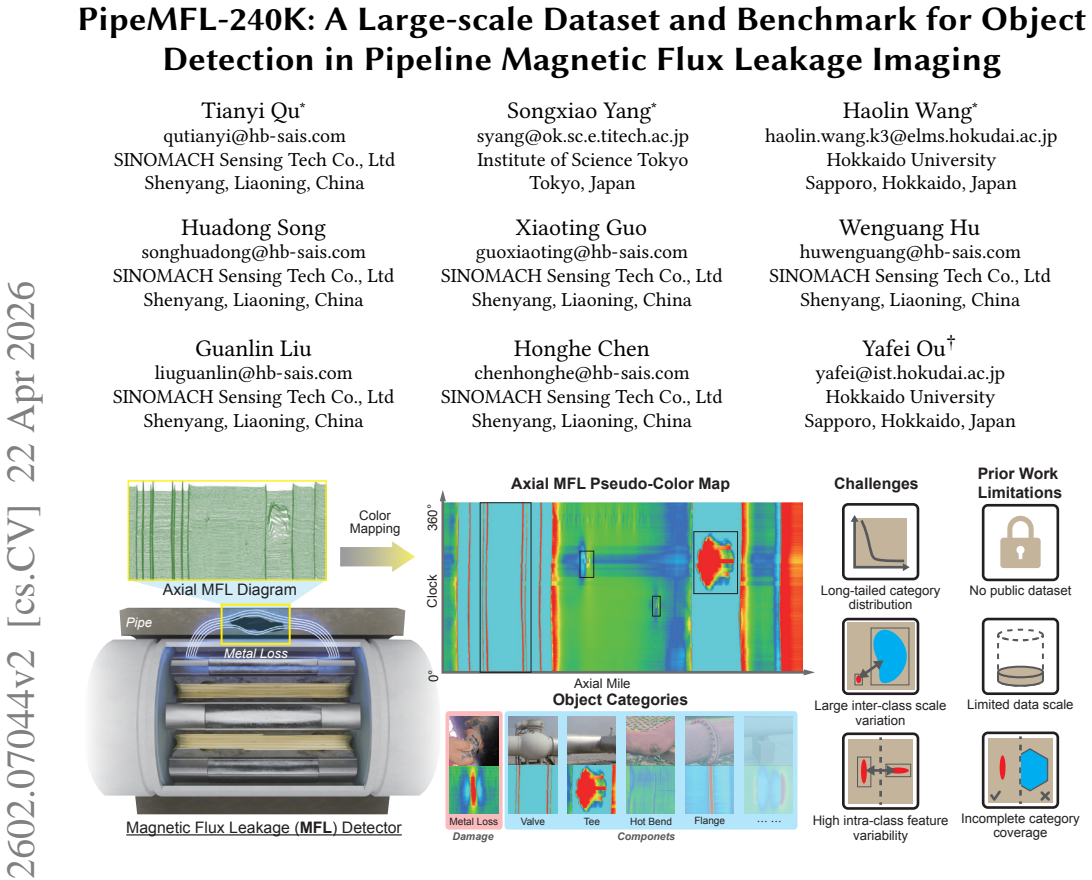
The PipeMFL-240K dataset is the first large public benchmark for object detection in pipeline MFL images and shows modern detectors still struggle with its long-tailed classes, tiny objects, and intra-class variability.
A machine-rendered reading of the paper's core claim, the machinery that carries it, and where it could break.
Core claim
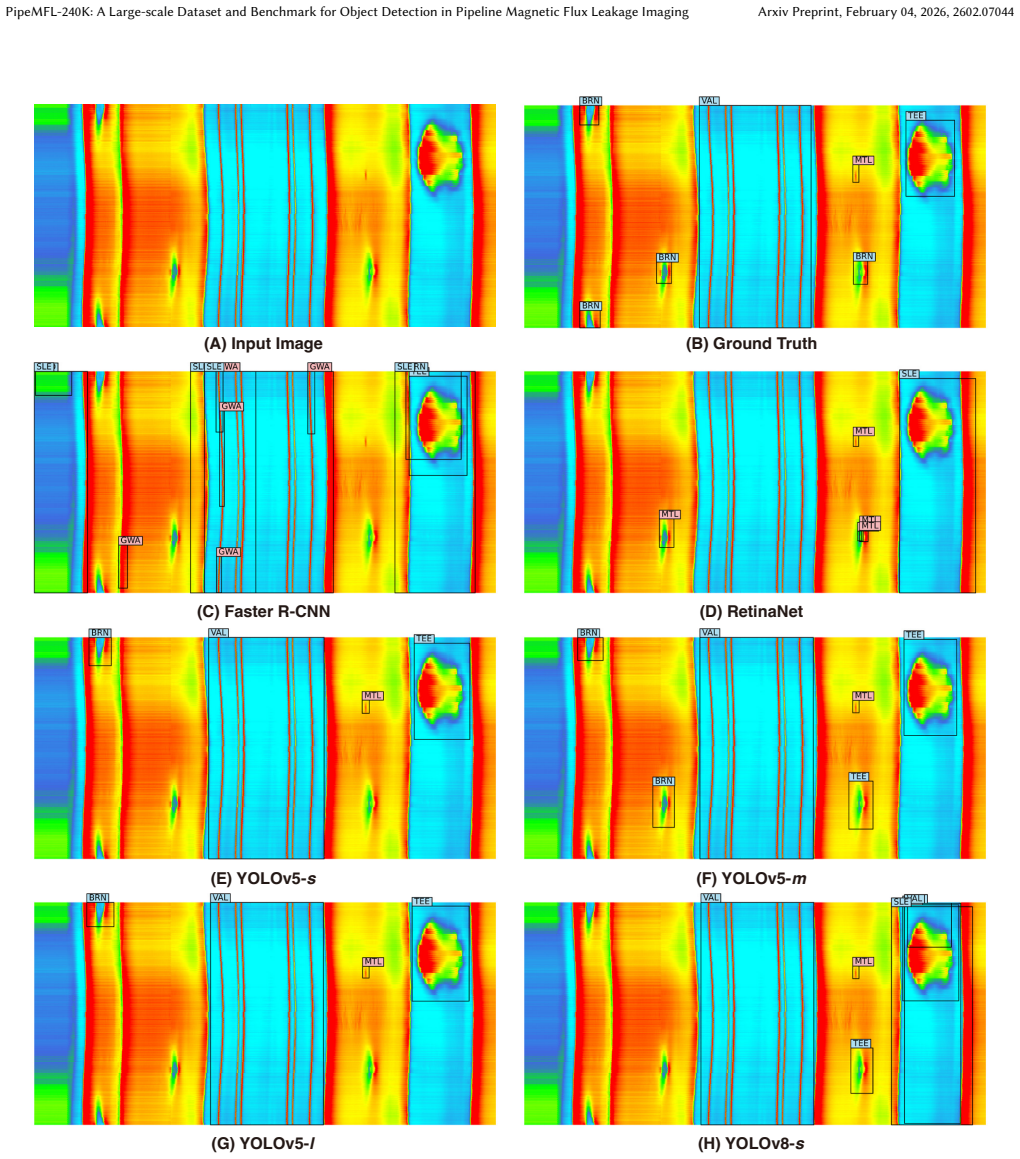
PipeMFL-240K is the first public dataset and benchmark of this scale and scope for pipeline MFL inspection. Modern detectors still struggle with its long-tailed distribution, tiny objects, and intra-class variability, highlighting considerable headroom for improvement.
What carries the argument
The PipeMFL-240K dataset, which carries the argument by supplying the first large-scale annotated collection of real MFL images that encodes the stated challenges of long-tailed classes, tiny objects, and intra-class variability.
If this is right
- Researchers can now perform fair, reproducible comparisons of detectors on MFL data.
- New algorithms must specifically address long-tailed distributions and tiny objects to succeed on this benchmark.
- Improved detection performance would directly support more reliable automated pipeline diagnostics.
- The dataset supplies a foundation for maintenance planning based on consistent MFL interpretation.
Where Pith is reading between the lines
- Methods developed for this benchmark may need to incorporate domain-specific priors about defect appearance rather than relying solely on transfer from natural-image detectors.
- The identified challenges suggest that progress in general object detection will not automatically transfer to industrial NDT without targeted adaptation.
- Releasing similar large annotated collections for other inspection modalities could accelerate automation across non-destructive testing.
Load-bearing premise
The 200,020 bounding-box annotations are high-quality and the images from 12 pipelines spanning 1,530 km accurately capture the full range of real-world MFL inspection complexity without significant labeling errors or selection bias.
What would settle it
A controlled experiment in which unmodified state-of-the-art detectors achieve high average precision on the held-out portion of PipeMFL-240K would falsify the claim of considerable headroom for improvement.
Figures




read the original abstract
Pipeline integrity is critical to industrial safety and environmental protection, with Magnetic Flux Leakage (MFL) detection being a primary non-destructive testing technology. Despite the promise of deep learning for automating MFL interpretation, progress toward reliable models has been constrained by the absence of a large-scale public dataset and benchmark, making fair comparison and reproducible evaluation difficult. We introduce \textbf{PipeMFL-240K}, a large-scale, meticulously annotated dataset and benchmark for complex object detection in pipeline MFL pseudo-color images. PipeMFL-240K reflects real-world inspection complexity and poses several unique challenges: (i) an extremely long-tailed distribution over \textbf{12} categories, (ii) a high prevalence of tiny objects that often comprise only a handful of pixels and (iii) substantial intra-class variability. The dataset contains \textbf{249,320} images and \textbf{200,020} high-quality bounding-box annotations, collected from 12 pipelines spanning approximately \textbf{1,530} km. Extensive experiments are conducted with state-of-the-art object detectors to establish baselines. Results show that modern detectors still struggle with the intrinsic properties of MFL data, highlighting considerable headroom for improvement, while PipeMFL-240K provides a reliable and challenging testbed to drive future research. As the first public dataset and the first benchmark of this scale and scope for pipeline MFL inspection, it provides a critical foundation for efficient pipeline diagnostics as well as maintenance planning and is expected to accelerate algorithmic innovation and reproducible research in MFL-based pipeline integrity assessment.
Editorial analysis
A structured set of objections, weighed in public.
Referee Report
Summary. The paper introduces PipeMFL-240K as the first large-scale public dataset and benchmark for object detection in pipeline MFL pseudo-color images. It comprises 249,320 images with 200,020 bounding-box annotations across 12 categories, collected from 12 pipelines spanning 1,530 km. The dataset is characterized by an extremely long-tailed class distribution, high prevalence of tiny objects, and substantial intra-class variability. Baselines are established via experiments with state-of-the-art detectors, which are reported to struggle on these properties and thus indicate headroom for future work.
Significance. If the annotation quality and sampling representativeness are verified, the release of PipeMFL-240K would constitute a significant contribution by providing the first public benchmark of this scale and scope in the MFL inspection domain. It would enable reproducible comparisons and accelerate research on automated pipeline diagnostics, directly addressing the current absence of large public datasets in this industrial application area.
major comments (3)
- [Abstract] Abstract: the central claim that the 200,020 bounding boxes are 'high-quality' and 'meticulously annotated' is load-bearing for the 'reliable testbed' assertion, yet the manuscript supplies no annotation protocol, inter-annotator agreement metrics, or expert verification steps.
- [Abstract] Abstract: the statement that 'extensive experiments are conducted with state-of-the-art object detectors to establish baselines' and that 'modern detectors still struggle' is unsupported by any quantitative metrics, error bars, data-split details, or per-detector performance numbers, preventing assessment of the claimed intrinsic difficulty.
- [Abstract] Abstract: the dataset is drawn from only 12 pipelines (1,530 km); without explicit selection criteria or analysis of potential sampling bias, it is unclear whether the collection faithfully represents the full range of real-world MFL variability required for the benchmark claim.
Simulated Author's Rebuttal
We thank the referee for the detailed and constructive comments. We address each major comment point by point below, indicating planned revisions to strengthen the manuscript.
read point-by-point responses
-
Referee: [Abstract] Abstract: the central claim that the 200,020 bounding boxes are 'high-quality' and 'meticulously annotated' is load-bearing for the 'reliable testbed' assertion, yet the manuscript supplies no annotation protocol, inter-annotator agreement metrics, or expert verification steps.
Authors: We agree the abstract lacks supporting details on annotation quality. The full manuscript (Section 3.2) describes the annotation protocol, which involved domain-expert annotators following a standardized guideline with multiple verification rounds by pipeline inspection specialists. We will revise the abstract to reference this protocol and the expert verification steps. However, formal inter-annotator agreement metrics were not computed. revision: partial
-
Referee: [Abstract] Abstract: the statement that 'extensive experiments are conducted with state-of-the-art object detectors to establish baselines' and that 'modern detectors still struggle' is unsupported by any quantitative metrics, error bars, data-split details, or per-detector performance numbers, preventing assessment of the claimed intrinsic difficulty.
Authors: The full manuscript contains a complete Experiments section (Section 4) with quantitative results, including per-detector mAP scores, data splits (train/val/test), and analysis of failure modes on long-tailed and tiny-object cases. The abstract summarizes these findings concisely. We will revise the abstract to include key baseline metrics and data-split information to better support the claims. revision: yes
-
Referee: [Abstract] Abstract: the dataset is drawn from only 12 pipelines (1,530 km); without explicit selection criteria or analysis of potential sampling bias, it is unclear whether the collection faithfully represents the full range of real-world MFL variability required for the benchmark claim.
Authors: Section 3.1 of the manuscript details the collection process from 12 pipelines selected across different geographic regions, pipe materials, and operational histories to maximize diversity. We will revise both the abstract and the dataset section to explicitly state the selection criteria and include a brief discussion of potential sampling biases and mitigation steps. revision: yes
- Inter-annotator agreement metrics were not computed during the annotation process and therefore cannot be provided.
Circularity Check
No circularity; dataset paper with no derivations or fitted predictions
full rationale
This is a dataset contribution paper. It presents PipeMFL-240K (249,320 images, 200,020 annotations from 12 pipelines) and reports standard baseline evaluations of existing object detectors on the released data. No equations, derivations, parameter fitting, predictions, uniqueness theorems, or ansatzes appear in the text. The central claim is the existence and properties of the data itself; reported detector struggles are empirical observations on the new benchmark, not reductions to inputs by construction. No self-citation load-bearing steps or renamings of known results are present. The paper is self-contained as a data release.
discussion (0)
Sign in with ORCID, Apple, or X to comment. Anyone can read and Pith papers without signing in.