Probabilistic NDVI Forecasting from Sparse Satellite Time Series and Weather Covariates
Pith reviewed 2026-05-16 07:13 UTC · model grok-4.3
The pith
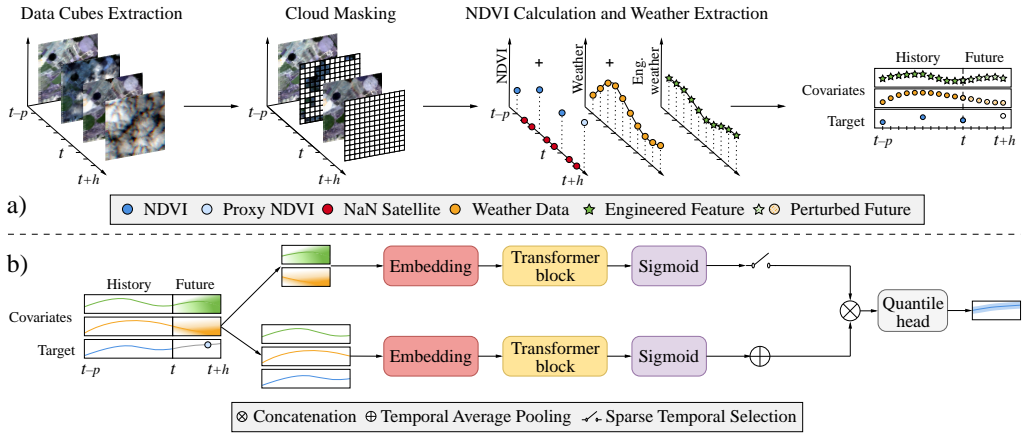
A probabilistic NDVI forecasting model separates historical encodings from future weather covariates to handle sparse satellite data.
A machine-rendered reading of the paper's core claim, the machinery that carries it, and where it could break.
Core claim
The central discovery is that a multimodal architecture encoding historical NDVI and meteorological observations separately from future exogenous covariates, combined with a temporal-distance weighted quantile loss and engineered cumulative/extreme-weather features, achieves better probabilistic multi-step NDVI predictions under sparse and irregular clear-sky acquisitions than existing baselines.
What carries the argument
The architecture that separates the encoding of historical NDVI and meteorological observations from future exogenous covariates for multi-step quantile prediction, trained with a temporal-distance weighted quantile loss.
If this is right
- Probabilistic forecasts quantify uncertainty arising from cloud masking in satellite data.
- Feature engineering for cumulative and extreme weather effects improves capture of vegetation response delays.
- Target history serves as the primary driver of predictive performance.
- Meteorological covariates yield additional gains when integrated in the full multimodal setup.
- Outperformance holds across both pointwise accuracy and probabilistic metrics.
Where Pith is reading between the lines
- This approach could support more reliable decision-making in precision agriculture where satellite revisits are infrequent.
- Retraining on datasets with different cloud masking statistics might be necessary for global applicability.
- Extending the model to incorporate additional data sources like soil moisture could reduce dependence on clear-sky observations.
Load-bearing premise
The temporal-distance weighted quantile loss and engineered cumulative/extreme-weather features will generalize beyond the European dataset and specific cloud-masking patterns used.
What would settle it
Evaluating the model on satellite data from a non-European region with markedly different revisit frequencies and weather patterns, where it fails to outperform baselines, would falsify the performance claims.
Figures


read the original abstract
Short-term forecasting of vegetation dynamics is a key enabler for data-driven decision support in precision agriculture. Normalized Difference Vegetation Index (NDVI) forecasting from satellite observations, however, remains challenging due to sparse and irregular sampling caused by cloud masking, as well as the heterogeneous climatic conditions under which crops evolve. In this work, we propose a probabilistic forecasting framework for field-level NDVI prediction under sparse, irregular clear-sky acquisitions. The architecture separates the encoding of historical NDVI and meteorological observations from future exogenous covariates, fusing both representations for multi-step quantile prediction. To address irregular revisit patterns and horizon-dependent uncertainty, we introduce a temporal-distance weighted quantile loss that aligns the training objective with the effective forecasting horizon. In addition, we incorporate cumulative and extreme-weather feature engineering to capture delayed meteorological effects relevant to vegetation response. Experiments on European satellite data show that the proposed approach outperforms statistical, deep learning, and time-series baselines on both pointwise and probabilistic evaluation metrics. Ablation studies confirm that target history is the primary driver of performance, with meteorological covariates providing additional gains in the full multimodal setting. The code is available at https://github.com/arco-group/ndvi-forecasting.
Editorial analysis
A structured set of objections, weighed in public.
Referee Report
Summary. The manuscript proposes a probabilistic NDVI forecasting framework that encodes historical NDVI and meteorological observations separately from future exogenous weather covariates, fuses the representations for multi-step quantile prediction, introduces a temporal-distance weighted quantile loss to handle irregular sampling and horizon-dependent uncertainty, and incorporates cumulative and extreme-weather feature engineering. Experiments on European satellite data report outperformance over statistical, deep learning, and time-series baselines on both pointwise and probabilistic metrics, with ablation studies identifying target history as the primary performance driver. The code is released at a public repository.
Significance. If the empirical results hold under clarified validation, the work would provide a practical contribution to precision agriculture by improving short-term vegetation forecasting under sparse, cloud-masked satellite observations. The separation of historical and future inputs, horizon-aware loss, and multimodal fusion directly target the challenges of irregular revisit patterns and delayed weather effects. Ablation results and code release add value by highlighting component importance and supporting reproducibility.
major comments (1)
- [Experiments] Experiments section: The train/test split methodology is not described in sufficient detail. It remains unclear whether the same agricultural fields appear in both training and test sets, which is load-bearing for confirming that the reported outperformance on pointwise and probabilistic metrics is not due to data leakage or field-specific correlations.
minor comments (2)
- [Abstract] Abstract: A brief mention of dataset scale (number of fields, time span) and the temporal split strategy would strengthen the central claim of outperformance.
- [Method] Method section: The precise mathematical definition of the temporal-distance weighted quantile loss would benefit from an explicit equation to improve reproducibility.
Simulated Author's Rebuttal
We thank the referee for the constructive comment regarding the train/test split. We have revised the manuscript to provide a clear and detailed description of the methodology, confirming a field-disjoint split that eliminates the possibility of data leakage.
read point-by-point responses
-
Referee: [Experiments] Experiments section: The train/test split methodology is not described in sufficient detail. It remains unclear whether the same agricultural fields appear in both training and test sets, which is load-bearing for confirming that the reported outperformance on pointwise and probabilistic metrics is not due to data leakage or field-specific correlations.
Authors: We appreciate the referee raising this critical point about potential data leakage. In the revised manuscript, we have expanded the 'Experiments' section (specifically the 'Dataset and Preprocessing' and 'Evaluation Protocol' subsections) to explicitly detail the split procedure. The dataset was partitioned at the field level: individual agricultural fields were randomly assigned to training (70%), validation (15%), and test (15%) sets, with all time series belonging to a given field kept entirely within one split. No field appears in more than one partition. This design ensures that performance gains cannot be attributed to field-specific correlations, repeated observations of the same location, or leakage across train and test sets. We believe this clarification directly addresses the concern and strengthens the validity of the reported results. revision: yes
Circularity Check
No significant circularity
full rationale
The paper presents an empirical machine learning framework for probabilistic NDVI forecasting. Its central claims rest on experimental outperformance against statistical, deep learning, and time-series baselines on a European satellite dataset, supported by ablation studies identifying target history as the primary driver. No mathematical derivation, first-principles result, or uniqueness theorem is claimed; the temporal-distance weighted quantile loss and cumulative/extreme-weather features are introduced as design choices to handle irregular sampling and delayed effects, without reducing to fitted parameters by construction. No load-bearing self-citations or ansatz smuggling appear in the provided text. The contribution is self-contained as an empirical comparison.
Axiom & Free-Parameter Ledger
free parameters (2)
- quantile levels
- temporal weighting schedule
axioms (2)
- domain assumption Vegetation response to weather is sufficiently stationary within the European study region and time period to allow generalization from training to test fields.
- domain assumption Clear-sky NDVI observations are missing at random conditional on the weather covariates.
Lean theorems connected to this paper
-
IndisputableMonolith/Cost/FunctionalEquation.leanwashburn_uniqueness_aczel unclear?
unclearRelation between the paper passage and the cited Recognition theorem.
temporal-distance weighted quantile loss ... wk = 1/(1 + α·Δdays_k) with α=0.5
-
IndisputableMonolith/Foundation/ArithmeticFromLogic.leanreality_from_one_distinction unclear?
unclearRelation between the paper passage and the cited Recognition theorem.
transformer-based architecture ... history and future branches
What do these tags mean?
- matches
- The paper's claim is directly supported by a theorem in the formal canon.
- supports
- The theorem supports part of the paper's argument, but the paper may add assumptions or extra steps.
- extends
- The paper goes beyond the formal theorem; the theorem is a base layer rather than the whole result.
- uses
- The paper appears to rely on the theorem as machinery.
- contradicts
- The paper's claim conflicts with a theorem or certificate in the canon.
- unclear
- Pith found a possible connection, but the passage is too broad, indirect, or ambiguous to say the theorem truly supports the claim.
Forward citations
Cited by 1 Pith paper
-
VegSim: A Geospatial World Model for Scenario-Conditioned Vegetation Simulation
VegSim uses recurrent latent dynamics to enable both standard NDVI forecasting and user-controlled scenario simulation of vegetation from sparse satellite and weather inputs.
discussion (0)
Sign in with ORCID, Apple, or X to comment. Anyone can read and Pith papers without signing in.