HistCAD: A Constraint-Aware Parametric History-Based CAD Representation, Dataset, and Benchmark with Industrial Complexity
Pith reviewed 2026-05-17 01:10 UTC · model grok-4.3
The pith
Explicit constraints in parametric CAD sequences preserve design intent after parameter edits.
A machine-rendered reading of the paper's core claim, the machinery that carries it, and where it could break.
Core claim
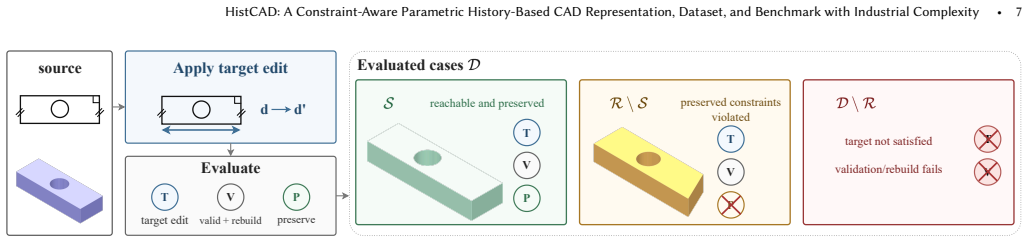
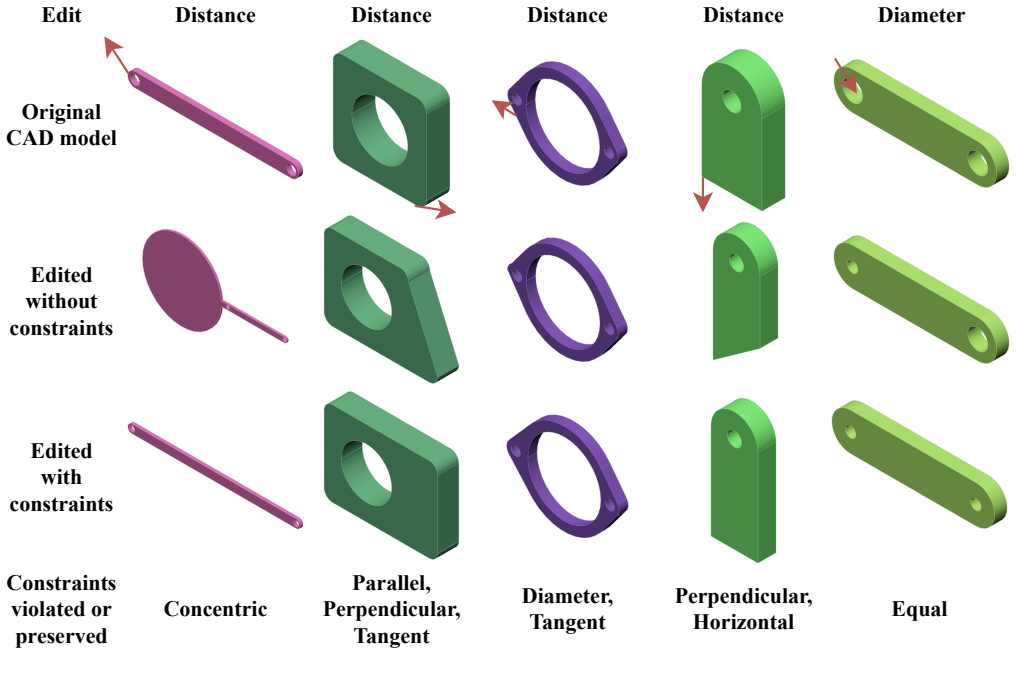
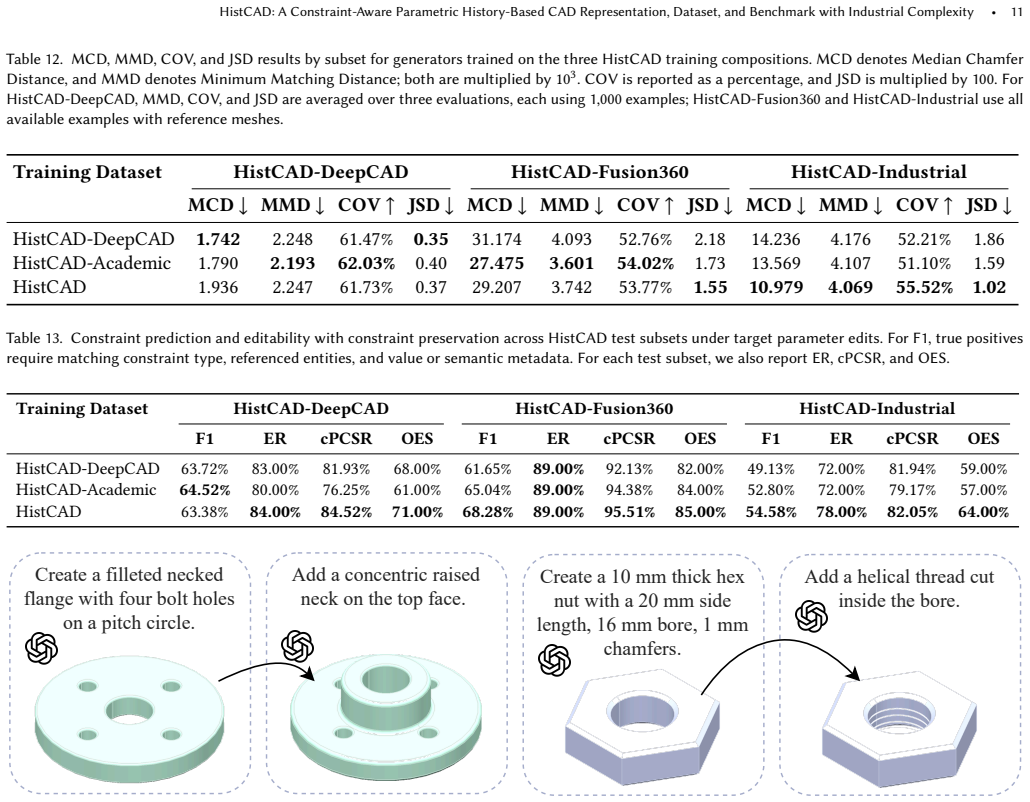
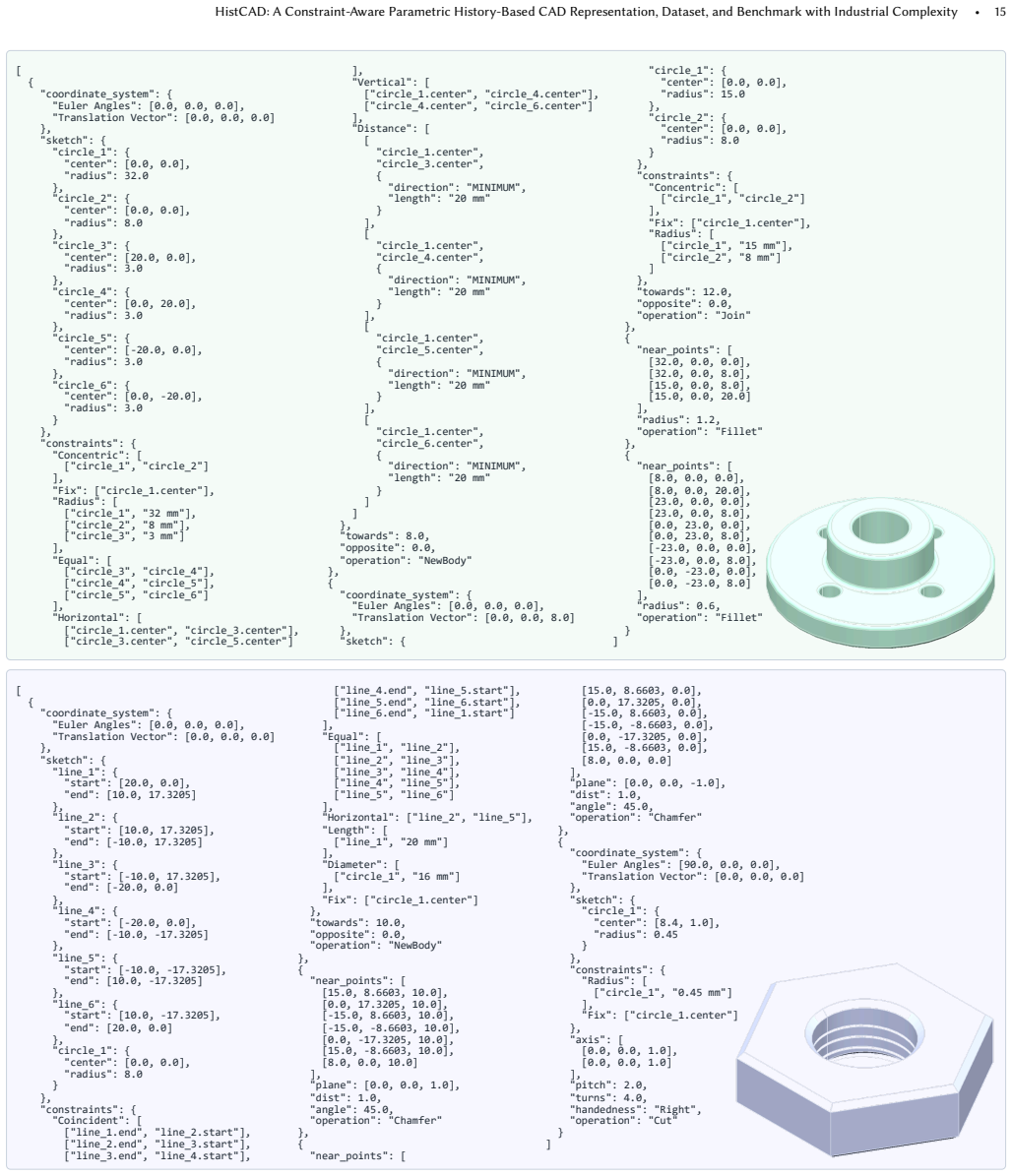
HistCAD defines an intermediate language that records sketch primitives, constraints, feature operations, and 3D point boundary references for operations such as fillet and chamfer. The accompanying dataset of 170,236 sequences is aligned with native CAD models and STEP files. The Constraint-Aware Editability Benchmark measures Edit Reachability, conditional preserved constraint satisfaction, and Overall Editable Success to separate failures to reach a valid state from failures to keep required constraints. Experiments show that explicit constraints are essential for preserving design intent after edits and that HistCAD enables supervised CAD generation from text and direct LLM workflows.
What carries the argument
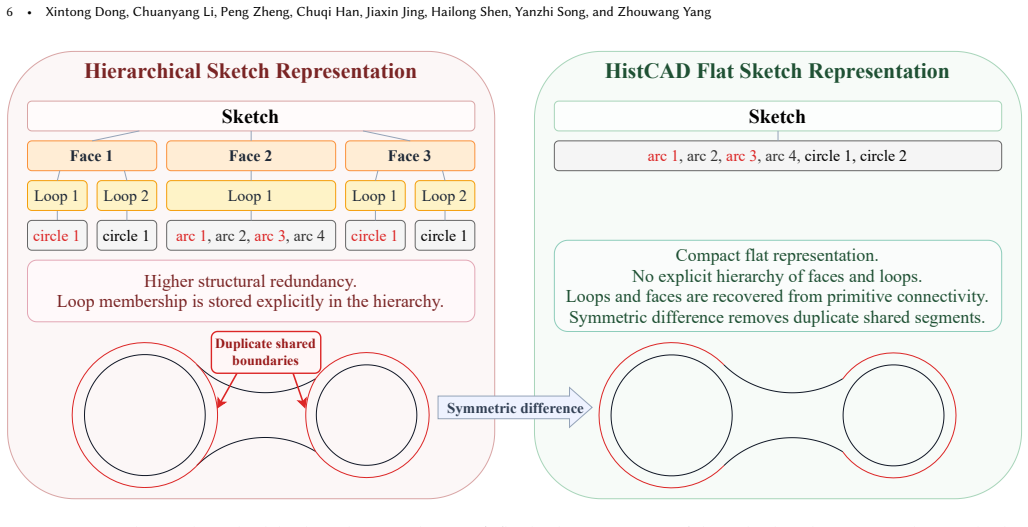
HistCAD intermediate language that records constraints and operations independently of CAD software to measure and enforce editability of parametric sequences.
If this is right
- CAD generation systems can be trained to output constraint-explicit sequences that remain valid after parameter changes.
- Text-to-CAD pipelines gain practical utility because generated models preserve intended behavior under edits.
- LLM-based CAD workflows can produce reusable histories directly rather than static geometry.
- Evaluation of new CAD generators can now distinguish reachability errors from constraint-violation errors.
Where Pith is reading between the lines
- The representation could support automatic conversion of legacy CAD files into editable constraint-aware forms.
- Training on the 170k-scale dataset may improve generalization of generative models across different industrial domains.
- Extending the benchmark to assembly-level constraints or multi-step feature edits would test broader applicability.
Load-bearing premise
The introduced metrics of Edit Reachability, conditional preserved constraint satisfaction, and Overall Editable Success, together with dataset alignment to native CAD models, sufficiently capture real-world design intent preservation and industrial complexity.
What would settle it
Running the edit benchmark on CAD sequences generated by methods that omit explicit constraints and finding that their Overall Editable Success rates equal or exceed those of HistCAD-trained models would falsify the claim that explicit constraints are essential.
Figures

read the original abstract
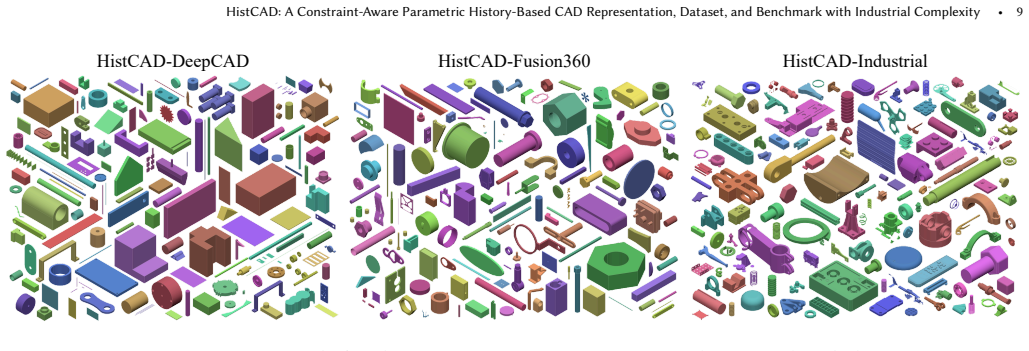
Parametric CAD sequences are reusable because dimensional and geometric constraints govern how parameter changes propagate. Existing CAD generation datasets and benchmarks emphasize reconstruction fidelity, execution validity, or static shape similarity, leaving preservation of design intent under edits largely unmeasured. We introduce HistCAD, a representation standard, dataset, and benchmark for executable parametric CAD with explicit constraints. HistCAD defines an intermediate language independent of CAD software, recording sketch primitives, constraints, feature operations, and 3D point boundary references for operations such as fillet and chamfer. The dataset contains 170,236 executable sequences aligned with native CAD models, STEP files, rendered views, and text annotations, combining academic scale with professionally authored industrial complexity. Building on this representation, the Constraint-Aware Editability Benchmark applies parameter edits and reports Edit Reachability, conditional preserved constraint satisfaction, and Overall Editable Success, abbreviated ER, cPCSR, and OES; these metrics separate failures to reach a valid edited state from failures to preserve required constraints. Experiments show that explicit constraints are essential for preserving design intent after edits, and that HistCAD supports supervised CAD generation from text and direct LLM workflows. We argue that HistCAD reframes CAD generation from static shape imitation to the synthesis of reusable parametric sequences with explicit constraints.
Editorial analysis
A structured set of objections, weighed in public.
Referee Report
Summary. The paper introduces HistCAD, a constraint-aware parametric history-based CAD representation using an intermediate language that records sketch primitives, explicit constraints, feature operations, and 3D boundary references. It releases a dataset of 170,236 executable sequences aligned with native CAD models, STEP files, rendered views, and text annotations that combines academic scale with industrial complexity. A new Constraint-Aware Editability Benchmark is defined with metrics Edit Reachability (ER), conditional preserved constraint satisfaction (cPCSR), and Overall Editable Success (OES) that separate failures to reach a valid edited state from failures to preserve constraints. Experiments are reported to show that explicit constraints are essential for preserving design intent after edits and that HistCAD enables supervised CAD generation from text as well as direct LLM workflows.
Significance. If the results hold, HistCAD could meaningfully shift CAD generation research from static shape imitation toward synthesis of reusable parametric sequences that preserve design intent under editing. The dataset scale, alignment with professionally authored industrial models, and the new metrics that disentangle reachability from constraint preservation are concrete strengths that could support more reliable generative CAD pipelines and LLM integration. Credit is due for releasing an executable representation standard and benchmark rather than another reconstruction-only corpus.
major comments (3)
- [Dataset construction] Dataset construction section: alignment of HistCAD sequences with native CAD models and STEP files is described, but no expert validation or analysis is reported to confirm that the extracted explicit constraints capture relevant implicit relations or manufacturing constraints typical in industrial practice. This is load-bearing for the claim that higher cPCSR/OES scores demonstrate preservation of design intent rather than merely improved executability.
- [Experiments] Experiments section: the claim that experiments demonstrate the value of explicit constraints for intent preservation is stated, yet details on validation procedures, error analysis, and automatic verification of constraint satisfaction are insufficient. Without these, the empirical support for the central necessity argument remains only moderately grounded.
- [Constraint-Aware Editability Benchmark] Benchmark definition: ER, cPCSR, and OES treat the constraints recorded in HistCAD as ground-truth intent. If the dataset alignment misses implicit design relations, superior scores for constraint-aware models would indicate only better executability, weakening the argument that explicit constraints are essential for real-world design intent preservation.
minor comments (2)
- [Notation and presentation] Ensure all abbreviations (ER, cPCSR, OES) are defined at first use and used consistently in text, tables, and figure captions.
- [Figures] Figure captions for rendered views and edit examples should explicitly note whether the displayed models satisfy the reported constraint sets.
Simulated Author's Rebuttal
We thank the referee for the constructive and detailed feedback. We address each major comment point by point below. Revisions have been made to improve clarity, add details, and acknowledge limitations where appropriate.
read point-by-point responses
-
Referee: [Dataset construction] Dataset construction section: alignment of HistCAD sequences with native CAD models and STEP files is described, but no expert validation or analysis is reported to confirm that the extracted explicit constraints capture relevant implicit relations or manufacturing constraints typical in industrial practice. This is load-bearing for the claim that higher cPCSR/OES scores demonstrate preservation of design intent rather than merely improved executability.
Authors: We agree that expert validation would provide additional support. HistCAD sequences are extracted directly from the parametric histories of the source industrial CAD models, so the recorded constraints are precisely the explicit ones used by the original designers. Alignment is verified by successful execution to matching STEP geometry and rendered views. We acknowledge that unrecorded implicit relations or manufacturing constraints may exist outside the history. The revised manuscript adds a dedicated limitations paragraph clarifying that cPCSR/OES evaluate preservation of the recorded explicit constraints and discusses the distinction from implicit intent. revision: partial
-
Referee: [Experiments] Experiments section: the claim that experiments demonstrate the value of explicit constraints for intent preservation is stated, yet details on validation procedures, error analysis, and automatic verification of constraint satisfaction are insufficient. Without these, the empirical support for the central necessity argument remains only moderately grounded.
Authors: We appreciate the request for greater rigor. The original text summarized the setup at a high level. The revised Experiments section now includes: (1) explicit description of the automatic constraint-satisfaction checker implemented via the CAD kernel API, (2) breakdown of failure modes with quantitative error analysis across the test set, and (3) additional ablation tables isolating the contribution of explicit constraints. These additions directly strengthen the empirical grounding of the necessity claim. revision: yes
-
Referee: [Constraint-Aware Editability Benchmark] Benchmark definition: ER, cPCSR, and OES treat the constraints recorded in HistCAD as ground-truth intent. If the dataset alignment misses implicit design relations, superior scores for constraint-aware models would indicate only better executability, weakening the argument that explicit constraints are essential for real-world design intent preservation.
Authors: This is a fair observation. The benchmark is deliberately defined relative to the constraints present in the aligned HistCAD sequences. Higher cPCSR and OES therefore demonstrate superior preservation of those recorded constraints under editing. We have revised the benchmark section to state this scope explicitly and to note that the metrics do not claim to capture unrecorded implicit relations. The distinction is now discussed in both the benchmark definition and the limitations paragraph. revision: yes
- Absence of independent expert validation confirming that extracted constraints capture implicit manufacturing relations typical in industrial practice
Circularity Check
No significant circularity: new representation, dataset, and benchmark with explicitly defined metrics
full rationale
The paper introduces HistCAD as a new intermediate language and representation for parametric CAD sequences that include explicit constraints, along with a dataset of 170,236 sequences and a benchmark using newly defined metrics (ER, cPCSR, OES). These metrics are constructed directly from the HistCAD format to measure edit reachability and constraint preservation, but the central claims rest on empirical evaluation against this new resource rather than any closed derivation or self-referential equations. No load-bearing self-citations, fitted parameters renamed as predictions, or ansatzes smuggled via prior work are evident in the provided abstract and context; the contribution is constructive and self-contained against external CAD models and STEP files.
Axiom & Free-Parameter Ledger
axioms (1)
- domain assumption Parametric CAD sequences are reusable because dimensional and geometric constraints govern how parameter changes propagate.
invented entities (1)
-
HistCAD intermediate language
no independent evidence
Lean theorems connected to this paper
-
IndisputableMonolith/Cost/FunctionalEquation.leanwashburn_uniqueness_aczel unclear?
unclearRelation between the paper passage and the cited Recognition theorem.
HistCAD defines an intermediate language ... recording sketch primitives, constraints, feature operations, and 3D point boundary references ... Constraint-Aware Editability Benchmark ... ER, cPCSR, and OES
-
IndisputableMonolith/Foundation/AbsoluteFloorClosure.leanabsolute_floor_iff_bare_distinguishability unclear?
unclearRelation between the paper passage and the cited Recognition theorem.
explicit constraints are essential for preserving design intent after edits
What do these tags mean?
- matches
- The paper's claim is directly supported by a theorem in the formal canon.
- supports
- The theorem supports part of the paper's argument, but the paper may add assumptions or extra steps.
- extends
- The paper goes beyond the formal theorem; the theorem is a base layer rather than the whole result.
- uses
- The paper appears to rely on the theorem as machinery.
- contradicts
- The paper's claim conflicts with a theorem or certificate in the canon.
- unclear
- Pith found a possible connection, but the passage is too broad, indirect, or ambiguous to say the theorem truly supports the claim.
Forward citations
Cited by 3 Pith papers
-
FllumaOne: A Code-Native Multimodal CAD Dataset with Executable Programs and Kernel-Validated Feature Histories
FllumaOne releases 100,000 kernel-validated CAD models as executable Python programs with aligned multimodal data including feature histories and geometry exports.
-
BenchCAD: A Comprehensive, Industry-Standard Benchmark for Programmatic CAD
BenchCAD is a new benchmark showing that frontier multimodal models recover coarse geometry but fail to generate faithful parametric CAD programs for industrial parts.
-
BenchCAD: A Comprehensive, Industry-Standard Benchmark for Programmatic CAD
BenchCAD benchmark shows frontier multimodal models recover coarse geometry but fail to produce accurate parametric CAD programs for industrial parts, with limited generalization after fine-tuning.
discussion (0)
Sign in with ORCID, Apple, or X to comment. Anyone can read and Pith papers without signing in.