Impact of stellar rotation on type II supernova progenitor masses from pre-explosion imaging
Pith reviewed 2026-05-15 00:26 UTC · model grok-4.3
The pith
Stellar rotation causes only modest downward shifts in type II supernova progenitor mass estimates from pre-explosion imaging.
A machine-rendered reading of the paper's core claim, the machinery that carries it, and where it could break.
Core claim
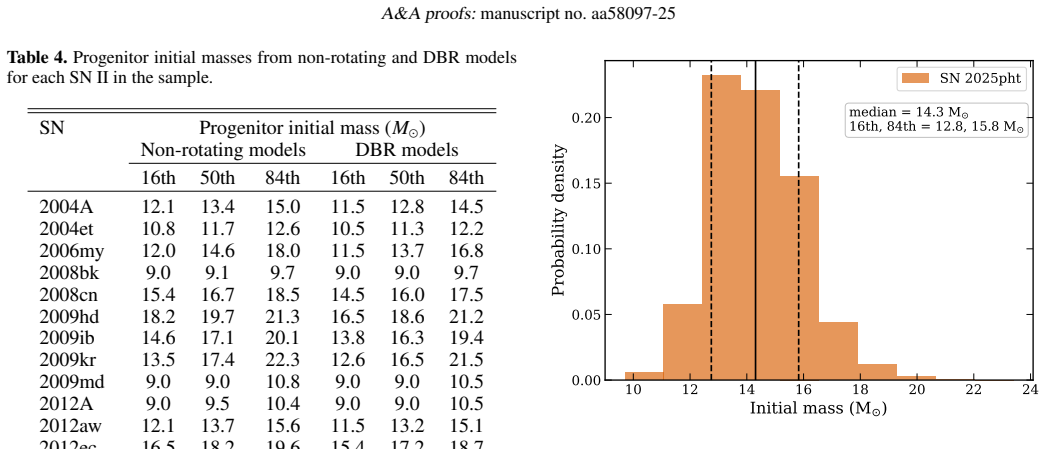
When initial rotational velocities are sampled from the observed distribution in massive stars, rotating stellar evolution models yield progenitor initial mass estimates for type II supernovae that are slightly lower than those from non-rotating models, but the differences stay within current uncertainties. This holds for individual supernovae, overall probability distributions, cumulative functions, and the upper mass limit, which is inferred as 20.4^{+2.3}_{-1.9} M_⊙.
What carries the argument
Rotating stellar evolution models with initial velocities sampled from the observed distribution of massive star rotations, used to recompute initial masses from pre-explosion luminosities and compared to non-rotating models.
If this is right
- Individual SN II progenitor mass estimates shift only slightly lower with rotation included.
- The overall probability distribution of inferred masses moves modestly toward lower values.
- The cumulative distribution of progenitor masses shows only minor changes.
- The upper initial-mass limit remains 20.4 solar masses within uncertainties.
- Adopting the observed rotation distribution produces small differences compared to non-rotating models.
Where Pith is reading between the lines
- Other factors such as binary evolution may be more important than rotation for explaining any remaining mass discrepancies.
- Non-rotating models remain adequate for most population-level studies of SN progenitors.
- Future direct rotation measurements of nearby massive stars could refine the upper mass boundary further.
Load-bearing premise
The observed distribution of rotational velocities in massive stars accurately represents the initial rotational velocities of the specific type II supernova progenitors studied.
What would settle it
A measurement showing that the initial rotation rates of a sample of SN II progenitors deviate enough from the general massive-star distribution to produce mass estimate shifts larger than the reported uncertainties.
Figures




read the original abstract
The initial masses of red supergiant (RSG) type II supernova (SN II) progenitors are commonly inferred from pre-explosion imaging by converting the progenitor luminosity into an initial mass estimate using non-rotating stellar evolution models. However, stellar rotation affects the evolution and may influence these estimates. We investigate how the observed distribution of rotational velocities in massive stars influences the progenitor initial masses of SNe II inferred from pre-SN imaging. We compare initial mass estimates obtained from non-rotating models with those derived from rotating models, where the initial rotational velocities of the stellar models are sampled from the observed distribution. We analyse the inferred progenitor initial masses by (i) comparing the results for each SN individually, (ii) examining the overall probability density function, (iii) constructing the cumulative distribution function, and (iv) determining the upper initial-mass boundary. In all cases, the distributions obtained from rotating models are slightly shifted towards lower masses, although the differences remain smaller than the typical uncertainties. When using the observed distribution of initial rotational velocities for massive stars, we infer an upper initial-mass limit for SN II progenitors of 20.4$^{+2.3}_{-1.9} M_{\odot}$. Taken together, these analyses demonstrate that stellar rotation has only a modest impact on progenitor mass estimates from pre-SN imaging within the current observational and model uncertainties when the observed distribution of initial rotational velocities is taken into account. Therefore, adopting this distribution leads to small differences compared to non-rotating models.
Editorial analysis
A structured set of objections, weighed in public.
Referee Report
Summary. The paper claims that sampling initial rotational velocities for rotating stellar models from the observed distribution of massive stars produces only modest shifts toward lower inferred initial masses for Type II SN progenitors compared to non-rotating models. Individual SN comparisons, PDF, CDF, and upper-limit analyses all show differences smaller than typical uncertainties, yielding an upper initial-mass limit of 20.4^{+2.3}_{-1.9} M_⊙ and supporting the conclusion that rotation has limited impact on pre-explosion mass estimates when the observed velocity distribution is used.
Significance. If the central result holds after addressing conditioning, the work strengthens the robustness of progenitor mass inferences from pre-SN imaging by quantifying rotation effects across multiple statistical tests (individual, PDF, CDF, upper-limit). It provides a concrete upper-mass bound and supports continued use of non-rotating tracks with small corrections, which is useful for population studies of SN II progenitors.
major comments (1)
- [Methods and rotating-model analysis] The sampling procedure for rotating models (described in the methods and analysis sections): initial velocities are drawn directly from the observed distribution of massive stars without reweighting by the rotation-dependent probability of RSG formation and SN II outcome. Faster initial rotation enhances mixing and mass loss, lowering the likelihood of retaining a hydrogen envelope; applying the unconditioned distribution therefore leaves open whether the reported modest shifts and 20.4 M_⊙ limit would persist for the actual progenitor subset.
minor comments (2)
- [Results] The abstract and results sections refer to 'PDF' and 'CDF' analyses without explicitly defining the binning, kernel choice, or handling of upper limits in the text; a short methods paragraph would improve reproducibility.
- [Stellar models] Details on the specific rotating stellar grids (e.g., code version, overshooting parameters, mass-loss prescriptions) are referenced but not tabulated; adding a brief comparison table to the non-rotating grid would clarify the source of any mass shifts.
Simulated Author's Rebuttal
We thank the referee for their careful reading and for identifying this important methodological point regarding the sampling of initial rotational velocities. We address the comment below and have revised the manuscript with additional discussion to clarify the approach and its implications.
read point-by-point responses
-
Referee: The sampling procedure for rotating models (described in the methods and analysis sections): initial velocities are drawn directly from the observed distribution of massive stars without reweighting by the rotation-dependent probability of RSG formation and SN II outcome. Faster initial rotation enhances mixing and mass loss, lowering the likelihood of retaining a hydrogen envelope; applying the unconditioned distribution therefore leaves open whether the reported modest shifts and 20.4 M_⊙ limit would persist for the actual progenitor subset.
Authors: We agree that a fully conditioned analysis would weight the initial-velocity distribution by the rotation-dependent probability of a star retaining a hydrogen envelope and exploding as a Type II supernova. Our study instead samples directly from the observed distribution of massive-star velocities to quantify the typical effect on mass inferences when using realistic (unconditioned) inputs. Because faster rotators are less likely to become RSG progenitors, the true progenitor distribution would be skewed toward slower velocities, which would reduce the already-modest differences relative to non-rotating tracks and leave the 20.4 M_⊙ upper limit essentially unchanged or slightly lower. We have added a dedicated paragraph in the Discussion section acknowledging this limitation, explaining why the unconditioned sampling provides a conservative estimate of rotation’s impact, and noting that a full reweighting would require population-synthesis modeling beyond the present scope. revision: partial
Circularity Check
No significant circularity detected in derivation chain
full rationale
The paper derives its central result—an upper initial-mass limit of 20.4 M_⊙ and the conclusion of only modest impact—by comparing mass estimates from non-rotating stellar evolution tracks against rotating tracks whose initial velocities are drawn from an externally observed distribution of massive-star rotations. This comparison is performed via four independent statistical summaries (per-SN differences, PDF, CDF, and boundary determination) whose outputs are not algebraically or statistically forced to equal the input distribution by construction. No parameter is fitted inside the paper and then relabeled as a prediction, no self-citation supplies a load-bearing uniqueness theorem, and no ansatz is smuggled via prior work. The skeptic concern about conditioning the rotation distribution on RSG/SN II outcome is a question of assumption validity and selection bias, not a circular reduction of the reported result to its own inputs.
Axiom & Free-Parameter Ledger
axioms (2)
- domain assumption The observed distribution of rotational velocities in massive stars applies to the progenitors of type II supernovae.
- domain assumption Stellar evolution models correctly map initial mass and rotation rate to the pre-explosion luminosity of red supergiants.
Lean theorems connected to this paper
-
IndisputableMonolith/Cost/FunctionalEquation.leanwashburn_uniqueness_aczel unclear?
unclearRelation between the paper passage and the cited Recognition theorem.
We compare initial mass estimates obtained from non-rotating models with those derived from rotating models, where the initial rotational velocities of the stellar models are sampled from the observed distribution.
-
IndisputableMonolith/Foundation/DimensionForcing.leanalexander_duality_circle_linking unclear?
unclearRelation between the paper passage and the cited Recognition theorem.
we infer an upper initial-mass limit for SN II progenitors of 20.4^{+2.3}_{-1.9} M_⊙
What do these tags mean?
- matches
- The paper's claim is directly supported by a theorem in the formal canon.
- supports
- The theorem supports part of the paper's argument, but the paper may add assumptions or extra steps.
- extends
- The paper goes beyond the formal theorem; the theorem is a base layer rather than the whole result.
- uses
- The paper appears to rely on the theorem as machinery.
- contradicts
- The paper's claim conflicts with a theorem or certificate in the canon.
- unclear
- Pith found a possible connection, but the passage is too broad, indirect, or ambiguous to say the theorem truly supports the claim.
Reference graph
Works this paper leans on
- [1]
- [2]
-
[3]
Beasor, E. R., Smith, N., & Jencson, J. E. 2025, ApJ, 979, 117 Björklund, R., Sundqvist, J. O., Singh, S. M., Puls, J., & Najarro, F. 2023, A&A, 676, A109
work page 2025
- [4]
- [5]
- [6]
-
[7]
Davies, B. & Beasor, E. R. 2020, MNRAS, 493, 468 de Mink, S. E., Langer, N., Izzard, R. G., Sana, H., & de Koter, A. 2013, ApJ, 764, 166
work page 2020
-
[8]
2021, A&A, 652, A137 Ekström, S., Georgy, C., Eggenberger, P., et al
Eggenberger, P., Ekström, S., Georgy, C., et al. 2021, A&A, 652, A137 Ekström, S., Georgy, C., Eggenberger, P., et al. 2012, A&A, 537, A146
work page 2021
-
[9]
Eldridge, J. J., Guo, N. Y ., Rodrigues, N., Stanway, E. R., & Xiao, L. 2019, PASA, 36, e041
work page 2019
- [10]
-
[11]
Eldridge, J. J. & Tout, C. A. 2004, MNRAS, 353, 87
work page 2004
-
[12]
Endal, A. S. & Sofia, S. 1978, ApJ, 220, 279
work page 1978
- [13]
-
[14]
Farmer, R., Fields, C. E., Petermann, I., et al. 2016, ApJS, 227, 22
work page 2016
-
[15]
Filippenko, A. V ., Matheson, T., & Ho, L. C. 1993, ApJ, 415, L103
work page 1993
- [16]
-
[17]
Georgy, C., Ekström, S., Eggenberger, P., et al. 2013, A&A, 558, A103
work page 2013
-
[18]
Goldman, S. R., van Loon, J. T., Zijlstra, A. A., et al. 2017, MNRAS, 465, 403
work page 2017
-
[19]
Heger, A., Langer, N., & Woosley, S. E. 2000, ApJ, 528, 368
work page 2000
- [20]
-
[21]
1909, Journal für die reine und angewandte Mathematik, 1909, 210
Hellinger, E. 1909, Journal für die reine und angewandte Mathematik, 1909, 210
work page 1909
-
[22]
Hiramatsu, D., Howell, D. A., Van Dyk, S. D., et al. 2021, Nature Astronomy, 5, 903
work page 2021
-
[23]
Holgado, G., Simón-Díaz, S., Herrero, A., & Barbá, R. H. 2022, A&A, 665, A150
work page 2022
- [24]
-
[25]
Hunter, J. D. 2007, Computing In Science & Engineering, 9, 90
work page 2007
-
[26]
Jerkstrand, A., Smartt, S. J., Sollerman, J., et al. 2015, MNRAS, 448, 2482
work page 2015
- [27]
-
[28]
Kilpatrick, C. D., Izzo, L., Bentley, R. O., et al. 2023, MNRAS, 524, 2161
work page 2023
-
[29]
Kilpatrick, C. D., Suresh, A., Davis, K. W., et al. 2025, ApJ, 992, L10
work page 2025
-
[30]
Kippenhahn, R., Ruschenplatt, G., & Thomas, H.-C. 1980, A&A, 91, 175
work page 1980
-
[31]
2013, Stellar Structure and Evolution (Springer)
Kippenhahn, R., Weigert, A., & Weiss, A. 2013, Stellar Structure and Evolution (Springer)
work page 2013
-
[32]
2016, in Positioning and Power in Academic Publishing: Players, Agents and Agendas, IOS Press, 87–90
Kluyver, T., Ragan-Kelley, B., Pérez, F., et al. 2016, in Positioning and Power in Academic Publishing: Players, Agents and Agendas, IOS Press, 87–90
work page 2016
- [33]
- [34]
-
[35]
Levesque, E. M., Massey, P., Olsen, K. A. G., et al. 2006, ApJ, 645, 1102
work page 2006
- [36]
-
[37]
Limongi, M., Roberti, L., Chieffi, A., & Nomoto, K. 2024, ApJS, 270, 29
work page 2024
- [38]
-
[39]
2009, Physics, Formation and Evolution of Rotating Stars (Springer)
Maeder, A. 2009, Physics, Formation and Evolution of Rotating Stars (Springer)
work page 2009
- [40]
-
[41]
Martinez, L., Bersten, M. C., Anderson, J. P., et al. 2020, A&A, 642, A143
work page 2020
-
[42]
Martinez, L., Bersten, M. C., Anderson, J. P., et al. 2022, A&A, 660, A41
work page 2022
- [43]
-
[44]
Maund, J. R. 2017, MNRAS, 469, 2202
work page 2017
-
[45]
2010, in Proceedings of the 9th Python in Science Conference, ed
McKinney, W. 2010, in Proceedings of the 9th Python in Science Conference, ed. Stéfan van der Walt & Jarrod Millman, 56 – 61
work page 2010
- [46]
- [47]
-
[48]
Miyaji, S., Nomoto, K., Yokoi, K., & Sugimoto, D. 1980, PASJ, 32, 303
work page 1980
-
[49]
Moe, M. & Di Stefano, R. 2017, ApJS, 230, 15 Article number, page 10 L. Martinez et al.: Impact of rotation on SN II progenitor masses
work page 2017
-
[50]
Monpribat, E., Martinet, S., Courtin, S., et al. 2022, A&A, 660, A47
work page 2022
- [51]
-
[52]
Mowlavi, N., Meynet, G., Maeder, A., Schaerer, D., & Charbonnel, C. 1998, A&A, 335, 573
work page 1998
- [53]
-
[54]
Oliphant, T. E. 2006, A guide to NumPy, V ol. 1 (Trelgol Publishing USA) O’Neill, D., Kotak, R., Fraser, M., et al. 2019, A&A, 622, L1
work page 2006
- [55]
- [56]
- [57]
- [58]
- [59]
- [60]
-
[61]
Poelarends, A. J. T., Herwig, F., Langer, N., & Heger, A. 2008, ApJ, 675, 614
work page 2008
-
[62]
Sana, H., de Mink, S. E., de Koter, A., et al. 2012, Science, 337, 444
work page 2012
-
[63]
Shivvers, I., Modjaz, M., Zheng, W., et al. 2017, PASP, 129, 054201
work page 2017
-
[64]
Smartt, S. J. 2015, PASA, 32, e016
work page 2015
-
[65]
Smartt, S. J., Eldridge, J. J., Crockett, R. M., & Maund, J. R. 2009, MNRAS, 395, 1409
work page 2009
-
[66]
Smartt, S. J., Maund, J. R., Hendry, M. A., et al. 2004, Science, 303, 499
work page 2004
-
[67]
Spruit, H. C. 2002, A&A, 381, 923
work page 2002
-
[68]
2019, ApJ, 881, 158 Takáts, K., Pignata, G., Pumo, M
Straniero, O., Dominguez, I., Piersanti, L., Giannotti, M., & Mirizzi, A. 2019, ApJ, 881, 158 Takáts, K., Pignata, G., Pumo, M. L., et al. 2015, MNRAS, 450, 3137 Van Der Walt, S., Colbert, S. C., & Varoquaux, G. 2011, Computing in Science & Engineering, 13, 22 Van Dyk, S. D. 2025, Galaxies, 13, 33 Van Dyk, S. D., Bostroem, K. A., Zheng, W., et al. 2023, M...
work page 2019
-
[69]
Vink, J. S. 2022, ARA&A, 60, 203
work page 2022
-
[70]
Vink, J. S., de Koter, A., & Lamers, H. J. G. L. M. 2001, A&A, 369, 574
work page 2001
- [71]
-
[72]
Wang, C., Langer, N., Schootemeijer, A., et al. 2020, ApJ, 888, L12
work page 2020
- [73]
-
[74]
Williams, B. F., Hillis, T. J., Murphy, J. W., et al. 2018, ApJ, 860, 39
work page 2018
-
[75]
Woosley, S. E. & Heger, A. 2007, Phys. Rep., 442, 269
work page 2007
-
[76]
Woosley, S. E. & Heger, A. 2015, ApJ, 810, 34
work page 2015
- [77]
-
[78]
Zahn, J. P. 1992, A&A, 265, 115
work page 1992
-
[79]
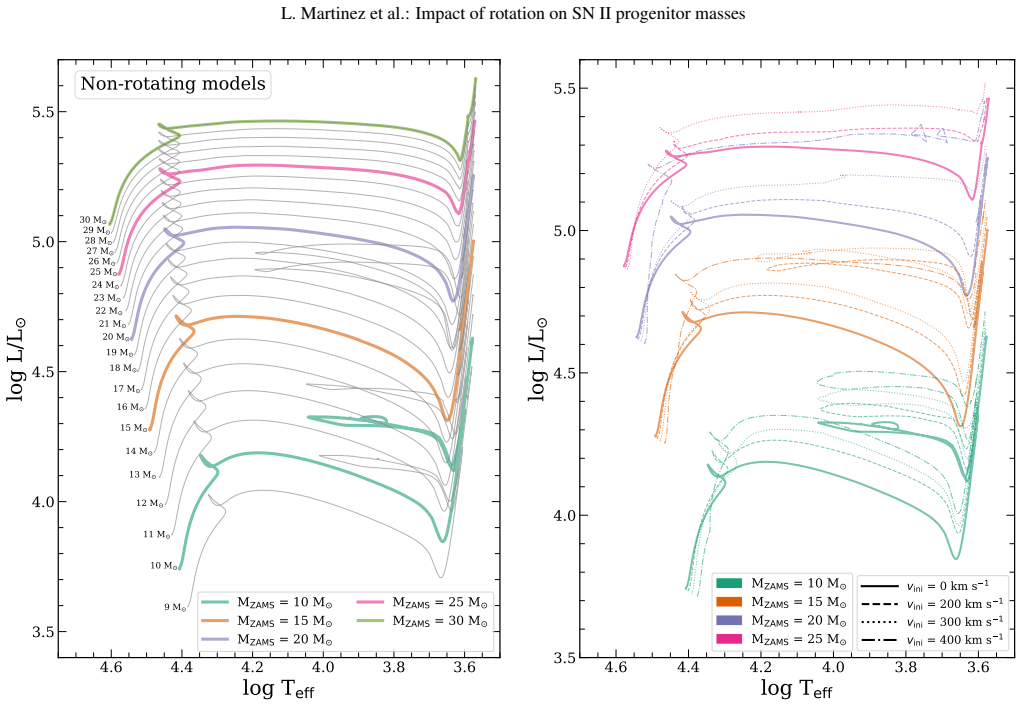
Zapartas, E., de Mink, S. E., Justham, S., et al. 2019, A&A, 631, A5 Article number, page 11 A&A proofs:manuscript no. aa58097-25 Appendix A: Hertzsprung–Russell diagrams Figures A.1 and A.2 show HR diagrams for a subsample of stellar models. Each panel corresponds to a fixed initial mass and different initial rotational velocities. 3.63.84.04.24.4 3.6 3....
work page 2019
discussion (0)
Sign in with ORCID, Apple, or X to comment. Anyone can read and Pith papers without signing in.