Reconciling Latent Variables and Networks: Exploring and extending the Psychometric-Toolbox
Pith reviewed 2026-05-19 17:17 UTC · model grok-4.3
The pith
Reviewing connections between network psychometrics and classical models like IRT, SEM, and GLM extends the psychometric toolbox and fosters collaboration across fields.
A machine-rendered reading of the paper's core claim, the machinery that carries it, and where it could break.
Core claim
The authors review and advance connections between network psychometrics and classical models including IRT, SEM, and GLM, along with methods from other domains. They present a visual synthesis of these links and argue that incorporating methodologies from outside psychometrics can broaden the available tools, render development more systematic, and enable a division of labor between theoretical work and software implementation for empirical use.
What carries the argument
Exploratory literature search combined with visual synthesis to identify and display methodological commonalities between network models and classical latent variable frameworks.
If this is right
- Incorporating statistical methodologies developed in other research domains to address similar problems in psychometrics.
- Fostering collaboration across research fields that have traditionally remained largely independent.
- Rendering methodological development more systematic and goal-directed.
- Enabling a meaningful division of labor between the development of statistical methodology and its practical implementation for empirical research through software tools.
- Providing new opportunities for empirical research and contributing to reconciliation with conceptual issues concerning psychometric constructs.
Where Pith is reading between the lines
- Hybrid analysis approaches that combine network structures with latent variable components could emerge as practical extensions for modeling complex psychological data.
- Software implementations might eventually automate the selection or integration of methods based on the commonalities identified in the synthesis.
- Similar reconciliation efforts could apply to adjacent areas such as educational testing or clinical assessment tools.
- The visual presentation format may encourage further mapping of connections that the initial review left unexplored.
Load-bearing premise
That an exploratory literature search combined with visual synthesis is sufficient to accurately identify and extend all relevant connections between network psychometrics and classical models without missing key prior work or introducing selection bias.
What would settle it
A broader literature search that uncovers major overlooked connections or prior developments that change the synthesized picture of how these models relate, or an empirical application where the proposed toolbox extensions fail to improve analysis outcomes compared to existing approaches.
Figures


read the original abstract
Since the introduction of network psychometrics, several connections to statistical models in "classical" psychometrics (i.e., IRT, SEM, GLM) as well as to approaches from other research fields have been established. In this paper, these developments have been reviewed and synthesized and, based on an exploratory literature search, further advanced and presented in an accessible visual format. This perspective opens up promising opportunities to extend the psychometric-toolbox by incorporating and learning from statistical methodologies developed in other research domains, which often address similar or even identical problems. Highlighting these methodological commonalities may also foster collaboration across research fields that have traditionally remained largely independent. Moreover, awareness of these connections may render methodological development more systematic and goal-directed and may enable a meaningful division of labor, for example between the development of statistical methodology and its practical implementation for empirical research through software tools. Finally, these methodological advances provide new opportunities for empirical research and may contribute to a reconciliation with longstanding conceptual issues concerning psychometric constructs and, more broadly, psychological phenomena.
Editorial analysis
A structured set of objections, weighed in public.
Referee Report
Summary. The manuscript reviews connections between network psychometrics and classical psychometric approaches (IRT, SEM, GLM) as well as related methods from other fields. Drawing on an exploratory literature search, it synthesizes these links, extends them, and presents the results in visual form. The central argument is that recognizing these commonalities can enlarge the psychometric toolbox, promote cross-disciplinary collaboration, support more systematic methodological work, enable division of labor between theory and software implementation, and open new avenues for empirical research while addressing longstanding conceptual questions about psychometric constructs.
Significance. A thorough and balanced synthesis of these methodological overlaps could usefully bridge research communities that have developed in parallel, potentially accelerating the transfer of techniques for handling latent structures, network representations, and measurement models. The visual extensions and forward-looking discussion of collaboration and software tools are constructive if the underlying literature mapping is reliable. The absence of a documented search protocol, however, leaves open the possibility that important prior reconciliations have been overlooked, which would reduce the paper’s utility as a foundation for future integrative work.
major comments (1)
- [Abstract] Abstract (and any methods or supplementary search description): the synthesis and visual extensions rest on an exploratory literature search, yet no search strings, databases, date ranges, inclusion/exclusion criteria, or screening process are reported. Without these details it is impossible to evaluate whether the identified connections are representative or whether selection bias has shaped the claimed reconciliation; this directly affects the load-bearing assertion that the work opens “promising opportunities to extend the psychometric-toolbox.”
minor comments (1)
- [Introduction] Clarify in the introduction or a dedicated section how the visual format was constructed (e.g., which software or diagramming conventions were used) so that readers can reproduce or extend the diagrams.
Simulated Author's Rebuttal
We thank the referee for their constructive and balanced review, which recognizes the manuscript's aim to synthesize connections between network psychometrics and classical approaches while highlighting opportunities for cross-domain extensions. We address the single major comment below and have revised the manuscript to improve transparency.
read point-by-point responses
-
Referee: [Abstract] Abstract (and any methods or supplementary search description): the synthesis and visual extensions rest on an exploratory literature search, yet no search strings, databases, date ranges, inclusion/exclusion criteria, or screening process are reported. Without these details it is impossible to evaluate whether the identified connections are representative or whether selection bias has shaped the claimed reconciliation; this directly affects the load-bearing assertion that the work opens “promising opportunities to extend the psychometric-toolbox.”
Authors: We appreciate the referee's emphasis on methodological transparency. The search underlying the synthesis was exploratory rather than systematic, with the goal of identifying and visually extending prominent, established links across psychometrics and related fields rather than exhaustively cataloguing every possible connection. In the revised version we have added a concise 'Literature Search Approach' subsection (placed after the abstract and before the main synthesis) that describes the process: keyword searches were conducted in Google Scholar using combinations such as 'network psychometrics AND latent variable models', 'IRT network equivalence', 'SEM and graphical models', and 'psychometric networks and factor models', with emphasis on publications from approximately 2010 onward that explicitly discuss overlaps, equivalences, or extensions. Initial screening was performed on titles and abstracts, followed by forward and backward citation checks on key papers. No formal PRISMA protocol or pre-registered inclusion/exclusion criteria were applied, as the intent was illustrative synthesis rather than meta-analytic completeness. This documentation now allows readers to assess the scope and potential biases while preserving the paper's core argument that the identified commonalities open avenues for extending the psychometric toolbox. revision: yes
Circularity Check
No circularity: review paper synthesizes external literature without self-referential derivations or fitted predictions
full rationale
This is a literature review and visual synthesis paper that reviews established connections between network psychometrics and classical models (IRT, SEM, GLM) drawn from an exploratory search of external sources. It advances no new equations, parameter fits, or quantitative predictions within its own framework that could reduce to its inputs by construction. The central claims about fostering cross-field collaboration and extending the psychometric toolbox rest on the reviewed external developments rather than any self-citation chain, ansatz smuggling, or renaming of results as novel derivations. No load-bearing step equates a claimed output to a fitted input or prior self-work by definition, making the synthesis self-contained against external benchmarks.
Axiom & Free-Parameter Ledger
axioms (2)
- domain assumption Psychometric constructs can be equivalently represented through both latent variable models and network structures.
- domain assumption Methodological commonalities across independent research fields can be identified through literature search and visual synthesis.
Lean theorems connected to this paper
-
IndisputableMonolith/Foundation/RealityFromDistinction.leanreality_from_one_distinction unclear?
unclearRelation between the paper passage and the cited Recognition theorem.
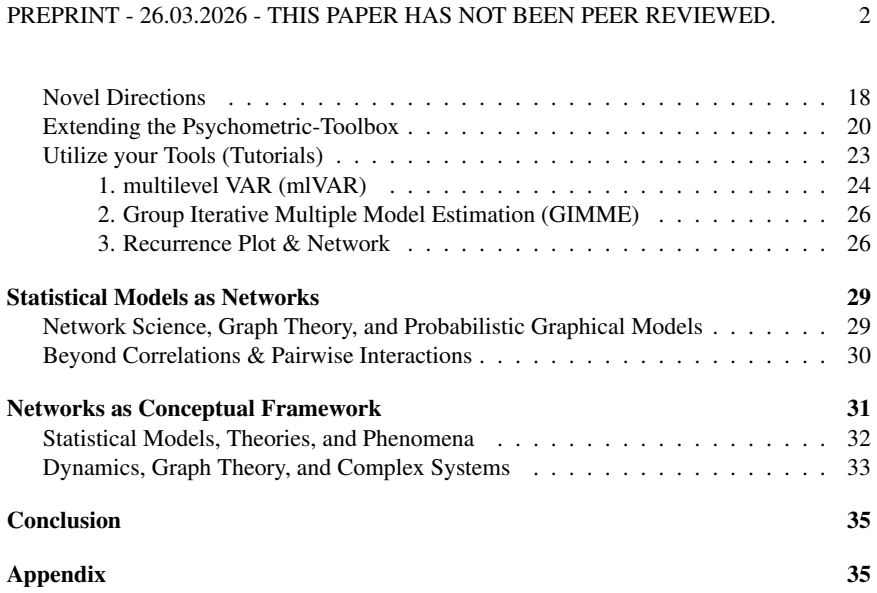
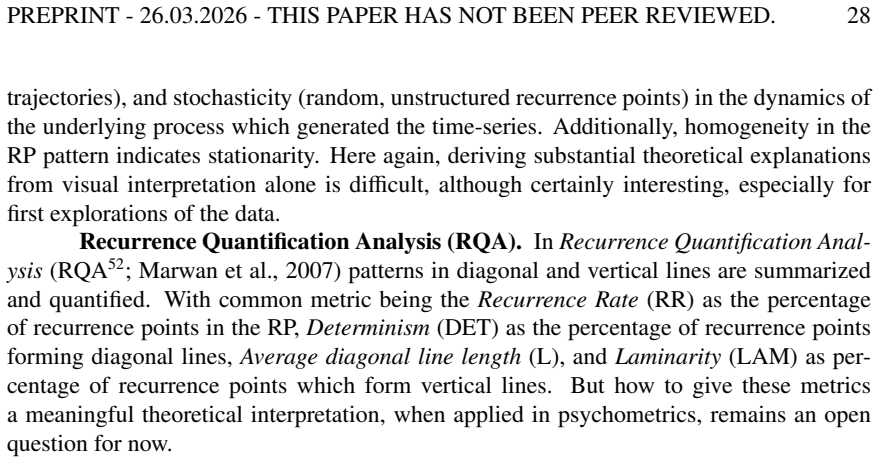
exploratory literature search... diagram of relations between statistical models... IRT and the Ising Model... GGM... VAR... GIMME... Recurrence Plot & Network
-
IndisputableMonolith/Cost/FunctionalEquation.leanwashburn_uniqueness_aczel unclear?
unclearRelation between the paper passage and the cited Recognition theorem.
Formal equivalences between the IM and certain IRT models... GGM reparameterization... Latent Network Modeling (LNM)
What do these tags mean?
- matches
- The paper's claim is directly supported by a theorem in the formal canon.
- supports
- The theorem supports part of the paper's argument, but the paper may add assumptions or extra steps.
- extends
- The paper goes beyond the formal theorem; the theorem is a base layer rather than the whole result.
- uses
- The paper appears to rely on the theorem as machinery.
- contradicts
- The paper's claim conflicts with a theorem or certificate in the canon.
- unclear
- Pith found a possible connection, but the passage is too broad, indirect, or ambiguous to say the theorem truly supports the claim.
discussion (0)
Sign in with ORCID, Apple, or X to comment. Anyone can read and Pith papers without signing in.