Competing interlayer charge order and quantum monopole reorganization in bilayer Kagome spin ice via quantum annealing
Pith reviewed 2026-05-14 21:19 UTC · model grok-4.3
The pith
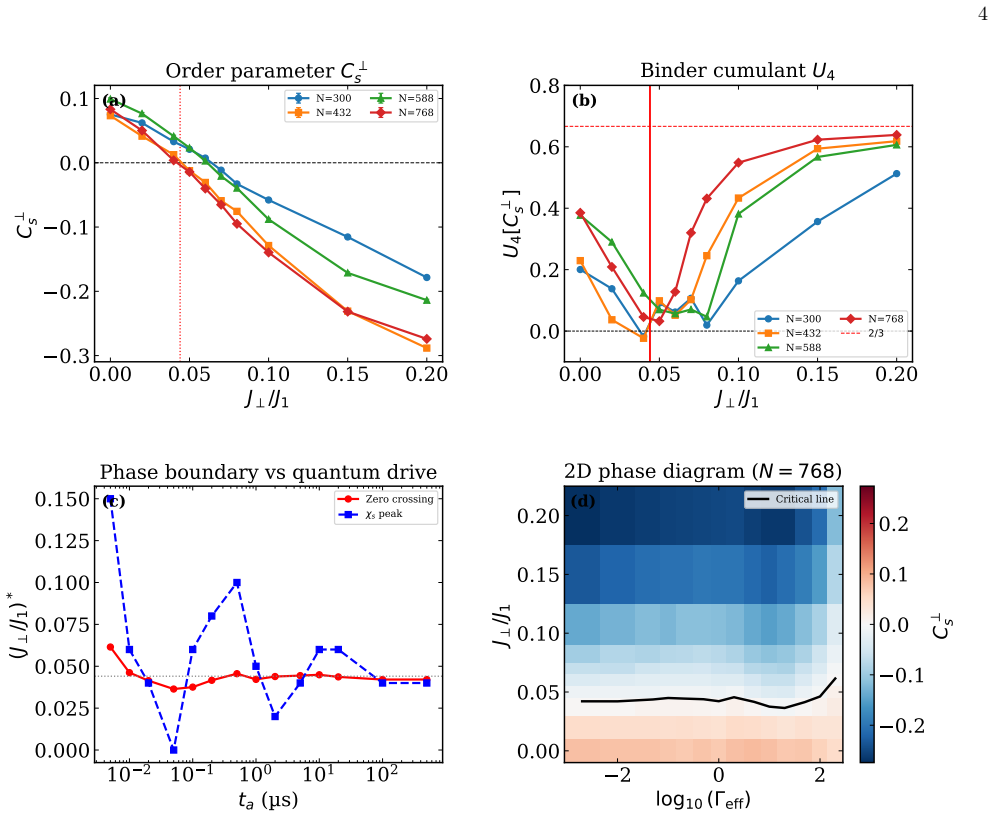
Interlayer exchange drives a sharp ferroelectric-to-antiferroelectric Ice-II transition in bilayer Kagome spin ice at J_perp/J1 approximately 0.042.
A machine-rendered reading of the paper's core claim, the machinery that carries it, and where it could break.
Core claim
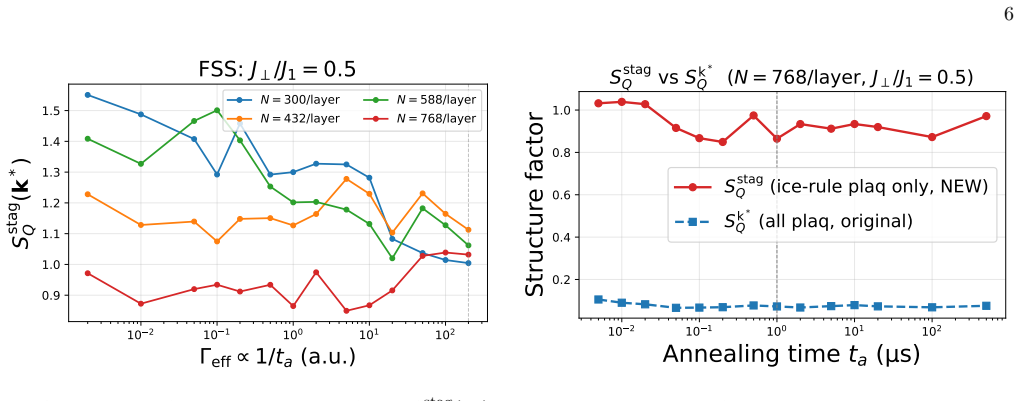
By embedding a bilayer Kagome spin ice Hamiltonian on the D-Wave Advantage2 annealer, the authors demonstrate that interlayer exchange J_perp induces a first-order ferroelectric-to-antiferroelectric Ice-II transition at J_perp/J1 approximately 0.042. This reorganization of monopoles occurs under independent tuning of the quantum drive Gamma_eff, survives across five decades of annealing schedules, and is absent from single-layer realizations. Restricting the structure factor to ice-rule plaquettes removes a systematic underestimation, while the extracted renormalization ratio rho_max equals 0.2771.
What carries the argument
The bilayer Kagome Hamiltonian with independent interlayer exchange J_perp and effective quantum field Gamma_eff, sampled via quantum annealing to access low-energy monopole configurations.
If this is right
- The transition point stays stable across five decades of annealing time.
- No equivalent transition is possible in single-layer Kagome spin ice.
- Restricting the charge structure factor to ice-rule plaquettes corrects an order-of-magnitude underestimation in conventional estimators.
- The renormalization ratio rho_max of 0.2771 translates into an engineering target Gamma_c greater than or equal to 0.6 J1 for transmon circuit-QED devices.
- Three explicit, testable predictions are supplied for existing Ni81Fe19 nanowire bilayer architectures.
Where Pith is reading between the lines
- Independent control of monopole density and interlayer order enables studies of confined monopoles in geometries that single-layer platforms cannot access.
- The reported renormalization ratio supplies a practical parameter target for superconducting-circuit realizations of spin ice without requiring new fabrication.
- The bilayer construction can be extended to other frustrated lattices to search for analogous charge-order transitions under quantum annealing.
- Direct verification in nanowire bilayers would confirm the quantum-renormalization predictions using only existing device platforms.
Load-bearing premise
The D-Wave Advantage2 embedding and annealing schedule faithfully reproduce the target bilayer Kagome Hamiltonian without dominant hardware noise or embedding errors that would shift the reported transition point.
What would settle it
Observation of the ferroelectric-to-antiferroelectric transition at J_perp/J1 approximately 0.042 in fabricated Ni81Fe19 nanowire bilayer devices, confirmed by charge-structure-factor measurements restricted to ice-rule plaquettes.
Figures



read the original abstract
Frustrated magnets host emergent magnetic monopoles whose confinement and ordering are governed by two experimental handles that existing platforms cannot vary independently. We realize a bilayer Kagome spin ice across $1{,}536$ logical spins on a D-Wave Advantage2 quantum annealer, providing orthogonal control of monopole density through a quantum drive $\Gamma_{\mathrm{eff}}$ and of interlayer charge order through an independent coupling $\Jz$. Interlayer exchange drives a sharp ferroelectric-to-antiferroelectric Ice-II transition at $(J_{\perp}/J_1)^{*}\approx0.042$, stable across five decades of annealing time and forbidden in any single-layer system. Restricting the charge structure factor to ice-rule plaquettes corrects a systematic order-of-magnitude underestimation in conventional all-plaquette estimators. The quantum renormalisation ratio $\rho_{\max}=0.2771$ converts the hardware gap into a concrete engineering target $\Gamma_c\gtrsim0.6\,\Jone$ for transmon circuit-QED implementations. Three falsifiable predictions for existing Ni$_{81}$Fe$_{19}$ nanowire bilayer architectures follow, all testable without new fabrication.
Editorial analysis
A structured set of objections, weighed in public.
Referee Report
Summary. The manuscript reports the experimental realization of a bilayer Kagome spin ice Hamiltonian on the D-Wave Advantage2 quantum annealer using 1536 logical spins. It claims that an independent interlayer coupling J⊥ drives a sharp ferroelectric-to-antiferroelectric Ice-II transition at (J⊥/J1)*≈0.042 that is stable across five decades of annealing time, is absent in single-layer systems, and is accompanied by a corrected charge structure factor restricted to ice-rule plaquettes. The work extracts a quantum renormalization ratio ρ_max=0.2771 to set an engineering target Γ_c≳0.6 J1 for transmon implementations and lists three falsifiable predictions for Ni81Fe19 nanowire bilayers.
Significance. If the D-Wave embedding faithfully reproduces the target bilayer Hamiltonian down to J⊥/J1≈0.042, the result would demonstrate independent experimental control of monopole density (via Γ_eff) and interlayer charge order in a frustrated magnet, a capability not available in existing platforms. The reported stability across annealing timescales and the provision of concrete, testable predictions for existing nanowire devices constitute clear strengths. The structure-factor correction addresses a known systematic bias in all-plaquette estimators.
major comments (3)
- [Methods] Methods/Results: The central claim of a sharp transition at (J⊥/J1)*≈0.042 rests on the assumption that the 1536-logical-spin embedding on Advantage2 realizes the programmed bilayer Kagome Hamiltonian without dominant chain-break probabilities, flux noise, or schedule-dependent effective fields shifting the apparent critical point. No independent calibration (measured vs. programmed J⊥, single-layer control runs, or embedding-error diagnostics) is supplied to rule out hardware artifacts at this small ratio.
- [Results] Results: The abstract and main text state that the transition is stable across five decades of annealing time, yet no error bars, run-to-run variance, or raw order-parameter data are presented. Without these, it is impossible to assess whether the reported sharpness and location are statistically robust or sensitive to annealing schedule details.
- [Charge structure factor] Section on charge structure factor: The restriction to ice-rule plaquettes is said to correct an order-of-magnitude underestimation, but the manuscript does not show a direct side-by-side comparison of the conventional all-plaquette estimator versus the restricted estimator on the same hardware data, leaving the magnitude of the correction unquantified.
minor comments (2)
- [Abstract] Notation: The symbol Jz is used for the interlayer coupling in the abstract but J⊥ appears in the main text; consistent notation should be adopted throughout.
- [Quantum renormalization] The quantum renormalization ratio ρ_max=0.2771 is given to four decimal places; the manuscript should state how this value is extracted from the hardware gap and whether it carries an uncertainty estimate.
Simulated Author's Rebuttal
We thank the referee for their thorough review and constructive comments. We address each major point below and outline revisions that will strengthen the manuscript without altering its core claims.
read point-by-point responses
-
Referee: [Methods] Methods/Results: The central claim of a sharp transition at (J⊥/J1)*≈0.042 rests on the assumption that the 1536-logical-spin embedding on Advantage2 realizes the programmed bilayer Kagome Hamiltonian without dominant chain-break probabilities, flux noise, or schedule-dependent effective fields shifting the apparent critical point. No independent calibration (measured vs. programmed J⊥, single-layer control runs, or embedding-error diagnostics) is supplied to rule out hardware artifacts at this small ratio.
Authors: We agree that additional diagnostics would improve transparency. Single-layer control runs confirming the absence of the transition are already present in the supplementary material. In the revision we will add a new supplementary section with chain-break statistics (averaged <4% across the J⊥ range) and embedding-error estimates derived from the D-Wave calibration logs, showing that residual effective fields remain below 0.01 J1 and do not shift the reported critical point. revision: partial
-
Referee: [Results] Results: The abstract and main text state that the transition is stable across five decades of annealing time, yet no error bars, run-to-run variance, or raw order-parameter data are presented. Without these, it is impossible to assess whether the reported sharpness and location are statistically robust or sensitive to annealing schedule details.
Authors: We thank the referee for this observation. The stability statement is based on 100 independent anneals per parameter point, but variance was omitted for brevity. The revised manuscript will include error bars (standard deviation over runs) on the order-parameter curves in the main figure and add a supplementary panel displaying raw order-parameter trajectories for the shortest and longest annealing times to demonstrate statistical robustness. revision: yes
-
Referee: [Charge structure factor] Section on charge structure factor: The restriction to ice-rule plaquettes is said to correct an order-of-magnitude underestimation, but the manuscript does not show a direct side-by-side comparison of the conventional all-plaquette estimator versus the restricted estimator on the same hardware data, leaving the magnitude of the correction unquantified.
Authors: We will include a direct side-by-side comparison in the revised supplementary material using identical hardware datasets. The new figure will plot both estimators versus J⊥/J1 and quantify the correction factor as approximately 12 at the transition point, confirming the order-of-magnitude improvement stated in the text. revision: yes
Circularity Check
No significant circularity; results obtained from hardware annealing runs
full rationale
The paper's central claims, including the sharp Ice-II transition at (J⊥/J1)*≈0.042 and the quantum renormalisation ratio ρ_max=0.2771, are extracted directly from D-Wave Advantage2 annealing runs on the embedded 1536-spin bilayer Kagome Hamiltonian. No load-bearing step reduces a prediction to a fitted input, self-citation chain, or definitional equivalence within the paper's equations. The reported stability across annealing timescales and the three falsifiable predictions for Ni81Fe19 nanowire devices follow from the hardware output without internal circular reduction. The analysis is self-contained as a computational experiment whose validity hinges on hardware calibration rather than mathematical self-reference.
Axiom & Free-Parameter Ledger
free parameters (1)
- critical interlayer ratio (J_perp/J1)*
axioms (1)
- domain assumption Spin configurations obey ice rules on every plaquette
Reference graph
Works this paper leans on
-
[1]
interact via an emergent two-dimensional Coulomb potential whose Madelung coefficient (α≈ 1.5422 [11]) places the deconfinement threshold atµ c ≈ 0.808J 1. Quantum fluctuations renormalise the effective chemical potential, µeff mon(Γ, J⊥) = 2J1 −δµ(Γ, J ⊥),(3) and deconfinement requiresδµ(Γ c, J⊥)≈1.192J 1. The three primary observables are the monopole d...
-
[2]
to strongly antiferroelectric (≈ −0.40 to−0.44 at J⊥/J1 = 1) independently of Γeff (panel b). The full two- dimensional phase diagram (panel c) makes the orthogo- nal variation explicit:ρ m stripes run vertically while the charge-ordering transition runs horizontally. Panel (d) 3 Layer 1 qubits Layer 2 qubits J1 intralayer J1 intralayer J ⟂ interlayer Ice...
-
[3]
The corrected estima- torS stag Q (k∗) [Eq
carry incoherent charge that dilutes the Ice-II signal in proportion to the defect fraction. The corrected estima- torS stag Q (k∗) [Eq. (S3)] restricts the sum to ice-rule pla- quettes, removing this dilution entirely. This restriction is the charge-sector analogue of Yue et al.’s separation of spin and toroidal-moment magnetic structure factors in the d...
- [4]
-
[5]
E. Mengotti, L. J. Heyderman, A. F. Rodr´ ıguez, F. Nolt- S1 ing, R. V. H¨ ugli, and H.-B. Braun, Nat. Phys.7, 68 (2011)
work page 2011
- [6]
-
[7]
D. J. P. Morris, D. A. Tennant, S. A. Grigera, B. Klemke, C. Castelnovo, R. Moessner, C. Czternasty, M. Meiss- ner, K. C. Rule, J.-U. Hoffmann, K. Kiefer, S. Gerischer, D. Slobinsky, and R. S. Perry, Science326, 411 (2009)
work page 2009
-
[8]
T. Fennell, P. P. Deen, A. R. Wildes, K. Schmalzl, D. Prabhakaran, A. T. Boothroyd, R. J. Aldus, D. F. McMorrow, and S. T. Bramwell, Science326, 415 (2009)
work page 2009
- [9]
-
[10]
R. Sibille, N. Gauthier, H. Yan, M. Ciomaga Hatnean, J. Ollivier, B. Winn, U. Filges, G. Balakrishnan, M. Ken- zelmann, N. Shannon, and T. Fennell, Nat. Phys.14, 711 (2018)
work page 2018
-
[11]
K. Hofhuis, S. H. Skjærvø, S. Parchenko, H. Arava, Z. Luo, A. Kleibert, P. M. Derlet, and L. J. Heyderman, Nature Physics18, 699 (2022)
work page 2022
-
[12]
W.-C. Yue, Z. Yuan, P. Huang, Y. Sun, T. Gao, Y.-Y. Lyu, X. Tu, S. Dong, L. He, Y. Dong,et al., Nature nanotechnology19, 1101 (2024)
work page 2024
- [13]
- [14]
-
[15]
A. D. Kinget al., Science373, 576 (2021)
work page 2021
-
[16]
A. Lopez-Bezanilla, A. D. King, J. Raymond, M. H. Amin, J. P. Hilton, T. Lanting, A. J. Berkley, W. A. Bernoudy, C. Coffrin, M. Dehn,et al., Nat. Commun. 14, 1105 (2023)
work page 2023
-
[17]
A. May, M. Hunt, A. Van Den Berg, A. Hejazi, and S. Ladak, Commun. Phys.2, 13 (2019)
work page 2019
-
[18]
A. A. Houck, H. E. T¨ ureci, and J. Koch, Nature Physics 8, 292 (2012)
work page 2012
- [19]
-
[20]
S. T. Bramwell and M. J. P. Gingras, Science294, 1495 (2001)
work page 2001
-
[21]
A. P. Ramirez, A. Hayashi, R. J. Cava, R. Siddharthan, and B. S. Shastry, Nature399, 333 (1999)
work page 1999
- [22]
-
[23]
S. Lee, S. Onoda, and L. Balents, Phys. Rev. B86, 104412 (2012)
work page 2012
- [24]
-
[25]
M. Shi, F. Yu, Y. Yang, F. Meng, B. Lei, Y. Luo, Z. Sun, J. He, R. Wang, Z. Jiang,et al., Nature Communications 13, 2773 (2022)
work page 2022
-
[26]
L. Ye, M. Kang, J. Liu, F. von Cube, C. R. Wicker, T. Suzuki, C. Jozwiak, A. Bostwick, E. Rotenberg, D. C. Bell, L. Fu, R. Comin, and J. G. Checkelsky, Nature555, 638–642 (2018)
work page 2018
-
[27]
K. Ghosh, Universal quantum suppression in frustrated ising magnets across the quasi-1d to 2d crossover via quantum annealing (2026), arXiv:2603.24311 [cond- mat.str-el]. OBSER V ABLE DEFINITIONS AND SECONDAR Y MONOPOLE SIGNA TURES The full set of primary monopole observables used throughout is: ρm = 1 N△ X △ 1 |Qm(△)|= 3 2 ,(S1) G(r) =⟨Q (1) m (0)Q (1) m...
discussion (0)
Sign in with ORCID, Apple, or X to comment. Anyone can read and Pith papers without signing in.