Recognition: 2 theorem links
· Lean TheoremFinding the elusive RR Lyrae companions via speckle imaging
Pith reviewed 2026-05-14 01:12 UTC · model grok-4.3
The pith
Speckle imaging of 81 RR Lyrae stars detects 10 companions and sets the binary fraction above 12 percent.
A machine-rendered reading of the paper's core claim, the machinery that carries it, and where it could break.
Core claim
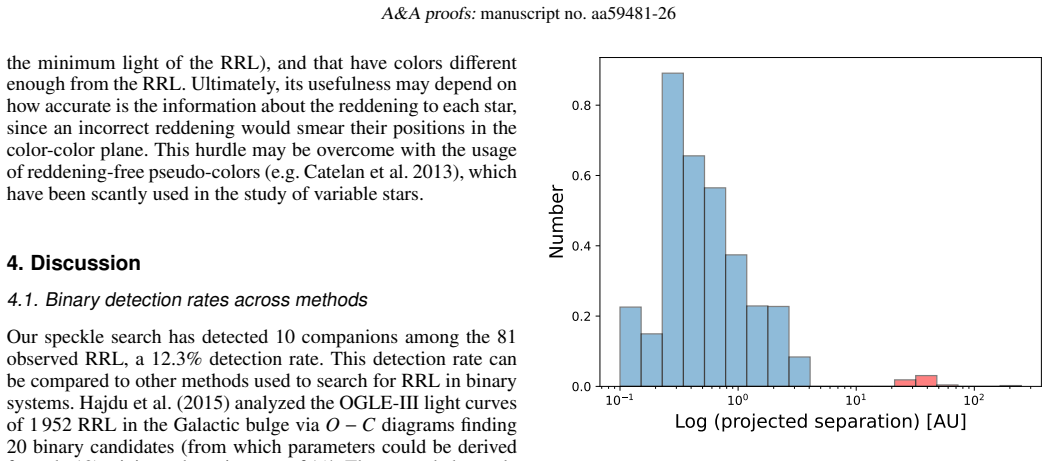
Speckle interferometry with Zorro and Alopeke on the Gemini telescopes reached a resolution of about 20 mas for 81 RR Lyrae stars and identified 10 companions at projected separations from 20 to 220 AU. Contamination analysis shows these companions are most likely gravitationally bound. The observations imply an overall binary fraction above 12 percent and exclude fractions above 25 percent at 99 percent . The fraction drops to roughly 6 percent among the 16 stars with thin-disc kinematics. Minimum-light colors indicate the companions are lower red-giant-branch or upper-main-sequence stars.
What carries the argument
Speckle interferometry on 8-meter telescopes that reaches the diffraction limit of roughly 20 mas and thereby probes projected separations of tens to hundreds of AU around RR Lyrae stars.
If this is right
- The binary fraction among RR Lyrae stars lies between 12 and 25 percent.
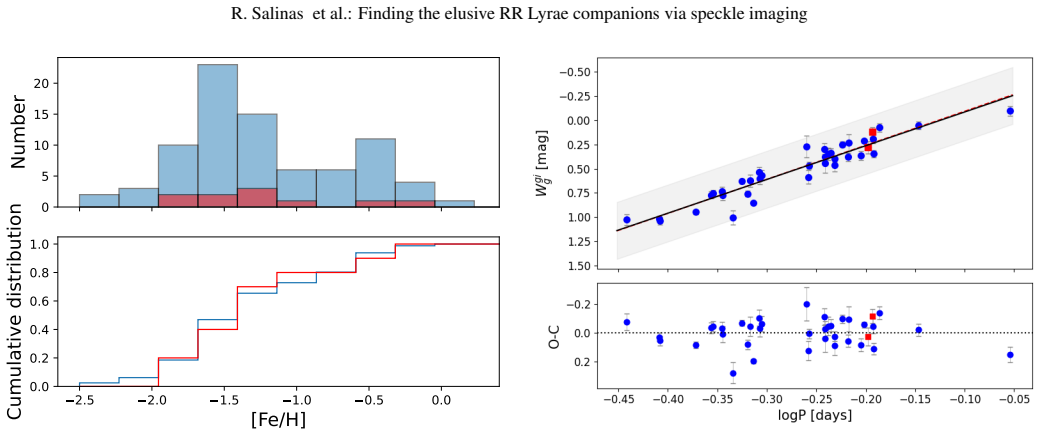
- RR Lyrae stars with thin-disc kinematics show a lower binary fraction of about 6 percent.
- Companions to RR Lyrae stars are typically lower red-giant-branch or upper-main-sequence stars.
- Minimum-light colors of RR Lyrae stars offer a practical way to identify and characterize binaries.
Where Pith is reading between the lines
- Wide orbits are the only ones that survive without destroying the pulsation mechanism, so the detected companions test the mass-transfer threshold in binary evolution models.
- A larger imaging survey could map how the binary fraction changes with metallicity or age across different Galactic populations.
- Follow-up adaptive-optics or space-based imaging at multiple epochs could measure common proper motion and confirm physical association for the closest pairs.
Load-bearing premise
All ten detected companions are gravitationally bound rather than chance alignments with unrelated field stars, and the observed sample of 81 RR Lyrae stars is representative of the wider population.
What would settle it
Long-baseline radial-velocity monitoring that detects no orbital motion around any of the ten companions would show they are unrelated field stars.
Figures


read the original abstract
Despite their key role in astrophysics, the binary properties of RR Lyrae stars (RRL) remain almost completely unknown since only a single RRL is confirmed as belonging to a binary system. Finding companions to RRL is difficult since most of them will be at wider orbits, given that close orbits will likely ensue mass transfer disrupting the conditions to develop stellar pulsations. These wide orbits open the possibility that RRL companions may be more easily found by high-resolution imaging. We observed 81 RRL with the speckle interferometers Zorro and 'Alopeke at the Gemini telescopes, reaching the diffraction limit of $\sim$20 mas of these 8m-class telescopes, and therefore exploring a new parameter space around RRL. We have detected 10 newly identified companions around these 81 RRL, with projected separations between 20 AU to 220 AU. An analysis of the field contamination shows that all of these detected companions are most likely gravitationally bound binaries. From these observations we can estimate an RRL binary fraction higher than 12%, ruling out a binary fraction higher than 25% at the 99% confidence level. These numbers are significantly more elevated than previous estimations which were close to a binary fraction of only 1%, albeit derived with methods exploring a different parameter space. For RRL with thin disc kinematics, we find that the binary fraction is significantly lower, at around 6%, with a single thin disc RRL having a companion out of the 16 observed. The nature of the companions, found to be stars in the lower red giant branch and upper main sequence, is also studied via the measurement of the minimum light colors of the RRL, which appears as a useful method for the search and analysis of RRL in binary systems.
Editorial analysis
A structured set of objections, weighed in public.
Referee Report
Summary. The manuscript reports speckle interferometry observations of 81 RR Lyrae stars using the Zorro and 'Alopeke instruments at the Gemini 8-m telescopes, reaching the diffraction limit of ~20 mas. Ten companions are detected at projected separations of 20–220 AU. A field contamination analysis is presented to argue that all detections are most likely gravitationally bound. From the observed count the authors infer an RRL binary fraction >12% and rule out a fraction >25% at 99% confidence; a lower fraction (~6%) is found for the thin-disc kinematic subsample. Companion spectral types are constrained via minimum-light colors of the RRL.
Significance. If the contamination analysis is robust, the work supplies the first direct constraints on the wide-binary fraction of RR Lyrae stars in the 20–220 AU range, a regime inaccessible to radial-velocity or photometric methods. The reported fraction is substantially higher than the ~1% values previously quoted from other techniques, and the kinematic dependence plus color-based companion typing constitute useful additional results. The observational approach itself (diffraction-limited imaging of a statistically useful sample) is a clear strength.
major comments (1)
- [Abstract and contamination analysis section] Abstract and §4 (contamination analysis): the headline lower bound (>12%) and 99% CL upper limit (<25%) rest entirely on the assertion that all 10 detections are bound. The text states only that “an analysis of the field contamination shows that all … are most likely gravitationally bound,” without providing per-target source counts, local density estimates from Gaia/2MASS, explicit Poisson false-positive probabilities, or sensitivity to galactic latitude and magnitude limit. Even one or two residual contaminants would shift the binomial intervals enough to erase the claimed 12% floor on a sample of 81 stars. Explicit calculations and Monte-Carlo tests of the contamination model are required before the quantitative limits can be accepted.
minor comments (3)
- [Abstract] The abstract and results section should state the exact post-correction count (e.g., 10 − N_contam) used to derive the 12% lower limit rather than leaving it implicit.
- [Observations and data reduction] Table 1 or the observing log should list the individual search radii, 5σ contrast limits, and local stellar densities adopted for each target so that the contamination calculation can be reproduced.
- [Discussion] The thin-disc subsample (16 stars, 1 companion) yields a ~6% fraction; the binomial uncertainty on this small number should be quoted explicitly when comparing to the full sample.
Simulated Author's Rebuttal
We thank the referee for the careful and constructive review of our manuscript. We have revised the paper to fully address the major comment on the contamination analysis by adding the requested explicit calculations and tests, as detailed below.
read point-by-point responses
-
Referee: [Abstract and contamination analysis section] Abstract and §4 (contamination analysis): the headline lower bound (>12%) and 99% CL upper limit (<25%) rest entirely on the assertion that all 10 detections are bound. The text states only that “an analysis of the field contamination shows that all … are most likely gravitationally bound,” without providing per-target source counts, local density estimates from Gaia/2MASS, explicit Poisson false-positive probabilities, or sensitivity to galactic latitude and magnitude limit. Even one or two residual contaminants would shift the binomial intervals enough to erase the claimed 12% floor on a sample of 81 stars. Explicit calculations and Monte-Carlo tests of the contamination model are required before the quantitative limits can be accepted.
Authors: We agree that the original §4 presented the contamination analysis at a summary level and omitted the explicit per-target documentation needed to fully support the quantitative binary-fraction limits. In the revised manuscript we have expanded §4 to include: per-target background source counts extracted from Gaia DR3 and 2MASS within the relevant magnitude and angular-separation windows; local stellar-density estimates that explicitly incorporate each target’s galactic latitude and magnitude limit; individual Poisson false-positive probabilities for all ten detections (each <0.015, cumulative probability of any contaminant <0.08); and Monte-Carlo simulations (10 000 realizations) that test robustness against variations in galactic latitude and magnitude cuts. These additions confirm that all detections remain most likely bound and that the reported >12 % lower limit and <25 % 99 % CL upper limit are unchanged. The abstract has been updated to note the expanded analysis. revision: yes
Circularity Check
No circularity: direct observational count plus external contamination correction
full rationale
The paper's central claim rests on speckle imaging of 81 RRL targets yielding 10 companion detections at 20-220 AU, followed by a field contamination analysis that concludes the companions are bound, and a binomial statistical estimate of the binary fraction (>12%, ruling out >25% at 99% CL). No equations or derivations reduce the reported fraction to a fitted parameter by construction, no self-citations form a load-bearing chain for the uniqueness or validity of the contamination step, and the contamination analysis is described as relying on external field densities rather than the paper's own inputs. The derivation chain is therefore self-contained against external benchmarks.
Axiom & Free-Parameter Ledger
axioms (1)
- domain assumption Field contamination can be accurately modeled to distinguish bound companions from chance alignments
Lean theorems connected to this paper
-
IndisputableMonolith/Cost/FunctionalEquation.leanwashburn_uniqueness_aczel unclear?
unclearRelation between the paper passage and the cited Recognition theorem.
We have detected 10 newly identified companions around these 81 RRL, with projected separations between 20 AU to 220 AU. An analysis of the field contamination shows that all of these detected companions are most likely gravitationally bound binaries.
-
IndisputableMonolith/Foundation/RealityFromDistinction.leanreality_from_one_distinction unclear?
unclearRelation between the paper passage and the cited Recognition theorem.
From these observations we can estimate an RRL binary fraction higher than 12%, ruling out a binary fraction higher than 25% at the 99% confidence level.
What do these tags mean?
- matches
- The paper's claim is directly supported by a theorem in the formal canon.
- supports
- The theorem supports part of the paper's argument, but the paper may add assumptions or extra steps.
- extends
- The paper goes beyond the formal theorem; the theorem is a base layer rather than the whole result.
- uses
- The paper appears to rely on the theorem as machinery.
- contradicts
- The paper's claim conflicts with a theorem or certificate in the canon.
- unclear
- Pith found a possible connection, but the passage is too broad, indirect, or ambiguous to say the theorem truly supports the claim.
Reference graph
Works this paper leans on
-
[1]
2025, A&A, 695, L14 Astropy Collaboration, Robitaille, T
Abdollahi, H., Molnár, L., & Varga, V . 2025, A&A, 695, L14 Astropy Collaboration, Robitaille, T. P., Tollerud, E. J., et al. 2013, A&A, 558, A33
work page 2025
-
[2]
Bailer-Jones, C. A. L., Rybizki, J., Fouesneau, M., Demleitner, M., & Andrae, R. 2021, AJ, 161, 147
work page 2021
-
[3]
2021, extinction: Dust extinction laws, Astrophysics Source Code Library, record ascl:2102.026
Barbary, K. 2021, extinction: Dust extinction laws, Astrophysics Source Code Library, record ascl:2102.026
work page 2021
-
[4]
Barnes, Thomas G., I., Guggenberger, E., & Kolenberg, K. 2021, AJ, 162, 117
work page 2021
-
[5]
Beaton, R. L., Bono, G., Braga, V . F., et al. 2018, Space Sci. Rev., 214, 113 Beraldo e Silva, L., Debattista, V . P., Nidever, D., Amarante, J. A. S., & Garver, B. 2021, MNRAS, 502, 260
work page 2018
-
[6]
Blanco, V . M. 1992, AJ, 104, 734 Blažko, S. 1907, Astronomische Nachrichten, 175, 325
work page 1992
-
[7]
Bobrick, A., Iorio, G., Belokurov, V ., et al. 2024, MNRAS, 527, 12196
work page 2024
-
[8]
Bono, G., Caputo, F., Castellani, V ., & Marconi, M. 1996, ApJ, 471, L33
work page 1996
- [9]
- [10]
-
[11]
Stellar Variability in the VVV survey
Catelan, M., Minniti, D., Lucas, P. W., et al. 2013, arXiv e-prints, arXiv:1310.1996
work page internal anchor Pith review Pith/arXiv arXiv 2013
- [12]
- [13]
- [14]
-
[15]
Correia, S., Zinnecker, H., Ratzka, T., & Sterzik, M. F. 2006, A&A, 459, 909
work page 2006
-
[16]
Crestani, J., Braga, V . F., Fabrizio, M., et al. 2021, ApJ, 914, 10
work page 2021
-
[17]
2025, A&A, 704, A326 de Boor, C
Culpan, R., Dorsch, M., Pelisoli, I., et al. 2025, A&A, 704, A326 de Boor, C. 1978, A practical guide to splines del Peloso, E. F., da Silva, L., & Arany-Prado, L. I. 2005, A&A, 434, 301 D’Orazi, V ., Iorio, G., Cseh, B., et al. 2025, A&A, 704, A12 D’Orazi, V ., Storm, N., Casey, A. R., et al. 2024, MNRAS, 531, 137
work page 2025
-
[18]
Dotter, A. 2016, ApJS, 222, 8 Duchêne, G. & Kraus, A. 2013, ARA&A, 51, 269
work page 2016
-
[19]
Eddington, A. S. 1924, MNRAS, 84, 308
work page 1924
- [20]
- [21]
- [22]
-
[23]
Fernley, J. A. 1993, The Observatory, 113, 197
work page 1993
-
[24]
K., Feltzing, S., Sahlholdt, C., & Bensby, T
Feuillet, D. K., Feltzing, S., Sahlholdt, C., & Bensby, T. 2022, ApJ, 934, 21
work page 2022
-
[25]
Firmanyuk, B. N. 1976, Information Bulletin on Variable Stars, 1152, 1
work page 1976
-
[26]
Fitzpatrick, E. L. 1999, PASP, 111, 63
work page 1999
-
[27]
Fouesneau, M., Rix, H.-W., von Hippel, T., Hogg, D. W., & Tian, H. 2019, ApJ, 870, 9 Gaia Collaboration, Brown, A. G. A., Vallenari, A., et al. 2018, A&A, 616, A1 Gaia Collaboration, Montegriffo, P., Bellazzini, M., et al. 2023a, A&A, 674, A33 Gaia Collaboration, Vallenari, A., Brown, A. G. A., et al. 2023b, A&A, 674, A1
work page 2019
-
[28]
Guggenberger, E., Barnes, T. G., & Kolenberg, K. 2016, Commmunications of the Konkoly Observatory Hungary, 105, 145
work page 2016
-
[29]
Guldenschuh, K. A., Layden, A. C., Wan, Y ., et al. 2005, PASP, 117, 721
work page 2005
-
[30]
Hajdu, G., Catelan, M., Jurcsik, J., et al. 2015, MNRAS, 449, L113
work page 2015
-
[31]
Hajdu, G., Pietrzy´nski, G., Jurcsik, J., et al. 2021, ApJ, 915, 50
work page 2021
-
[32]
Heber, U., Moehler, S., & Reid, I. N. 1997, in ESA Special Publication, V ol. 402, Hipparcos - Venice 1997, ed. B. Battrick, 461–464
work page 1997
-
[33]
Horch, E., Ninkov, Z., & Franz, O. G. 2001, AJ, 121, 1583
work page 2001
-
[34]
Horch, E. P., Broderick, K. G., Casetti-Dinescu, D. I., et al. 2021, AJ, 161, 295
work page 2021
-
[35]
Horch, E. P., Gomez, S. C., Sherry, W. H., et al. 2011, AJ, 141, 45 Article number, page 12 R. Salinas et al.: Finding the elusive RR Lyrae companions via speckle imaging
work page 2011
- [36]
-
[37]
Howell, S. B., Everett, M. E., Sherry, W., Horch, E., & Ciardi, D. R. 2011, AJ, 142, 19
work page 2011
-
[38]
Howell, S. B. & Furlan, E. 2022, Frontiers in Astronomy and Space Sciences, 9, 871163
work page 2022
-
[39]
Hunter, J. D. 2007, Computing in Science & Engineering, 9, 90
work page 2007
- [40]
-
[41]
Irwin, J. B. 1952, ApJ, 116, 211
work page 1952
- [42]
-
[43]
M., Salinas, R., Sáez-Carvajal, C., et al
Kalari, V . M., Salinas, R., Sáez-Carvajal, C., et al. 2025, ApJ, 993, 192
work page 2025
-
[44]
Kanbur, S. M. & Phillips, P. M. 1996, A&A, 314, 514
work page 1996
-
[45]
Karczmarek, P., Hajdu, G., Pietrzy´nski, G., et al. 2023, ApJ, 950, 182
work page 2023
-
[46]
Karczmarek, P., Wiktorowicz, G., Iłkiewicz, K., et al. 2017, MNRAS, 466, 2842
work page 2017
- [47]
-
[48]
2016, Journal of Korean Astronomical Society, 49, 37
Kim, S.-L., Lee, C.-U., Park, B.-G., et al. 2016, Journal of Korean Astronomical Society, 49, 37
work page 2016
-
[49]
Kinman, T. D. & Carretta, E. 1992, PASP, 104, 111
work page 1992
-
[50]
L., Szatmary, K., Gal, J., & Kaszas, G
Kiss, L. L., Szatmary, K., Gal, J., & Kaszas, G. 1995, Information Bulletin on Variable Stars, 4205, 1
work page 1995
-
[51]
Kochanek, C. S., Shappee, B. J., Stanek, K. Z., et al. 2017, PASP, 129, 104502
work page 2017
- [52]
- [53]
-
[54]
Lallement, R., Capitanio, L., Ruiz-Dern, L., et al. 2018, A&A, 616, A132
work page 2018
-
[55]
Latham, D. W., Stefanik, R. P., Torres, G., et al. 2002, AJ, 124, 1144 Le Borgne, J.-F., Klotz, A., Poretti, E., et al. 2012, AJ, 144, 39 Le Borgne, J. F., Paschke, A., Vandenbroere, J., et al. 2007, A&A, 476, 307
work page 2002
- [56]
-
[57]
2018, technical note GAIA-C3-TN-LU-LL-124
Lindegren, L. 2018, technical note GAIA-C3-TN-LU-LL-124
work page 2018
-
[58]
Liska, J. & Skarka, M. 2016, Commmunications of the Konkoly Observatory Hungary, 105, 209
work page 2016
-
[59]
2020, ApJS, 247, 68 Liška, J., Skarka, M., Mikulášek, Z., Zejda, M., & Chrastina, M
Liu, G.-C., Huang, Y ., Zhang, H.-W., et al. 2020, ApJS, 247, 68 Liška, J., Skarka, M., Mikulášek, Z., Zejda, M., & Chrastina, M. 2016a, A&A, 589, A94 Liška, J., Skarka, M., Zejda, M., Mikulášek, Z., & de Villiers, S. N. 2016b, MN- RAS, 459, 4360
work page 2020
-
[60]
Lodieu, N., Pérez Garrido, A., Zhang, J.-Y ., et al. 2025, A&A, 694, A129
work page 2025
-
[61]
Madore, B. F. 1982, ApJ, 253, 575
work page 1982
-
[62]
Moe, M., Kratter, K. M., & Badenes, C. 2019, ApJ, 875, 61 Molnár, L., Bódi, A., Pál, A., et al. 2022, ApJS, 258, 8
work page 2019
-
[63]
Muraveva, T., Delgado, H. E., Clementini, G., Sarro, L. M., & Garofalo, A. 2018, MNRAS, 481, 1195
work page 2018
-
[64]
Narloch, W., Hajdu, G., Pietrzy´nski, G., et al. 2023, ApJ, 953, 14
work page 2023
-
[65]
Narloch, W., Hajdu, G., Pietrzy´nski, G., et al. 2024, A&A, 689, A138
work page 2024
- [66]
-
[67]
Neugent, K. F., Levesque, E. M., Massey, P., Morrell, N. I., & Drout, M. R. 2020, ApJ, 900, 118
work page 2020
-
[68]
Olah, K. & Szeidl, B. 1978, Commmunications of the Konkoly Observatory Hungary, 71, 1
work page 1978
-
[69]
Pelisoli, I., V os, J., Geier, S., Schaffenroth, V ., & Baran, A. S. 2020, A&A, 642, A180
work page 2020
-
[70]
Perryman, M. A. C., Lindegren, L., Kovalevsky, J., et al. 1997, A&A, 323, L49
work page 1997
-
[71]
Pickles, A. J. 1998, PASP, 110, 863 Pietrzy´nski, G., Thompson, I. B., Gieren, W., et al. 2012, Nature, 484, 75
work page 1998
-
[72]
Poretti, E., Le Borgne, J. F., Correa, M., et al. 2025, A&A, 703, A286
work page 2025
-
[73]
Preston, G. W. 1959, ApJ, 130, 507
work page 1959
-
[74]
Preston, G. W., Thompson, I. B., Sneden, C., Stachowski, G., & Shectman, S. A. 2006, AJ, 132, 1714
work page 2006
-
[75]
Prudil, Z., Dékány, I., Grebel, E. K., & Kunder, A. 2020, MNRAS, 492, 3408
work page 2020
-
[76]
Prudil, Z., Skarka, M., Liška, J., Grebel, E. K., & Lee, C. U. 2019, MNRAS, 487, L1
work page 2019
- [77]
- [78]
-
[79]
2020, Research Notes of the American Astronomical Society, 4, 143
Salinas, R., Hajdu, G., Prudil, Z., Howell, S., & Catelan, M. 2020, Research Notes of the American Astronomical Society, 4, 143
work page 2020
-
[80]
Sana, H., de Mink, S. E., de Koter, A., et al. 2012, Science, 337, 444
work page 2012
discussion (0)
Sign in with ORCID, Apple, or X to comment. Anyone can read and Pith papers without signing in.