Self-Assembled Telecom Color Centers in Silicon and Their Growth Environment
Pith reviewed 2026-05-10 17:49 UTC · model grok-4.3
The pith
Ultra-low-temperature molecular beam epitaxy enables controlled self-assembly of telecom color centers in silicon by tuning growth pressure and temperature.
A machine-rendered reading of the paper's core claim, the machinery that carries it, and where it could break.
Core claim
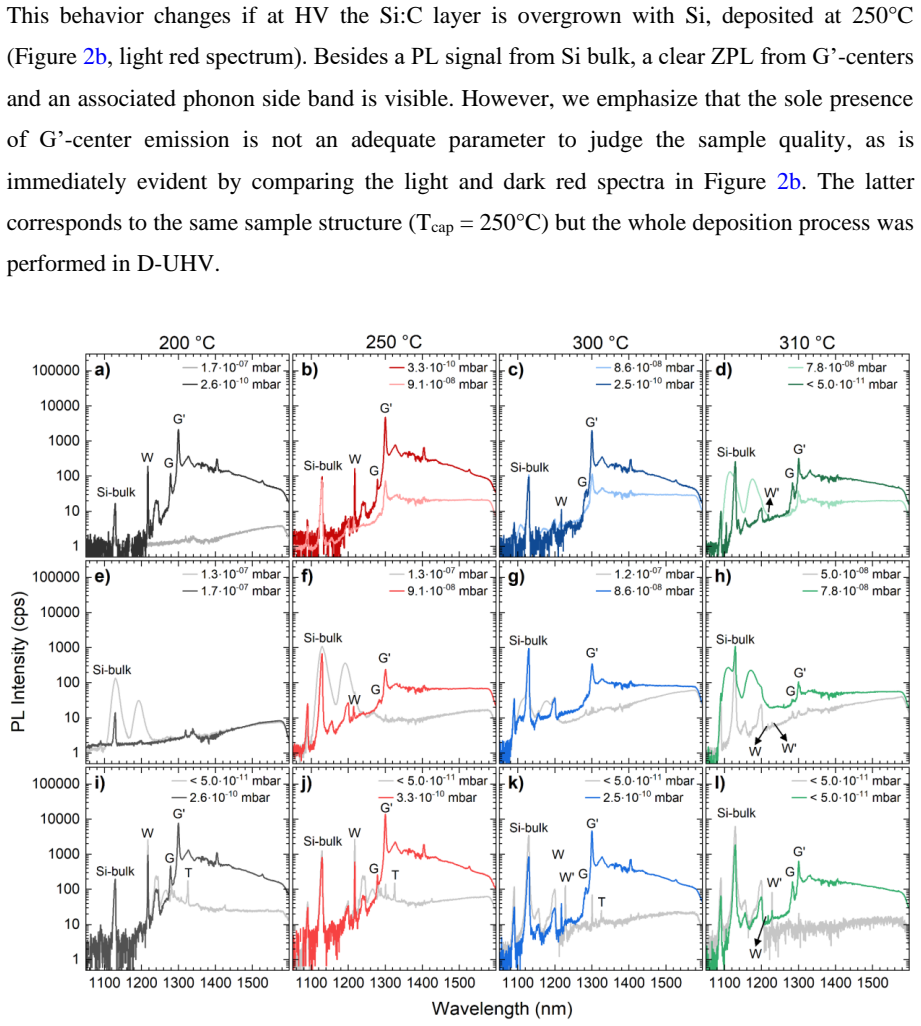
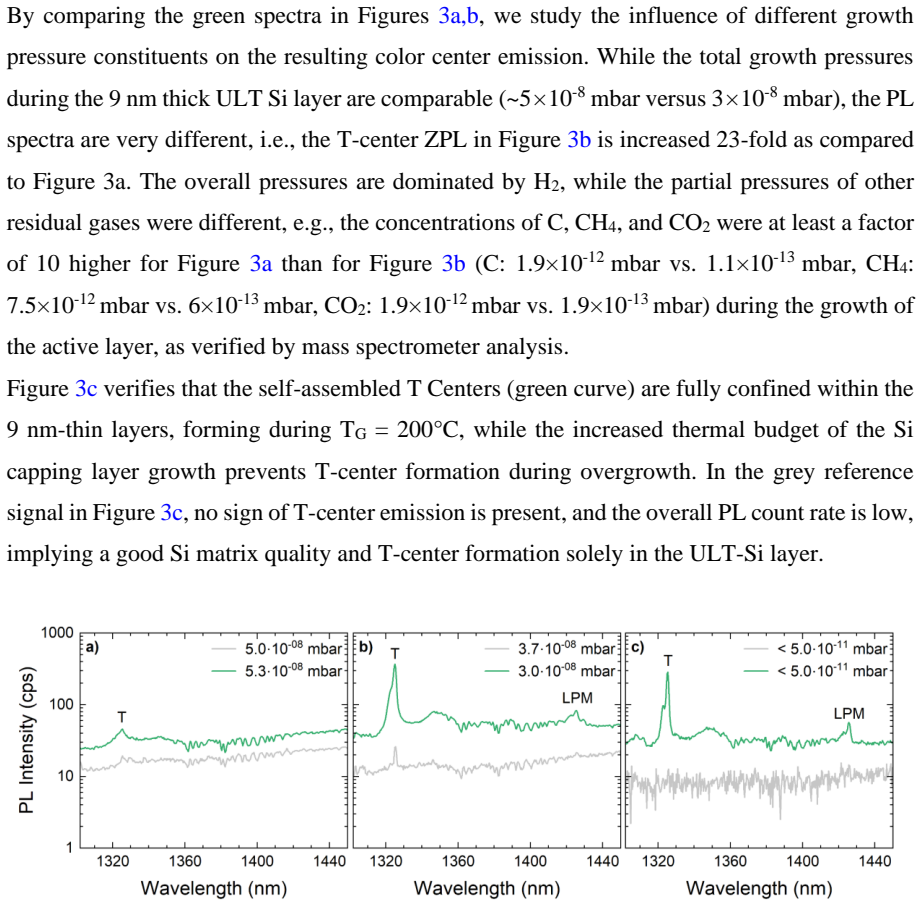
SiCCs such as the W, G, G', and T centers form by self-assembly during kinetically limited growth of carbon-doped silicon at ultra-low temperatures. Their photoluminescence intensities and the surrounding crystal quality vary with substrate temperature and growth pressure, with lower pressures suppressing background luminescence by maintaining a sufficiently pristine environment that prevents incorporation of background impurities.
What carries the argument
Kinetically limited self-assembly of carbon-related point defects into specific color centers during ultra-low-temperature MBE, made possible by a clean vacuum that limits unintended impurity incorporation.
If this is right
- Specific telecom color centers can be formed in silicon without the vertical straggle or lattice damage caused by ion implantation.
- Lower growth pressure directly reduces luminescence background, improving the signal-to-noise ratio needed for single-photon sources.
- The all-epitaxial process is compatible with existing silicon device fabrication flows.
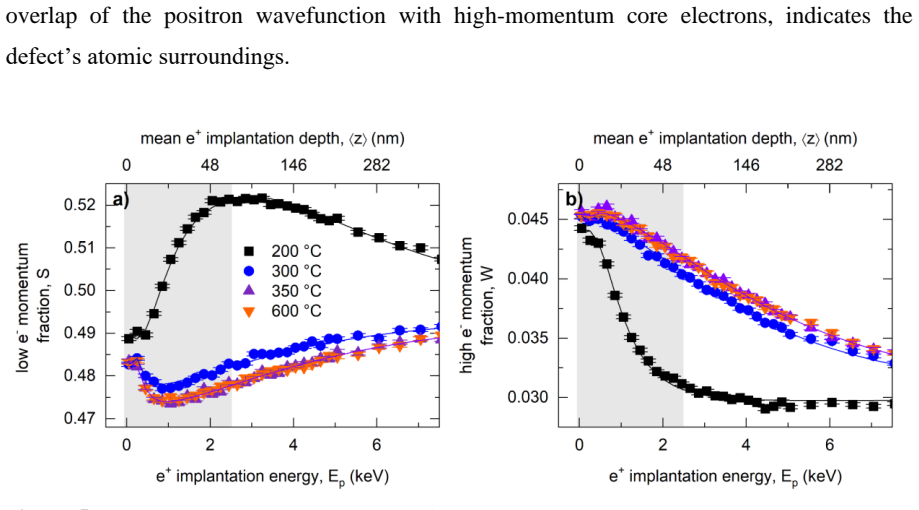
- Doppler broadening positron annihilation spectroscopy can be used to monitor how growth pressure affects defect density in the matrix around the centers.
Where Pith is reading between the lines
- The method could enable monolithic integration of quantum emitters directly into silicon photonic circuits without separate implantation or annealing steps.
- If the yield of desired centers proves high enough under optimized pressure, the approach may support wafer-scale production of silicon-based quantum light sources.
- Similar pressure-controlled self-assembly might be tested in other low-temperature epitaxial systems to create different defect-based emitters.
Load-bearing premise
The growth chamber can be kept clean enough at ultra-low temperatures that background impurities do not create extra defects that would mask or compete with the desired color centers.
What would settle it
Photoluminescence spectra showing no reduction in background emission when growth pressure is lowered, or positron annihilation spectra showing no corresponding improvement in crystal quality, would indicate that vacuum conditions do not control SiCC formation as claimed.
Figures


read the original abstract
Artificial atoms based on color centers in silicon (SiCCs) have recently emerged as promising candidates for highly integrable and scalable key components in photonic quantum technology, including telecom single-photon sources and spin memory devices. A novel all-epitaxial fabrication technique for SiCCs, based on ultra-low-temperature (ULT) molecular beam epitaxy (MBE), addresses limitations of conventional fabrication via ion implantation, such as vertical ion straggle and collateral crystal lattice damage. This method solely relies on self-assembly of SiCCs during kinetically-limited growth of (carbon-doped) Si(:C) at ULTs <~350{\deg}C. The latter requires an extraordinary pristine growth environment to prevent unintended defect formation caused by the incorporation of impurities from the background vapor; however, so far, no study has specifically addressed how exactly the vacuum conditions during epitaxy influence SiCC formation, their optical properties, and the quality of the surrounding crystal matrix. Here, we investigate the impact of the growth pressure and the substrate temperature on the self-assembly and photoluminescence (PL) properties of important SiCCs, such as W, G, G', and T centers. Further, we use PL and Doppler broadening variable energy positron annihilation spectroscopy to emphasize the role of the growth pressure in suppressing the luminescence background, which is crucial for advancing quantum photonics applications.
Editorial analysis
A structured set of objections, weighed in public.
Referee Report
Summary. The manuscript presents a novel all-epitaxial fabrication technique for silicon color centers (SiCCs) based on ultra-low-temperature molecular beam epitaxy (MBE) of carbon-doped silicon. It systematically investigates the effects of growth pressure and substrate temperature on the self-assembly and photoluminescence (PL) properties of W, G, G', and T centers, while using PL spectra and Doppler-broadening variable-energy positron annihilation spectroscopy to demonstrate that lower pressures suppress luminescence background and reduce defect density in the crystal matrix.
Significance. If the central claims hold, the work offers a damage-free, scalable route to integrating telecom-wavelength color centers in silicon, directly addressing limitations of ion-implantation methods such as straggle and lattice damage. Credit is due for the internal consistency provided by the combined PL and positron-annihilation data that link growth pressure to background suppression and defect reduction, supplying falsifiable experimental evidence for the role of the growth environment.
major comments (1)
- Abstract and main results: the claims that pressure and temperature specifically impact PL properties and background suppression are stated without accompanying quantitative metrics (e.g., intensity ratios, linewidth changes, or defect concentrations with error bars), which are required to evaluate the magnitude and statistical significance of the reported effects.
minor comments (2)
- The abbreviation ULT should be defined on first use in the main text.
- Figure captions for PL spectra and positron data should explicitly state the growth pressures, temperatures, and any normalization procedures used.
Simulated Author's Rebuttal
We thank the referee for the positive assessment of our work and the recommendation for minor revision. We address the single major comment below.
read point-by-point responses
-
Referee: Abstract and main results: the claims that pressure and temperature specifically impact PL properties and background suppression are stated without accompanying quantitative metrics (e.g., intensity ratios, linewidth changes, or defect concentrations with error bars), which are required to evaluate the magnitude and statistical significance of the reported effects.
Authors: We agree that explicit quantitative metrics would improve the clarity and evaluability of the claims. The manuscript presents the relevant trends through PL spectra and Doppler-broadening positron annihilation data in the figures, but does not extract or report specific numerical values (such as peak-to-background intensity ratios, linewidths, or defect concentrations with uncertainties) in the abstract or main text. In the revised version we will add these metrics, including intensity ratios for the W, G, G', and T centers relative to the background, any observed linewidth variations, and defect concentrations from the positron spectroscopy together with error bars where the data permit. revision: yes
Circularity Check
No significant circularity
full rationale
The paper is a purely experimental study of ultra-low-temperature MBE growth of silicon color centers. It reports direct measurements (PL spectra, Doppler-broadening positron annihilation) that link growth pressure and temperature to defect density and optical properties. No equations, derivations, fitted parameters presented as predictions, or self-citation chains appear in the provided text. The central claim rests on empirical data rather than any definitional or fitted reduction to its own inputs, making the work self-contained against external benchmarks.
Axiom & Free-Parameter Ledger
axioms (1)
- domain assumption Standard assumptions of molecular beam epitaxy and photoluminescence/positron annihilation spectroscopy apply without modification.
Reference graph
Works this paper leans on
-
[1]
G. Davies, Phys. Rep. 1989, 176, 83. https://doi.org/10.1016/0370-1573(89)90064-1
-
[2]
M. Khoury, M. Abbarchi, J. Appl. Phys. 2022, 131, 200901. https://doi.org/10.1063/5.0093822
-
[3]
W. Redjem, A. Durand, T. Herzig, A. Benali, S. Pezzagna, J. Meijer, A. Y. Kuznetsov, H. S. Nguyen, S. Cueff, J.-M. Gérard, I. Robert-Philip, B. Gil, D. Caliste, P. Pochet, M. Abbarchi, V. Jacques, A. Dréau, G. Cassabois, Nat. Electron. 2020, 3, 738. https://doi.org/10.1038/s41928-020-00499-0
-
[4]
M. Hollenbach, Y. Berencén, U. Kentsch, M. Helm, G. V. Astakhov, Opt. Express 2020, 28, 26111. https://doi.org/10.1364/OE.397377
-
[5]
D. B. Higginbottom, A. T. K. Kurkjian, C. Chartrand, M. Kazemi, N. A. Brunelle, E. R. MacQuarrie, J. R. Klein, N. R. Lee-Hone, J. Stacho, M. Ruether, C. Bowness, L. Bergeron, A. DeAbreu, S. R. Harrigan, J. Kanaganayagam, D. W. Marsden, T. S. Richards, L. A. Stott, S. Roorda, K. J. Morse, M. L. W. Thewalt, S. Simmons, Nature 2022, 607, 266. https://doi.org...
-
[6]
S. Wen, G. Pieplow, J. Yang, K. Jamshidi, M. Helm, J.-W. Luo, T. Schröder, S. Zhou, Y. Berencén, arXiv 2025, 2502.07632. https://doi.org/10.48550/arXiv.2502.07632
-
[7]
H. Song, X. Zhang, L. Komza, N. Fiaschi, Y. Xiong, Y. Zhi, S. Dhuey, A. Schwartzberg, T. Schenkel, G. Hautier, Z.-H. Zhang and A. Sipahigil, Nature Nanotechnology 2025, https://doi.org/10.1038/s41565-025-02066-0
-
[8]
Nature Reviews Physics , year = 2023, month = jun, volume =
C. Couteau, S. Barz, T. Durt, T. Gerrits, J. Huwer, R. Prevedel, J. Rarity, A. Shields, G. Weihs, Nat. Rev. Phys. 2023, 5, 326. https://doi.org/10.1038/s42254-023-00583-2
-
[9]
Quantum internet: A vision for the road ahead,
S. Wehner, D. Elkouss, R. Hanson, Science 2018, 362, 303. https://doi.org/10.1126/science.aam9288
-
[10]
A. M. Fox, Adv. Quantum Technol. 2025, 8, 2300390. https://doi.org/10.1002/qute.202300390
-
[11]
M. Prabhu, C. Errando-Herranz, L. De Santis, I. Christen, C. Chen, C. Gerlach, D. Englund, Nat. Commun. 2023, 14, 2380. https://doi.org/10.1038/s41467-023-37655-x
-
[12]
B. Lefaucher, Y. Baron, J.-B. Jager, V. Calvo, C. Elsässer, G. Coppola, F. Mazen, S. Kerdilès, F. Cache, A. Dréau, J.-M. Gérard, arXiv 2025, 2501.12744. https://doi.org/10.48550/arXiv.2501.12744 19
-
[13]
Nature Communications15(1), 6920 (2024) https: //doi.org/10.1038/s41467-024-51265-1
L. Komza, P. Samutpraphoot, M. Odeh, Y.-L. Tang, M. Mathew, J. Chang, H. Song, M.-K. Kim, Y. Xiong, G. Hautier and A. Sipahigil, Nature Communications 2024, 15, 6920 https://doi.org/10.1038/s41467-024-51265-1
-
[14]
M. Dobinson, C. Bowness, S. A. Meynell, C. Chartrand, E. Hoffmann, M. Gascoine, I. MacGilp, F. Afzal, C. Dangel, N. Jahed, M. L. W. Thewalt, S. Simmons, D. B. Higginbottom, Nat. Photon. 2025, 19, 1132. https://doi.org/10.1038/s41566-025- 01752-8
-
[15]
Life and death of colloidal bonds control the rate-dependent rheology of gels
A. Buzzi, C. Papon, M. Pirro, O. Hooybergs, H. Raniwala, V. Saggio, C. Errando- Herranz, D. Englund, Nat. Commun. 2025, 16, 8829. https://doi.org/10.1038/s41467- 025-63871-8
-
[16]
M. Hollenbach, N. Klingner, N. S. Jagtap, L. Bischoff, C. Fowley, U. Kentsch, G. Hlawacek, A. Erbe, N. V. Abrosimov, M. Helm, Y. Berencén, G. V. Astakhov, Nat. Commun. 2022, 13, 7683. https://doi.org/10.1038/s41467-022-35051-5
-
[17]
Y. Baron, A. Durand, T. Herzig, M. Khoury, S. Pezzagna, J. Meijer, I. Robert-Philip, M. Abbarchi, J.-M. Hartmann, S. Reboh, J.-M. Gérard, V. Jacques, G. Cassabois, A. Dréau, Appl. Phys. Lett. 2022, 121, 084003. https://doi.org/10.1063/5.0097407
-
[18]
A. M. Day, M. Sutula, J. R. Dietz, A. Raun, D. D. Sukachev, M. K. Bhaskar, E. L. Hu, Nature Communications 2024, 15, 4772 https://doi.org/10.1038/s41467-024-48968-w
-
[19]
G. Davies, S. Hayama, L. Murin, R. Krause-Rehberg, V. Bondarenko, A. Sengupta, C. Davia, A. Karpenko, Phys. Rev. B 2006, 73, 165202. https://doi.org/10.1103/PhysRevB.73.165202
-
[20]
S. M. Buckley, A. N. Tait, G. Moody, B. Primavera, S. Olson, J. Herman, K. L. Silverman, S. P. Rao, S. W. Nam, R. P. Mirin, and J. M. Shainline, Opt. Express 2020, 28, 16057. https://doi.org/10.1364/OE.386450
-
[21]
J. F. Ziegler, M. D. Ziegler, J. P. Biersack, Nucl. Instrum. Methods Phys. Res., B 2010, 268, 1818. https://doi.org/10.1016/j.nimb.2010.02.091
-
[22]
J. Aberl, E. Prado Navarrete, M. Karaman, D. Haya Enriquez, C. Wilflingseder, A. Salomon, D. Primetzhofer, M. A. Schubert, G. Capellini, T. Fromherz, P. Deák, P. Udvarhelyi, S. Li, Á. Gali, M. Brehm, Adv. Mater. 2024, 36, 2408424. https://doi.org/10.1002/adma.202408424
-
[23]
T. Poempool, J. Aberl, Ma. Clementi, L. Spindlberger, L. Vukušić, M. Galli, D. Gerace, F. Fournel, Je.-M. Hartmann, F. Schäffler, M. Brehm, T. Fromherz, Opt. Express 2023, 31, 15564. https://doi.org/10.1364/OE.480281 20
-
[24]
A. Salomon, J. Aberl, E. Prado Navarrete, M. Karaman, O. E. Lang, D. Primetzhofer, P. Deák, Á. Gali, T. Fromherz, M. Brehm, ACS Photonics 2025, 12, 2364. https://doi.org/10.1021/acsphotonics.4c01662
-
[25]
C. Chartrand, L. Bergeron, K. J. Morse, H. Riemann,N. V. Abrosimov, P. Becker, H.- J. Pohl, S. Simmons, M. L. W. Thewalt, Phys. Rev. B 2018, 98, 195201 https://link.aps.org/doi/10.1103/PhysRevB.98.195201
-
[26]
Y. Arakawa, M. J. Holmes, Appl. Phys. Rev. 2020, 7, 021309. https://doi.org/10.1063/5.0010193
-
[27]
D. Huber, M. Reindl, J. Aberl, A. Rastelli, R. Trotta, J. Opt. 2018, 20, 073002. https://doi.org/10.1088/2040-8986/aac4c4
-
[28]
R. F. C. Farrow, Molecular beam epitaxy: Applications to Key Materials, Noyes Publications, 1995
work page 1995
-
[29]
N. Yabumoto, AIP Conf. Proc. 1998, 449, 696. https://doi.org/10.1063/1.56895
-
[30]
R. Auguste, M.O. Liedke, M. Butterling, B.P. Uberuaga, F.A. Selim, A. Wagner, P. Hosemann, J. Appl. Phys. 2023, 133, 185901. https://doi.org/10.1063/5.0144308
-
[31]
M. Grodzicki, M.O. Liedke, K. Moszak, W. Olszewski, Ł. Pawlaczyk, D. Majchrzak, R. Idczak, D. Pucicki, J. Serafińczuk, M. Butterling, E. Hirschmann, A. Wagner, R. Kudrawiec, D. Hommel, Vacuum. 2024, 229, 113554. https://doi.org/10.1016/j.vacuum.2024.113554
-
[32]
C. Beaufils, W. Redjem, E. Rousseau, V. Jacques, A. Y. Kuznetsov, C. Raynaud, C. Voisin, A. Benali, T. Herzig, S. Pezzagna, J. Meijer, M. Abbarchi, G. Cassabois, Phys. Rev. B 2018, 97, 035303. https://doi.org/10.1103/PhysRevB.97.035303
-
[33]
S. Binetti, S. Pizzini, E. Leoni, R. Somaschini, A. Castaldini, A. Cavallini, J. Appl. Phys. 2002, 92, 2437–2445. https://doi.org/10.1063/1.1497450
-
[34]
Y. Baron, A. Durand, P. Udvarhelyi, T. Herzig, M. Khoury, S. Pezzagna, J. Meijer, I. Robert-Philip, M. Abbarchi, J.-M. Hartmann, V. Mazzocchi, J.-M. Gérard, A. Gali, V. Jacques, G. Cassabois, A. Dréau, ACS Photonics 2022, 9 (7), 2337-2345 https://doi.org/10.1021/acsphotonics.2c00336
-
[35]
G. Davies, E. C. Lightowlers, Z. E. Ciechanowska, J. Phys. C: Solid State Phys. 20, 191 (1987). https://doi.org/10.1088/0022-3719/20/2/003
- [36]
-
[37]
PRX Quantum1, 020301 (2020) https://doi
L. Bergeron, C. Chartrand, A. T. K. Kurkjian, K. J. Morse, H. Riemann, N. Abrosimov, P. Becker, H.-J. Pohl, H. M. Thewalt, S. Simmons, PRX Quantum 2020, 1, 020301. https://doi.org/10.1103/PRXQuantum.1.020301
-
[38]
M. Hakala, M.J. Puska, R.M. Nieminen, Phys. Rev. B. 1998, 57, 7621–7627 https://doi.org/10.1103/PhysRevB.57.7621
-
[39]
S. Assali, M. Elsayed, J. Nicolas, M.O. Liedke, A. Wagner, M. Butterling, R. Krause- Rehberg, O. Moutanabbir, Appl. Phys. Lett. 2019, 114, 251907. https://doi.org/10.1063/1.5108878
-
[40]
Analysis of positron profiling data by means of ‘VEPFIT,
A. van Veen, H. Schut, J. de Vries, R. A. Hakvoort, and M. R. Ijpma, “Analysis of positron profiling data by means of ‘VEPFIT,” in AIP Conference Proceedings 1991, 218 (1), 171–198, https://doi.org/doi:10.1063/1.40182
-
[41]
A. Salomon, J. Aberl, L. Vukušić, M. Hauser, T. Fromherz, M. Brehm, physica status solidi (a) 2022, 219, 2200154. https://doi.org/10.1002/pssa.202200154
-
[42]
C. Wilflingseder, J. Aberl, E. Prado Navarrete, G. Hesser, H. Groiss, M. O. Liedke, M. Butterling, A. Wagner, E. Hirschmann, C. Corley-Wiciak, M. H. Zoellner, G. Capellini, T. Fromherz, M. Brehm, ACS Applied Electronic Materials 2024, 6 (12), 9029-9039. https://doi.org/10.1021/acsaelm.4c01678
-
[43]
L. Wind, S. Preiß, D. Nazzari, J. Aberl, E. Prado Navarrete, M. Brehm, L. Vogl, A. M. Minor, M. Sistani, W. M. Weber, Solid-State Electronics 2025, 225, 109069. https://doi.org/10.1016/j.sse.2025.109069
-
[44]
A. Fuchsberger, L. Wind, D. Nazzari, L. Kühberger, D. Popp, J. Aberl, E. Prado Navarrete, M. Brehm, L. Vogl, P. Schweizer, S. Lellig, X. Maeder, M. Sistani, W. M. Weber, IEEE Journal of the Electron Devices Society 2024, 12, 83-87. https://doi.org/10.1109/JEDS.2024.3350209
-
[45]
Fuchsberger et al., IEEE Transactions on Electron Devices, 2025, 72, 6, 2868-
A. Fuchsberger et al., IEEE Transactions on Electron Devices, 2025, 72, 6, 2868-
work page 2025
-
[46]
https://doi.org/10.1109/TED.2025.3559912
-
[47]
A. Fuchsberger, K. Eysin, L. Wind, E. Prado Navarrete, J. Aberl, M. Brehm, I. Ratschinski, D. Hiller, M. Sistani, W. M. Weber, IEEE Electron Device Letters, 2025, 46, 8, 1429-1432 https://doi.org/10.1109/LED.2025.3577243
-
[48]
M. Oehme, M. Bauer, C. P. Parry, G. Eifler, E. Kasper, Thin Solid Films 2000, 380, 75-77 https://doi.org/10.1016/S0040-6090(00)01533-9
-
[49]
A.G. Attallah, N. Koehler, M.O. Liedke, M. Butterling, E. Hirschmann, R. Ecke, S.E. Schulz, A. Wagner, Microporous Mesoporous Mater. 2020, 308, 110457. https://doi.org/10.1016/j.micromeso.2020.110457 22
-
[50]
W. Anwand, G. Brauer, M. Butterling, H. R. Kissener, and A. Wagner, Defect Diffus. Forum, 2012, 331, 25–40 https://doi.org/doi:10.4028/www.scientific.net/DDF.331.25
-
[51]
J. Dryzek and P. Horodek, Nucl. Instruments Methods Phys. Res. Sect. B Beam Interact. with Mater. Atoms, 2008, 266 (18), 4000–4009 https://doi.org/doi:10.1016/j.nimb.2008.06.033
-
[52]
A. van Veen, H. Schut, M. Clement, J. M. M. de Nijs, A. Kruseman, and M. R. IJpma, Appl. Surf. Sci., 1995, 85 ©, 216–224 https://doi.org/doi:10.1016/0169- 4332(94)00334-3
-
[53]
C. Hoppe, F. Mitschker, M. Butterling, M.O. Liedke, T. de Los Arcos, P. Awakowicz, A. Wagner, G. Grundmeier, J. Phys. D. Appl. Phys. 2020, 53, 475205 https://doi.org/10.1088/1361-6463/aba8ba
-
[54]
J. Čížek et al., Phys. B Condens. Matter, 2012, 407 (14), 2659–2664, https://doi.org/doi:10.1016/j.physb.2011.12.122
-
[55]
F. Tuomisto, I. Makkonen, Rev. Mod. Phys. 2013, 85, 1583–1631 https://doi.org/10.1103/RevModPhys.85.1583
-
[56]
R. Krause-Rehberg, H.S. Leipner, Positron Annihilation in Semiconductors", Vol. 127 of Series "Solid-State Sciences", Springer-Verlag, Berlin 1999
work page 1999
-
[57]
P. Asoka‐Kumar, K.G. Lynn, D.O. Welch, J. Appl. Phys. 1994, 76, 4935–4982 https://doi.org/10.1063/1.357207 23 Supporting Information Self-Assembled Telecom Color Centers in Silicon and their Growth Environment Jacqueline Marböck*, Enrique Prado Navarrete, Merve Karaman, Oliver E. Lang, Thomas Fromherz, Maciej O. Liedke, Andreas Wagner, Moritz Brehm*, Joha...
discussion (0)
Sign in with ORCID, Apple, or X to comment. Anyone can read and Pith papers without signing in.