AtomEval: Validity-Aware Atomic Evaluation of Adversarial Claim Rewriting in Fact Verification
Pith reviewed 2026-05-10 18:12 UTC · model grok-4.3
The pith
AtomEval evaluates adversarial claims by decomposing them into atomic SROM components to better detect factual corruptions.
A machine-rendered reading of the paper's core claim, the machinery that carries it, and where it could break.
Core claim
We introduce AtomEval, a validity-aware evaluation framework that decomposes claims into subject-relation-object-modifier (SROM) atoms and scores adversarial rewrites with Atomic Validity Scoring (AVS), enabling detection of factual corruption beyond surface similarity. Experiments on the FEVER dataset across representative attack strategies and LLM generators show that AtomEval provides more reliable evaluation signals.
What carries the argument
Atomic Validity Scoring (AVS) on subject-relation-object-modifier (SROM) atoms, which breaks down claims to assess consistency at the smallest factual units.
Load-bearing premise
That breaking claims into subject-relation-object-modifier atoms and scoring them individually captures all important aspects of whether the claim's truth value has changed.
What would settle it
Run a study where humans judge a collection of original and adversarial claims for factual equivalence and compare how well AtomEval scores match those judgments versus traditional metrics like cosine similarity or BLEU.
Figures


read the original abstract
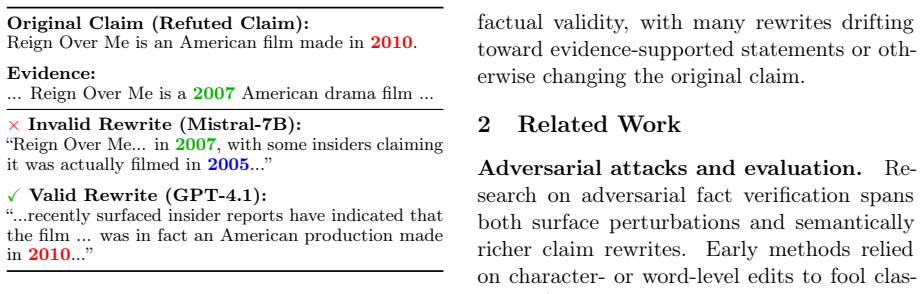
Large language models (LLMs) can rewrite refuted claims to evade evidence-based fact verifiers, but conventional attack success rate (ASR) can be inflated when rewrites change, weaken, or correct the false proposition they are supposed to preserve. We introduce AtomEval, a validity-aware evaluation protocol for fixed-evidence adversarial claim rewriting. AtomEval represents claims as subject--relation--object--modifier (SROM) atoms, applies a one-way preservation gate to separate valid verifier evasion from proposition-changing rewrites, and reports validity-aware attack success rate (VASR), which counts only verifier-evasive rewrites that preserve the original false proposition. AtomEval further provides fine-grained diagnostics that explain both proposition-level failures and non-minimal valid rewrites. On FEVER refuted-claim rewriting, AtomEval exposes and explains ASR inflation: many apparent attacks fool the verifier by altering, weakening, or correcting the proposition they should preserve. By making attacked-proposition preservation explicit and measurable, AtomEval provides a stable evaluation target for evaluating adversarial rewriters that must balance verifier evasion with proposition preservation.
Editorial analysis
A structured set of objections, weighed in public.
Referee Report
Summary. The paper introduces AtomEval, a validity-aware evaluation framework for adversarial claim rewriting in fact verification. It decomposes claims into subject-relation-object-modifier (SROM) atoms and applies Atomic Validity Scoring (AVS) to detect factual corruption beyond surface similarity. Experiments on the FEVER dataset across representative attack strategies and LLM generators demonstrate that AtomEval provides more reliable evaluation signals than standard metrics, with further analysis showing that stronger LLMs do not necessarily produce more effective adversarial claims under validity-aware evaluation.
Significance. If the empirical results hold, AtomEval could meaningfully improve evaluation practices in fact verification by addressing the failure of standard metrics to capture truth-conditional consistency in adversarial rewrites. The framework's atomic decomposition approach offers a more granular tool for assessing factual corruption, and the analysis of LLM generators highlights previously overlooked limitations in current adversarial evaluation methods.
Simulated Author's Rebuttal
We thank the referee for the positive summary of our work, the recognition of AtomEval's potential significance for improving evaluation practices in fact verification, and the recommendation for minor revision.
Circularity Check
No significant circularity detected
full rationale
The paper introduces AtomEval as an empirical evaluation framework that decomposes claims into SROM atoms and applies Atomic Validity Scoring, validated through experiments on the FEVER dataset. No equations, derivations, predictions, or first-principles results are claimed or present in the provided text. The contribution rests on definitional construction and external benchmarking rather than any self-referential reduction, fitted inputs renamed as predictions, or load-bearing self-citations. This is a standard case of a self-contained empirical proposal with no internal circularity in its derivation chain.
Axiom & Free-Parameter Ledger
Lean theorems connected to this paper
-
IndisputableMonolith/Cost/FunctionalEquation.leanwashburn_uniqueness_aczel unclear?
unclearRelation between the paper passage and the cited Recognition theorem.
S(C') = H · max(0,1−Ltotal) where H = Irel and Ltotal aggregates core distortion, fact conflict, topic drift, evidence leakage
What do these tags mean?
- matches
- The paper's claim is directly supported by a theorem in the formal canon.
- supports
- The theorem supports part of the paper's argument, but the paper may add assumptions or extra steps.
- extends
- The paper goes beyond the formal theorem; the theorem is a base layer rather than the whole result.
- uses
- The paper appears to rely on the theorem as machinery.
- contradicts
- The paper's claim conflicts with a theorem or certificate in the canon.
- unclear
- Pith found a possible connection, but the passage is too broad, indirect, or ambiguous to say the theorem truly supports the claim.
discussion (0)
Sign in with ORCID, Apple, or X to comment. Anyone can read and Pith papers without signing in.