Recognition: unknown
Euclid: Scaled-up little red dots and other sources with v-shaped spectral energy distributions at z>4
Pith reviewed 2026-05-10 07:52 UTC · model grok-4.3
The pith
Euclid data reveals 16 compact massive candidates for little red dots at z>4
A machine-rendered reading of the paper's core claim, the machinery that carries it, and where it could break.
Core claim
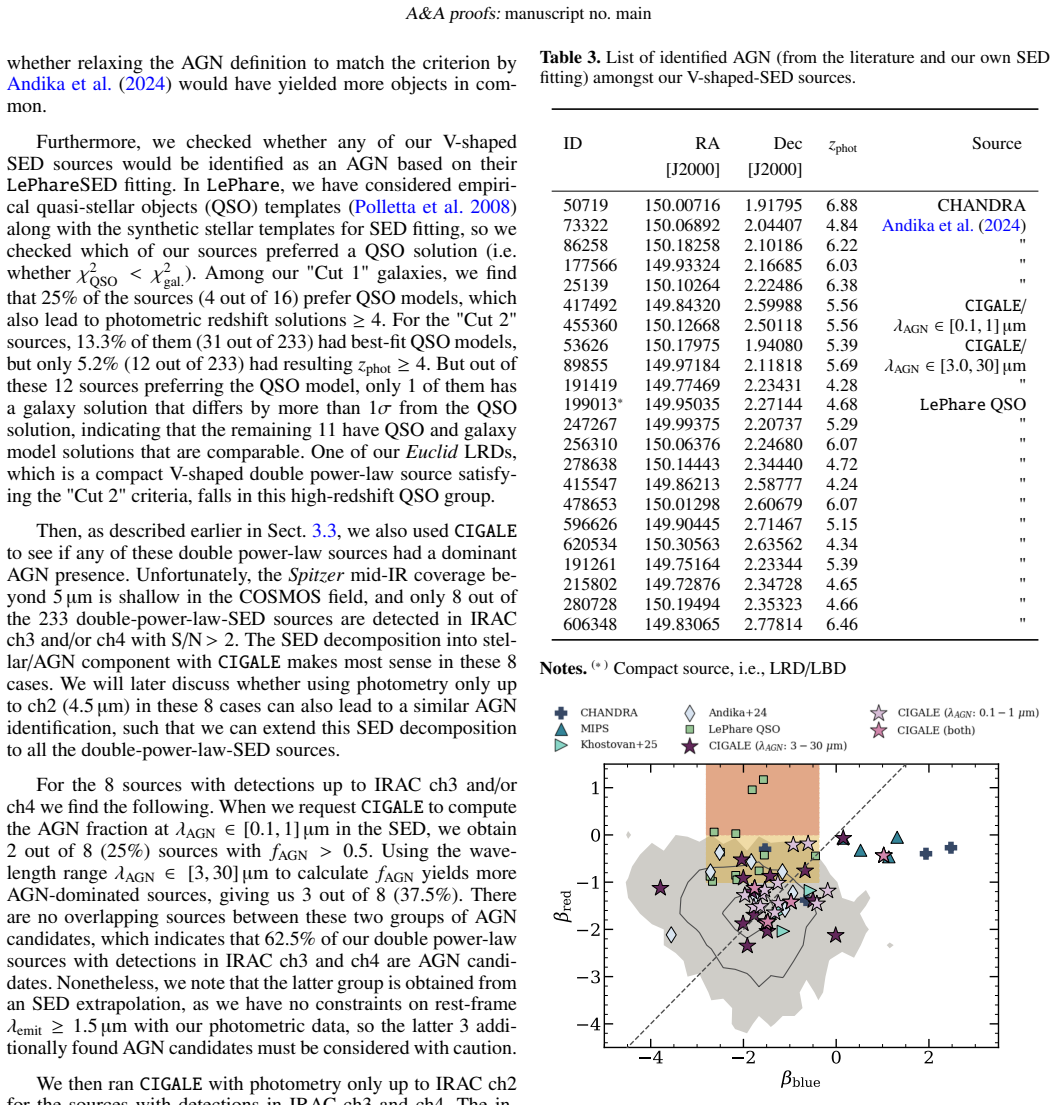
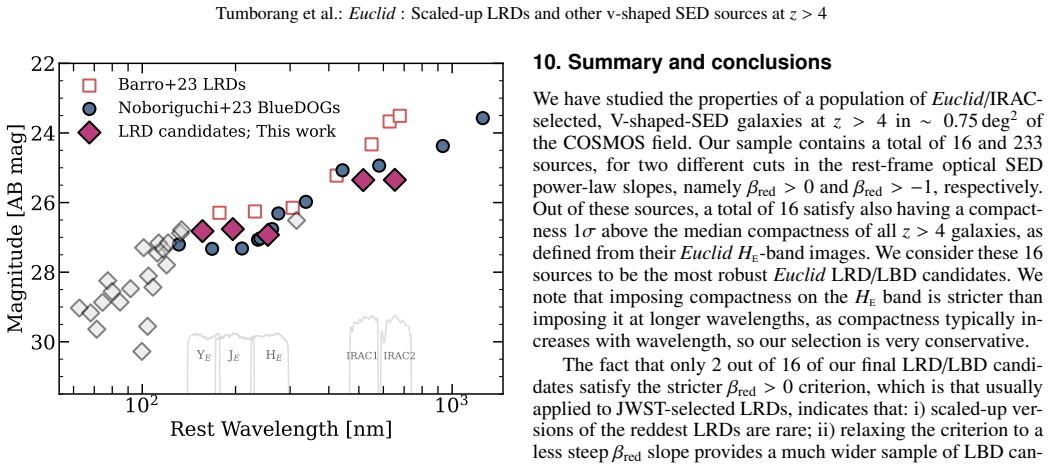
Out of 233 sources with V-shaped SEDs at z>4, 16 sources with compactness more than 1 sigma above the median of all z>4 galaxies are identified as robust LRD/LBD candidates. These have stellar masses in the range 10^8.5 to 10^10.5 solar masses, half of them approximately as old as the universe at their redshifts, and their median properties resemble those of Blue DOGs. Less than 10 percent of the V-shaped sources, including only one of the Euclid LBD candidates, correspond to known AGN, forming a population largely disjoint from known AGN.
What carries the argument
Photometric selection of V-shaped spectral energy distributions from Euclid NIR plus Spitzer IRAC data, followed by a compactness cut relative to the median size distribution of z>4 galaxies.
If this is right
- Brighter and more massive versions of the JWST LRD/LBD population exist and can be detected with wide-field near-infrared imaging.
- Some compact high-redshift galaxies with V-shaped SEDs reach stellar ages comparable to the age of the universe at their observed redshifts.
- The V-shaped SED population at z>4 is mostly distinct from the known AGN population at these redshifts.
- The 16 candidates provide targets for follow-up observations to test whether they represent a transition stage toward standard AGN.
Where Pith is reading between the lines
- If the reported ages hold, these objects would require extremely rapid star formation and quenching within the first few hundred million years after the Big Bang.
- The similarity to Blue DOGs suggests a possible evolutionary link between the V-shaped sources and dust-obscured galaxy populations at lower redshifts.
- Larger-area surveys could measure the volume density of such sources and clarify whether they represent a brief but common phase in early galaxy assembly.
Load-bearing premise
That the combination of V-shaped SED shape and a compactness threshold isolates the same physical population as the JWST LRDs and LBDs without substantial contamination from unrelated high-redshift sources or misclassified AGN.
What would settle it
Deep spectroscopy of the 16 compact candidates that checks for the presence or absence of broad emission lines and other spectral signatures known to characterize JWST-selected LRDs.
Figures




read the original abstract
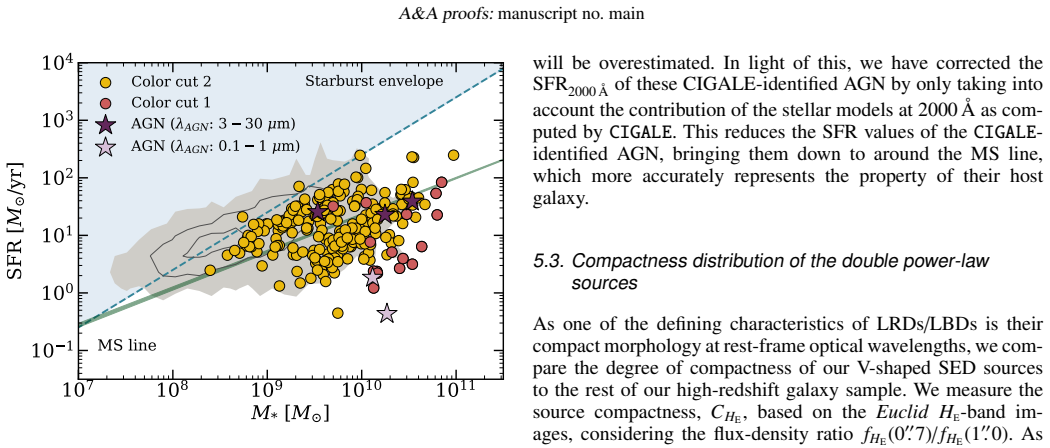
Little Red Dots (LRDs) are some the most intriguing galaxy populations recently identified at z>~4 with JWST. They constitute the most extreme class of a more abundant population of sources with `V-shaped' spectral energy distributions (SEDs) and compact morphologies, which includes also Little Blue Dots (LBDs). Finding brighter analogues to these sources requires surveying sky areas which are significantly larger than those covered with JWST. Euclid deep images are ideally suited for this purpose. We make use of Euclid near-infrared images, complemented by Spitzer Infrared Array Camera (IRAC) data, over 0.75 sq. deg. of the COSMOS field to select a sample of 233 sources with `V-shaped' SEDs at z>4. Out of those, we identify 16 sources with compactness >1sigma above the median of all z>4 galaxies, which we consider robust LRD/LBD candidates in our sample. The stellar masses of these 16 sources are in the range 10^{8.5} - 10^{10.5} Msun, so they are significantly more massive than typical JWST-selected LRDs/LBDs. Interestingly, half of them are about as old as the Universe at their redshifts. In addition, we find that the median photometric properties of the Euclid LRDs/LBDs are similar to those of the so-called Blue Dust-Obscured Galaxies (Blue DOGs). Less than 10% of all our `V-shaped' SED sources, including only one of the Euclid LBDs, correspond to known AGN. The latter mostly constitute a population disjoint to the `V-shaped' SED sources. Spectroscopic follow up of the Euclid LRDs/LBD candidates remains necessary to probe whether they host BLAGN as fainter analogues do and whether constitute a transition phase from these fainter sources to standard AGN.
Editorial analysis
A structured set of objections, weighed in public.
Referee Report
Summary. This paper uses Euclid near-IR and Spitzer IRAC photometry over 0.75 deg² in COSMOS to select 233 sources with V-shaped SEDs at z>4. Of these, 16 are identified as compact (compactness >1σ above the median of all z>4 galaxies) and presented as robust scaled-up LRD/LBD candidates with stellar masses 10^{8.5}–10^{10.5} M_⊙. Half are reported to have photometric stellar ages comparable to the age of the Universe at their redshifts; the sample shows median properties similar to Blue DOGs and <10% overlap with known AGN. Spectroscopic follow-up is recommended to test for broad-line AGN.
Significance. If the photometric selection and derived properties hold, the work would usefully extend the LRD/LBD population to higher masses and wider survey areas, suggesting these sources are more massive and potentially older than typical JWST examples and may overlap with Blue DOGs. This has implications for early galaxy assembly and the transition to AGN. The use of public wide-field data is a practical strength, but the central claims rest on untested aspects of the SED modeling.
major comments (3)
- [Abstract] Abstract: The headline result that half of the 16 compact V-shaped sources have stellar ages 'about as old as the Universe at their redshifts' is obtained from SED fitting on Euclid NIR + IRAC bands only. At z>4, V-shaped SEDs are shaped by strong breaks or dust, so parametric fits are sensitive to SFH and attenuation assumptions; the manuscript provides no details on the fitting code, assumed SFHs, dust laws, or tests against non-parametric models or full posterior age distributions.
- [Candidate selection] Candidate selection: The V-shaped SED color cuts and the compactness threshold (>1σ above the z>4 median) are free parameters that directly define the final sample of 16 sources. No sensitivity tests, alternative thresholds, or justification for these choices are described, undermining the claim that these 16 are robust scaled-up analogues of JWST LRDs/LBDs.
- [Stellar mass and age estimates] Stellar masses and redshifts: The reported mass range 10^{8.5}–10^{10.5} M_⊙ and the z>4 selection lack reported uncertainties, photometric redshift quality metrics, or discussion of possible biases from the limited number of bands and strong spectral features. These quantities are load-bearing for the 'scaled-up' and 'more massive' conclusions.
minor comments (2)
- The abstract refers to 'Blue Dust-Obscured Galaxies (Blue DOGs)' without citing the defining papers; a brief reference would help readers place the median-property comparison.
- Clarify the exact number of photometric bands entering the SED fits and any fixed assumptions (metallicity, IMF) used when deriving the masses and ages of the 16 candidates.
Simulated Author's Rebuttal
We thank the referee for their constructive and detailed comments, which have helped us improve the clarity and robustness of the manuscript. We address each major comment point by point below and have made revisions to the manuscript where appropriate.
read point-by-point responses
-
Referee: [Abstract] Abstract: The headline result that half of the 16 compact V-shaped sources have stellar ages 'about as old as the Universe at their redshifts' is obtained from SED fitting on Euclid NIR + IRAC bands only. At z>4, V-shaped SEDs are shaped by strong breaks or dust, so parametric fits are sensitive to SFH and attenuation assumptions; the manuscript provides no details on the fitting code, assumed SFHs, dust laws, or tests against non-parametric models or full posterior age distributions.
Authors: We agree that the original manuscript lacked sufficient methodological detail on the SED fitting to support the age claims. In the revised version we have added a new subsection in the Methods section that specifies the fitting code, the assumed parametric star-formation histories, the dust attenuation law, and direct comparisons with non-parametric SFH models. We also include the full posterior age distributions for the 16 compact sources, demonstrating that the result that half are comparable in age to the Universe at their redshifts is robust within the explored modeling assumptions. revision: yes
-
Referee: [Candidate selection] Candidate selection: The V-shaped SED color cuts and the compactness threshold (>1σ above the z>4 median) are free parameters that directly define the final sample of 16 sources. No sensitivity tests, alternative thresholds, or justification for these choices are described, undermining the claim that these 16 are robust scaled-up analogues of JWST LRDs/LBDs.
Authors: The V-shaped color selection is directly motivated by the color criteria used in the JWST LRD/LBD literature to ensure we identify analogous sources at brighter magnitudes. The compactness threshold (>1σ above the median) follows standard practice for identifying morphological outliers. We acknowledge that the original submission did not include sensitivity tests. We have now added an appendix presenting results for modest variations in both the color cuts (±0.2 mag) and the compactness threshold (0.5σ and 1.5σ), showing that the median properties and the conclusion that the sources are scaled-up analogues remain stable. A brief justification for the fiducial choices has also been inserted in Section 3. revision: yes
-
Referee: [Stellar mass and age estimates] Stellar masses and redshifts: The reported mass range 10^{8.5}–10^{10.5} M_⊙ and the z>4 selection lack reported uncertainties, photometric redshift quality metrics, or discussion of possible biases from the limited number of bands and strong spectral features. These quantities are load-bearing for the 'scaled-up' and 'more massive' conclusions.
Authors: We have revised the text to report the 16th–84th percentile uncertainties on stellar masses and photometric redshifts for the 16 sources. We now include standard photo-z quality metrics (e.g., χ² and odds) and have added a paragraph discussing possible biases arising from the limited number of bands and strong spectral breaks. Mock-catalog tests quantifying the impact on mass and redshift recovery have been included to support the claim that these Euclid sources are more massive than typical JWST LRDs/LBDs. revision: yes
Circularity Check
No significant circularity in observational selection and SED-derived properties
full rationale
The paper conducts direct photometric source selection of V-shaped SEDs at z>4 from Euclid NIR and Spitzer IRAC imaging over 0.75 sq. deg., applies a compactness cut relative to the median of z>4 galaxies, and performs standard SED fitting to derive stellar masses (10^8.5-10^10.5 Msun) and ages. No equations, predictions, or first-principles derivations are presented that reduce by construction to the input photometry or to self-cited results. The central claims (16 robust candidates, half as old as the Universe at their redshifts, <10% known AGN) are outputs of data analysis and fitting, not tautological re-expressions of inputs. Any self-citations are non-load-bearing and do not create a circular chain.
Axiom & Free-Parameter Ledger
free parameters (2)
- compactness threshold
- V-shaped SED color cuts
axioms (2)
- domain assumption Photometric redshifts from Euclid+Spitzer data accurately place sources at z>4 with low contamination
- domain assumption SED fitting yields reliable stellar masses and ages for these sources
Reference graph
Works this paper leans on
-
[1]
B., Casey, C
Akins, H. B., Casey, C. M., Lambrides, E., et al. 2025, ApJ, 991, 37
2025
-
[2]
T., Jahnke, K., Onoue, M., et al
Andika, I. T., Jahnke, K., Onoue, M., et al. 2024, A&A, 685, A25
2024
-
[3]
& Ilbert, O
Arnouts, S. & Ilbert, O. 2011, LePHARE: Photometric Analysis for Redshift
2011
-
[4]
Ashby, M. L. N., Caputi, K. I., Cowley, W., et al. 2018, ApJS, 237, 39
2018
-
[5]
J., Walton, D
Assef, R. J., Walton, D. J., Brightman, M., et al. 2016, ApJ, 819, 111
2016
-
[6]
G., Kocevski, D
Barro, G., Pérez-González, P. G., Kocevski, D. D., et al. 2026, ApJ, 997, 48
2026
-
[7]
& Arnouts, S
Bertin, E. & Arnouts, S. 1996, A&AS, 117, 393
1996
-
[8]
2026, A&A, 706, A29
Billand, J.-B., Elbaz, D., Gentile, F., et al. 2026, A&A, 706, A29
2026
-
[9]
2019, A&A, 622, A103
Boquien, M., Burgarella, D., Roehlly, Y ., et al. 2019, A&A, 622, A103
2019
-
[10]
Brazzini, M., D’Eugenio, F., Maiolino, R., et al. 2026, arXiv e-prints, arXiv:2601.22214
-
[11]
& Charlot, S
Bruzual, G. & Charlot, S. 2003, MNRAS, 344, 1000
2003
-
[12]
C., et al
Calzetti, D., Armus, L., Bohlin, R. C., et al. 2000, ApJ, 533, 682
2000
-
[13]
2013, SPLASH: Spitzer Large Area Sur- vey with Hyper-Suprime-Cam, Spitzer Proposal ID #10042
Capak, P., Aussel, H., Bundy, K., et al. 2013, SPLASH: Spitzer Large Area Sur- vey with Hyper-Suprime-Cam, Spitzer Proposal ID #10042
2013
-
[14]
I., Caminha, G
Caputi, K. I., Caminha, G. B., Fujimoto, S., et al. 2021, ApJ, 908, 146
2021
-
[15]
I., Cirasuolo, M., Dunlop, J
Caputi, K. I., Cirasuolo, M., Dunlop, J. S., et al. 2011, MNRAS, 413, 162
2011
-
[16]
Caputi, K. I., Cooper, R. A., Rinaldi, P., Navarro-Carrera, R., & Iani, E. 2026, arXiv e-prints, arXiv:2601.11466
-
[17]
I., Deshmukh, S., Ashby, M
Caputi, K. I., Deshmukh, S., Ashby, M. L. N., et al. 2017, ApJ, 849, 45
2017
-
[18]
I., Ilbert, O., Laigle, C., et al
Caputi, K. I., Ilbert, O., Laigle, C., et al. 2015, ApJ, 810, 73
2015
-
[19]
2003, PASP, 115, 763
Chabrier, G. 2003, PASP, 115, 763
2003
-
[20]
2016, ApJ, 819, 62
Civano, F., Marchesi, S., Comastri, A., et al. 2016, ApJ, 819, 62
2016
-
[21]
M., et al
Dahlen, T., Mobasher, B., Faber, S. M., et al. 2013, ApJ, 775, 93
2013
-
[22]
I., Ashby, M
Deshmukh, S., Caputi, K. I., Ashby, M. L. N., et al. 2018, ApJ, 864, 166
2018
-
[23]
T., Desai, V ., et al
Dey, A., Soifer, B. T., Desai, V ., et al. 2008, ApJ, 677, 943
2008
-
[24]
Draine, B. T., Aniano, G., Krause, O., et al. 2014, ApJ, 780, 172 Euclid Collaboration: Bisigello, L., Rodighiero, G., Fotopoulou, S., et al. 2025, A&A, in press (Euclid Q1 SI),https://doi.org/10.1051/0004-6361/ 202554537, arXiv:2503.15323 Euclid Collaboration: Cropper, M., Al-Bahlawan, A., Amiaux, J., et al. 2025, A&A, 697, A2 Euclid Collaboration: Jahnk...
-
[25]
G., Hora, J
Fazio, G. G., Hora, J. L., Allen, L. E., et al. 2004, ApJS, 154, 10
2004
-
[26]
J., Zitrin, A., Plat, A., et al
Furtak, L. J., Zitrin, A., Plat, A., et al. 2023, ApJ, 952, 142
2023
-
[27]
N., Maiolino, R., Juodžbalis, I., et al
Hainline, K. N., Maiolino, R., Juodžbalis, I., et al. 2025, ApJ, 979, 138
2025
-
[28]
2023, ApJ, 959, 39
Harikane, Y ., Zhang, Y ., Nakajima, K., et al. 2023, ApJ, 959, 39
2023
-
[29]
2012, ApJS, 203, 23
Hsieh, B.-C., Wang, W.-H., Hsieh, C.-C., et al. 2012, ApJS, 203, 23
2012
-
[30]
E., de Graaff, A., Miller, T
Hviding, R. E., de Graaff, A., Miller, T. B., et al. 2025, A&A, 702, A57
2025
-
[31]
I., et al
Iani, E., Rinaldi, P., Caputi, K. I., et al. 2025, ApJ, 989, 160
2025
-
[32]
2026, arXiv e-prints, arXiv:2603.17967
Iani, E., Rinaldi, P., Torralba, A., et al. 2026, arXiv e-prints, arXiv:2603.17967
- [33]
-
[34]
Kennicutt, Jr., R. C. 1998, ARA&A, 36, 189
1998
-
[35]
Khostovan, A. A., Kartaltepe, J. S., Salvato, M., et al. 2025, arXiv e-prints, arXiv:2503.00120
-
[36]
2025, ApJ, 992, 70
Kim, S., Jeong, W.-S., Kim, M., et al. 2025, ApJ, 992, 70
2025
-
[37]
D., Finkelstein, S
Kocevski, D. D., Finkelstein, S. L., Barro, G., et al. 2025, ApJ, 986, 126
2025
-
[38]
I., Greene, J
Kokorev, V ., Caputi, K. I., Greene, J. E., et al. 2024, ApJ, 968, 38
2024
-
[39]
& Silk, J
Kritos, K. & Silk, J. 2026, ApJ, 1000, L21 Labbé, I., van Dokkum, P., Nelson, E., et al. 2023, Nature, 616, 266
2026
-
[40]
Leitherer, C., Li, I.-H., Calzetti, D., & Heckman, T. M. 2002, ApJS, 140, 303
2002
-
[41]
2026, ApJ, 997, 364
Lin, X., Fan, X., Cai, Z., et al. 2026, ApJ, 997, 364
2026
-
[42]
Ma, Y ., Greene, J. E., V olonteri, M., et al. 2025, arXiv e-prints, arXiv:2509.02662
-
[43]
& Dickinson, M
Madau, P. & Dickinson, M. 2014, ARA&A, 52, 415
2014
- [44]
-
[45]
2025, MNRAS, 538, 1921
Maiolino, R., Risaliti, G., Signorini, M., et al. 2025, MNRAS, 538, 1921
2025
-
[46]
P., Brammer, G., et al
Matthee, J., Naidu, R. P., Brammer, G., et al. 2024, ApJ, 963, 129
2024
-
[47]
J., Milvang-Jensen, B., Dunlop, J., et al
McCracken, H. J., Milvang-Jensen, B., Dunlop, J., et al. 2012, A&A, 544, A156
2012
-
[48]
K., Nagao, T., Toba, Y ., & Misawa, T
Noboriguchi, A., Inoue, A. K., Nagao, T., Toba, Y ., & Misawa, T. 2023, ApJ, 959, L14
2023
-
[49]
2022, ApJ, 941, 195
Noboriguchi, A., Nagao, T., Toba, Y ., et al. 2022, ApJ, 941, 195
2022
-
[50]
2019, ApJ, 876, 132
Noboriguchi, A., Nagao, T., Toba, Y ., et al. 2019, ApJ, 876, 132
2019
-
[51]
Oke, J. B. & Gunn, J. E. 1983, ApJ, 266, 713
1983
-
[52]
Pacucci, F. & Loeb, A. 2025, ApJ, 989, L19 Pérez-González, P. G., Barro, G., Carniani, S., et al. 2026, arXiv e-prints, arXiv:2602.20247
-
[53]
2008, ApJ, 675, 960
Polletta, M., Weedman, D., Hönig, S., et al. 2008, ApJ, 675, 960
2008
-
[54]
S., Dey, A., et al
Pope, A., Bussmann, R. S., Dey, A., et al. 2008, ApJ, 689, 127
2008
-
[55]
I., van Mierlo, S
Rinaldi, P., Caputi, K. I., van Mierlo, S. E., et al. 2022, ApJ, 930, 128
2022
-
[56]
Rinaldi, P., Hainline, K., D’Eugenio, F., et al. 2026, arXiv e-prints, arXiv:2604.07138
work page internal anchor Pith review Pith/arXiv arXiv 2026
-
[57]
Rinaldi, P., Rieke, G. H., Wu, Z., et al. 2025c, arXiv e-prints, arXiv:2507.17738
-
[58]
2025, arXiv e-prints, arXiv:2508.20177
Ronayne, K., Papovich, C., Kirkpatrick, A., et al. 2025, arXiv e-prints, arXiv:2508.20177
-
[59]
P., et al
Rusakov, V ., Watson, D., Nikopoulos, G. P., et al. 2026, Nature, 649, 574
2026
-
[60]
B., Mazzarella, J
Sanders, D. B., Mazzarella, J. M., Kim, D. C., Surace, J. A., & Soifer, B. T. 2003, AJ, 126, 1607
2003
-
[61]
Schlafly, E. F. & Finkbeiner, D. P. 2011, ApJ, 737, 103
2011
-
[62]
1968, ApJ, 151, 393
Schmidt, M. 1968, ApJ, 151, 393
1968
-
[63]
2007, ApJS, 172, 1
Scoville, N., Aussel, H., Brusa, M., et al. 2007, ApJS, 172, 1
2007
-
[64]
Stalevski, M., Fritz, J., Baes, M., Nakos, T., & Popovi ´c, L. ˇC. 2012, MNRAS, 420, 2756
2012
-
[65]
2016, MNRAS, 458, 2288
Stalevski, M., Ricci, C., Ueda, Y ., et al. 2016, MNRAS, 458, 2288
2016
-
[66]
2007, ApJS, 172, 9
Taniguchi, Y ., Scoville, N., Murayama, T., et al. 2007, ApJS, 172, 9
2007
-
[67]
L., Steidel, C
Theios, R. L., Steidel, C. C., Strom, A. L., et al. 2019, ApJ, 871, 128
2019
-
[68]
R., Kauffmann, O
Weaver, J. R., Kauffmann, O. B., Ilbert, O., et al. 2022, ApJS, 258, 11
2022
-
[69]
N., et al
Yang, G., Boquien, M., Brandt, W. N., et al. 2022, ApJ, 927, 192
2022
-
[70]
2020, MNRAS, 491, 740
Yang, G., Boquien, M., Buat, V ., et al. 2020, MNRAS, 491, 740
2020
-
[71]
I., Papovich, C., et al
Yang, G., Caputi, K. I., Papovich, C., et al. 2023, ApJ, 950, L5
2023
-
[72]
T., et al
Yue, M., Eilers, A.-C., Ananna, T. T., et al. 2024, ApJ, 974, L26
2024
-
[73]
G. Galilei
Zalesky, L., McPartland, C. J. R., Weaver, J. R., et al. 2025, A&A, 695, A229 Article number, page 14 Tumborang et al.:Euclid: Scaled-up LRDs and other v-shaped SED sources atz>4 Authors and affiliations A. A. Tumborang⋆1, K. I. Caputi1,2 , P. Rinaldi3, L. Bisigello4, G. Girardi5,4 , E. Iani6, R. Bouwens7, R. Navarro-Carrera1, G. Desprez1, R. A. Cooper1, ...
2025
-
[74]
Toulouse, France 107 Université St Joseph; Faculty of Sciences, Beirut, Lebanon 108 Departamento de Física, FCFM, Universidad de Chile, Blanco Encalada 2008, Santiago, Chile 109 Universität Innsbruck, Institut für Astro- und Teilchenphysik, Technikerstr. 25/8, 6020 Innsbruck, Austria 110 Department of Physics and Helsinki Institute of Physics, Gustaf Häll...
2008
discussion (0)
Sign in with ORCID, Apple, or X to comment. Anyone can read and Pith papers without signing in.