Supermassive Black Hole Winds in X-rays: SUBWAYS IV. Tracing Radio Emission and Unveiling the Role of Winds
Pith reviewed 2026-05-19 17:03 UTC · model grok-4.3
The pith
AGN with ultra-fast outflows show larger radio extensions and steep spectra from wind shocks.
A machine-rendered reading of the paper's core claim, the machinery that carries it, and where it could break.
Core claim
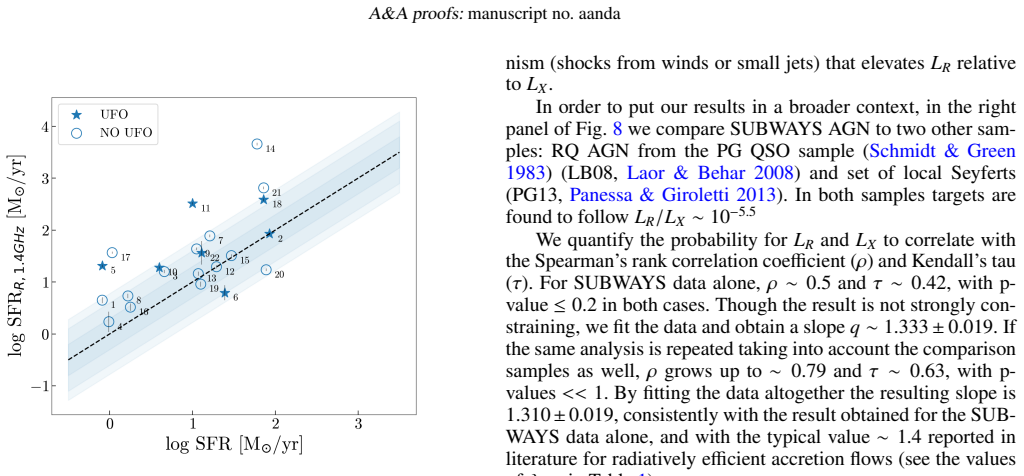
AGN with UFOs tend to have larger radio extension and a steep radio spectrum consistent with outflows. The radio emission of the 6 UFO hosts is consistent with predictions from wind-driven shock models, possibly indicating a direct connection between the two phases.
What carries the argument
Radio spectral indices, luminosities, and morphologies compared to wind-driven shock model predictions to identify outflow-driven emission.
If this is right
- 80 percent of the sources show radio properties suggesting the presence of an outflow.
- UFO hosts exhibit larger radio extensions than non-UFO sources.
- Steep radio spectra in UFO hosts are consistent with outflow mechanisms.
- Radio data for the six UFO sources match wind-driven shock model expectations.
Where Pith is reading between the lines
- The pattern may allow radio observations to flag AGN likely to host inner UFOs for targeted X-ray follow-up.
- Similar multi-scale wind signatures could appear in lower-luminosity or higher-redshift AGN samples.
- This supports models in which AGN feedback operates through connected wind phases across different radii.
Load-bearing premise
Radio spectral indices, luminosities, and morphologies can distinguish outflow-driven emission from star formation without major bias from sample selection or data limits.
What would settle it
Higher-resolution radio imaging or tighter correlations with star-formation tracers showing that emission in UFO hosts is dominated by star formation rather than shocks would falsify the connection.
Figures




read the original abstract
Most Active Galactic Nuclei (AGN) are Radio Quiet, with radio emission that may arise from star-formation activity, AGN-driven winds, weak jets, and coronal activity. Disentangling these mechanisms is challenging and requires detailed multi-wavelength investigation, but it is crucial for quantifying AGN feedback in galaxy evolution. We present a detailed radio investigation of 21 X-ray selected AGN in the Supermassive Black Hole Winds in X-Rays (SUBWAYS) sample (log Lbol = 44.9-46.3 erg/s, z=0.1-0.5), selected to systematically search for Ultra-Fast Outflows (UFOs). UFOs are detected in 30% of the targets, making the sample particularly well-suited for investigating the role and signatures of multi-scale outflows at different frequencies. We build the radio SED of the sources complementing our proprietary data, collected with the JVLA at 1.5 and 6 GHz, with images from LoTSS and other publicly available radio surveys between 150 and 1400 MHz. We investigate the role and occurrence of the aforementioned mechanisms, with particular interest in outflows and their possible relation with UFOs. We combined information on spectral indices, luminosities, and morphologies of the radio emission with properties derived in other wavebands, such as Star Formation Rate, X-ray luminosity, Eddington ratio or the UFO kinetic luminosity. All the sources are detected and are mostly consistent with RQ AGN. For 80% of the sources the data suggest the presence of an outflow (wind or weak jet). Interestingly, our results indicate that AGN with UFOs tend to have larger radio extension and a steep radio spectrum consistent with outflows. Moreover, the radio emission of the 6 UFO hosts is consistent with predictions from wind-driven shock models, possibly indicating a direct connection between the two phases. Alternatively, this may reflect physical conditions favouring the rise of both phenomena.
Editorial analysis
A structured set of objections, weighed in public.
Referee Report
Summary. The manuscript analyzes radio properties of 21 X-ray-selected AGN from the SUBWAYS sample (log L_bol = 44.9–46.3 erg s^{-1}, z = 0.1–0.5), using new JVLA 1.5/6 GHz data supplemented by LoTSS and other survey imaging. All sources are detected and mostly radio-quiet; the authors report that 80% show outflow signatures and that the 6 UFO hosts preferentially exhibit larger radio extensions and steeper spectra, with their radio luminosities and morphologies consistent with wind-driven shock models, suggesting a physical link between UFOs and radio outflows.
Significance. If the central claims hold after statistical scrutiny, the work supplies multi-wavelength evidence connecting X-ray ultra-fast outflows to radio emission from wind shocks in radio-quiet AGN, directly addressing the role of AGN feedback across scales. The systematic X-ray selection and multi-frequency SED construction are strengths that could help quantify the contribution of winds versus star formation or weak jets.
major comments (3)
- [Section 4] Section 4 (radio properties of UFO subsample): the statement that 'AGN with UFOs tend to have larger radio extension' rests on only 6 sources. No Kolmogorov-Smirnov test, Mann-Whitney U test, or matched control comparison (in L_X, z, or SFR) is reported, nor are uncertainties on the measured extensions or a quantitative assessment of selection bias from the X-ray flux limit. This directly underpins the main conclusion linking UFOs to radio outflows.
- [Section 5] Section 5 (comparison to wind-driven shock models): the claim that radio emission of the 6 UFO hosts 'is consistent with predictions from wind-driven shock models' is presented without the specific model parameters (e.g., shock velocity, ambient density), predicted 1.5 GHz luminosities, or any goodness-of-fit metric. Without these, it is impossible to judge whether the agreement is unique to wind shocks or could arise from star-formation or weak-jet scenarios.
- [Section 3] Section 3 (radio data assembly): combining proprietary JVLA observations with heterogeneous LoTSS and survey data at 150–1400 MHz introduces variable resolution and sensitivity. The manuscript does not quantify how beam-size differences or low-frequency sensitivity limits affect the reported 'larger extension' or spectral-index measurements for the UFO subsample.
minor comments (2)
- [Abstract] Abstract: the phrase 'consistent with predictions from wind-driven shock models' would be strengthened by citing the specific models (e.g., reference to the relevant wind-shock papers) and noting the key assumptions.
- [Figures] Figure captions and text: ensure all radio size measurements are accompanied by the restoring beam size and the criterion used to define 'extension' (e.g., >3σ contour major axis).
Simulated Author's Rebuttal
We thank the referee for their careful and constructive review of our manuscript. The comments highlight important areas for strengthening the statistical rigor, model comparisons, and data characterization, and we have revised the paper to address them directly. Below we respond point by point to the major comments.
read point-by-point responses
-
Referee: [Section 4] Section 4 (radio properties of UFO subsample): the statement that 'AGN with UFOs tend to have larger radio extension' rests on only 6 sources. No Kolmogorov-Smirnov test, Mann-Whitney U test, or matched control comparison (in L_X, z, or SFR) is reported, nor are uncertainties on the measured extensions or a quantitative assessment of selection bias from the X-ray flux limit. This directly underpins the main conclusion linking UFOs to radio outflows.
Authors: We agree that additional statistical tests are warranted given the subsample size. Although the six UFO hosts represent the full set of detections in this systematically X-ray-selected sample, we will add a Kolmogorov-Smirnov test and Mann-Whitney U test comparing radio extensions (and spectral indices) between the UFO and non-UFO groups in the revised Section 4. Uncertainties on the measured extensions will be reported explicitly, derived from the imaging noise and fitting procedures. We will also include a matched control comparison accounting for L_X and redshift (and, where possible, SFR estimates). For selection bias arising from the X-ray flux limit, we will add a quantitative discussion based on the sample's luminosity and redshift distribution together with comparisons to larger AGN surveys; this will be presented as a new paragraph in Section 4. revision: yes
-
Referee: [Section 5] Section 5 (comparison to wind-driven shock models): the claim that radio emission of the 6 UFO hosts 'is consistent with predictions from wind-driven shock models' is presented without the specific model parameters (e.g., shock velocity, ambient density), predicted 1.5 GHz luminosities, or any goodness-of-fit metric. Without these, it is impossible to judge whether the agreement is unique to wind shocks or could arise from star-formation or weak-jet scenarios.
Authors: We accept that the model comparison requires more explicit detail. In the revised Section 5 we will specify the wind-driven shock model parameters employed (shock velocity ~1000 km s^{-1}, ambient density 0.1–1 cm^{-3}, and magnetic field strength consistent with equipartition assumptions), report the predicted 1.5 GHz luminosities, and include a quantitative goodness-of-fit metric (reduced chi-squared) between observed and model radio luminosities and morphologies. We will also add a short discussion contrasting these predictions with those expected from star-formation-driven emission and weak-jet scenarios to clarify the degree to which the wind-shock interpretation is favored. revision: yes
-
Referee: [Section 3] Section 3 (radio data assembly): combining proprietary JVLA observations with heterogeneous LoTSS and survey data at 150–1400 MHz introduces variable resolution and sensitivity. The manuscript does not quantify how beam-size differences or low-frequency sensitivity limits affect the reported 'larger extension' or spectral-index measurements for the UFO subsample.
Authors: We acknowledge the importance of characterizing the impact of heterogeneous datasets. In the revised Section 3 we will tabulate the synthesized beam sizes, sensitivities, and frequency coverage for each observation (JVLA, LoTSS, and survey data). We will quantify the effect of beam-size differences on the measured radio extensions for the UFO subsample by re-imaging or convolving data to a common resolution where feasible and reporting the resulting changes. For spectral-index measurements we will discuss the role of low-frequency sensitivity limits and include propagated uncertainties that incorporate these effects. These additions will be presented as an expanded methods subsection and will directly support the robustness of the extension and spectral-index results. revision: yes
Circularity Check
No significant circularity; claims derive from direct multi-frequency observations and external model comparisons
full rationale
The paper reports radio SEDs built from JVLA 1.5/6 GHz proprietary data plus LoTSS and survey imaging for 21 X-ray-selected AGN. All sources are detected; 80% show outflow-consistent properties via measured spectral indices, luminosities, and morphologies. The key statement that the 6 UFO hosts exhibit larger radio extensions and steep spectra is an empirical result from these direct measurements, cross-checked against independent quantities (SFR, X-ray luminosity, Eddington ratio, UFO kinetic luminosity). Consistency with wind-driven shock models is presented as a comparison to published predictions, not as a quantity derived or fitted from the present dataset. No equations reduce a claimed prediction to a fitted input by construction, no self-citation chain supplies the central uniqueness or ansatz, and no renaming of known results occurs. The derivation chain is therefore self-contained against external benchmarks.
Axiom & Free-Parameter Ledger
axioms (1)
- domain assumption Radio emission in radio-quiet AGN can arise from star formation, AGN-driven winds, weak jets, or coronal activity.
Lean theorems connected to this paper
-
IndisputableMonolith/Cost/FunctionalEquation.leanwashburn_uniqueness_aczel unclear?
unclearRelation between the paper passage and the cited Recognition theorem.
our results indicate that AGN with UFOs tend to have larger radio extension and a steep radio spectrum consistent with outflows... radio emission of the 6 UFO hosts is consistent with predictions from wind-driven shock models
-
IndisputableMonolith/Foundation/AbsoluteFloorClosure.leanreality_from_one_distinction unclear?
unclearRelation between the paper passage and the cited Recognition theorem.
All the sources are detected and are mostly consistent with RQ AGN. For 80% of the sources the data suggest the presence of an outflow
What do these tags mean?
- matches
- The paper's claim is directly supported by a theorem in the formal canon.
- supports
- The theorem supports part of the paper's argument, but the paper may add assumptions or extra steps.
- extends
- The paper goes beyond the formal theorem; the theorem is a base layer rather than the whole result.
- uses
- The paper appears to rely on the theorem as machinery.
- contradicts
- The paper's claim conflicts with a theorem or certificate in the canon.
- unclear
- Pith found a possible connection, but the passage is too broad, indirect, or ambiguous to say the theorem truly supports the claim.
Reference graph
Works this paper leans on
-
[1]
, " * write output.state after.block = add.period write newline
ENTRY address archiveprefix author booktitle chapter edition editor howpublished institution eprint journal key month note number organization pages publisher school series title type volume year label extra.label sort.label short.list INTEGERS output.state before.all mid.sentence after.sentence after.block FUNCTION init.state.consts #0 'before.all := #1 ...
-
[2]
" write newline "" before.all 'output.state := FUNCTION n.dashify 't := "" t empty not t #1 #1 substring "-" = t #1 #2 substring "--" = not "--" * t #2 global.max substring 't := t #1 #1 substring "-" = "-" * t #2 global.max substring 't := while if t #1 #1 substring * t #2 global.max substring 't := if while FUNCTION word.in bbl.in " " * FUNCTION format....
-
[3]
1966, in Stellar Evolution, ed.\ R
Baker, N. 1966, in Stellar Evolution, ed.\ R. F. Stein,& A. G. W. Cameron (Plenum, New York) 333
work page 1966
- [4]
-
[5]
Cox, J. P. 1980, Theory of Stellar Pulsation (Princeton University Press, Princeton) 165
work page 1980
-
[6]
Cox, A. N.,& Stewart, J. N. 1969, Academia Nauk, Scientific Information 15, 1
work page 1969
- [7]
-
[8]
Tscharnuter W. M. 1987, A&A, 188, 55
work page 1987
-
[9]
Terlevich, R. 1992, in ASP Conf. Ser. 31, Relationships between Active Galactic Nuclei and Starburst Galaxies, ed. A. V. Filippenko, 13
work page 1992
-
[10]
Yorke, H. W. 1980a, A&A, 86, 286
- [11]
discussion (0)
Sign in with ORCID, Apple, or X to comment. Anyone can read and Pith papers without signing in.